How do you promote a classified website on social media? Pick the one or two networks where your niche already spends time, post your listings there in a form people can use without clicking, take part in the local Facebook and WhatsApp groups your buyers and sellers already use (within each group's rules), let your site post new listings to your own page or channel automatically, and add short videos and a few local creators once the basics run. Then judge each network by the listings and sign-ups it brings, not by likes. This guide shows how to do that on a small budget, with a weekly posting plan at the end. Social media for marketplaces works differently from social media for a shop: you need sellers as well as buyers, so every step below has a seller side too.
This post is part of our guide to growing a marketplace. Social media is one channel among several: start with the marketing plan for a marketplace if you haven't set one yet, and with getting your first sellers and buyers if your site is still empty. A social post that sends people to a site with five listings does more harm than good.
In short
- Pick one or two networks where your niche already is: Facebook and YouTube for audiences over 40, Instagram and TikTok for under 30.
- Make every listing easy to share first, with share buttons and a 1200 x 630 preview image.
- In Facebook and WhatsApp groups, read the rules and ask the admin, never add people without asking, and never require sharing or tagging to enter a contest.
- Auto-post new listings to a channel, film 20 to 60 second walkarounds, and pay small local creators who label their posts as ads.
- Follow a weekly plan of about three hours, tag links with UTM codes and judge each network by sign-ups and listings, not likes.
Part of the guide Growing your marketplace
Before you post: make every listing easy to share
Most of the social traffic a small classifieds site gets doesn't come from its own page. It comes from people sharing a listing with a friend, in a family chat or in a local group. Make that easy first, because it costs nothing to run:
- Share buttons on every listing. WhatsApp, Facebook, X and "copy link" cover most of what people use. On a phone, the browser's own share sheet (the Web Share API) also reaches apps that never appear in a row of buttons. It only works on HTTPS pages and after a tap, so a site should fall back to normal buttons when it isn't available (MDN).
- A good preview card. When a link is pasted into Facebook, WhatsApp or LinkedIn, the preview is built from the page's Open Graph tags (title, image, URL). Facebook recommends images of 1200 x 630 pixels so the photo shows without cropping (Meta for Developers). Paste one of your listings into Facebook's Sharing Debugger to see what people will see. A bare link with no photo or price gets few clicks.
- Short, clean listing URLs that go straight to the listing or category, not to your home page.
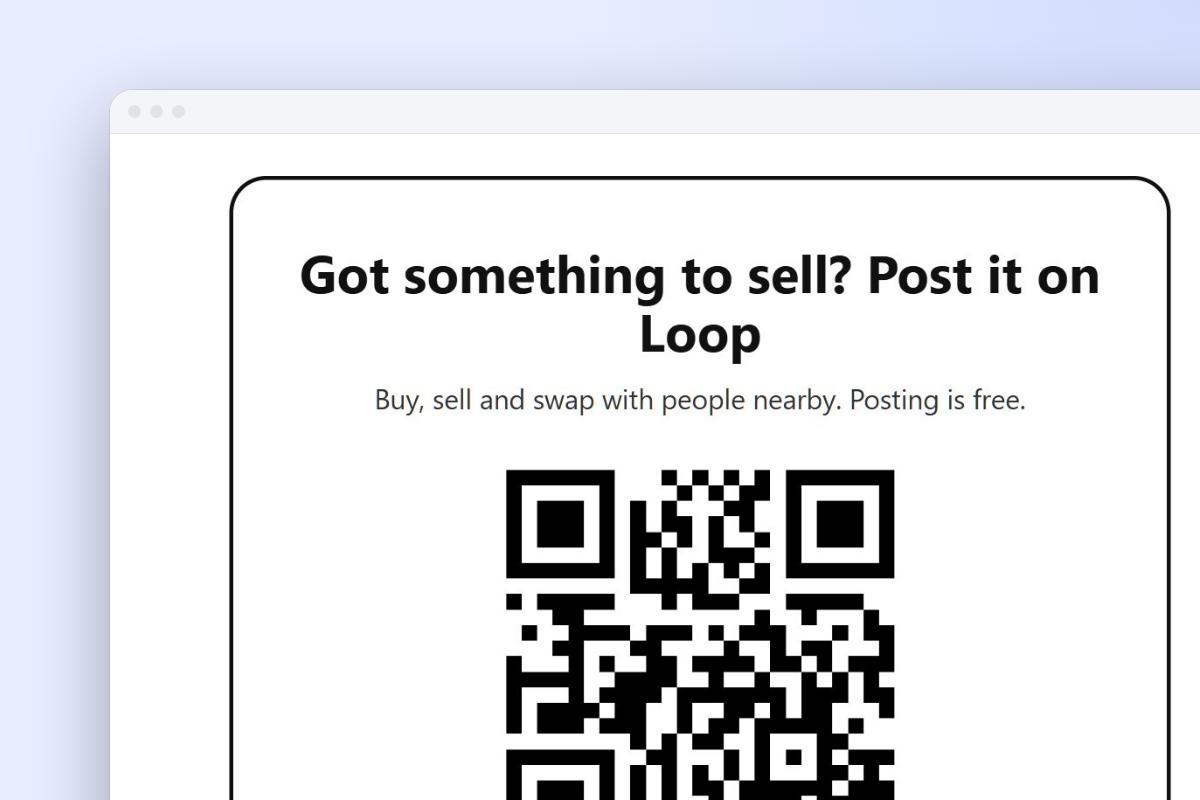
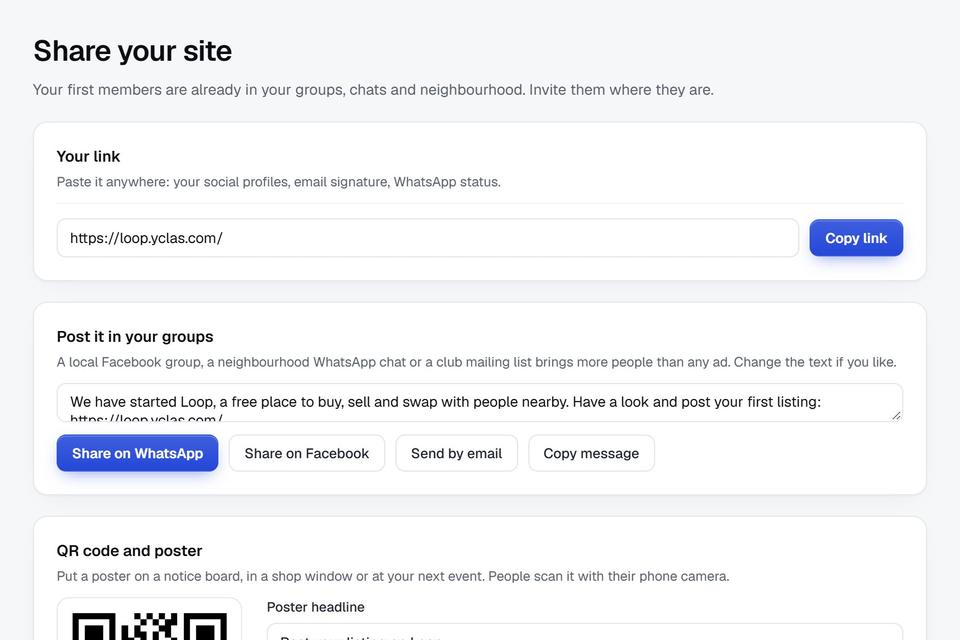
On Yclas, listings have sharing buttons, and the "Share your site" kit gives you the site link, a ready-made message for WhatsApp and Facebook groups or email, a QR code and a printable poster, so you don't have to write the first announcement from scratch.
Template
Social posts to promote your marketplace and its listings
Pick the version for each platform, swap in a real listing and link, and post a mix of single listings, roundups and posts about the site itself.
Ask the seller before you feature their listing, and only post in groups whose rules allow it. More free tools →
Which social networks fit which niche
Choose networks by where your buyers and sellers already are, not by what is new. The clearest current figures for the US come from Pew Research Center's Americans' Social Media Use 2025 (published November 20, 2025; 5,022 adults surveyed February 5 to June 18, 2025). In other countries the order can be different, so check a local source if your site isn't in the US.
| Network | US adults who use it (Pew, 2025) | Fits these niches | What works there |
|---|---|---|---|
| YouTube | 84% | Cars, machinery, property, tools, anything people research before buying | Walkaround videos, "how to check a used..." guides, Shorts of standout listings |
| 71% (80% of 30- to 49-year-olds) | Local general classifieds, rentals, jobs, farm and equipment, community sites | Local buy-and-sell groups, your own Page and group, weekly roundups | |
| 50% (about 8 in 10 aged 18-29, 19% of 65+) | Fashion, furniture, vintage, crafts, pets, cars | Photo carousels, Reels, Stories with new listings | |
| TikTok | 37% (about half of 18- to 29-year-olds use it daily) | Resale, sneakers, collectibles, student and young-adult markets | Short "what I found this week" and "under $50" videos |
| 32% | Local and diaspora communities, small towns, trades | Sharing listings in groups, a channel or community for your site | |
| 26% | Hobby and niche markets with active subreddits | Helpful answers; promotion only where a community's rules allow it |
How often people open an app matters as much as whether they have it. In Pew's frequency survey of early 2025, about half of US adults visit Facebook and YouTube at least once a day, against 24% for TikTok and 10% for X. A practical rule: if your sellers and buyers are mostly over 40, start with Facebook and YouTube. If they are under 30, start with Instagram and TikTok. A marketplace for farm equipment and one for vintage clothing should not have the same plan. Two networks done every week beat five done once a month.
Facebook and WhatsApp groups: how to post without getting removed
For a local or niche classifieds site, groups usually bring more sellers than your own Page, because the people are already there to buy and sell. They are also where it is easiest to get banned.
Other people's Facebook groups
- Read the rules and ask the admin first. Many buy-and-sell groups ban links to other sites, or allow promotion only on one day a week. Send the admin a short message saying what your site is and asking whether a post is welcome. Some admins are happy to pin it if your site is free for local sellers.
- Be useful without a link. Answer questions ("where can I sell a trailer around here?"), post price guides for your niche, and mention your site only when it answers the question.
- Don't post the same message to many groups at once. It looks like spam to members and to Facebook. Write a version for each group.
Your own Page and group
A group of your own ("Buy and sell tools in [town]") gives you a place where you set the rules, and people who join are exactly your audience. Keep it moderated and point people to the site for the full listing and contact details.
Two Facebook rules matter for a Page. First, contests: Meta's Pages, Groups and Events policies say a promotion must not require or reward people for sharing, reposting or tagging others, and entrants must release Meta and be told the promotion isn't run by Meta. "Tag three friends to enter" is not allowed. Second, links: since December 2025 Meta has been testing a limit of two posts with external links a month for Pages and professional profiles that don't pay (TechCrunch). On September 15, 2026 Meta launched Meta One, whose Advanced plan for businesses and creators (from $49.99 a month) lists links in organic posts and reels as a feature, and Social Media Today reported on September 17, 2026 that the cap is being applied to more Pages. Meta still calls it a test and not every Page is affected, but check whether yours is before planning daily link posts. Make posts useful on their own (photos, price, area) and save your link posts for what matters most.
Facebook Marketplace: a channel and a competitor
Marketplace is where many of your future sellers already list. It is also a rival: on November 14, 2024 the European Commission fined Meta EUR 797.72 million for tying Marketplace to Facebook and for using ad data from competing classified-ad services that advertise on Facebook and Instagram to benefit Marketplace. Marketplace listings must be for a real item: Meta's Commerce Policies don't allow commerce posts that offer no product for sale, so a "visit my website" listing doesn't belong there. Use Marketplace to find active sellers in your niche and invite them personally, and to check what things sell for.
WhatsApp and Telegram
- Share into groups you belong to, with a short message and one link, and only where the group's admin is happy with it.
- Never add people to a group without asking. Invite them with a link instead. WhatsApp restricts accounts for unauthorized automated or bulk messaging, so send personal messages, not mass blasts.
- Give your site a channel (a WhatsApp channel or a Telegram channel) where people can follow new listings without joining a chat.
Yclas's "Recruit sellers" page helps with the personal approach: you keep a private list of people and businesses to invite, each gets a personal sign-up link, and WhatsApp, email and call buttons open your own apps with the message filled in. It also shows which searches on your site found nothing, so you know which sellers are missing. More on this in getting your first sellers and buyers.
Template
Outreach message to recruit your first sellers
Use this to contact people already selling on other sites, in groups or in shops; personalise the first line every time and offer what you can really deliver.
Send no more than one follow-up to people who did not reply, and keep a list of who asked not to be contacted. More free tools →
Classifieds software with social media integration: auto-posting new listings
Posting every new listing by hand stops working after the first few dozen. Classifieds software with social media integration can do it for you. When you compare tools, check three things: which networks it posts to automatically, whether each listing has share buttons and a proper preview card, and whether you can see in your analytics which network sent visitors.
Yclas posts new listings automatically to a Facebook Page, X and a Telegram channel once you connect them in the panel. A few practical points:
- Auto-posts are a feed, not a strategy. A stream of identical "new listing" posts gets little reach. Use auto-posting for your channel or Telegram followers, and write a few posts by hand each week for your main network.
- Watch the costs and caps. Posting to X uses your own X developer app, and the X API is now billed per use: as of October 2026, $0.015 to create a post and $0.20 for a post that contains a URL (X API pricing). On Facebook, auto-posted links count toward the link-post limit if your Page is in Meta's test. On a busy site, post only featured listings or one category.
- Embedded feeds need business accounts. If you show an Instagram feed on your site, note that Meta shut down the Instagram Basic Display API on December 4, 2024, so widgets that used a personal account stopped working (Meta for Developers). Use a professional account.
Short video: what to film for a classifieds site
Short vertical video is where most social reach is now, and a phone is enough. YouTube Shorts can be up to three minutes long (YouTube Help), but 20 to 60 seconds is plenty for a listing. Film once, then post the same clip as a Reel, a Short and a TikTok. Ideas that work for classifieds:
- Walkarounds of one standout listing: a car, a tractor, a flat to rent. Show the condition, say the price and area, end with "full details on [site name]". Ask the seller first.
- "Five things under $50 this week" in your town or niche, from real listings.
- How to post an ad in 60 seconds, filmed on your own site. This one recruits sellers.
- Seller stories: a local seller explains what they sell and why they list with you.
- Buying tips for your niche ("three things to check on a used trailer"). These keep being found for months, especially on YouTube.
Put the link in your profile and in the video description, and say the site name out loud, because many viewers won't click.
Influencer marketing for marketplaces: working with local creators
Influencer marketing for marketplaces works best at a small scale. A local food blogger, a farm machinery YouTuber with 8,000 subscribers or a vintage-fashion account in your city reaches exactly the people you need, often for a small fee or a free featured listing. Influencer Marketing Hub's Benchmark Report 2026 (May 4, 2026, 600+ brands and agencies) shows the same direction: 52.83% plan to work with more micro creators and 51.43% with more nano creators, and promo or discount codes are the most-used way to track results (45.9%), ahead of affiliate links (26.0%).

How to find and approach them
- List 10 to 20 local or niche creators (roughly 1,000 to 50,000 followers) whose followers live in your area or share your niche. Search local hashtags and the groups you already use.
- Check the audience is real. Look at the comments: real questions from real local people are a good sign; a wall of emojis from unrelated countries is not. The same report found fake or bot followers made up 56.5% of the fraud and quality problems brands reported.
- Send a short personal message (a DM works for small creators, email for larger ones): who you are, why their audience fits, what you offer, and what you'd like them to post.
- Pay simply: a small fee, free featured listings for their own items, or a commission on sign-ups through their personal code or link.
- Ask for sellers as well as buyers. "Here's where I sell my old gear" recruits sellers. A post that only sends buyers to a thin site wastes the attention.
- Track each creator with their own link or code, and renew only those whose followers sign up, list or buy.
Disclosure rules: FTC and ASA
A fee, a free product, a free featured listing or a commission is a material connection, and the post has to say so. Put these rules in your written agreement with every creator, because the brand can be held responsible too.
- United States (FTC). The FTC's Disclosures 101 for Social Media Influencers says free or discounted products count, the disclosure must sit with the endorsement where it is hard to miss (not only in a bio or behind "more"), it should be in the video itself and repeated during livestreams, and plain words like "ad" or "sponsored" work, while "sp", "spon" or "collab" don't. The Endorsement Guides updated on June 29, 2023 add that a platform's built-in disclosure tool "might not be an adequate disclosure" and that tags can be endorsements. Creators may only talk about what they actually tried.
- Fake influence and reviews (FTC). The Consumer Reviews and Testimonials Rule, in force since October 21, 2024, bans buying followers or views you know or should know are fake, and bans rewards for reviews that must express a particular opinion. Reward people for taking part, never for praise.
- United Kingdom (ASA and CMA). The Influencers' guide was updated in 2026 (4th edition) after the Digital Markets, Competition and Consumers Act. The ASA's advice on recognising ads asks for a prominent "Ad" label up front, usually at the beginning. Labels like "sponsored", "gifted" or "in association with" are unlikely to be clear enough. Gifts and affiliate links or codes count as advertising, and for affiliate content the brand is usually held at least jointly responsible.
Other countries have their own rules (in the EU, national consumer and advertising law); if you work with creators there, check the local regulator's guidance.
Contests, challenges and posts from your users
A simple contest or challenge can bring a burst of new listings, as long as it stays easy to join and within the rules above. Ideas that suit a classifieds site:
- "Post your first listing this month" and enter a draw for a free featured listing. This rewards an action on your site, not shares.
- Best listing photo of the month, chosen by you, shown on your Page with the seller's permission.
- A "sold it" story: invite sellers to send a photo of something they sold through your site and feature one a week.
- Polls asking which category people want more of. They cost nothing and tell you which sellers to recruit next.
Publish the official rules (dates, who can enter, the prize) on a page of your site and link to them. Instagram has its own promotion guidelines, similar to Facebook's: entrants release Instagram and the promotion must say Instagram isn't involved (Instagram Help Center). Your members can also bring friends through Yclas's referral program: members share an invite link and get wallet credit or a coupon when the friend publishes a listing or pays, with a monthly cap. See referrals and word of mouth for how to set one up.
Template
Referral program terms and invite message
Use these for a simple invite-a-friend program; set your own reward, limits and dates, and have the terms checked against local consumer and tax rules.
Tie the reward to a real action such as an approved ad, not just a sign-up, to avoid fake accounts. More free tools →

A weekly posting plan for a small classifieds site
This plan takes about three hours a week. Swap the networks for the two you chose above, and keep the same rhythm for at least eight weeks before you judge it.
| Day | Where | What to post | Time |
|---|---|---|---|
| Monday | Your Facebook Page or group, plus one or two groups that allow it | "New this week": 5 to 8 listings with photo, price and area in the post, one link to the category page | 30 min |
| Tuesday | Reels, Shorts and TikTok (same clip) | A 30 to 60 second walkaround of one standout listing, filmed with the seller's OK | 45 min |
| Wednesday | WhatsApp or Telegram channel | Three picks from new listings, or a tip ("save a search to get new tractors by email") | 15 min |
| Thursday | Instagram or Facebook | Seller spotlight or a how-to (how to photograph an item, how to post an ad) | 30 min |
| Friday | Local and niche groups, Reddit if it fits | Answer questions and help, no links unless asked | 20 min |
| Saturday | Stories on Instagram and Facebook | Weekend picks or "under $50" roundup; a poll on what people want to see | 15 min |
| Sunday | Your analytics | Check visits, sign-ups and new listings by network; message one or two creators; plan next week | 25 min |
Auto-posting keeps your channel and Telegram followers up to date in between. For ideas on what to write in posts and on your blog, see content marketing for marketplaces.
Measure what each network brings
Likes don't pay for a classifieds site; listings and returning visitors do. Add UTM tags to the links you post (for example ?utm_source=facebook&utm_medium=social&utm_campaign=weekly) so Google Analytics shows which network and which post brought people who signed up or posted an ad. Google Analytics can be added in the Yclas panel, and sellers can see views and stats for their listings, which is also a good reason for them to share their own listings.
Social media is also cheap market research. Polls, the questions people ask in groups and the posts that get saved or shared tell you which categories and towns to focus on. Free tools for watching public posts have shrunk (Meta closed CrowdTangle on August 14, 2024), so in practice you'll use each network's own insights and your own analytics. For which numbers to watch each month, see metrics and analytics for a marketplace.
Finally, treat social reach as rented. Networks change their rules and their reach often: Meta stopped handling checkout inside Facebook and Instagram Shops in 2025 and now sends buyers to the seller's own website (PPC Land), and link posts on Pages are being capped. Move people from social to something you control as soon as you can. On Yclas, members get a weekly email digest of new listings and can save searches with alerts, so they come back without depending on a feed (more in email marketing and community and retention). And social posts don't replace search: people looking for "used tractors in [region]" find you through Google, which is why Yclas builds category and location pages, sitemaps and structured data for every site (see SEO and speed on Yclas and SEO for classifieds sites).
Reaching Gen Z buyers and sellers: the 2026 numbers
This page also replaces our older post on how online marketplaces are adapting to Gen Z buyers. If your niche is resale, fashion, sneakers or anything else young people buy and sell, these figures show where they spend their time and how they use a marketplace.
Where the youngest buyers spend their time
Pew Research Center's December 2025 survey of US teens aged 13 to 17 (the youngest Gen Z) found that roughly nine in ten use YouTube, about six in ten use TikTok and Instagram, and about one in five use TikTok almost constantly. 64% have used an AI chatbot, and about three in ten use one every day.
What a Gen Z marketplace looks like: Depop and ThredUp
| Marketplace | Latest reported figures |
|---|---|
| Depop | At the end of 2025: about 55.6 million registered users, 7.0 million active buyers and 3.2 million active sellers. 87% of its buyers over the past year were under 34, and 92% of its sales happened in the app. Gross merchandise sales rose 36.3% to $1,074.9 million in 2025, active sellers in the US grew 60%, and about 59% of sellers who made a sale also bought something (Etsy 2025 Form 10-K). |
| Depop's sale | In February 2026 eBay agreed to buy Depop from Etsy for $1.2 billion. The deal closed on July 30, 2026, and eBay paid $1.4 billion in cash including purchase price adjustments (eBay Q2 2026 Form 10-Q). |
| ThredUp | Revenue from continuing operations up 19.5% to $310.8 million in 2025, active buyers up 29.5% to about 1.7 million and orders up 25.3% (ThredUp 2025 Form 10-K). Its 2026 Resale Report expects the global secondhand clothing market to reach $393 billion by 2030, growing twice as fast as clothing overall, and warns that resale is becoming more competitive and remains highly fragmented. |
What to do with these numbers
- Build for the phone first. When 92% of a Gen Z marketplace's sales happen in its app, a slow or cramped mobile listing page costs you sales. Make posting a listing with photos from a phone take minutes.
- Make it easy to sell as well as buy. Most Depop sellers also buy. Show buyers a "sell yours" prompt after a purchase and let them list in a few taps.
- Make listings easy for AI to read. With about three in ten teens using an AI chatbot every day, clear titles, categories, prices and locations help your listings appear in AI answers as well as in Google results.
- Expect competition from big platforms. eBay buying Depop shows large marketplaces paying for young audiences. A smaller site wins with a clear niche, community and lower fees, not by copying everything a general platform does.
Frequently asked questions
How often should a classifieds site post on social media?
Three to five posts a week on your main network, plus automatic posts of new listings to a channel, is enough for a small site. Being regular matters more than volume.
Should I pay for social media ads?
Not before the free steps above work and your site has enough listings to keep visitors. Then small, local, well-targeted campaigns can help, especially to recruit sellers in one category. See paid advertising for marketplaces.
Do I need to be on TikTok?
Only if your buyers and sellers are young or your niche is visual and trend-driven, such as resale fashion or collectibles. For local trades, property or machinery, Facebook and YouTube usually reach more of the people who actually buy.
Can I post my site's listings on Facebook Marketplace?
A seller can list a real item there, but a listing that only advertises your website goes against Meta's Commerce Policies. Use Marketplace to find sellers and invite them to your site instead.
Want a classifieds site that already has sharing buttons, a "Share your site" kit and automatic posting to Facebook, X and Telegram? You can try Yclas free for 15 days.
Want to run a classifieds site for your own town, region or niche instead? Our classified website builder sets one up in minutes, this guide shows how to create a classifieds website, and our classifieds software page compares the options.