Most marketplaces let sellers post for free and then charge them for something extra: the right to post in a valuable category, the right to contact a buyer, or a better spot on the page. These are listing fees, lead fees and featured or sponsored listings. A listing fee is what a seller pays to publish a listing. A lead fee is what a seller or service provider pays for a lead: a buyer's request, a contact or the right to send a quote. A featured listing (also called a sponsored, promoted or boosted listing) is a listing the seller has paid to show higher up, with a badge, for a set time. This guide explains each one, shows what the big marketplaces charge, and gives you a plain way to set featured pricing and introduce paid visibility without driving sellers away.
These fees are one part of a wider plan. For the full picture, see our guide on how to monetize a classifieds website and the overview of marketplace business models.
In short
- A listing fee pays to publish, a lead fee pays for a buyer's request or contact, and a featured listing pays for a better position and a badge for a set time.
- Keep posting free in most categories and charge only where listings are worth a lot, as Craigslist does with jobs, vehicles, services and property.
- Lead fees suit services, where one contact can become a large job, as on Thumbtack and Upwork, and they also filter out scammers.
- Start with optional featured listings and bumps at a flat price for 7 or 30 days, then paid categories, then lead fees for services, and banners last.
- Label every paid placement clearly as Ad or Sponsored, which US FTC guidance and EU consumer law require.
Part of the guide Making money from your marketplace
Listing fees, lead fees and featured listings at a glance
| Model | What the seller pays for | Works best when | Main risk |
|---|---|---|---|
| Listing fee | Publishing a listing, often only in some categories or after a free allowance | Each listing is worth a lot to the seller (cars, property, jobs, services) or spam is a problem | Fewer listings if the fee is too high or applies everywhere |
| Lead fee | A buyer's request or contact, or the right to reply or apply | One lead can turn into a large job or contract | Sellers feel they pay for leads that go nowhere |
| Featured or sponsored listing | A better position and a badge for a set number of days | There is enough traffic that position matters | Too many paid results make search less useful |
| Bump or boost | Moving an older listing back to the top, once or several times | Listings are sorted by date and drop out of sight quickly | Constant bumping can bury sellers who don't pay |
| Banner and ad space | Display space on the site, sold to sellers or outside businesses | Traffic is steady and you have a clear niche audience | Ads that distract from the listings themselves |
What is a lead fee? Pay per lead explained
A lead fee means the seller pays when a potential customer shows interest, not when the listing goes up or when a sale is made. It suits services, where one contact can be worth hundreds or thousands of dollars.
Thumbtack, the marketplace for local service professionals, is the best-known example. Customers request quotes for things like home improvement, wedding planning, tutoring and personal training. Professionals who receive a request can send a quote, a personal message and details about their service. Thumbtack charges the professional for each lead, and the price depends on the type of service and the customer's location (Zippia).
Upwork uses lead fees in the form of Connects: virtual tokens freelancers spend to apply for jobs. Free accounts get some Connects each month and can buy more.
Why lead fees reduce spam and fraud

A lead fee also works as a filter. Scammers and fake sellers rarely pay to reach buyers, because they don't expect to make an honest sale (Forbes). Even a small charge per contact means:
- fewer spam messages to buyers,
- replies only from sellers who are serious about the job,
- a safer place for buyers and sellers to deal with each other.
To introduce lead fees:
- Find where bad actors are most active on your site, and start there.
- Decide the fee structure: per contact, per quote or bundles of credits, with a free allowance.
- Tell users about the change and the reasons for it before it starts.
- Offer refunds for leads that are clearly fake, as Thumbtack does.
- Monitor complaints and adjust the price.
Listing fees: charging to post for better-quality listings

The main reason to charge a listing fee is better-quality listings. When posting costs something, sellers:
- put more effort into photos and descriptions,
- think twice before posting items that nobody wants,
- stop posting the same item many times.
The worry is obvious: a fee can put sellers off, and an empty marketplace helps nobody. That is why most marketplaces keep posting free in general and charge only where a listing is worth a lot. Craigslist is the clearest case. Most of its categories are free, but it charges for job posts in many US areas, and for a few other categories such as services, vehicles and apartment rentals in some cities. The fees cut spam and improve the quality of those listings while bringing in revenue (Forbes). Etsy and eBay take a different route: a small fee per listing, with eBay giving sellers a free monthly allowance first.
To introduce listing fees:
- Research what competitors charge in your niche.
- Choose where the fee applies: a few high-value categories, or every listing after a free allowance.
- Decide whether you want tiers, for example a basic paid listing and one that includes a featured period.
- Explain the benefits to sellers: less spam around their listings and more serious buyers.
- Test, monitor and adjust, and help existing sellers through the change.
Featured listings and sponsored listings

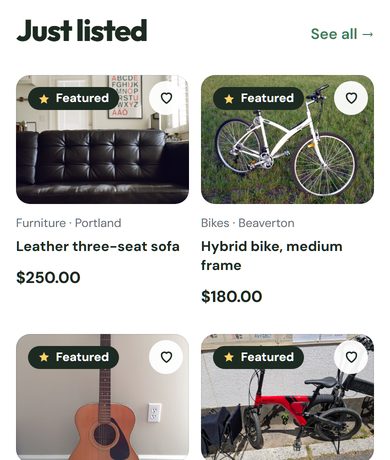
Featured listings give sellers more visibility, usually at the top of search results or category pages, on the home page and with a badge. Listings in prominent spots get more clicks, and property sites such as StreetEasy and Your Move report that featured listings get noticeably more views and clicks. The marketplace earns an extra fee, and the sellers who invest most in their listings get more sales. Clutch lists further benefits of featured listings from the seller's side.
"Featured", "sponsored" and "promoted" mostly describe the same idea. The difference is usually in how it is sold:
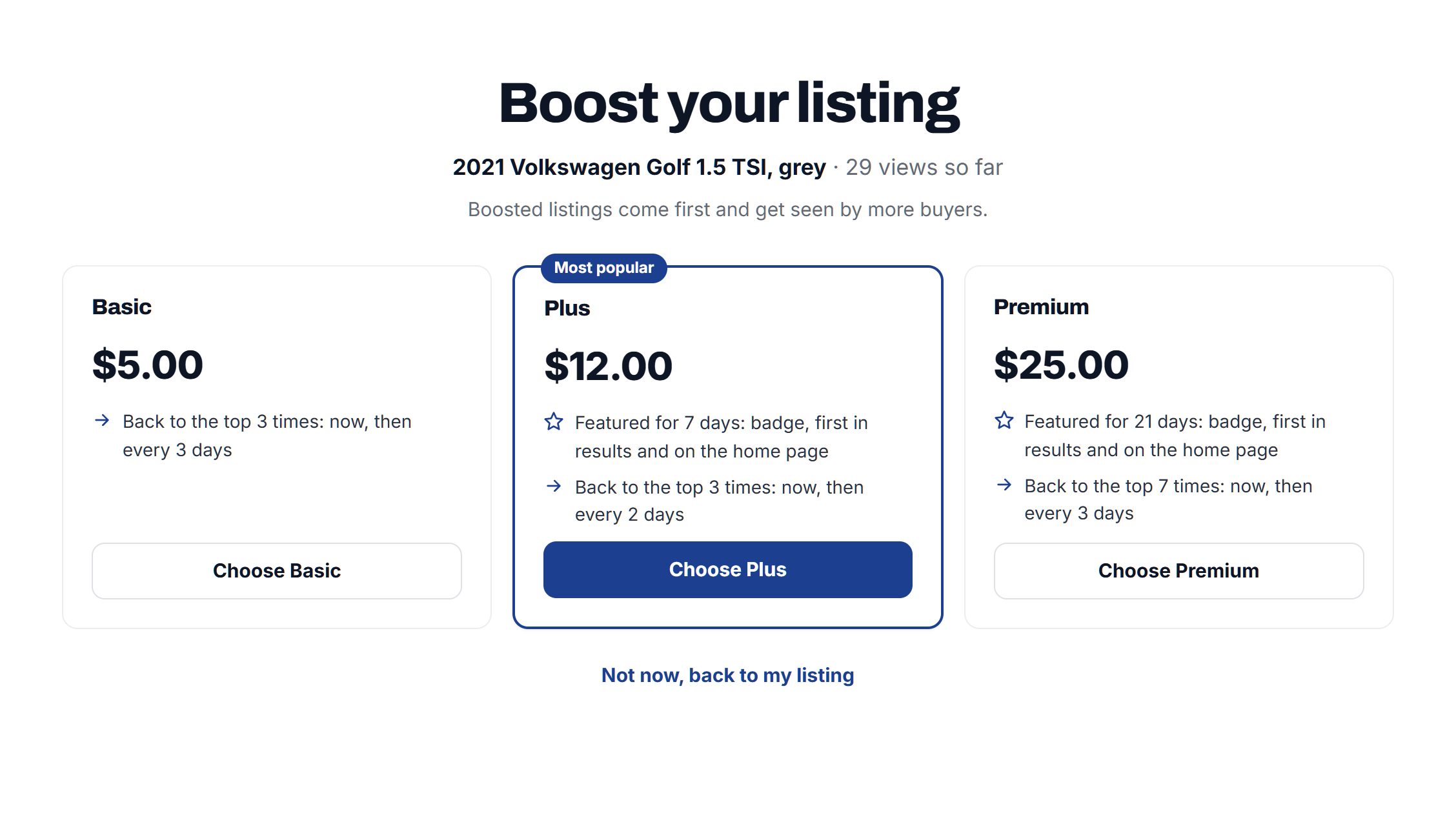
- Flat price for a set time: the seller pays a fixed amount for, say, 7 or 30 days in a featured spot. This is the common model on classifieds sites.
- Pay per click: the seller bids for a position and pays when a buyer clicks. Fiverr's Promoted Gigs work this way, showing gigs at the top of search results and in a section of the home page.
- Pay per sale: the seller pays a percentage only when a promoted item sells. eBay's Promoted Listings General works this way, which makes it close to a commission (see our guide to transaction fees and commission). eBay also lets sellers target search terms and groups of buyers, a form of keyword advertising.
- Included in a plan: a monthly seller plan comes with a number of featured days each month (see subscription marketplaces).
Bumps, boosts and other paid extras
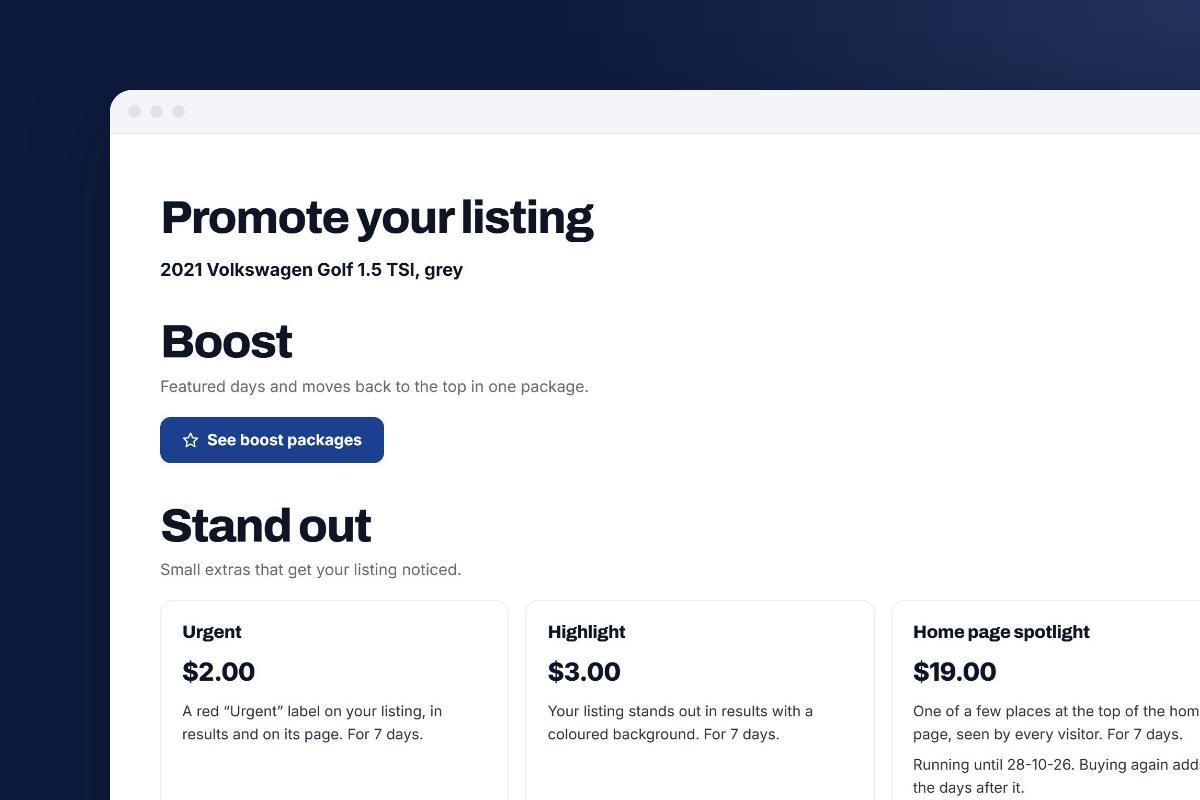
On a classifieds site sorted by date, a listing drops off the first page quickly. A bump (or "bring to top") moves it back to the top for a small fee. A boost is usually a package: some featured days plus several bumps spread over time. Other paid extras include an "Urgent" or "Highlight" label, a home page spotlight and paid renewals. These cost the buyer nothing, are easy for sellers to understand, and suit low-value items where a lead fee would make no sense. Our guide to value-added services covers more extras you can sell.
What listing, lead and promotion fees look like in 2026
The big marketplaces have changed how they charge for listings, leads and promotion in recent years. Before you set your own prices, here is what they charge today:
| Marketplace | Model | What it costs today |
|---|---|---|
| Etsy | Listing fee plus commission | $0.20 per listing (renews every four months), 6.5% transaction fee, and 3% + $0.25 payment processing in the US. Since September 2024 new shops also pay a one-time $15–$29 setup fee (Craftybase, April 2026; see also Etsy's seller terms) |
| eBay | Free listing allowance plus paid promotion | 250 free listings a month, then $0.35 per listing. The final value fee is 13.6% in most categories. Promoted Listings General charges a percentage ad rate on sales within 30 days of an ad click. Priority charges per click (Frooition, August 2026) |
| Craigslist | Pay-per-post in selected categories | Jobs cost $10–$75 depending on the area. Gigs cost $3–$10. Services, cars by owner or dealer, RVs and motorcycles by owner, for-sale-by-dealer, commercial real estate, and apartment rentals in Boston, Chicago and New York cost $5. Most other categories are free (Craigslist posting fees) |
| Thumbtack | Pay per lead | Thumbtack prices each lead by category, job size, location and competition. Pros set a budget and can choose to set exact lead prices, and they can request refunds on qualifying charges (Procured, April 2026) |
| Upwork | Pay to apply (Connects) | $0.15 per Connect, 10 free per month on free accounts, and usually 2 to 6 Connects ($0.30–$0.90) per proposal, depending on the job (Unilink, May 2026) |
| Fiverr | Commission plus paid promotion | A 20% fee on orders, plus Promoted Gigs: cost-per-click bids with a daily budget, for Level 1 sellers and above (Fiverr Tutorials, April 2026) |
Paid visibility is now a large business
For the largest marketplaces, selling visibility to their own sellers is one of their main businesses:
- Amazon reported advertising services revenue of $19.8 billion for the second quarter of 2026 alone, up 26% year over year (Amazon Q2 2026 results, 30 July 2026). Its four 2025 quarters added up to roughly $68.6 billion (Amazon Q4 2025 results), mostly from sponsored listings inside search results rather than banners.
- eBay's first-party ads, mainly Promoted Listings, made $570 million in Q2 2026, up 25% year over year. All its ad products together came to $596 million, 2.7% of GMV, and 5.7 million sellers used at least one advertising product (Value Added Resource, Q2 2026).
- Across the whole ad market, WARC's October 2026 forecast puts global ad spend at $1.34 trillion in 2026, up 11.9%, and $1.46 trillion in 2027, with retail media (advertising sold by marketplaces and retailers) at about $202 billion in 2026 (The Desk, 8 October 2026).
The lesson for a small marketplace: your first advertisers are your own sellers. About 95% of eBay's ad revenue in Q2 2026 came from its own sellers paying for visibility, not from outside brands. Featured spots and bumps don't depend on attracting big advertisers, which is the hard part for a small site.
Calculator
What could your marketplace earn a month?
Type in your own numbers. Leave any way of earning you don't use at 0.
An estimate from the numbers you enter, not a promise. Payment providers charge their own fees on each payment. More free tools →
eBay has also widened when its cost-per-sale ads are charged. Since 13 January 2026 the fee applies when any buyer clicked the ad and the item sells within 30 days (Value Added Resource). In the UK, Germany and Australia, where the change came earlier, sellers report that the share of their sales carrying an ad fee rose from about half to 80–90% or more (Frooition, August 2026). Pricing that feels like a hidden commission is exactly what makes sellers angry.
Featured pricing: how to set your fees
- Charge for posts only where a listing is worth a lot to the seller. Craigslist keeps most categories free and charges only for jobs, vehicles, services, property and dealer posts. A small paid category is easier to accept than a fee on every post.
- Keep listing fees low enough to filter spam, not supply. Etsy charges $0.20 and eBay $0.35 after a free allowance. A fee in that range stops bulk spam without putting off occasional sellers.
- Charge for leads only when one lead can turn into a big job. Thumbtack and Upwork can charge per contact because one home-improvement job or freelance contract is worth far more than the fee. For low-value used goods, use featured or "bump to top" listings instead.
- Sell time, not auctions. On a local classifieds site, a fixed price for a set number of days is easier to explain than bidding, and easier for sellers to judge. Offer two or three durations (for example 7 and 30 days) with a lower daily price for the longer one.
- Price against the value of the item. A featured spot for a used car or a rental apartment can cost far more than one for a sofa. Different prices per category are fair and easy to explain.
- Be open about how promotion fees work. Simple, flat prices for a featured slot are easier to explain than fees on sales after a click.
Selling banner and ad space
Once traffic is steady, you can also sell display space: banners on the home page or category pages, or Google AdSense. This is the only model on this list where your customer may be an outside business rather than a seller, for example a local garage advertising on a car classifieds site. The marketplace advertising guide from e-tailize covers the options in more detail.
| Ad format | Advantages | Disadvantages |
|---|---|---|
| Display banners | High visibility, easy to set up, can be sold to outside businesses | Can feel intrusive if overused |
| Sponsored listings | Promote specific items to buyers already searching | Only sellers on the site can buy them |
| Native ads | Match the look of the site, less disruptive | Must still be clearly labeled as ads |
| AdSense | No sales work: Google fills the space | Low income on small sites, and the ads may send buyers elsewhere |
Ways to price ad space:
- Flat rate: a fixed fee per week or month for a placement such as a home page banner. Easiest for a small site.
- Cost per impression (CPM): a price per thousand views.
- Pay per click (PPC): a price per click on the ad.
To attract your first advertisers, show them your audience and traffic figures, offer an introductory discount or a free trial period, and send them simple reports of views and clicks. Keep banners out of the listing grid, so they don't push down the sellers who are paying you for featured spots. Some marketplaces also sell an ad-free experience to users as part of a paid plan.
Label every paid placement
If you sell visibility, buyers must be able to tell which results are paid. This is both good practice and, in many places, the law:
| Rule | What it requires | Practical meaning for a marketplace |
|---|---|---|
| FTC native advertising guidance and policy on deceptively formatted ads (US) | Paid content must be identifiable as advertising and disclosed clearly and prominently. The FTC names "Ad", "Advertisement", "Paid Advertisement" and "Sponsored Advertising Content" as labels consumers are likely to understand. It warns that "Promoted" is at best ambiguous. | Put a plain "Ad" or "Sponsored" badge at the start of every paid listing card, not in small print at the bottom. |
| EU Omnibus Directive (applied from 28 May 2022) | Showing search results without clearly disclosing paid advertising or payment for higher ranking is an unfair commercial practice (Directive 2019/2161, Annex I point 11a). | A clear label on featured and bumped listings is required, not optional, for any size of site selling to EU consumers. |
| EU Digital Services Act (applies to online platforms since 17 February 2024) | Ads must be labeled and show who placed them and why the user sees them. Ads targeted at minors using profiling, and ads based on sensitive data, are banned. Micro and small enterprises are exempt from this part of the DSA (DSA Library, Art. 19). | Larger platforms should show which seller placed a paid listing and why it appears (for example "Sponsored: paid placement"). |
How to introduce paid visibility without driving sellers away
The order you introduce fees in matters as much as the price. A practical rollout:
- Start with seller-paid visibility. Featured listings for a set number of days and a small fee to bump an older listing are optional, so nobody is forced to pay. Label them clearly.
- Add paid posting only in the categories where listings are worth the most, such as cars, property and jobs, and keep a free allowance elsewhere.
- Add lead fees only for services, where one contact can turn into a large job.
- Add display banners or AdSense last, once traffic is steady.
Along the way:
- Run a pilot. Try a fee in one category or for a month, and collect feedback before rolling it out everywhere.
- Announce changes early and explain what sellers get for the money.
- Cap the share of paid results. Two or three featured listings above the others keep search useful. If every result is paid, buyers stop trusting the order, and small sellers feel they can't compete.
- Report results to sellers. Show views and contacts for each paid listing so sellers can see whether the money paid off.
- Watch the numbers: new listings per week, the share of sellers who buy an extra, and complaints. If new listings fall sharply after a fee starts, lower it or add a free allowance.
Charging listing fees and featured listings with Yclas

If you run your marketplace on Yclas, the models in this guide are built in:
- Sellers can buy featured listings (a badge, first place in results and a home page spot), bring a listing back to the top, or buy boosts: packages of featured days and moves back to the top.
- You can charge to post in the categories you choose, and sell monthly seller plans.
- You can sell extras such as Urgent and Highlight labels, home page Spotlight places and paid renewals, plus banner space or AdSense.
Payments go straight to your own Stripe or PayPal account (Yclas also supports many regional payment gateways), and Yclas takes no commission on any plan. The Make money wizard in your site's admin switches it on in four steps. See how to make money with Yclas, compare plans and prices, or start a free 15-day trial.
Frequently asked questions
What does lead fee mean?
A lead fee is a charge a seller or service provider pays for a lead: a potential customer's request, contact details, or the right to send a quote or apply for a job. Thumbtack charges per lead, and Upwork charges for Connects used to apply for jobs.
What is a listing fee?
A listing fee is a charge to publish a listing. Some marketplaces charge for every listing (Etsy), some give a free allowance first (eBay), and some charge only in certain categories (Craigslist).
What is the difference between featured and sponsored listings?
Very little. Both are listings a seller has paid to show more prominently. "Featured" is common on classifieds sites with a flat price for a set time; "sponsored" or "promoted" is common where sellers bid per click or pay per sale. Whatever you call them, label them clearly as paid.
How much should I charge for a featured listing?
Start with a flat price for a set number of days, look at what competitors in your niche charge, and set higher prices in categories where items are worth more. Offer a longer option at a lower daily price, then adjust based on how many sellers buy.
Will fees drive sellers away?
They can if they apply to everything at once. Optional paid visibility (featured listings, bumps) doesn't stop anyone from posting. Keep posting free in most categories, charge only where listings are valuable, and announce changes in advance.
How can sellers tell if a featured listing paid off?
By comparing views, clicks and contacts on the listing while it was featured with the same numbers before. Showing sellers these figures is the best way to get them to buy again.
Should I sell banner ads or featured listings first?
Featured listings. Your own sellers are your easiest advertisers, and featured spots don't distract buyers from the listings. Add banners once traffic is steady.
Summary
- Listing fees improve listing quality and cut spam; charge them where listings are valuable, after a free allowance.
- Lead fees suit services, where one contact is worth a lot, and keep scammers out.
- Featured and sponsored listings, bumps and boosts are the easiest place to start: optional for sellers, simple to price, and the model behind most marketplace ad revenue.
- Banner and ad space comes last, once traffic is steady.
- Whatever you sell, label paid placements clearly and keep enough free results for search to stay useful.
Thinking of starting a buy-and-sell site of your own? See our marketplace website builder, software for a second-hand marketplace and how to start an online marketplace.