To attract sellers to a new marketplace, start with sellers, not buyers: pick one narrow niche and one area, recruit your first 20 to 50 sellers one by one with a personal message, help them post their first listings, and only then bring in buyers through the local groups and communities where those buyers already meet. That is the honest answer to the chicken-and-egg problem. Buyers come for listings, and sellers stay when buyers reply. An empty site convinces nobody, so the first weeks are about getting real listings up, legally and by hand, not about advertising.
This post is part of our guide to growing a marketplace. It covers the empty-site stage: which side to start with, how to fill the site without copying other sites, where to find your first sellers, what to say to them, a checklist for your first 50, and what to do as both sides grow. The marketing plan for a marketplace covers what comes after.
In short
- Start with sellers in one narrow niche and area, and recruit the first 20 to 50 one by one with a personal message.
- Seed listings honestly by posting your own items or posting for sellers with their permission, never by copying other sites or faking reviews.
- Build a list of 100 names, offer to post each seller's first listing and share it so they get an early reply.
- 14 of 17 large marketplaces studied focused on supply first, mostly through direct sales, and typically used just two tactics.
- Bring buyers in from local groups and clubs once you have 20 or more live listings, and start free with a dated launch offer.
Part of the guide Growing your marketplace
The chicken-and-egg problem: which side to get first
Every marketplace starts empty. Buyers won't visit a site with nothing to see, and sellers won't post where there are no buyers. You can't solve both at once, so you choose an order.
For most classifieds sites, directories and small marketplaces, sellers come first. A listing stays on the site and keeps working for weeks; a visitor who finds nothing leaves and rarely comes back. Fifty good listings give every later visitor a reason to stay, and give you something to share.
There are a few exceptions where demand can come first:
- You already have the buyers. If you run a club, a newsletter, a local Facebook group or a trade association, your audience is the asset. Tell sellers about it: "300 people in this group are looking for exactly this."
- Requests are the product. On a jobs board or a services site, a "wanted" post (a job, a quote request) can be what attracts the supply side.
- A few sellers can cover everyone. If three local dealers can list most of what buyers want, sign those three before you spend any time on buyers.
Whichever side you start with, make the market small. "Used farm equipment in one county" can look full with 50 listings. "Everything for sale in the country" looks empty with 5,000. You can widen the categories and the area once the first one works.
Calculator
How many listings do you need at launch?
Visitors leave a category that looks empty. Pick how many listings a category page needs to look alive, for the categories and places you launch with.
Too many weeks? Launch with fewer categories or one area first, and add more as listings come in.
The founders did it by hand too
The well-known marketplaces started small and manually. Craigslist began in early 1995 as Craig Newmark's email list of San Francisco events for friends, and grew by word of mouth before it was a website (craigslist mission and history). Paul Graham's essay "Do Things That Don't Scale" (July 2013) describes Airbnb's founders going door to door in New York to recruit hosts and help them improve their listings, and calls recruiting users by hand the most common unscalable thing founders do at the start. Your version of that is a list of 50 names and a free afternoon a week.
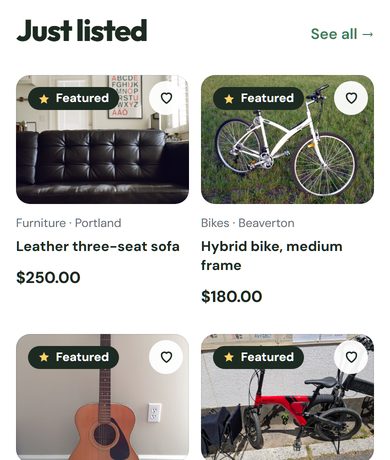
What sellers want before they join
A seller who doesn't know you asks three questions: will anyone see my listing, how much work is it, and what does it cost? Answer them before they ask.
- Buyers, or a believable plan to get them. At the start you can't promise traffic. You can say who you are building for, which groups you will share listings in, and what you'll do each week. Be specific and honest.
- Little effort. Posting should take a few minutes on a phone. Offer to post the first listing for them from their photos and text.
- Clear, low costs. Free to start, with fees written on one page. Nobody joins an unknown site that charges on day one.
- A reason to choose you over the big sites. Usually that is focus: the right buyers in one niche or area, and a person who answers.
- Trust. Your name, a way to contact you, simple rules for what may be posted, and a quick answer when something goes wrong. Small sites gain the most from this, because nobody knows them yet.
Use the big platforms' fees as your opening
The largest marketplaces are taking more from each sale. Etsy's full-year 2025 results (published February 19, 2026) show its take rate (revenue as a share of sales) rising from 22.3% to 24.2% in one year, while active sellers on the Etsy marketplace fell to 5.6 million in the fourth quarter of 2025, down 1.5% year over year. Amazon's US selling page (checked October 2026) lists $0.99 per item sold on the Individual plan or $39.99 a month on the Professional plan, plus a referral fee on each sale that varies by category, up to 45%.
Three lessons for a small marketplace:
- A simple, published fee stands out. Put your fees on one page and let sellers compare them with what they pay elsewhere.
- Make launch offers time-limited and tied to a milestone. Amazon's own launch offer for new brands (over $50,000 in credits and benefits, including referral-fee waivers in the first year, on the same page) is not "free forever". Do the same on a small scale: free featured listings for your first 50 sellers for three months, or no fees until a seller's first ten sales.
- Count active sellers, not sign-ups. A seller with no live listing in the last 30 days is not a seller. Contact the ones who go quiet. Our guide to marketplace metrics explains what to track.
Seeding the first listings legally
You want the site to look alive before you invite anyone. There are honest ways to do that and some tempting ones that can get you into trouble.
What you can do
- Post your own items and services, and ask friends and family to post things they really want to sell.
- Post on behalf of a seller, with their permission, using their own photos and words. Get the OK in writing (a message is enough), and put the listing on their account or under their name with their real contact details.
- Import a seller's own listings from a spreadsheet or another platform, when the seller asks you to or agrees. It is their content to move.
- Use clearly labelled examples to show what a good listing looks like, and remove them once real listings arrive.
- Publish "wanted" posts for real requests you have collected, such as people in your group looking for a specific item.
What to avoid
- Copying listings from other sites. The photos and descriptions belong to whoever made them (copyright), most classifieds sites' terms forbid copying, and in the EU the Database Directive (96/9/EC) lets a site owner stop others extracting or re-using a substantial part of its database, including by repeated small copies. It also annoys the very sellers you want: they get calls about items they never posted with you.
- Fake listings. Items that don't exist waste buyers' time, and the first buyer who finds out will tell others.
- Fake reviews or ratings. In the US, the FTC's rule on consumer reviews and testimonials, in force since October 21, 2024, bans fake reviews and paying for positive ones, and allows civil penalties for knowing violations. You may ask for honest reviews, and even offer a small thank-you, as long as it doesn't depend on the review being positive. Reviews by you or your staff must say who wrote them.
Recruiting your first 20 to 50 sellers, one by one
Paid ads won't fill an empty marketplace (see our guide to paid advertising for when they start to make sense). Personal invitations will. Plan on a few hours a week for the first month.
1. Build a list of 100 names
You will need about two names for every seller who posts. Look where your sellers already sell or advertise:
- Other platforms: people with several listings in your niche on general classifieds sites, Facebook Marketplace or Etsy. Contact them through the channel they published, and invite them; don't copy their listings.
- Local businesses: shops, dealers, workshops, studios and service providers with a website, a Google Business Profile or a sign on the street.
- Fairs, markets and events: stallholders at craft fairs, car boot sales, trade shows and farmers' markets. Bring a printed QR code.
- Your own network: past customers, colleagues, club members.
2. Send a personal message, not a campaign
Write to each person by name, say where you found them and why your site fits what they sell. Ask for one small step: post one listing, or send you photos so you can post it for them. Follow up once after a few days, then stop. The template below gives you a starting point.
3. Make the first listing effortless
Offer to set up their first listing from their photos and text, the way Stripe's founders set up their service on people's laptops on the spot (also from Paul Graham's essay). Then show them the live listing and how to edit it.
4. Get them a first reply
A seller who gets an enquiry in the first week stays. Share each new listing in the local groups below, and send interested people straight to it. Northwestern University's Spiegel Research Center found a product with five reviews was 270% more likely to be bought than one with none, so after each completed deal, ask both sides for an honest rating.
5. Ask each seller for one more name
Sellers know other sellers. Ask every happy seller who else should be on the site. A referral program turns this into a habit once you have a few dozen members.
Stay within the rules when you reach out
Personal one-to-one messages are the safest kind, but email rules still apply. In the US, the FTC's CAN-SPAM guide says the law makes no exception for business-to-business email: commercial messages need honest sender and subject lines, a postal address and a way to opt out, honoured within 10 business days. In the UK, the ICO's business-to-business marketing guidance (under review as of October 2026) treats companies differently from sole traders and partnerships, who generally need to have agreed before you send them marketing email. Rules elsewhere in the EU are similar. In practice: write to published business contacts, one at a time, say who you are and how you found them, accept a "no" and never add anyone to a mailing list without their permission. Our email marketing guide covers newsletters once people have signed up.
Seller outreach message template
Adapt it to your niche and keep it short. Send it by email, WhatsApp or the contact form the seller published, and write the parts in brackets yourself for every person.
Hi [first name],
I'm [your name] and I run [site name], a new site for [what is sold, e.g. used farm equipment] in [area]. I found you through [where: your listing on X / your stand at the Saturday market / your shop on Main Street], and your [items or service] are exactly what our buyers are looking for.
We're inviting our first [50] sellers. Listing is free [until date / for your first ten sales], and I'll share every new listing in [named groups or newsletter, with their size if you know it].
If you like, send me two or three photos and a price and I'll post your first listing for you. You can edit or remove it any time.
Here is your sign-up link: [link]
If this isn't for you, just say so and I won't message again.
Thanks, [your name], [phone or email]
Why it works: it is personal, it says how you found them, it asks for one small step, it promises something you can deliver, and it makes saying no easy. Don't invent figures like "thousands of buyers" that you can't show yet.
Template
Outreach message to recruit your first sellers
Use this to contact people already selling on other sites, in groups or in shops; personalise the first line every time and offer what you can really deliver.
Send no more than one follow-up to people who did not reply, and keep a list of who asked not to be contacted.
Bringing in the first buyers: local groups and communities
Once you have 20 or more live listings, start bringing buyers to them. For a small or local marketplace, the fastest place is where people already gather:
- Local and niche Facebook groups, WhatsApp communities and forums. Read each group's rules and ask the admin before posting. Many groups ban links; an admin who likes your site may share it for you, or let you post a weekly roundup of new listings.
- Clubs and associations in your niche: a newsletter mention or a poster at their meeting place reaches exactly the right people.
- Offline: a poster with a QR code at markets, shops, community centres and noticeboards.
- Your sellers' own followers. Ask each seller to share their listing; it is in their interest.
Our guide to social media for classifieds sites goes further. Search traffic takes months to build, so start early: give each category and area its own page with useful text (see SEO for classifieds sites).
Talk to your first users and make the listings look good
Your first 50 sellers are also your best source of advice. Call or message them after their first week: was posting easy, did anyone reply, what is missing? Fix the small things fast and tell them you did. At your scale, user research is a five-minute phone call.
Write simple posting rules and enforce them while volumes are small. Swappa, a used-phone marketplace, has its moderators review every listing before it goes live, and Etsy's Creativity Standards define what may be sold. Both make buyers trust what they see. For photos, Google's Merchant Center image requirements (checked October 2026) are a good model to borrow:
| Google's standard | What to tell your sellers |
|---|---|
| About 1500 × 1500 pixels or larger recommended; at least 500 × 500 pixels for all products from January 31, 2027 | Upload the original photo from the phone, not a screenshot or thumbnail |
| The product fills 75% to 90% of the image | Get close: the item, not the room, should fill the picture |
| No promotional text, prices, watermarks, borders or added logos | Put the price and details in the listing, not on the photo |
| No placeholder or generic images; AI-generated images must keep metadata saying so | Photograph the actual item, never a catalogue or AI image of something second-hand |
Hold new listings for approval for the first weeks so you can coach sellers whose photos fall short. Keeping that first group active is the start of community and retention.
Template
Posting rules for your classifieds site
Publish this as your posting rules page and link it from the post-an-ad form; adjust the prohibited list to your country's laws and your niche.
Check your country's rules on items such as weapons, animals, alcohol and medicines before publishing.
First-50-sellers checklist
Work through it in order. Most owners get through it in four to six weeks with a few hours a week.
- Choose one niche and one area your first 50 listings can cover.
- Write a one-line promise for sellers: who the buyers are and why your site, not the big ones.
- Publish your fees and posting rules on one page each. Start free, with a dated launch offer.
- Add your name, a contact method and an "about" page.
- Post your own listings and those of friends and family (real items only).
- Replace or remove any example listings before you invite anyone.
- Build a list of 100 possible sellers, with where you found each one.
- Send 10 personal messages a day using the template; follow up once.
- Offer to post the first listing for anyone who sends photos.
- Join or contact five local groups or clubs and ask the admins how you may share listings.
- Share each new listing within a day of it going live.
- Call every new seller after a week: any replies? What was hard?
- Ask each happy seller for one more name and for an honest rating after each deal.
- Track weekly: sellers contacted, sellers with a live listing, listings, buyer messages.
- At 50 active sellers, widen to the next category or area.
What research, today's platforms and the rules add
This page also replaces our older posts on getting the first 50 customers for an online marketplace, on generating interest from sellers and from buyers, and on balancing supply and demand.
What 17 large marketplaces did first
In November 2019 Lenny Rachitsky interviewed the founders and early employees of 17 of the largest marketplaces, including Airbnb, Uber, DoorDash, Etsy and Thumbtack. 14 of the 17 concentrated on supply in their early days. Only three, Rover, TaskRabbit and Zillow, focused on demand first. The same study looked at which tactics brought in that first supply:
| Tactic | Share of the 17 marketplaces |
|---|---|
| Direct sales (door to door, phone, visits) | About 60% |
| Referral programs | About 33% |
| Recruiting from existing platforms | About 33% |
| Word of mouth | About 25% |
| Subsidies or guarantees | About 25% |
The typical company relied on just two tactics (the median was two, the average 2.5), so choose the two that suit your niche and do them well.
The study also says to start narrower than feels comfortable. Rover started in Seattle and Airbnb in New York. Etsy started with just three categories (vintage, craft supplies and handmade), and OpenTable reckoned it needed 50 to 100 restaurants concentrated in a city before it worked.
Two smaller points from the same older post: under the FTC's CAN-SPAM compliance guide, each email that breaks the rules can cost up to $53,088. And if you put banners on your own home page, use them to promote your own services (seller plans, a launch discount, your blog) rather than third-party ads that earn little.
Why sellers cross-list, and what that means for you
The big platforms are crowded and growing slowly. Etsy's revenue went from $2.57 billion in 2022 to $2.81 billion in 2024 and $2.88 billion in 2025. Upwork's barely moved between 2024 ($769.33 million) and 2025 ($787.78 million), according to StockAnalysis (checked October 2026) and its Upwork data. On a smaller, focused marketplace, a seller's listings aren't buried under millions of others.
Listing on the big platforms is also almost effortless now:
- In March 2026, Meta added Meta AI tools to Facebook Marketplace that write a draft listing from a photo, suggest a price based on similar local items and auto-reply to buyers. Meta says more than 3.5 million listings are posted every day in the US and Canada.
- In July 2026 it launched a separate Seller app with bulk listing and a unified inbox, and reported 430 million items listed each month worldwide.
- Since November 2025, Marketplace has shown eBay and Poshmark inventory in its feeds.
Serious sellers cross-list everywhere, so you won't win them by being "another place to post". Be easier, cheaper or better targeted: keep only the fields buyers really filter on, test posting a listing from a phone in under two minutes, and offer what generic platforms lack, such as local visibility, verified buyers or category-specific fields (mileage, bedrooms, certifications).
Look at service sellers too. MBO Partners' State of Independence 2026 counts a record 74.9 million Americans earning income independently, almost 6 million of them making more than $100,000 a year. Tutors, cleaners, photographers and tradespeople are often easier to recruit for a local or niche marketplace than product sellers are.
Buyer trust is now partly a legal requirement
Similarweb's marketplace ranking for September 2026 has amazon.com first and temu.com second, ahead of ebay.com. Your first buyers compare you with those sites.
In the US, the INFORM Consumers Act has applied to online marketplaces since 27 June 2023. It covers "high-volume" third-party sellers: those with 200 or more sales of new or unused products and $5,000 or more in gross revenue in any continuous 12-month period within the last 24 months. The marketplace must collect and verify their bank or payee details, tax ID and contact details within 10 days and have them recertify every year, show the name, physical address and contact details of sellers with $20,000 or more in annual revenue, and give buyers a way to report suspicious conduct. The FTC lists civil penalties of $53,088 per violation. In the EU, the Digital Services Act works in a similar way: verified seller identity before selling, a clear way for buyers to see who is responsible for a sale, and informing buyers and offering redress when illegal products are found.
Many small or local sites don't meet these thresholds, so check which rules apply to you with a lawyer. The trust signals cost little either way:
- a seller profile with name, location and contact details, plus a "verified" badge once you have checked them
- a "Report this listing" link on every ad, and a stated time in which you respond
- a published policy for illegal or recalled items, and a way to contact past buyers
- a yearly re-check of active power sellers, removing inactive or unverified ones
Keeping supply and demand in balance as you grow
Once both sides are in, the balance can still shift, as the latest Fiverr and Airbnb annual reports show:
| Metric | 2023 | 2024 | 2025 |
|---|---|---|---|
| Fiverr annual active buyers | 4.03 million | 3.63 million | 3.14 million |
| Fiverr annual spend per buyer | $278 | $302 | $342 |
| Airbnb Nights and Seats Booked | n/a | 492 million | 533 million |
| Airbnb Gross Booking Value | n/a | $81.8 billion | $91.3 billion |
Sources: Fiverr Form 20-F for 2025 (dated 12 March 2026); Airbnb Form 10-K for 2025 (dated 12 February 2026).
Fiverr says AI tools have reduced demand for "simple and low-skilled services". Its active buyers fell 13.6% in 2025, while spend per buyer rose 13.3%. Airbnb's Nights and Seats Booked grew 3% in North America but 18% in Latin America and 15% in Asia Pacific. For a classifieds site:
- Track demand per category, not just in total. A flat overall number can hide one category shrinking while another grows.
- Measure value per user as well as user count: listings per seller and contacts per listing.
- Steer seller recruitment toward where demand outruns supply, in new regions or categories, and away from work buyers no longer pay for.
How Yclas helps with the empty-site stage
If you run your marketplace on Yclas, several of these steps are built in:
- Recruit sellers: a private list of the people and businesses you want to invite, a personal sign-up link for each, and WhatsApp, email and call buttons that open your own apps with the message filled in. It also shows which searches on your site found nothing, so you know which sellers are missing.
- Share your site: your site link, a ready message for WhatsApp, Facebook groups or email, a QR code and a printable poster.
- Getting listings in: four example listings written by AI when the site is created (replace them as real ones arrive), and importing a seller's listings from a CSV file, other platforms or pasted text.
- A referral program where members share an invite link and earn wallet credit or a coupon when a friend publishes a listing or pays, with a monthly cap.
- Bringing people back: a weekly email digest of new listings, saved searches with alerts, automatic posting of new listings to a Facebook page, Telegram and X, and coupons and featured listings for launch offers.
- Getting found by search engines: landing pages for each category and location, daily XML sitemaps and new listings sent through IndexNow (SEO and speed).
You can try all of it with a free 15-day trial.
Frequently asked questions
How can you attract sellers and buyers to a marketplace?
Start with sellers in one narrow niche and area. Invite 20 to 50 of them personally, help them post, then bring buyers from the local groups, clubs and communities where they already gather. Share every new listing so sellers get replies early.
How do you get the first users for a marketplace?
By hand. List 100 people who already sell what your site is for, message each one personally, and offer to post their first listing. Your own network, local businesses and stallholders at markets and fairs are the easiest places to start.
Should I get sellers or buyers first?
Usually sellers, because listings keep working after you post them and give buyers a reason to stay. Start with buyers only if you already have an audience, if requests are the product (jobs, quotes), or if a few sellers can cover most of the demand.
Can I copy listings from other sites to fill mine?
No. The photos and text belong to their authors, most sites' terms forbid it, and in the EU database rights can apply. Invite those sellers instead, and import their listings only with their permission.
Should I charge sellers from the start?
Usually not. Start free with a dated launch offer, publish your fees on one page, and switch on paid options such as featured listings once sellers are getting replies.
How many sellers do I need before I promote the site to buyers?
Enough that a visitor finds something in the category or area you promote. For a small, local niche, 20 to 50 active sellers with real listings is a reasonable first target.