It started in 2007, with two hosts offering their San Francisco home to three guests. Since then, the online marketplace Airbnb has grown to feature 9 million active listings worldwide with over 5.5 million hosts.
In 2022, 14,000 new hosts joined this platform every month.
And as of February 2022, these hosts had earned a total of more than 150 billion dollars in revenue. The vacation rental industry continues to grow steadily.
In 2020 alone, there were reportedly 115,000 vacation rental companies worldwide. Twenty-three thousand of them are in the US alone.
In short
- Airbnb now has 9 million+ listings, 5.5 million+ hosts and 12.2 billion dollars of 2025 revenue, so start niche (one region, property type or longer stays) rather than global.
- Begin with an MVP, as Airbnb and Zappos did: Airbnb's weekly revenue doubled to 400 dollars after it improved its listing photos.
- Airbnb's standard is now a single host-only fee of about 15.5%, replacing the split 3% host and 14.1-16.5% guest fee, so pick one fee model and show it clearly.
- Add a registration or license field to listings from day one if you operate in the EU (Regulation 2024/1028, from 20 May 2026) or a regulated city like New York.
- A custom Airbnb-like build costs around 300,000 dollars and 3,000+ hours, while a hosted platform such as Yclas comes with templates and payment gateways ready.
Part of the guide Starting a marketplace
Airbnb's Unique Selling Proposition for Its Online Rental Marketplace
 Airbnb may get a massive share of the pie, but that doesn't mean that it's getting everything. Many competitors for a vacation rental or apartment booking marketplace like Airbnb exist.
What turned Airbnb into a huge success was how it provided options for guests looking for more intimate accommodations.
Whereas traditional travelers might have booked hotels or hostels, the Airbnb platform brought them a more local experience by letting them book rooms or houses from hosts.
By doing so, it disrupted a hotel industry more than 1,000 years old with its "collaborative travel revolution." It also contributed to the thriving sharing economy industry.
In the United States alone, it was forecasted that more than 85 million people would be using sharing economy services like Airbnb by the end of 2021.
What Do Individuals Look for in Hosted Accommodations?
 According to a survey conducted among 844 respondents who had booked Airbnb accommodation, 61% opted to rent a place through the platform because it was more cost-effective than staying in a mid-range hotel.
Additionally, people like having access to convenient locations and amenities. Among these amenities, top of the list are pools, WiFi, and good kitchens.
Similarly, Airbnb listings let guests explore unique accommodations they can't get anywhere else. One group of travelers, for example, was able to book a place atop some horse stables.
On top of these, Airbnb and other rental marketplaces are packed with features that make it easy for guests and hosts to find each other. For example, users can create an account quickly with Google or social media integration.
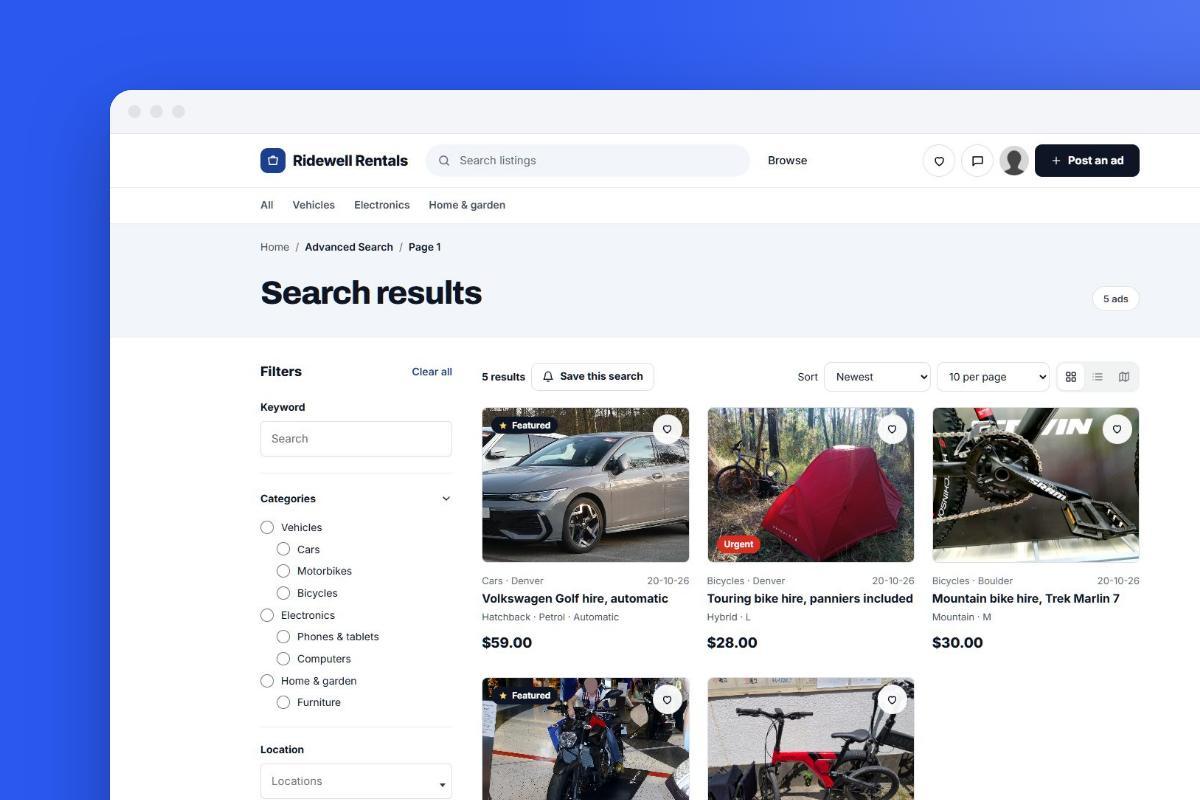
The separate user roles (guests and hosts) are tailored to each user's needs, including customizing search filters for specific property types, budgets, and amenities. Similarly, property pages are comprehensive, with the usual details, maps, photos and reviews.
In the case of Airbnb, these features allow homeowners to easily rent out their homes while the platform handles the transactions.
Still, Airbnb has quite a few challenges in running its platform, most of which may be beyond the platform's control (as in the case of guests who get noise complaints from neighbors). Another example is that hosts get hefty penalties for canceling a guest reservation, even if they may feel that it is not warranted.
Test Your Online Marketplace Idea in the Real World
 It started in 2007 with an air mattress and three guests. And a few years down the road, its founders navigated several roadblocks that left them selling cereal, at one point, to make ends meet.
Then they looked at their data and realized a common theme found in photos of their listings: they were terrible. Shortly after, they commissioned high-resolution photos for their listings and saw their weekly revenue double to $400.
In the same way, start small. Start with what's called an MVP (Minimum Viable Product).
An MVP or Minimum Viable Product is the simplest "saleable" version of a product or service you can offer. Done right, there are a lot of benefits with an MVP. It allows you to understand the demand for your business offering better, release increasingly better iterations of your product, find your first customers, and even secure funding.
And it's what the founder of the company that Amazon bought for 1.2 billion dollars first did.
Nick Swinmurn of Zappos wanted to buy a pair of shoes but couldn't find them in the closest mall he went to. So he thought he'd build a basic website where he could sell shoes and approached a local shoe store to take pictures.
He uploaded the photos on the website, got some orders, and returned to the shoe store to buy and ship the shoes. While he didn't earn a lot, he did learn that there was a ready market for what he wanted to do.
As you create your rental marketplace's MVP, spend some time on market research. Market research helps you to identify your customers, know what they think of your product, assess your offering against the competition, and evaluate whether your marketplace will be profitable.
An easy place to start is using something like SurveyMonkey to ask users what they are looking for.
Template
Customer interview script for marketplace research
Use it for 20 to 30 minute conversations with possible sellers or buyers before you build or change your marketplace; swap the examples in brackets for your niche.
Compliments about your idea are not evidence; a past problem they spent money or time on is. More free tools →
Creating an MVP (a minimum product to start) will also help you determine if you have the right value proposition. It will also tell you whether you are communicating your online value proposition in the right way.
Plan the Features for Your Online Rental Marketplace
For a marketplace website like Airbnb to work, you'll target two different user groups: your hosts and your guests. Some features overlap for both hosts and guests, such as authorization, messaging, geolocation, and payments.
And then, there are features that are specific to hosts, like property listings and management. Guests want to be able to conveniently search and filter results according to specific metrics like location and price.
How Does Airbnb Monetize Its Online Marketplace?
Airbnb mostly earns through service fees from bookings. Under its older split-fee model, guests paid a service fee of up to 14.2%, while hosts paid 3% on each transaction.
Airbnb also offers to promote listings at a price.
For your marketplace, you might choose from 6 revenue models.
- Sign-up or registration fees
- Subscription fees
- Product listing fees
- Transaction fees
- Sponsored or promoted listings
- Ads from third-party advertisers
Calculator
Which way of charging earns more for your marketplace?
The same sellers and listings, charged four different ways. Change the numbers to your market: the share who pay is the honest guess that decides it.
Revenue a month for each model on its own. Many marketplaces mix them: free listings with paid promotions is the most common start, because it keeps listings coming in. More free tools →
Airbnb in 2026: The Numbers, Fees and Rules a New Rental Marketplace Must Plan For
Airbnb has changed a lot since this guide was first written. If you are using it as a model, plan around today's platform and today's rules, not the 2022 version.
Airbnb then and now
| Metric | When this post was written | Latest figure |
|---|---|---|
| Active listings | 6 million | 9 million+ (end of 2025) |
| Hosts | 4 million+ | 5.5 million+ |
| All-time host earnings | $150 billion+ (Feb 2022) | $380 billion+ |
| Annual revenue | n/a | $12.2 billion (2025, +10%) |
| Gross booking value | n/a | $91.3 billion (2025, +12%) |
| Nights and seats booked | n/a | 533.0 million (2025, +8%) |
Sources: Airbnb Newsroom, About Us (updated May 2026) and the Airbnb Q4 2025 shareholder letter.
The same shareholder letter shows where the company is growing. In May 2025 Airbnb launched Airbnb Services and a relaunched Airbnb Experiences. In Q4 2025 it began a pilot partnering directly with boutique and independent hotels in New York, Los Angeles, Madrid and San Francisco, and it reports that nights booked by guests from India grew 50% year over year in that quarter. It also says it has removed over 550,000 listings since launching an updated hosting quality system in 2023. Even at Airbnb's scale, a smaller set of good listings is worth more than a big set of poor ones.
How Airbnb's fees work now
The fee numbers above in this post date from the older model. According to Airbnb's Help Center, there are now two structures:
- Split fee (being phased out): most hosts pay 3% (4% in Brazil and Mexico), and guests pay 14.1% to 16.5% of the booking subtotal.
- Single host-only fee (the standard): most hosts pay 15.5%, others typically 14% to 16%, and 16% in Brazil and Mexico. The guest sees one all-in price.
The lesson for your own marketplace is that where you charge the fee affects how people see it. Showing guests an all-in price makes the listing look honest, but hosts then have to price the fee in themselves. Choose one model, explain it on your pricing page, and keep it the same from the search results through to checkout.
Calculator
One sale: what the seller gets and what you keep
Enter an item price, your commission and your payment provider's rate (Stripe's standard US card rate is 2.9% + $0.30).
Taxes, refunds, chargebacks and currency conversion are not included. More free tools →
Registration rules are now a product feature
Short-term rental platforms are increasingly legally responsible for what they list:
- New York City: since enforcement of Local Law 18 began on 5 September 2023, hosts must register with the Mayor's Office of Special Enforcement. Platforms such as Airbnb and Vrbo may not process transactions for unregistered short-term rentals, and they have to check each one with the city's verification system (NYC OSE).
- European Union: Regulation (EU) 2024/1028 has applied since 20 May 2026. Where a local registration scheme exists, platforms must show each listing's registration number and share activity data with the authorities (European Commission, Transition Pathways; full text on EUR-Lex).
What this means for your MVP
- Start niche, not global. Airbnb's 9 million listings are hard to compete with head-on. A focused market, such as one region, one property type or longer stays, is far easier to fill with good listings.
- Add a registration or license field to listings from day one if you plan to operate in the EU or another regulated city. Adding it later means asking every host for it again.
- Decide your fee model early, whether that is a listing fee, a subscription or a commission, and show it clearly.
- Check quality, not just quantity. Remove listings that are inactive or keep getting complaints, just as Airbnb's quality system does.
Booking Beyond Rentals: What a Charter Booking Site Needs
This page also replaces our older guide to building an Expedia-style online booking service for a local flight or boat charter company. The same booking logic applies to any rental or booking marketplace, and charter flights add rules of their own. Here is what that guide covered that the sections above do not.
Booking engine essentials
- Define the service scope first. Decide whether you sell only your own company's services or list services from multiple providers, as Expedia does with hotels and flights, and whether prices are fixed or dynamic.
- Search and filters by date, time, location, destination and type (for flights: private or shared, and aircraft type).
- Real-time availability for each vehicle, boat or aircraft, connected to your internal fleet management system or a third-party booking API.
- A pricing engine that calculates costs from the selected options, such as distance, flight duration and aircraft model, plus dynamic pricing by season and demand if you want it.
- Instant booking, so a customer can confirm without manual intervention.
- Payments and paperwork: multi-currency support for international customers, and automatic invoices and confirmation emails or SMS after each booking.
- An admin panel to monitor bookings, assign aircraft, schedule pilots and crew, prevent overbooking and report on sales and fleet use.
Ready-made booking systems such as AeroCRS or Lemax can be integrated with a website instead of building a custom engine. Before launch, test usability, security and performance under high traffic.
US charter rules: Part 135 and Part 295
The rules depend on whether you operate the aircraft or sell flights on other operators' aircraft, as Expedia does. Many local companies do both.
If you fly the aircraft: Part 135. Flying passengers for pay requires an FAA Part 135 certificate. Flights sold without one are known as "illegal" or "gray" charters. In May 2026 the FAA added a searchable list of certificated Part 135 operators to its Safe Air Charter website, so customers and brokers can check whether a charter company is legally authorized. Earlier in 2026 the FAA temporarily took down its spreadsheet of operators and aircraft after repeated errors, so keep your certificate number and aircraft list (the D-085 list) ready to send on request.
If you sell other operators' flights: Part 295. Since February 14, 2019, DOT's air charter broker rule (14 CFR Part 295) applies to anyone who arranges charter flights they don't operate:
- Advertising (295.23): every ad, including your website, must clearly state that you are an air charter broker and not a direct air carrier.
- Before the customer commits (295.24): disclose the carrier in operational control of the aircraft, the capacity you act in (the customer's agent, the operator's agent or as principal) and the insurance that covers the flight. On request, give the total cost, third-party fees and business relationships that may influence which operator you pick.
- Who you may book (295.20): only carriers with the required DOT economic authority and FAA safety authority.
- Prohibited practices (295.50): presenting yourself as the operator, misrepresenting the aircraft, service, safety record or insurance, and selling flights you know cannot be legally performed.
According to NBAA's Part 295 Q&A, if disclosures are provided online, customers should be told when the information becomes available and when it changes.
The lesson matches the registration rules above: build regulated details into the listing and checkout from day one. Each search result should name the operating carrier, the checkout should show the required disclosures for the customer to acknowledge before paying, quotes should show the full price including taxes and fees, and any change of operator or aircraft should notify the customer automatically.
Start Your Marketplace Website With Yclas
Generally, building a marketplace website like Airbnb costs around $300,000, depending on where you live. And it can take more than 3,000 hours.
If you don't have that much money or time to build your online marketplace, try building an Airbnb-like website with Yclas. With ready-made templates that you can customize, you don't have to worry about hiring a design team to get started.
And with features that are already built into the software, having no coding skills isn't an issue.
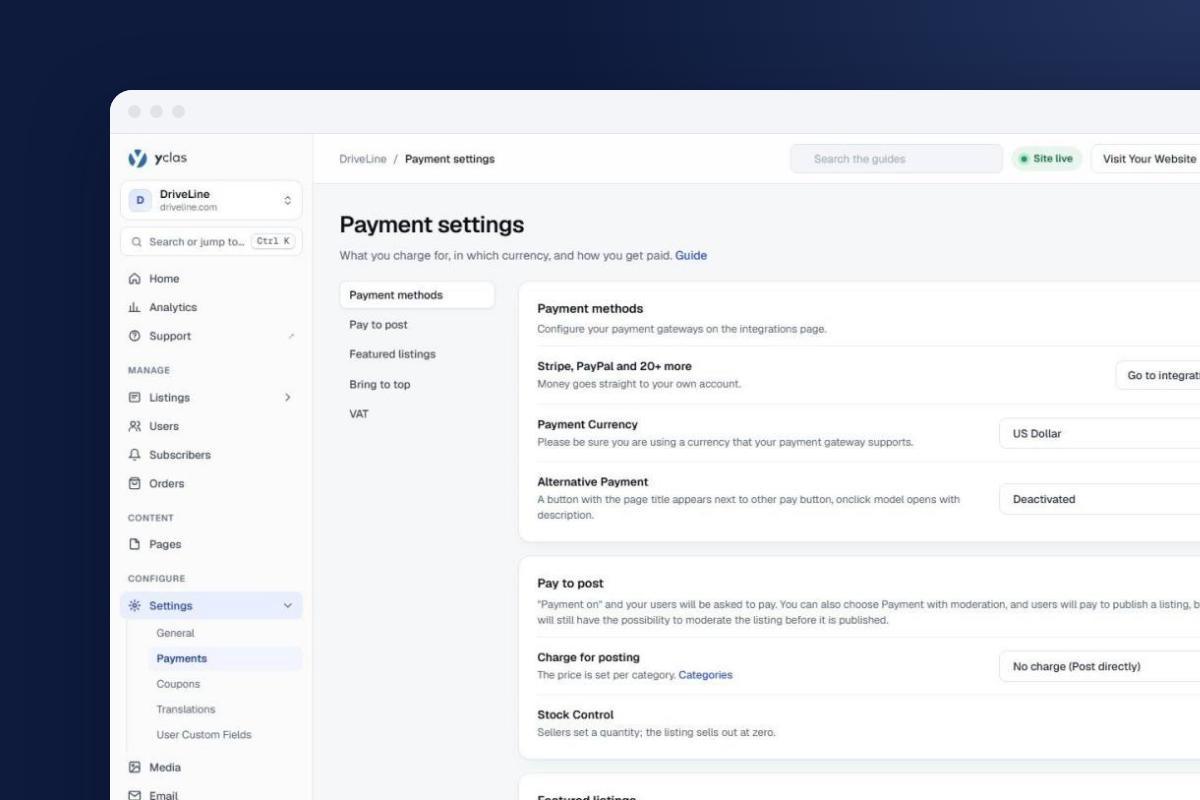
Yclas also integrates with several payment gateways to ensure secure and convenient payment transactions for your hosts and guests. Get started today.
Thinking of starting a buy-and-sell site of your own? See our marketplace website builder, software for a second-hand marketplace and how to start an online marketplace.