
A marketplace MVP that tests whether people will trade.
A marketplace MVP has one job: show that buyers and sellers in your niche will actually trade on your site. This guide covers what to test first, what to leave out, how fast you can launch a marketplace MVP on a hosted platform, and the signs that tell you it is time to grow out of it.
Free for 15 days · No credit card · Then $19 a month
Test the riskiest question first.
Most marketplace startups fail for lack of trade, not for lack of features. So the first version should answer, as cheaply as possible, the question that would end the idea if the answer were no. Write it down before you build anything.
- Will sellers list here? Ask twenty. Count how many post without you doing it for them.
- Will buyers find what they want? Watch the searches that come back empty.
- Will they get in touch? Count listings that receive at least one message.
- Will they pay? Offer one paid upgrade and see if anyone buys it.
If you can only measure one thing, measure messages per listing. It shows supply and demand meeting, which is the whole point of a marketplace.
Leave out everything the first deal does not need.
Every feature in an MVP is a feature you have to explain, support and fix. These are the usual candidates to leave for later, and the signal that says it is time to add each one.
| Leave out at first | Why | Add it when |
|---|---|---|
| Online payments | Buyers and sellers can pay each other while you learn | Sellers ask for it, or deals fall through on trust |
| Commission | It slows down the first sellers | Sellers already get buyers from you |
| Several languages | One market at a time | Visitors come from a second language area |
| A native app | A phone-friendly site does the job | People come back daily and ask for one |
| Complex seller tiers | One free plan is easy to explain | Dealers or shops list far more than others |
Launch a marketplace MVP in days.
On a hosted platform the software part takes a day. The rest of the first month is spent where it matters: on sellers.
| When | What you do |
|---|---|
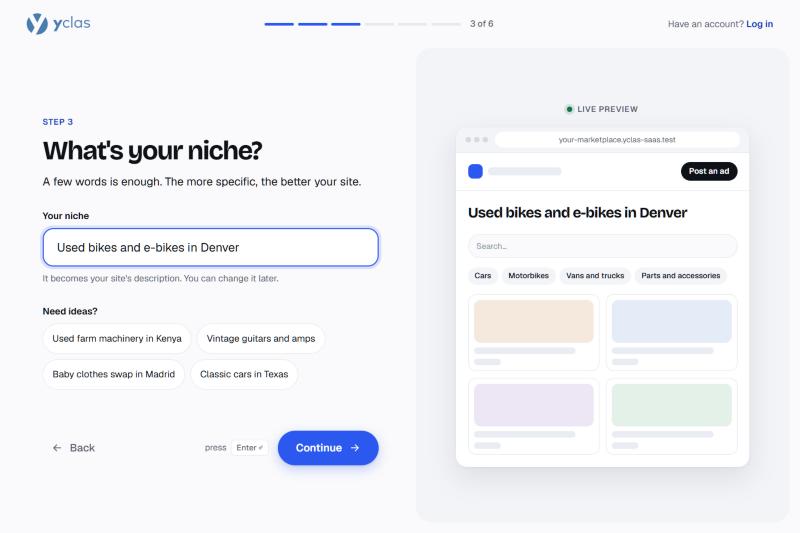
| Day 1 | Describe the marketplace in the sign-up wizard, fix the categories, pick a look |
| Days 2 to 3 | Add the fields buyers filter on, write the rules page, post your own first listings |
| Week 1 | Invite twenty sellers personally; import or paste what they already sell elsewhere |
| Weeks 2 to 4 | Share the site in the groups your buyers use; watch messages and empty searches |
| Month 2 | Switch on one way to earn and see who pays |
Do by hand what you would automate later.
Early marketplace startups often run parts of the service by hand: the founder writes listings for sellers, introduces buyers personally, or checks every seller before they go live. It does not scale, and it is not meant to. It teaches you what to automate.
- Post listings for sellers who will not do it themselves, from their photos.
- Approve every new listing by hand, so you read what people want to sell.
- Answer every message that sits unread for a day.
- Call the first sellers who sold something and ask what almost stopped them.
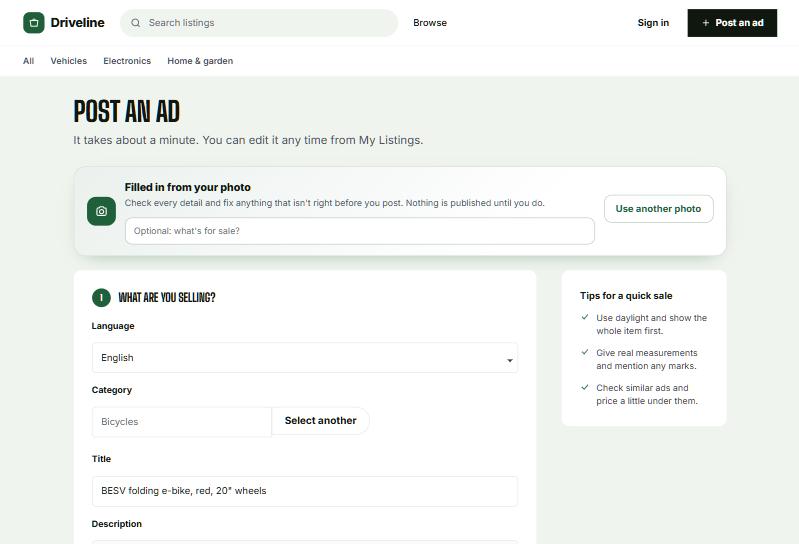
Listings from a photo are on every plan: 50 a month on Starter.
Know the signs you have outgrown your MVP.
A successful MVP creates the next problem. Some signs mean "move up a plan"; a few mean "it is time for software of your own". Knowing which is which saves a rebuild you do not need.
| The sign | Usually means |
|---|---|
| Dealers and shops list far more than private sellers | Seller plans and business accounts: Professional |
| Sellers want to be paid on the site | Buy now from Professional; cart and commission on Marketplace |
| Buyers ask for rentals by the day | Bookings from Professional |
| Your core flow is unlike any marketplace product | Custom software, or custom work on top of Yclas |
| You need your own engineers to change it every week | Your own codebase: export your data and move |
Five steps to a marketplace MVP.
- Name the riskThe one question that would end the idea.
- Build the smallest siteListings, search and messages. Nothing else yet.
- Fill it yourselfTwenty sellers, your own listings, imports.
- Measure tradeMessages per listing, empty searches, repeat sellers.
- DecideGrow it, change the niche, or stop while it is cheap.
What is a marketplace MVP?
The smallest version of a marketplace that lets real buyers and sellers trade, built to find out whether they will, before spending on a full product.
Should a marketplace MVP be no code?
For most ideas, yes. The risk is finding buyers and sellers, not writing software, and a hosted builder lets you test that in days. Write code once you know what the market needs.
How much does a marketplace MVP cost?
On Yclas, nothing for the first 15 days, then $19 a month on Starter. Add a domain and whatever you spend on reaching your first sellers.
Is Yclas a good fit for marketplace startups?
It fits startups whose marketplace is listing-based: goods, vehicles, equipment, rentals, local services. If your product is a new kind of matching or workflow, use Yclas to test demand and plan your own software for later.
Can I take payments in an MVP?
Yes, if your test needs it. Buy now starts on Professional, and the cart with your commission on Marketplace. Many MVPs learn more by leaving payments out at first.
What if the test fails?
Stop the plan, or change the niche and categories on the same site. Nothing is owed after the trial unless you choose a plan.
Can I keep my data if I move on?
Yes. Export listings and users whenever you like.
Related pages.
Read next.
Test your marketplace idea this week.
A working marketplace in a day, free for 15 days. Spend the rest of the time on sellers.
Launch my MVP