How to build a sustainable business directory that keeps greenwashing out.
This guide shows how to build a directory of green, low-waste and ethical businesses in one area: who looks for them, the practices people filter on, how the site earns money, where the first businesses come from, how to set criteria and spot greenwashing, the searches to target, and a launch planned around the green calendar.
Free for 15 days · No credit card · Plans from $19 a month
Help people act on good intentions without doing hours of research.
Many people want to buy less plastic, repair instead of replace and shop locally, but they give up because finding the right places takes too long. Where is the nearest refill shop? Who repairs a coffee machine? Which cafe accepts my own cup? Which builder knows heat pumps? Map apps cannot answer these, because "sustainable" is not a category they understand. Green guides from magazines are written once and never updated, and city sustainability pages often list a dozen places and stop.
Choose an angle you can verify
- Low-waste living in one city. Refill shops, bulk food, repair cafes, thrift and secondhand stores, tool libraries. This is the easiest to start and the easiest to check, because a refill station either exists or it does not.
- Green home and energy services. Solar installers, insulation specialists, heat pump fitters, energy auditors. High value per visitor, and buyers compare carefully.
- Ethical shopping nationally. Brands selling secondhand, repaired, organic or fair trade products online.
- Sustainable food. Farm shops, farmers markets, community supported agriculture boxes, restaurants that source locally.
Pick one and say plainly what qualifies. A directory that tries to cover everything "green" ends up listing everyone who asks, and then it means nothing.
Filter on concrete practices, not on vague green labels.
The most useful fields describe something a visitor can check on arrival: a refill station, a repair service, secondhand stock, a certification with a name. Avoid fields like "eco-friendly: yes or no", which every business will tick. Use checkboxes for specific practices instead, and a separate field for certifications held.
Keep categories simple: shopping, food and drink, repair and reuse, home and energy, transport, and services such as cleaning, printing or events. The practices then cut across them, so a visitor can find every place in town that offers refills, whether it is a grocer, a pharmacy or a cafe.
Add one field that sets your directory apart: evidence. A short line from the business explaining what it does, such as "all coffee grounds go to a community garden", is more convincing than any badge, and it gives you something to check.
Price range and opening hours still matter here: plenty of shoppers assume green means expensive, and a filter that shows affordable refill and secondhand options brings in more of them.
| Category | Example listings | Fields people filter on |
|---|---|---|
| Shopping | A refill shop, a zero-waste grocer, a secondhand clothing store | Refill station, package-free, secondhand stock, bring your own container |
| Repair and reuse | A repair cafe, a bike workshop, a tailor, a tool library | Items repaired, walk-in or by appointment, parts sourced used |
| Food and drink | A farm shop, a vegetarian cafe, a CSA box scheme | Locally sourced, organic certified, reusable cups accepted, vegan options |
| Home and energy | A solar installer, an insulation firm, a heat pump specialist | Service, service area, installer accreditation, free assessment |
| Transport | A bike shop, an e-bike rental, a car share club | Sales, rental or repair, cargo bikes, electric vehicles |
| Services | An eco cleaning company, a print shop with recycled paper, a zero-waste caterer | Practices, certifications held, evidence statement |
Keep certifications as a fixed list of recognized schemes, so nobody can type in a label they made up.

Earn from businesses that benefit, without selling green credentials.
The rule that protects everything else: no business can pay to be listed as sustainable, and no fee changes what your criteria say. Charge for visibility and leads only, and keep them clearly marked.
- Quote requests for home and energy services. A homeowner asking for solar, insulation or a heat pump quote is a valuable lead, and installers are used to paying for leads elsewhere. This is often the biggest earner in a green directory.
- Featured places. A refill shop opening a second branch, a repair cafe announcing a new evening.
- Memberships. A yearly package for businesses that want a verified badge after you have checked their evidence, a featured place and a mention in your newsletter.
- Banner spaces. Green energy suppliers, ethical banks, cargo bike makers. Turn down sponsors whose own claims you would not accept in a listing.
- Sponsored guides. A plastic-free July guide or a winter energy-saving guide with a named sponsor.
If a sponsor would fail your own listing criteria, decline the money.
| Model | Works when | Switch it on |
|---|---|---|
| Quote requests for home and energy | Homeowners compare installers | Once each energy service has several installers in your area |
| Featured places | Popular practices have many listings | When the refill or repair pages fill a screen |
| Verified memberships | Businesses want to prove their claims | When owners ask how to stand out from vague competitors |
| Banner spaces | Ethical brands want your audience | When you can show visitor numbers |
| Sponsored seasonal guides | A green campaign month drives searches | Two months ahead of the campaign |
Find the first businesses through the green groups that already exist.
Every town with a sustainability scene has people who already keep lists. Start with them.
- Zero-waste and plastic-free groups. Local Facebook groups and community chats share refill shops and repair tips daily. Ask the admins to share your directory and to suggest places.
- Repair cafes and transition town groups. Volunteers know every repairer, tailor and secondhand shop nearby.
- Farmers markets. A morning at the market can sign up farm shops, bakers and producers in one go.
- Public lists. Some cities and counties publish lists of repair, reuse or recycling services, and certification schemes such as organic certifiers publish who holds their labels. Use these to find businesses, then confirm each one.
- Google Places import. In Yclas you can import businesses from Google Places using your own Google key. It fills in name, address, phone, website and opening hours, without photos. It cannot tell a green business from any other, so search for specific terms such as refill shop or bike repair, and review each result before publishing.
- Owner claims. Invite each business to claim its page, add photos and write its evidence statement.
A spreadsheet from a local green network can be imported as a CSV, which saves a weekend of typing.
Publish your criteria and check the claims.
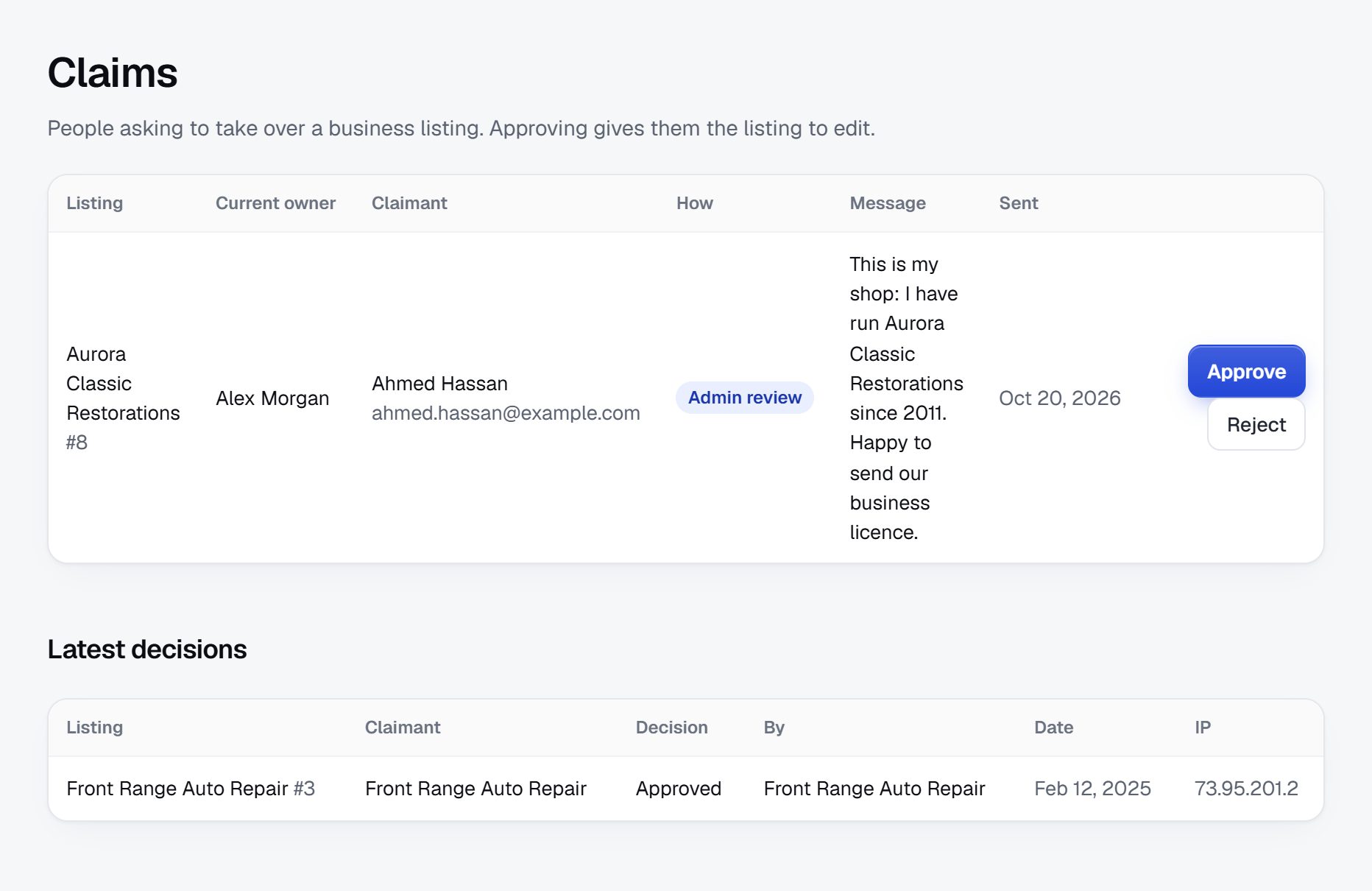
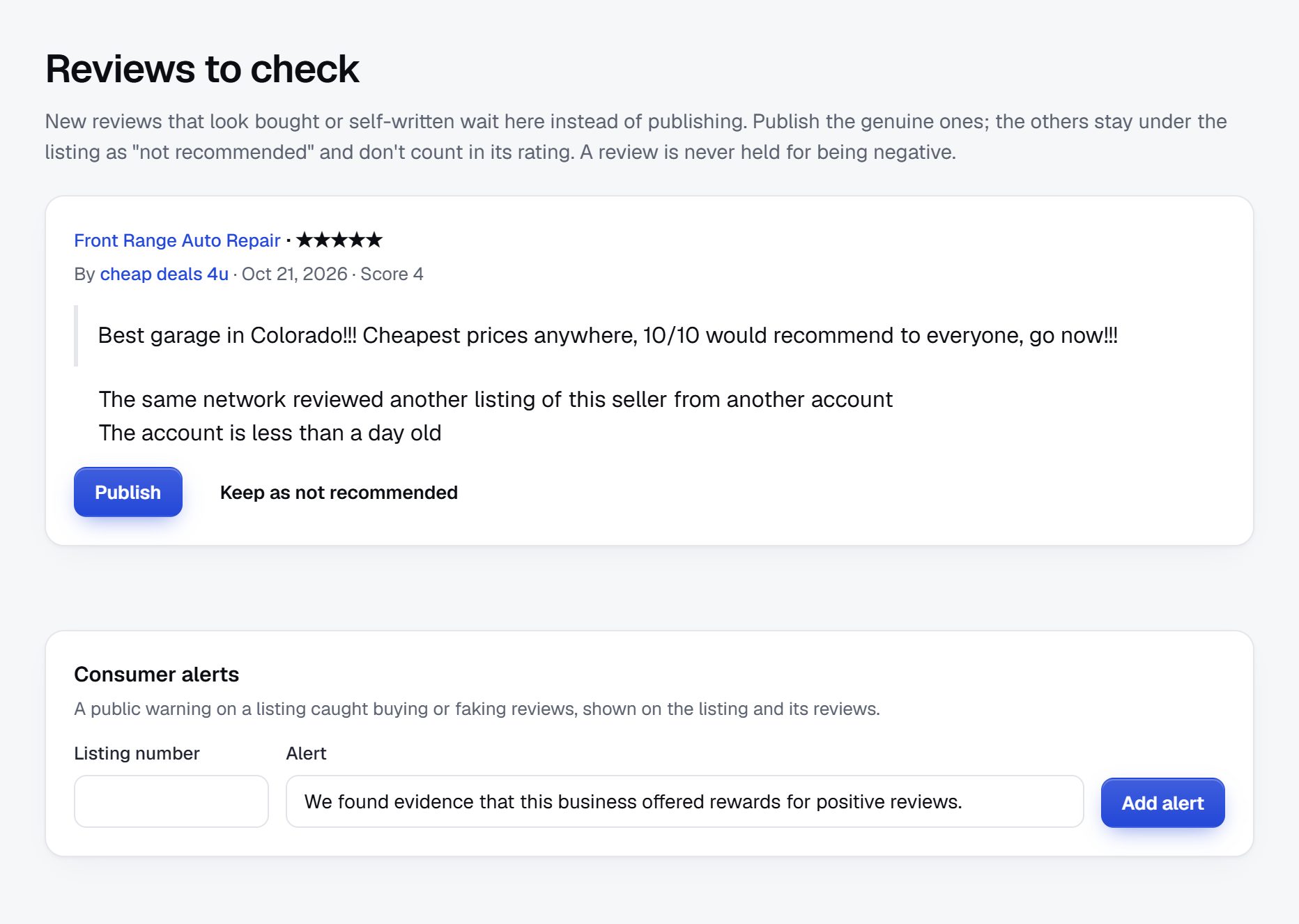
Greenwashing is the main risk for a sustainable directory. If visitors find a business that calls itself eco-friendly while doing nothing different, they stop trusting every listing. Write your criteria before launch, publish them, and apply them the same way to everyone.
Common greenwashing signs
- Vague words with no detail. "Natural", "eco", "green" and "conscious" with nothing specific behind them.
- One small change presented as the whole story. Paper straws in a business that changes nothing else.
- Invented labels. A badge the business designed itself. Only accept certifications from recognized schemes, and check the certifier's public list.
- Offset claims. "Carbon neutral" based only on bought offsets, without any reduction. Ask what is behind it.
How to check
- Require at least one concrete practice from your list, with a sentence of evidence.
- Visit or call new businesses in your first months, and mark checked ones with a verified badge.
- Ask businesses to update their practices once a year.
- Let visitors report a listing that does not match reality, and follow up.
Reviews with owner replies help: customers will point out a refill station that closed or a repair service that stopped. Rules on environmental claims in advertising are getting stricter in several places, such as the FTC Green Guides in the US, so check the rules where you operate before you describe any business as sustainable.
Answer the practical green searches people make every day.
Most searches in this niche are practical and local, which suits a directory well:
- "refill shop near me"
- "zero waste store Portland"
- "repair cafe Minneapolis"
- "where to recycle electronics in Austin"
- "solar installers in Phoenix reviews"
- "secondhand furniture store Brooklyn"
Pages to build
- Practice plus city pages. "Refill stations in Denver" and "bike repair in Denver" are pages that answer a search on their own.
- Neighborhood pages once a city has enough listings.
- How-to guides. How to start a low-waste kitchen in this city, where to repair electronics, what to ask a solar installer.
- Explainers on labels. What organic, fair trade and B Corp labels mean. People search for these and the guide links naturally to certified businesses.
- Seasonal content. Plastic Free July, Earth Day, Earth Hour and holiday gift guides without the waste.
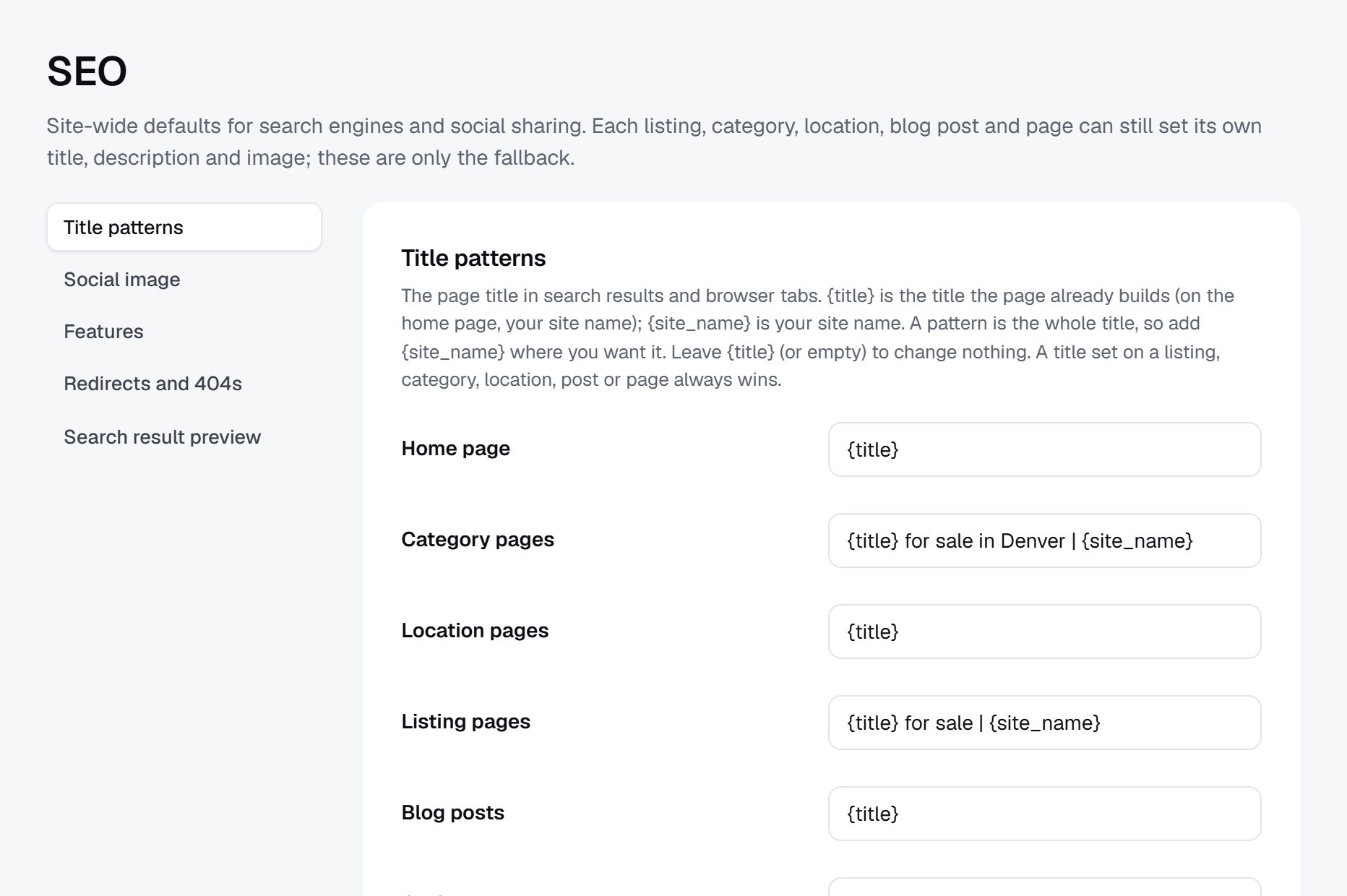
Write titles that use the words people type, "zero waste" and "refill", rather than broad words like "eco lifestyle" that few search for. Each business page should name its practices in plain text, which helps both readers and search engines.
Launch in one city around Earth Day or Plastic Free July.
Start with one city and two or three practices you can cover thoroughly: refills, repair and secondhand are the easiest. A complete list of refill stations in one city is more useful than a thin list for a whole country.
Dates that matter
- Earth Day, April 22. Local press looks for green stories in the weeks before.
- Plastic Free July. A month when low-waste searches rise and groups share resources daily.
- Repair days and swap events. Many repair cafes run monthly sessions, and clothing swaps happen in spring and fall.
- Winter energy season. Insulation and heat pump searches rise as heating bills arrive.
Partners
Repair cafe organizers, zero-waste groups, farmers market managers, the city's sustainability or waste team, and local reporters who cover the environment.
Checklist
- Write and publish your criteria and the list of accepted certifications.
- Set up practice checkboxes and the evidence field.
- List 100 checked businesses in one city.
- Invite owners to claim their pages.
- Write three practice plus city guides.
- Launch with a partner a month before Earth Day or July.
- Plan a yearly review of every listing's practices.
A worked example: a low-waste map for Milwaukee.
Consider a fictional directory called Lakeshore Low-Waste Map, covering Milwaukee, Wisconsin, and its nearest suburbs. It focuses on what a resident can check on a visit: refill stations, repair services, secondhand stock and locally grown food, plus a smaller section for home energy work. It does not try to rate whole companies on their footprint, which keeps its claims easy to defend. Long winters also shaped the plan: heating costs make energy work a year-round topic, while refill and repair visits rise in spring and summer.
Categories
- Refill and bulk
- Refill shops
- Grocers with bulk bins
- Repair and reuse
- Repairers and repair cafes
- Secondhand and consignment stores
- Tool and toy libraries
- Local food
- Farm shops and CSA boxes
- Farmers markets
- Home energy
- Insulation and heat pump installers
- Energy auditors
Every listing carries practice checkboxes and an evidence statement of one or two sentences, written by the business and checked by the founder before it goes live. A "last checked" date sits beside it, and a price range filter keeps affordable secondhand and refill options visible.
Who it serves
Renters who want to cut packaging without driving across town, students furnishing apartments from secondhand stores, homeowners facing a cold-winter heating bill and comparing insulation and heat pump installers, and parents looking for a toy library before buying new.
How it started
The founder volunteered at a monthly repair cafe and kept a notebook of fixers to send people to when a repair was beyond the volunteers: a vacuum specialist, a shoe repairer, a lamp rewirer. Visitors kept photographing the pages. She typed the notebook into a spreadsheet, added the refill shops her zero-waste group shared, visited each place over two months and launched with 120 checked listings the week before Earth Day. Eleven candidates were left out because nobody could point to a practice behind their green wording.
How it makes money
Quote requests to insulation firms, energy auditors and heat pump installers bring in most of the money, because one homeowner request can turn into a large job for the installer. Refill shops and repairers pay small amounts for featured places when they open or add a service, and a local credit union, whose own lending practices passed the same criteria, sponsors a Plastic Free July guide. No payment changes which practices a listing shows.
| Listing | Category and area | Practices and evidence |
|---|---|---|
| Refill shop and bulk grocer | Refill and bulk, Bay View | Refill station, bring your own container, "about 40 cleaning and pantry products refilled from bulk" |
| Small appliance repairer | Repair and reuse, Walker's Point | Vacuums, mixers and lamps, used parts where possible, walk-in repairs Tuesday to Saturday |
| Consignment furniture store | Repair and reuse, Wauwatosa | Secondhand stock, pickup service, "we refinish pieces in our own workshop" |
| Vegetable box from a family farm | Local food, Waukesha County | CSA box, certified organic with certifier named, pickup points in the city |
| Heat pump and insulation installer | Home energy, Milwaukee County | Installer accreditation listed, free home assessment, checked by a site visit |
The first 90 days, from criteria to a checked city map.
A sustainable directory earns trust slowly and loses it fast, so the first 90 days put criteria before volume. Finish the practice list, the accepted certifications and the evidence rule before you invite a single business, because every early listing will be read by people who know the local green scene well and will notice anything that does not fit.
Choose your launch date from the green calendar. Earth Day in April and Plastic Free July both bring press interest and group activity, and the start of the heating season suits a directory that leans on home energy. Count 12 weeks back and plan the visits: checking a refill station or a repair counter in person takes an hour per place once you include travel, so spread them over the middle month and group them by neighborhood. Combine visits with a stop at the farmers market or a repair cafe session, where you can meet several owners in one morning.
Keep a simple log of what you checked, when and how. A year later, when you recheck every listing, that log saves you from starting over, and it answers anyone who asks why a business is on the map. Note the businesses you turned down too, with the reason, so a later application gets the same answer.
| Weeks | Focus | Done when |
|---|---|---|
| 1-2 | Write the criteria, the practice checkboxes and the accepted certification list | Two people from local green groups have read the criteria and agree they are fair |
| 3-4 | Gather candidates from zero-waste groups, repair cafes, market lists and certifier lists | A list of 200 candidates exists with a source noted for each |
| 5-7 | Visit or call candidates and collect evidence statements | 120 businesses are checked, with notes logged for each visit |
| 8-9 | Set up practice plus city pages and send claim invitations | Every published listing names at least one practice with evidence |
| 10-11 | Recruit home energy installers and switch on quote requests | At least three installers cover each energy service in your area |
| 12 | Launch with a repair cafe or zero-waste group before your green calendar date | A partner has shared the map and the first report of an outdated listing has been fixed |
Ways to build a sustainable business directory, and what greenwashing asks of the software.
The software has to make vague claims hard to publish. That means practice checkboxes rather than a single green yes or no, a certification field limited to a list of recognized schemes, an evidence text field, approval of every listing and every edit, reports from visitors, and reviews with owner replies, since customers are usually the first to spot a refill station that disappeared. Home energy needs quote requests to several installers, and a "last checked" date on each listing helps visitors judge how current it is.
Building with developers fits a project with ambitions beyond a directory, such as scoring businesses on several criteria or pulling certificate data from certifiers automatically. Scoring raises the stakes of every claim you publish, so budget for review as well as code.
A directory script or WordPress plugin on your own server suits an environmental group that already has a WordPress site and a member with time to maintain it. Check whether the plugin can limit certifications to a fixed list and hold edits for approval, because many cannot.
A hosted builder such as Yclas fits a volunteer or a small team covering one city, since custom fields, approval, claims, reviews and quote requests are ready and the effort goes into visits and checks. It also saves you from patching a server, a task that tends to slip when the team is made of volunteers.
Avoid a shared map with open editing. It is quick to start, but anyone can add a business with a nice description and no proof, which is exactly the problem your directory exists to solve.
| Route | Fits when | Watch out for |
|---|---|---|
| Custom build with developers | You want scoring or automated certificate checks | Every score is a claim you must defend, and upkeep costs continue |
| Self-hosted directory script or WordPress plugin | A green group already runs WordPress with a capable volunteer | Plugins that cannot hold edits for approval or limit certification lists |
| Hosted builder | One person or a small team covers one city | Set the practice checkboxes and evidence field before the first import |
| Open, community-edited map | A group wants a quick shared list for an event | No checks, so greenwashed entries appear within weeks |
What a sustainable business directory costs to run.
The software is the smallest part of the bill. Most of the cost is your time in the first months: finding the first listings, answering questions and checking what gets posted.
Checking claims is the main cost, in time rather than money: calls, visits and reading certifier lists. Budget for your own Google key if you import from Google Places, and for a stall at a farmers market or repair event.
| Cost | Typical range | On Yclas |
|---|---|---|
| Domain | $10 to $20 a year | Your own, with SSL included |
| Software and hosting | $0 to $100+ a month, plus plugins and updates | Starter $19 a month, Professional $99 |
| Design | $0 to $100 for a theme, or a designer | 109 looks included |
| Payment fees | About 3% per payment | Your Stripe or PayPal fees; Yclas takes nothing |
| Business data | Free if you collect it, or a few cents per page of Google results | Paid to Google, with your key |
| Your time | 5 to 10 hours a week at the start | Finding listings, moderation, support |
Mistakes that turn a green directory into a greenwashed one.
- A single "eco-friendly" checkbox. Every business ticks it, and the filter then returns the whole directory. Replace it with specific practices a visitor can check, such as refills, repairs or secondhand stock.
- Taking money from the companies you are meant to filter. A banner from an energy company whose own claims would fail your criteria tells visitors your rules are for sale. Apply the listing criteria to sponsors as well, and decline when they do not pass. Write the sponsor rule on your criteria page so the refusal is never personal.
- Covering everything "green" at once. Trying to rate restaurants, banks, fashion brands and builders in one go leaves you with thin, unchecked lists everywhere. Start with two or three practices you can verify, finish them in one city, then widen.
- Never checking again. Refill stations close, repairers retire and farms stop their box schemes. Recheck every listing at least once a year, act on visitor reports within days, and show the date each listing was last confirmed. A visible date tells visitors the map is cared for, and tells owners you will notice changes.
- Publishing footprint numbers you cannot verify. Carbon figures and "percent less waste" claims supplied by a business turn into your claims once they sit on your page. Describe practices in words, and leave numbers to certifiers who audit them. If a business insists, link the claim to the certificate or report in its own words, not yours.
- Calling yourself a certifier. A badge that reads "certified sustainable" suggests an audit you did not do. Call it what it is, for example "practices checked by our team on this date", and keep formal certification for recognized schemes.
- Ignoring price. A map full of expensive boutiques confirms the belief that green means costly. Make secondhand stores, repair cafes, libraries of things and affordable refill options easy to find with a price range filter.
- Listing a chain because one store has one refill shelf. Visitors arrive at a different branch and find nothing. List only the locations where the practice exists, and describe exactly what is there.
- Treating recycling as the whole story. A page that lists only drop-off points misses the repair, reuse and refill options that most people are looking for. Put reduce and repair first, and add recycling points as a helpful extra.
- Lecturing visitors. Guilt-heavy copy drives away people who are just starting. Write practical, friendly guides that make the next step easy, such as where to repair a lamp this weekend.
Sustainability terms a directory founder should know.
These are the labels and words that will appear in business claims, and the ones you will need to check.
| Term | What it means |
|---|---|
| Greenwashing | Making a business, product or service sound better for the environment than it really is. |
| Zero waste | A goal of sending as little as possible to landfill or incineration, used loosely in shop names. |
| Refill station | A counter or dispenser where customers fill their own containers with products sold by weight or volume. |
| Circular economy | An approach that keeps products and materials in use through repair, reuse, sharing and recycling. |
| Repair cafe | A free community event where volunteers help people fix household items. |
| Library of things | A lending service for tools, toys or equipment that people would otherwise buy and seldom use. |
| CSA | Community supported agriculture, where customers pay a farm ahead of the season and receive a regular box of produce. |
| Fair trade | Certification that producers in the supply chain were paid and treated according to a scheme's standards. |
| B Corp | A company certified by the nonprofit B Lab as meeting its standards on social and environmental performance. |
| Carbon neutral | A claim that a business balances its emissions, often partly through bought offsets. |
| Carbon offset | A credit that pays for emissions to be reduced or removed somewhere else. |
| Third-party certification | A label awarded by an independent body after checking, rather than by the business itself. |
| Green Guides | The US Federal Trade Commission's guidance on environmental marketing claims. |
| Energy audit | An inspection of a home or building that identifies where energy is lost and what to improve. |
The same steps for a sustainable business directory on Yclas.
- Describe your directoryThe setup wizard writes the categories, an About page and example listings from one sentence.
- Add fieldsHours, services, areas served, prices: the details people search by, as filters.
- Fill itImport businesses from a spreadsheet or Google Places, then check them.
- Bring owners inOwners claim their page, update it and answer reviews.
- EarnSwitch on featured places, banners or memberships when visits arrive.
What does a green business directory cost to get going?
Mostly time. Apart from the site and a domain, you need a few weekends to sign up businesses, check their claims and write the first guides.
How do I decide which businesses count as sustainable?
Publish a list of concrete practices and accepted certifications, and require at least one with evidence. Apply the same criteria to everyone, including paying members.
What about businesses that greenwash?
Do not list a business on vague claims alone. Ask for specifics, check recognized certifications against the certifier's own list, and remove listings when reports show the claims are not true.
Can I get in legal trouble for calling a business sustainable?
Rules on environmental claims are getting stricter in several places. Describe what businesses do rather than giving them a general green label, and check the rules where you operate.
Where do the first listings come from?
Zero-waste groups, repair cafes, farmers markets, public lists of repair and reuse services, and certifier lists. Invite each business to claim its page and add evidence.
How does a sustainable directory make money?
Quote requests for solar, insulation and heat pump installers are usually the strongest, plus featured places, verified memberships and banners from ethical sponsors.
How is this better than searching a map app?
Map apps do not know which shop has a refill station or which repairer fixes electronics. A directory built around practices answers those questions directly.
Should I list big chains or only independent businesses?
Independent businesses usually fit better and are easier to check, but a chain location with a real refill station or repair service can qualify. List the specific location, describe the practice exactly, and recheck it as you would any other listing.
How do I handle a business that fails a recheck?
Tell the owner what you found and give them a short window to correct or explain it. If the practice is gone, remove that practice from the listing, or the whole listing if nothing qualifying remains.
Can I use ratings or scores for businesses?
Scores look helpful but turn every number into a claim you must defend. Most small directories do better listing concrete practices and evidence, and leaving formal ratings to certification schemes. Visitors can still compare places through reviews, practices and the date each listing was checked.
Is a sustainable directory only for cities?
Rural areas often have strong farm shops, CSA schemes, repairers and secondhand dealers, and they are harder to find online. A county or regional directory focused on food and repair can work well outside cities. Mark each farm's pickup points and days clearly, because distance is the first thing rural visitors check.
How do I keep people coming back after Earth Day?
Publish seasonal guides through the year: repair events in spring, Plastic Free July, back-to-school secondhand shopping and winter energy saving. Saved searches and a monthly email of new listings bring regular visitors back too. A short note on newly checked businesses gives owners a reason to share the directory as well.
Related pages.
The parts of Yclas this leans on.
You have the plan. Now map the green businesses in your city.
Describe your site in a sentence and the setup wizard writes the categories, example listings and a look. Free for 15 days, no credit card.
Start my directory