How to build a women-owned business directory that buyers and founders trust.
This guide explains how to build a directory of businesses founded and run by women: who uses it, from shoppers to corporate buyers, the details they filter on, the ways it earns money, how to recruit and confirm the first owners, how to keep claims honest, the searches worth targeting, and a launch built around the dates women founders already mark.
Free for 15 days · No credit card · Plans from $19 a month
Decide whether you serve shoppers, buyers or founders first.
A women-owned business directory has three audiences, and the best ones pick a lead. Shoppers want to spend with women founders: a florist, a bookshop, a skincare brand. Business buyers, from procurement teams to event planners, need women-owned suppliers for their own diversity goals and want proof. Founders want to find each other: a designer looking for a female accountant, a caterer looking for a photographer to partner with. The places these people search today are scattered: a women-owned attribute on map apps that only some owners set, member lists of networking groups locked behind a login, and roundup articles that age quickly.
Ways to narrow it
- A city or region, covering local shops and services.
- A sector, such as women-owned construction and trades firms, where buyers actively look for certified suppliers and few lists exist.
- Product makers who sell online nationally.
- Mothers who run businesses, rural women founders, or women-owned businesses in one language community.
Trades, manufacturing and professional services are where a directory saves buyers the most time, because those owners are hardest to find through ordinary search. Retail and beauty bring more casual visitors. A mix of both, in one area, is a sound starting point.
Give buyers the facts they check before they make contact.
Shoppers and business buyers filter differently, so plan fields for both without making the form long. Keep categories broad: retail and makers, food, beauty and wellness, professional services, trades and construction, creative services, and coaching and education. Fields then answer the practical questions.
Business buyers care about certification, capacity and where a company can work. Shoppers care about opening hours, whether a shop ships, and price range. Both care about one thing you should show on every page: how the ownership was confirmed, whether by the founder's own statement or by an outside certification with a name and date. Do not ask for personal details about the owner beyond her name and role. The listing is about the business, and many founders prefer not to put their photo or family situation on display.
For suppliers, add a field for the certification number, so a procurement officer can confirm it with the issuing body in a minute.
| Category | Example listings | Fields people filter on |
|---|---|---|
| Trades and construction | A roofing contractor, an electrical firm, a landscaping company | Trade, service area, licensed and insured, certified women-owned, crew size |
| Professional services | A bookkeeper, an HR consultancy, an architecture studio | Service, industries served, remote or on site, certification |
| Retail and makers | A boutique, a candle maker, a children's bookshop | Product type, ships nationally, online or in store, opening hours |
| Food and drink | A bakery, a food truck, a winery | Cuisine, catering, events, neighborhood |
| Beauty and wellness | A spa, a yoga studio, a physical therapy clinic | Services, accepts new clients, price range |
| Creative services | A photographer, a branding studio, a video producer | Specialty, portfolio, travels for work, typical project size |
A certification field with a fixed list of bodies plus an expiry date is more useful to buyers than a free text box.
Charge for reach and leads, keep the basic listing free.
Women-owned businesses are usually small, and many already pay for networking groups. Your free listing must be genuinely useful, and the paid extras must bring customers they could not easily reach otherwise.
- Quote requests. This is where the directory earns its keep with business buyers. A company planning an event or a renovation sends one request to several women-owned firms, and owners receive real work.
- Featured places. A spot at the top of a trade or city page, useful to newer businesses.
- Memberships. A yearly package with a featured place, a verified badge once you have seen certification or other evidence, and a mention in a newsletter to buyers.
- Banner spaces. Banks with small business programs, coworking spaces, accountants and insurers who target founders.
- Pay to post in chosen categories. Only worth it in categories where a listing reliably brings contracts, such as trades.
Founders are wary of directories that charge them first and deliver nothing, so wait until quote requests are arriving before you sell memberships.
| Model | Works when | Switch it on |
|---|---|---|
| Quote requests | Buyers hire services through the site | Once trades and professional services have 20 or more firms each |
| Featured places | Busy categories run past the first screen | When a category has more businesses than visitors scroll through |
| Founder memberships | Owners want leads and exposure, not just a listing | After the first quote requests arrive |
| Banner spaces | Sponsors target women founders | When you can show monthly visitors and members |
| Pay to post in chosen categories | A listing reliably brings paid work | Late, and only in those categories |
Recruit through the networks women founders already belong to.
Women founders tend to be well connected through groups built for them. That makes the first hundred businesses reachable through a handful of conversations.
- Women's business networks and chapters. Local networking groups, women's chambers of commerce and professional associations for women in construction, law or tech. Offer to list their members for free and give them a group page.
- Small business support centers. Many regions have women's business centers or programs that advise founders. They can share your invitation with their clients.
- Public certification lists. Some governments and certification bodies publish searchable lists of certified women-owned firms. Use them to find businesses, then ask each owner before listing her firm.
- Craft fairs and markets. Makers' markets are full of women founders who sell online and want more customers.
- Spreadsheet import. If a network sends a member list, import it as a CSV after members have agreed.
- Google Places. An import with your own key brings name, address, phone, website and opening hours, but no photos, and nothing about ownership. Use it only to save typing for businesses you already know qualify.
When owners claim their pages they add photos, update hours and answer reviews. Send every new business a claim invitation within a week of listing it.
Define women-owned clearly and keep the label honest.
A directory like this lives or dies on whether the label means something. Publish your definition before you list anyone. Certification programs commonly require that women own at least 51 percent of the business and control its management and daily operations. You may accept the owner's own statement instead, but say so on each listing.
Ways the label gets misused
- Front companies. A business put in a woman's name to win contracts while someone else runs it. This matters most in trades and government supply. For those categories, ask for certification or a short conversation with the owner about how the business runs.
- Founded but no longer owned. A company founded by a woman and later sold. Ask owners to reconfirm each year.
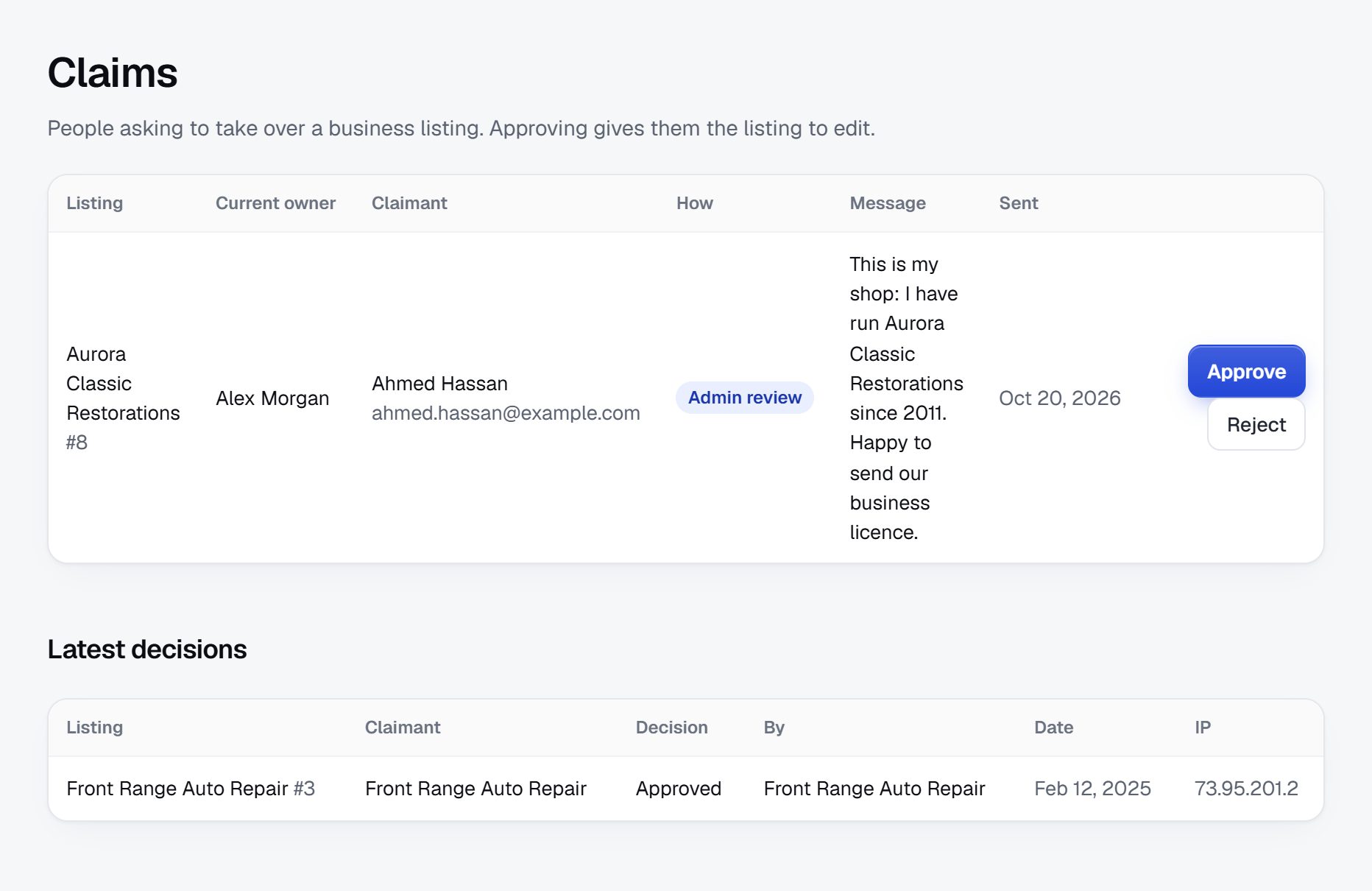
- Copied listings. Someone claiming a page that is not theirs. Approve every claim and check it against the business website or phone number.
Wording
Use "women-owned" or "woman-owned" consistently, and "founded by women" only where that is the claim. State plainly that your definition includes all women, and decide how you list businesses with nonbinary owners rather than leaving it to chance. Avoid cute or diminutive words for businesses; describe them by what they do.
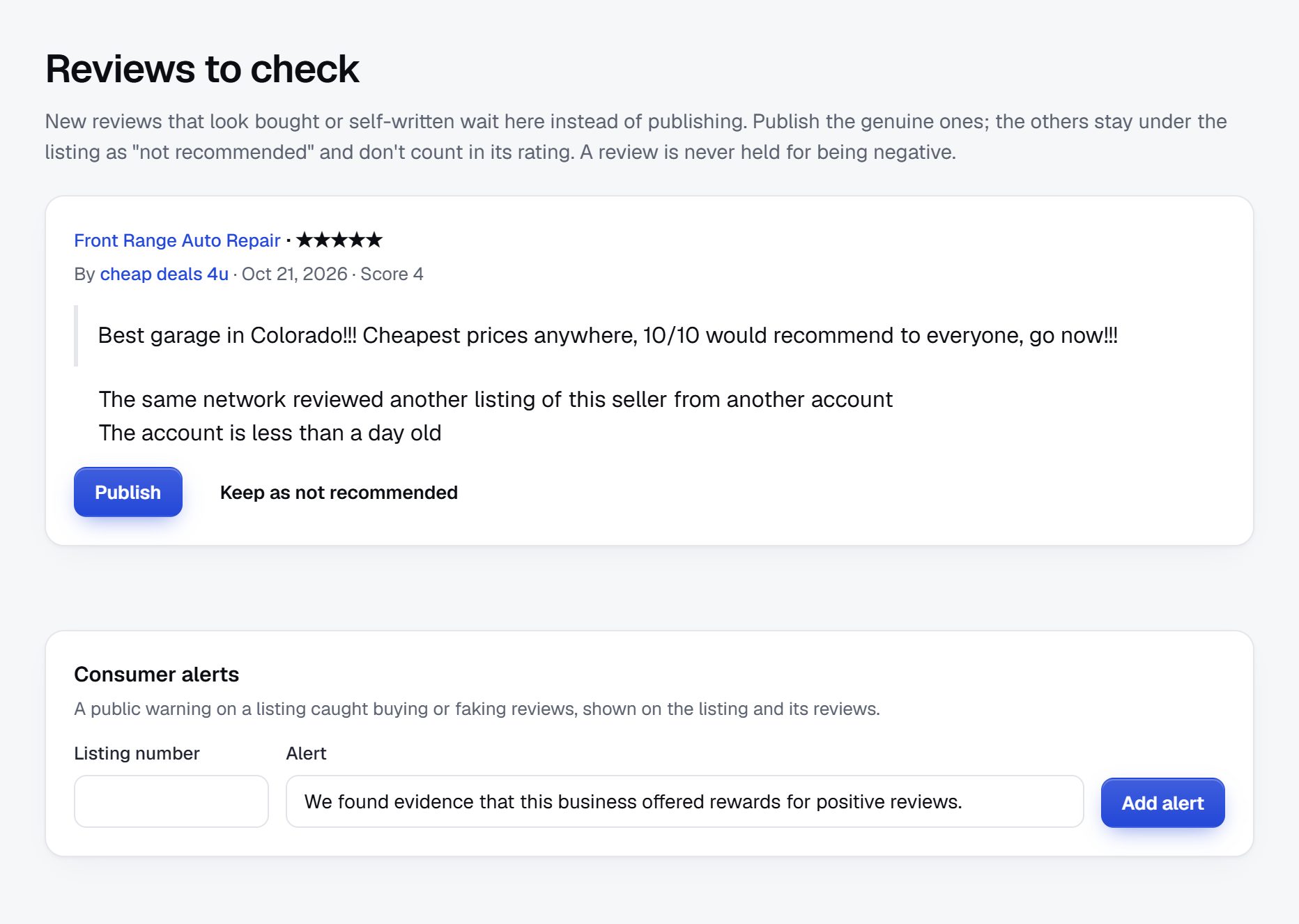
In Yclas, verified seller badges, profiles and reviews with owner replies help you show which businesses you have checked. Certification and contracting rules differ by country, so check the rules where you operate.
Target buyer searches, not just shopper searches.
Shopper searches have volume; buyer searches have value. Plan for both. Examples:
- "women-owned businesses near me"
- "women-owned construction companies in Texas"
- "certified women-owned suppliers"
- "female-owned bakery Denver"
- "women-owned clothing brands"
- "woman-owned marketing agency"
Pages to build
- Trade and state pages for suppliers. "Women-owned electrical contractors in Ohio" is a page a procurement officer will bookmark.
- City pages for shoppers. Women-owned restaurants, boutiques and salons per city and neighborhood.
- A buyer's guide. How certification works, what to ask a supplier, and how to find firms by trade. Buyers search for this and come back.
- Gift guides. Mother's Day, the holidays and small business shopping days, updated each year on the same page.
Write in both forms people use, "women-owned" and "female-owned", across titles and guides. Founder interviews, a series on women in the trades, and yearly lists of new businesses give you fresh content and owners share them with their own customers.
Launch with one network as a partner and one date as a deadline.
The fastest launch borrows an audience. Find one women's business network or chamber in your area, list its members first, and launch together.
Dates worth planning around
- March. Women's History Month and International Women's Day on March 8 bring press interest and searches.
- Spring. Mother's Day gift guides send shoppers to makers and boutiques.
- November. Women's Entrepreneurship Day falls in November in many countries, and holiday shopping follows.
- Budget season. Corporate and public buyers plan supplier lists for the coming year, often in the fall.
Partners
Women's networks, small business support centers, coworking spaces with many founders, local journalists who cover small business, and one or two larger companies that need women-owned suppliers.
Checklist
- Publish your definition and the confirmation levels.
- Choose one area and a mix of trade and shopping categories.
- Agree a launch partner and list its members.
- Reach 100 businesses, with at least 20 in trades or professional services.
- Send claim invitations to every owner.
- Write a buyer's guide and two city guides.
- Launch a few weeks before March 8.
A worked example: a women-owned supplier directory in Oregon's Willamette Valley.
Imagine a fictional directory called Cedar and Mill Founders Index, listing women-owned businesses across the Willamette Valley in Oregon, from Portland's southern suburbs down through Salem, Corvallis and Eugene. Its lead audience is business buyers: general contractors who need women-owned subcontractors on public projects, purchasing staff at hospitals and universities, and event planners. Shoppers are welcome, but the structure is built around the questions a buyer asks. The valley mixes growing cities with farm towns, so service area by county matters more than a street address.
Categories
- Build and maintain
- Construction trades
- Landscaping and site work
- Run the business
- Accounting, payroll and HR
- Marketing and design
- Events and hospitality
- Catering and venues
- Photography and video
- Makers and shops
Every supplier page has a certification dropdown with a fixed list of bodies, the certificate expiry date, the counties served and crew or team size. Makers and shops get a simpler set: product type, whether they ship and where to buy in person.
Who it serves
A contractor bidding on a school renovation who must show subcontracting with certified women-owned firms, a university buyer looking for a local print shop, a wedding planner building a vendor list, and founders who want to hire each other, a bakery owner who needs a bookkeeper who understands food businesses, for example.
How it started
The founder owned a small electrical contracting firm and was asked several times a month by general contractors whether she knew another certified woman-owned firm in a different trade. She kept a private spreadsheet, then turned it into a public directory with help from a regional women's construction network, which shared its member list after each member agreed. The first version had only 60 firms, all in trades, and buyers used it anyway because nothing else answered their question. Professional services and makers came later, once the trades pages had proved useful.
How it makes money
Quote requests carry the site: a contractor describes a job and sends it to several firms at once, and firms that win work take a yearly membership with a featured place in their trade. A community bank with a small business program sponsors the buyer guide, and a coworking space buys a banner on the founder pages. Listing and certification display stay free, and no fee moves a firm into or out of the certified filter.
| Listing | Category and area | Key details |
|---|---|---|
| Commercial painting contractor | Construction trades, Salem | Crew of 12, certified women-owned, certifier and expiry date shown |
| Excavation and site preparation firm | Landscaping and site work, Lane County | Own equipment, prevailing wage experience, quote requests on |
| Payroll and HR consultancy | Run the business, remote across Oregon | Serves firms of 5 to 100 staff, owner statement |
| Event photography studio | Events and hospitality, Corvallis | Weddings and conferences, travels statewide, portfolio linked |
| Stoneware tableware studio | Makers and shops, Eugene | Ships nationally, wholesale to restaurants, studio open Saturdays |
The first 90 days, built around one network and one buyer.
The quickest route for a women-owned directory is to borrow trust twice: from a network that already gathers women founders, and from at least one buyer who will actually use the list. Sign the network up in the first month, and find the buyer before you launch, so the first owners see a real reason to complete their pages.
Your date to aim for depends on whom you serve first. A shopper-led directory should be live before Women's History Month in March, or ahead of Mother's Day if that fits your calendar better. A supplier-led one should be ready before buyers plan their supplier lists, often in late summer or fall. Pick one and count 12 weeks back. If you serve both, launch the shopper pages first and open supplier pages once enough certified firms have joined.
Confirmation takes longer than people expect. Certifications have expiry dates and certificate numbers to check, and owners who rely on their own statement still deserve a short call. Budget the middle month for that work, and do not let the listing count race ahead of what you have checked. Note each check in a simple log with the date, the source and who did it, so a buyer who asks how a firm was confirmed gets a straight answer.
| Weeks | Focus | Done when |
|---|---|---|
| 1-2 | Publish your definition, confirmation levels and a policy on nonbinary owners | The policy page is live and two founders have read it and found nothing unclear |
| 3-4 | Set the categories, the certification dropdown and expiry field, and supplier fields such as counties served | A procurement contact has looked at a sample page and confirmed it answers her questions |
| 5-6 | Agree a partnership with one women's business network and list its consenting members | 50 members are listed with their consent recorded |
| 7-8 | Check certificates against the certifiers' public lists and call founders who gave an owner statement | Every listing shows a confirmation level you can back up |
| 9-10 | Recruit trades and professional services firms and switch on quote requests | 100 businesses are listed, at least 20 of them in trades or professional services |
| 11-12 | Write a buyer's guide, send claim invitations and launch with the partner before your chosen date | The first quote request has reached a listed firm |
Ways to build a women-owned business directory, and what buyers need from it.
A directory aimed only at shoppers can get by with categories, hours and a map. Once buyers are in the picture, it needs more: certification fields with a fixed list of bodies and an expiry date, filters for service area and capacity, quote requests that reach several firms at once, owner claims so founders update their own capability details, and a verified badge that only you can award.
Building with developers fits an organization running a formal supplier program, for example one that wants buyers to log in, save shortlists and export supplier data for their reports. That is a real software project with real upkeep, and buyers will expect it to keep working year after year.
A directory script or WordPress plugin on your own server suits a women's network that already runs a WordPress member site. The catch is that plugin directories often handle certification fields and expiry dates poorly, and every plugin you add is another thing to update.
A hosted builder such as Yclas fits a founder or a small network that wants supplier fields, quote requests, claims and featured places without running servers, leaving time to check certificates, recruit firms and meet the buyers who will use the pages.
Whatever you choose, test it with a real buyer before launch. Ask her to find three certified firms in one trade and one county; if it takes her more than a couple of minutes, fix the fields before you fix anything else. Then ask a founder to claim and update her own page without help, which tests the other side.
| Route | Fits when | Watch out for |
|---|---|---|
| Custom build with developers | A formal supplier program needs buyer accounts, shortlists and exports | Cost and upkeep, and buyers relying on features you must keep running |
| WordPress directory plugin on a server you run | A network already runs a WordPress member site | Weak support for certification and expiry fields, and plugin updates |
| Hosted builder | A founder or small network serves one region | Plan your certification dropdown and expiry field before importing anyone |
| Member list inside a networking group | Only existing members need to find each other | Buyers and shoppers outside the group never see it |
What a women-owned business directory costs to run.
The software is the smallest part of the bill. Most of the cost is your time in the first months: finding the first listings, answering questions and checking what gets posted.
Expect to spend on event tables, a few printed materials for network meetings, and possibly a sponsorship of a local founders event. If you check certifications yourself, it costs time rather than fees, since most bodies publish their certified lists.
| Cost | Typical range | On Yclas |
|---|---|---|
| Domain | $10 to $20 a year | Your own, with SSL included |
| Software and hosting | $0 to $100+ a month, plus plugins and updates | Starter $19 a month, Professional $99 |
| Design | $0 to $100 for a theme, or a designer | 109 looks included |
| Payment fees | About 3% per payment | Your Stripe or PayPal fees; Yclas takes nothing |
| Business data | Free if you collect it, or a few cents per page of Google results | Paid to Google, with your key |
| Your time | 5 to 10 hours a week at the start | Finding listings, moderation, support |
Mistakes that make buyers and founders lose faith in the list.
- Showing expired certifications. A buyer who relies on your page and finds the certificate lapsed last year will not use the directory again. Store the expiry date, hide the certified label automatically when it passes, and email the owner a month before. Renewals can take weeks, so an early reminder keeps good firms from dropping off the buyer pages.
- Ignoring front companies in the trades. In construction and public supply, a firm can be placed in a woman's name while someone else runs it. For those categories, ask for certification or talk to the owner about who signs contracts and manages the crews.
- Filling the site with boutiques only. Gift shops and salons bring friendly traffic, but buyers who need an electrician or an HR firm leave after one search. Recruit trades and professional services early, even if it is slower, through trade associations and the buyers who already know them.
- Charging founders before leads arrive. Women founders are approached constantly by paid directories and award schemes that deliver nothing. Keep listing free, show the first quote requests, and only then offer memberships, with a plain account of what members received last quarter.
- Treating other networks as competitors. Women's chambers, professional associations and business centers all hold part of your list. Offer them group pages and credit, and they will send members instead of ignoring you.
- Requiring a founder photo or personal story. Some owners welcome a profile story; many do not want their face or family on a supplier page. Make founder stories optional and keep the listing about what the business delivers.
- Leaving the definition vague. Without a written rule on ownership share, control, and how you treat nonbinary owners or businesses co-owned with a spouse, every edge case becomes an argument. Decide once and apply it the same way to all.
- Importing public certification lists wholesale. Those lists exist so buyers can check firms, not so others can republish them. Use them to find businesses and confirm certificates, then invite each owner to join.
- Hiding quote requests behind a sign-up wall. A buyer in a hurry will not create an account just to ask three firms for a price. Let buyers send a request with a name and work email, and screen for spam behind the scenes. Reply to every buyer within a day in the first months, because one quick, useful answer is what turns a curious buyer into a regular one.
- Writing only for one search term. People type "women-owned", "woman-owned" and "female-owned", and buyers add "certified" or a trade. Use all of them across titles and guides, while keeping one term on the listings themselves.
Terms a women-owned directory founder should know.
Buyers, certifiers and founders will use these words, often without explaining them.
| Term | What it means |
|---|---|
| WBE | Women's Business Enterprise, a common name for a business certified as at least 51 percent owned and controlled by women. |
| WBENC | The Women's Business Enterprise National Council, a US nonprofit that certifies women-owned businesses for corporate buyers. |
| WOSB | Women-Owned Small Business, a US Small Business Administration program for certain federal contracts. |
| EDWOSB | Economically Disadvantaged Women-Owned Small Business, a narrower SBA category with added financial limits. |
| Supplier diversity | A buying program in which a company or agency sets out to include women-owned and other underrepresented suppliers. |
| Set-aside | A public contract, or part of one, reserved for businesses in a specific group. |
| Prime contractor | The firm that holds the main contract with the client and often hires subcontractors. |
| Subcontractor | A firm hired by the prime contractor to do part of the work, such as electrical or painting. |
| Capability statement | A one or two page summary of what a supplier does, its certifications and past clients, sent to buyers. |
| NAICS code | A North American industry code that buyers use to search for suppliers by type of work. |
| RFP and RFQ | A request for proposal or request for quotation, the documents buyers send when asking suppliers to bid. |
| Front company | A business placed in a qualifying owner's name while someone else really controls it. |
| Women's business center | A local advice center for women founders, many of them partly funded by the SBA in the US. |
The same steps for a women-owned business directory on Yclas.
- Describe your directoryThe setup wizard writes the categories, an About page and example listings from one sentence.
- Add fieldsHours, services, areas served, prices: the details people search by, as filters.
- Fill itImport businesses from a spreadsheet or Google Places, then check them.
- Bring owners inOwners claim their page, update it and answer reviews.
- EarnSwitch on featured places, banners or memberships when visits arrive.
What should I budget for the first year?
Keep it small: a domain, the site, materials for a few networking events and your time. The biggest investment is the weeks spent signing up and confirming the first businesses.
How do I confirm a business is women-owned?
Accept the owner's statement as a starting level, and give a verified badge to businesses with an outside certification or that you have checked. Show which level applies on every listing.
Can I limit the directory to women-owned businesses legally?
Many directories do this, but equal treatment and advertising rules vary, especially for paid services. Check the rules where you operate and apply your published definition to everyone the same way.
How do I find the first businesses?
Through women's business networks, support centers, public certification lists and makers' markets. Ask each owner before you list her business, then invite her to claim the page.
What makes money in a directory like this?
Quote requests from business buyers are the strongest, followed by featured places, memberships and sponsor banners. Keep the basic listing free.
How do I stop front companies from getting listed?
For trades and supplier categories, require certification or speak to the owner about who runs the business. Act on reports and remove the label when the facts change.
Should I say female-owned or women-owned?
Use one term consistently on listings, but include both in titles and guides, because people search with both.
How should I treat businesses co-owned by a woman and a man?
Apply your published definition: if you follow the common certification rule, women must hold at least 51 percent and control the business. You can still list equal partnerships under a separate label such as "co-founded by a woman" if your audience wants them, as long as the wording is clear. Never show the women-owned label on a business that does not meet your own published rule.
Do buyers really search a directory like this?
Buyers with supplier diversity goals often struggle to find certified firms in a given trade and county, so a directory that answers that quickly gets used. Meet two or three of them before launch and build the pages around their questions. Ask which trades are hardest to fill, and recruit those first.
Should I include nonbinary founders?
Many women-owned directories now say how they treat nonbinary owners, and some welcome them explicitly. Decide your rule, publish it, and note that formal certification bodies may apply their own definitions. Whatever you decide, apply it the same way to every applicant.
How do I check whether a certificate is still valid?
Most certifiers offer a public search by business name or certificate number. Check it when you add the business, store the expiry date, and recheck before you renew any verified badge. If a certifier has no public search, ask the owner for a copy of the certificate and note the date you saw it.
Can I list women-owned businesses from outside my region?
For makers who ship nationally, yes, in a separate online shopping section. Keep trades and local services within the region you can confirm, because buyers need firms that can actually reach their sites. You can add a neighboring region later, once a partner there helps you confirm owners.
Related pages.
The parts of Yclas this leans on.
You have the plan. Now list the founders in your area.
Describe your site in a sentence and the setup wizard writes the categories, example listings and a look. Free for 15 days, no credit card.
Start my directory