How to build a church directory that newcomers can rely on.
This guide covers how to build a church directory for one town, region or tradition: who looks for a church and when, how to organize churches by denomination, language and service times, where the first few hundred congregations come from, how to keep listings accurate and neutral, and how to time your launch around Easter and Christmas.
Free for 15 days · No credit card · Plans from $19 a month
Start with the moments when people look for a church.
People search for a church at a few clear moments: they have just moved to town, they are visiting for a weekend, they want a Mass in Spanish, a congregation with a strong children's program, or simply one of their own denomination within a short drive. Map results give them a pin and office hours that say "closed" on a Tuesday. Denominational finders only list their own congregations, and plenty of church websites still show the service times from two pastors ago.
A good church directory answers the questions a visitor has before walking through the door: what time is the main service, in which language, what style of worship, is there parking and a nursery, and what happens on a first visit.
Pick your angle
- One city or county, every denomination. The widest audience and the easiest story for the local paper.
- One tradition across a region: Orthodox parishes in the Midwest, Reformed congregations in one state, Latin Mass communities across the country.
- One audience: churches with services in Korean, Portuguese or American Sign Language, or campus ministries near a university.
Decide early whether you list only Christian churches or every place of worship. Both work, but say which on the About page so nobody reads a missing listing as a judgment.
Today this information is scattered across diocesan and presbytery websites, ministerial association lists, the faith page of the local paper, and Facebook groups where newcomers ask for "a friendly church with a good youth group".
Service times are the reason people come. Keep them right and the rest follows.
Organize by tradition, then let people filter on what matters on Sunday.
Keep categories to broad traditions that a visitor recognizes, one level deep, and put everything else in fields. A newcomer rarely knows the difference between two Presbyterian bodies, but they do know they want a traditional liturgy at 9 am with a nursery.
- Service times deserve their own fields, not a line buried in the description. Ask for the main weekend service, any second service and the midweek gathering, each with a day and time.
- Language should be a checkbox list, because many churches hold services in two or three languages.
- Worship style works as a short dropdown: traditional, contemporary, blended, liturgical.
- Practical details such as wheelchair access, hearing loop, parking, nursery and live stream are checkboxes that families and older visitors filter on.
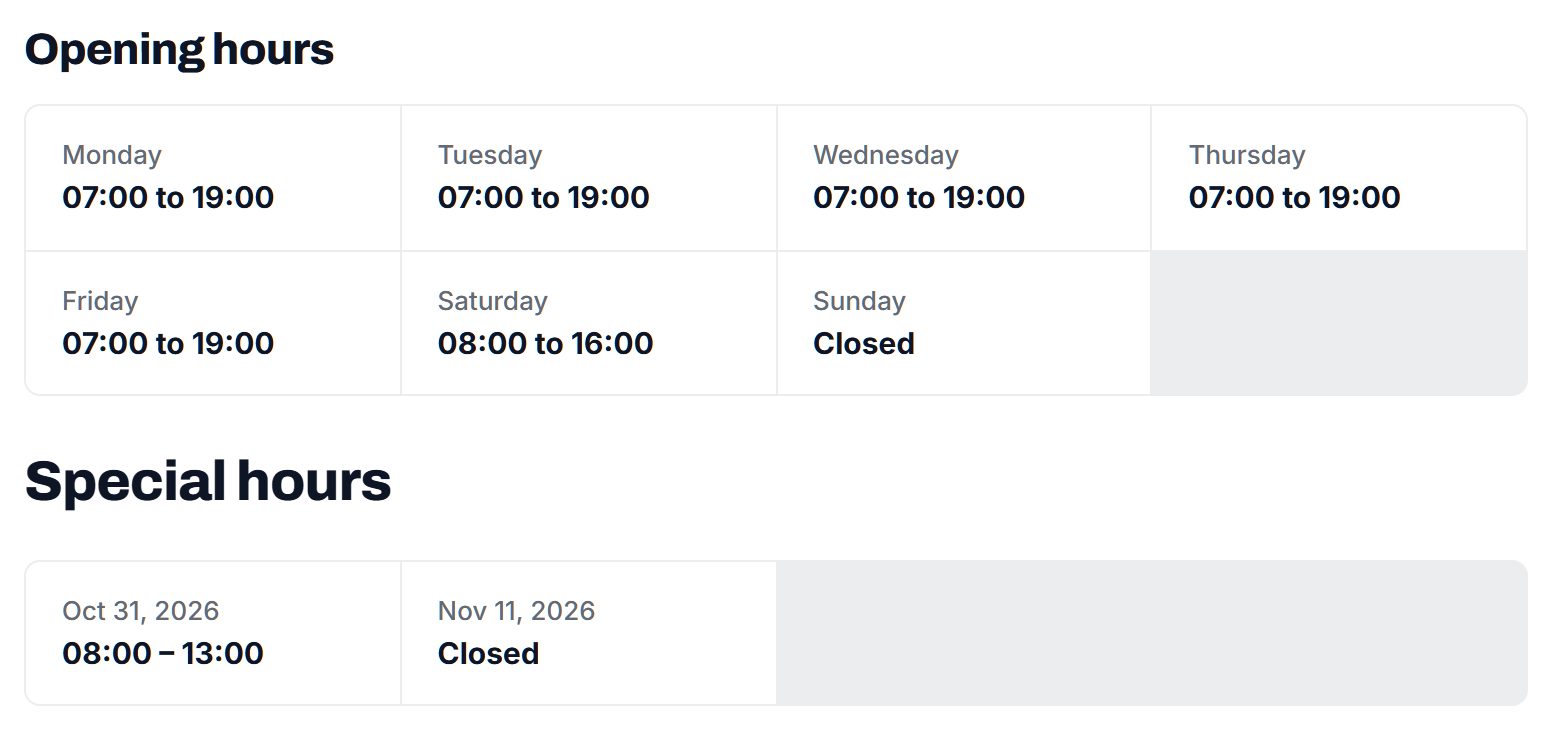
Opening hours on a church page usually mean office hours. Label them that way so nobody turns up to a locked door expecting a service. Leave out anything that reads as a doctrinal rating: describe, never rank.
| Category | Example listings | Details people filter on |
|---|---|---|
| Catholic | Parishes, missions, chapels with daily Mass | Mass times, language, confession times, Latin Mass |
| Baptist and nondenominational | Bible churches, community churches, church plants | Service times, worship style, kids' ministry, small groups |
| Mainline Protestant | Methodist, Lutheran, Presbyterian, Episcopal | Denomination, liturgical or contemporary, choir, accessibility |
| Orthodox | Greek, Antiochian, Russian, Coptic parishes | Jurisdiction, liturgy language, Divine Liturgy time |
| Pentecostal and charismatic | Assemblies of God, Church of God, independent | Language, midweek service, live stream |
| Ministries and programs | Food pantries, recovery groups, youth nights | Day of the week, age group, open to non-members |
In Yclas, fields can be text, numbers, dropdowns, checkboxes or dates, each one required or optional and shown as a search filter.
Earn from the people who serve churches, not from the churches themselves.
Most congregations run on tight budgets, and many are run by volunteers. If the basic listing costs money, the directory stays half empty and stops being useful. Keep the standard church page free for good and look for income elsewhere.
- Featured places make sense for church plants and congregations that have just moved, which want to be seen by newcomers while they build a following.
- Banner spaces suit the businesses that want a churchgoing audience: Christian schools, bookstores, wedding venues, funeral homes, counseling practices and summer camps.
- Memberships fit networks and dioceses that want to keep dozens of pages up to date and highlight their events.
- Seasonal sponsors for an Easter or Christmas Eve service guide can carry a whole quarter of costs.
Be careful with anything that looks like paying for a better place in results. A visitor who senses that the top church paid for the spot stops trusting the list. Mark every paid placement clearly as featured.
| Model | Works when | Switch it on |
|---|---|---|
| Free church pages | Always, it is what makes the directory complete | From day one |
| Featured places | Church plants and relocated congregations want newcomers | Once local searches bring steady visits |
| Banner spaces | Schools, camps and wedding venues want a faith audience | When you can show monthly visitors |
| Memberships for networks | A diocese or network manages many pages | After two or three networks have claimed pages |
| Sponsored seasonal guides | Easter and Christmas service searches peak | Six to eight weeks before each season |
Seed every congregation before you ask anyone to visit.
A church directory with gaps looks unfinished, and a pastor whose church is missing will say so loudly. Aim to list every congregation in your area before launch, even if each page starts with only the basics.
Where the first few hundred churches come from
- Denominational finders. Diocesan parish lists, presbytery and conference directories and association websites give names, addresses and often service times. Use them to check your data, and write your own descriptions.
- Google Places import. A search for churches across your county brings in name, address, phone, website and opening hours. No photos come across, and the hours are usually office hours, so add service times separately.
- Ministerial associations and chambers of commerce. Many keep a member spreadsheet you can turn into a CSV import with their permission.
- Your own visits. A Sunday drive with a camera gives you exterior photos taken from the street.
Then get churches to claim their pages. Call or write to the church office, not a pastor's personal number, and offer a short checklist: confirm service times, add a photo of the sanctuary, describe what a first visit is like. Church secretaries and office administrators are the people who keep pages current, so make the claim process easy for them.
Ten fully claimed churches persuade the next fifty more than any email does.
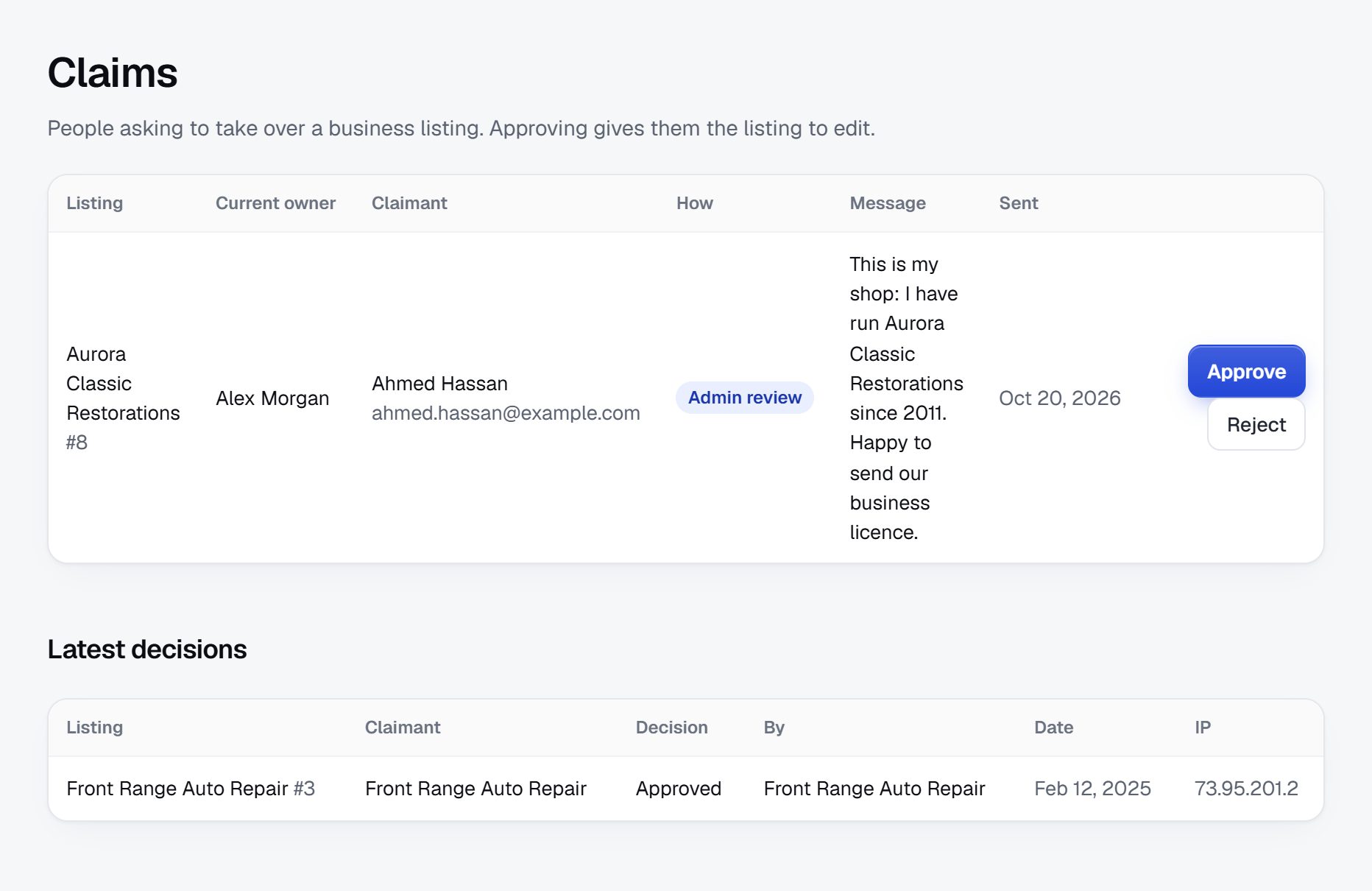
Protect congregations from impersonation and keep the directory neutral.
Churches face a specific kind of fraud: someone poses as the pastor by email or text and asks members to buy gift cards or send money urgently. A directory that publishes pastors' personal emails and phone numbers makes this easier. Show the church office contact and leave personal details off the page unless the church insists.
Rules worth setting from the start
- Verify every claim. Before handing over a page, call the phone number the church already publishes and confirm the person works there.
- Handle splits calmly. When a congregation divides, two groups may claim the same name. List both under distinct names and addresses, and do not take sides.
- Mark closures quickly. Merged and closed churches are common. A visitor who drives to an empty building will not trust you again.
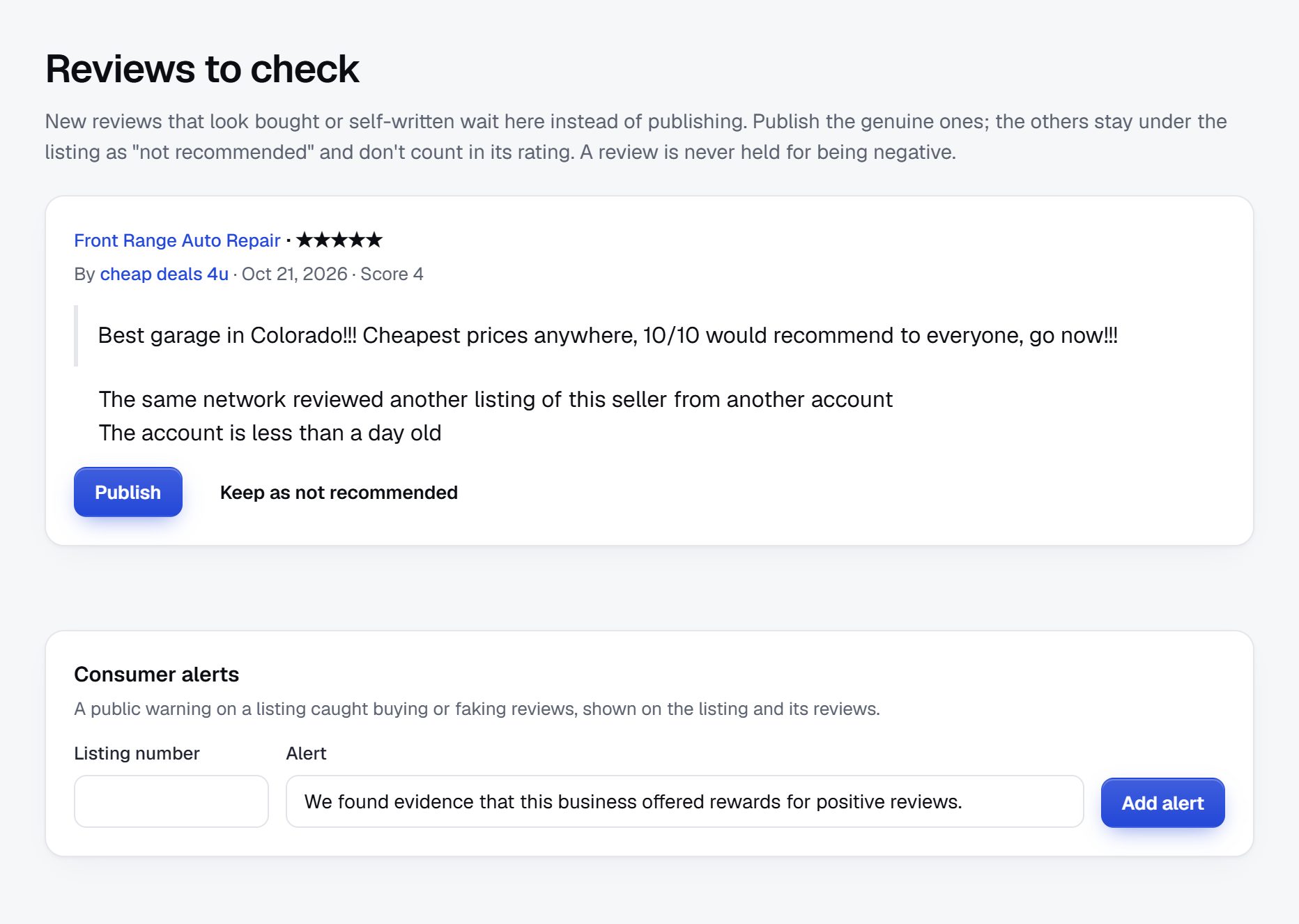
- Decide on reviews. Star ratings of churches can turn into doctrinal arguments. Many directory owners prefer written visitor notes with owner replies, moderated before they go live.
- Keep children safe. Do not publish names or photos of children or the contact details of volunteers who run youth programs. Encourage churches to mention that they have a safeguarding policy.
For photos of people, privacy and anything touching charitable status or political content, check the rules where you operate.
Build pages for the exact searches a visitor makes.
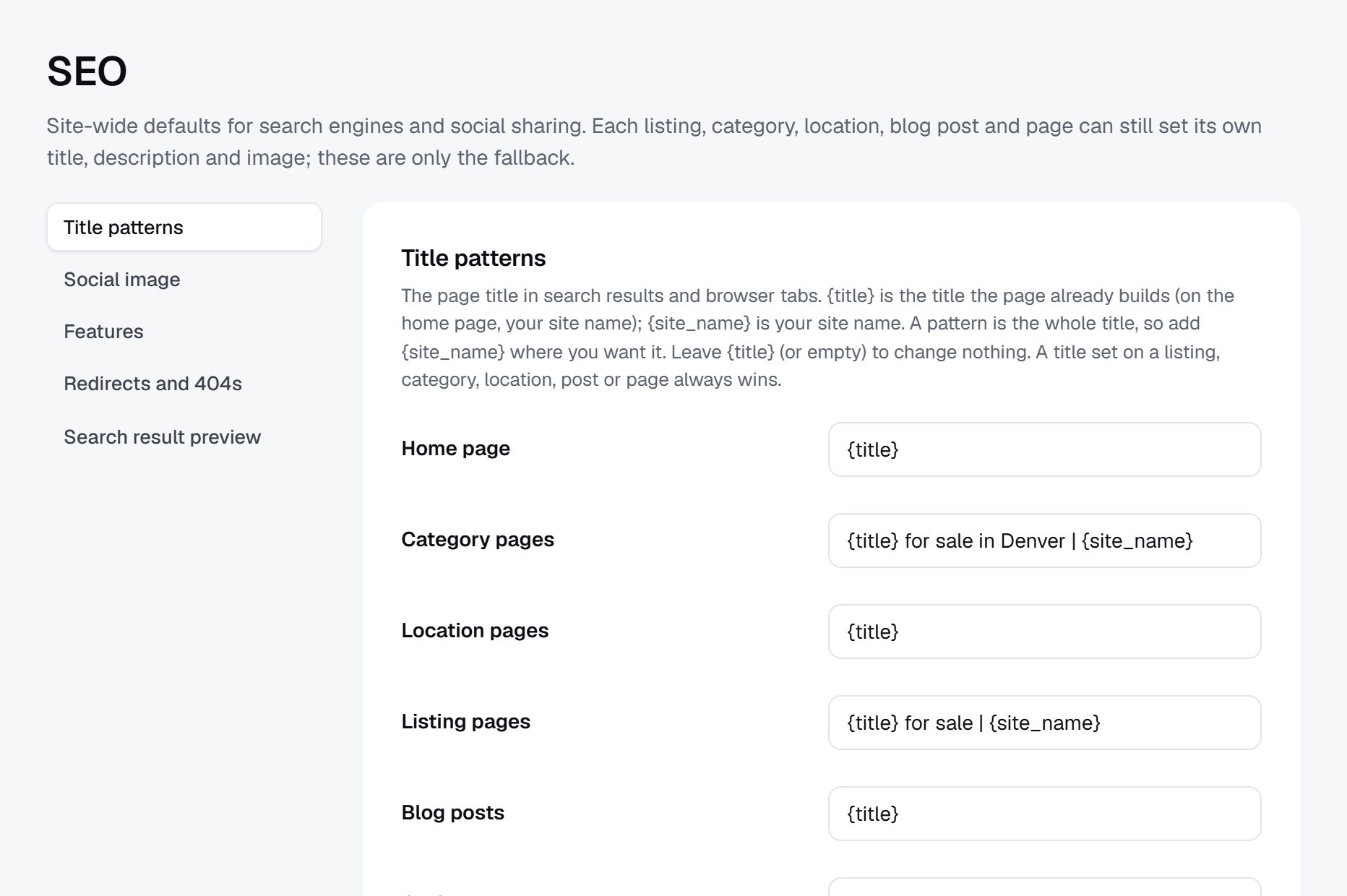
Church searches are local and specific, and they spike around a few dates. Typical examples: "catholic church near me mass times", "Christmas Eve services in Raleigh", "Spanish speaking church Houston", "Easter sunrise service Tulsa", "Greek Orthodox church Chicago", "church with nursery near me", "Ash Wednesday service times".
Pages to build
- Tradition plus city: Catholic churches in Dayton, Baptist churches in Dayton. These pages match how people type.
- Language pages: Spanish, Korean, Vietnamese or ASL services in your area.
- Seasonal pages for Christmas Eve, Easter, Holy Week and Ash Wednesday, updated every year with the times churches send you.
- Neighborhood pages for larger cities, where people pick a church within walking distance.
Content worth writing
- What to expect at your first Mass, Divine Liturgy or Pentecostal service.
- A plain guide to the denominations in your area and how they differ.
- How to choose a church after moving, written for families, students and retirees.
Write each church description yourself or with the church. Copying text from their website gives you a weaker page than the original.
Launch before Advent or Lent, with the ministerial association on your side.
Christmas and Easter are when the most people look for a church they do not yet attend. Plan to be complete and indexed at least six weeks before either season, so the seasonal pages have time to appear in search.
First area and partners
- Start with one county. Finish it properly before you add the next one.
- Ministerial associations meet monthly in many towns. Ask for ten minutes to show the directory and collect claims in the room.
- Relocation contacts. Real estate agents, relocation services, university orientation teams and hospital chaplains all get asked where to find a church.
- Local media. A community paper will often run a short piece on a new guide to local churches, especially before Christmas.
Launch checklist
- Every congregation in the county listed, with address and phone.
- Service times confirmed for at least half of them.
- Tradition and language pages built.
- About page explaining who is included and that listings are free.
- Claim process tested with two friendly church offices.
- Christmas Eve or Easter page ready with the times collected so far.
After launch, send a short reminder to church offices each August and January asking them to update fall and Lent schedules.
A worked example: Ridge and Valley Church Guide, the Roanoke Valley of Virginia.
To see how the parts connect, take an invented site: Ridge and Valley Church Guide, covering Roanoke, Salem, Vinton and the edges of Botetourt and Roanoke counties in Virginia. Nothing about it is real, but every decision in it is one a founder in this niche will face.
How the categories are arranged
- Catholic
- Parishes and missions
- Mass in Spanish
- Baptist and nondenominational
- Church plants
- Cowboy and biker churches
- Mainline Protestant
- Orthodox
- Ministries open to everyone
- Food pantries
- Recovery meetings held in church halls
Who uses it
The founder expected newcomers, and they did come: nurses starting at the regional hospital, families relocated by employers, students at the colleges in Salem. The surprise was grandparents. Visitors in town for a long weekend wanted a service near their children's homes, often with a hearing loop or large-print hymnals, and they searched late on Saturday night. A third group was people returning to church after years away, who read the first-visit notes closely and rarely phoned ahead.
How it got going
The founder, a retired church secretary, knew that most congregations in the valley had a phone number and a signboard but no current website. She imported every church in the two counties from map data, deleted the duplicates and the buildings that had been sold, then spent six Sundays driving a loop of about twenty churches each, photographing the signboards that listed service times. Those photos became her first set of facts, each one confirmed later by a call to the church office. The local ministerial association let her speak at its October meeting, and fourteen churches claimed their pages before the meeting ended.
How it makes money
Church pages are free and will stay free. The site earns from a Christmas Eve service guide sponsored by a funeral home and a Christian school, from banner spaces held by two wedding venues and a summer camp, and from featured places bought by three church plants that meet in school gyms and need to be found. A regional network of congregations pays a yearly membership so its office can keep a dozen pages current and highlight its events. Altogether it covers hosting, postage and the founder's gas money, which is all she set out to earn in year one.
Notice what is missing: no church pays to be listed, and nobody ranks one church above another.
| Church | Main services | Key details |
|---|---|---|
| Grace Hollow Baptist Church, Vinton | Sunday 10:30 am, contemporary | Nursery, Wednesday family supper, large parking lot |
| St. Brendan Catholic Mission, Salem | Saturday 5 pm vigil; Sunday 9 am, and 12:30 pm in Spanish | Confession Saturday 3:30 pm, wheelchair ramp at the side door |
| Holy Theophany Orthodox Church, Roanoke | Divine Liturgy Sunday 9:30 am | English and Greek, Vespers Saturday 6 pm, coffee hour after |
| Mill Creek Community Church, meets in an elementary school | Sunday 10 am, blended | New church plant, kids' program, live stream |
| Trinity Lutheran Church, southwest Roanoke | Sunday 8:15 am traditional, 10:45 am contemporary | Hearing loop, large-print bulletins, adult choir |
All five churches are fictional and invented for this example.
The first 90 days of a church directory.
A church directory has a natural rhythm. Sunday is when you can see churches in action, weekdays are when church offices answer the phone, and the calendar of Advent, Lent and the start of the school year decides when people search. Plan the first twelve weeks around those facts rather than around features.
Treat service times as perishable. Summer schedules, a new pastor or two parishes sharing one priest can change them overnight, so every confirmed time on the site should carry the month it was checked. Keep a simple log of each call: which church, who answered, what changed and when to check again. That log quickly becomes the most valuable file you own.
Leave money for the final weeks. A seasonal sponsor needs a finished Christmas Eve or Easter page to point to, and a church plant needs to see visitors before it pays for a featured place. Twelve weeks is enough for one county done properly, which is a far stronger base than three counties half done. Weeks with a holiday in them lose half their calls, so plan around Thanksgiving and the new year rather than through them.
| Weeks | Focus | Done when |
|---|---|---|
| 1-2 | Pick the county and the scope (Christian only or every faith); import churches; remove duplicates and sold buildings | One page per active congregation, and the scope stated on the About page |
| 3-4 | Collect weekend times from signboards, bulletins and denominational finders | Service times recorded for two churches in three |
| 5-6 | Call church offices to claim pages; add first-visit notes and sanctuary photos | 25 churches claimed, with times confirmed by the office |
| 7-8 | Build tradition, language and neighborhood pages; write the what-to-expect guides | Every tradition and language page shows at least three churches |
| 9-10 | Present at the ministerial association; contact relocation agents, hospital chaplains and campus ministries | The link shared by at least five partners |
| 11-12 | Build the next seasonal page; approach sponsors and church plants | Seasonal page live with times from 30 churches and one sponsor agreed |
Ways to build a church directory, and which one fits.
A church directory is modest in features and heavy in data. It needs structured service times that visitors can filter, checkbox fields for languages and accessibility, pages that church offices can claim, moderated visitor notes, and seasonal pages that come back every year. It does not need to take money from churches at all, which removes much of the complexity other directories carry.
Building it with developers
Custom code makes sense if you want something no directory tool offers, such as a live view of every Mass in a diocese starting in the next two hours. That is a real feature, but it is a large build, and you will pay to maintain it each time parishes change how they publish schedules. Founders who start here often spend the whole budget on code and have nothing left for the phone calls that make the directory correct.
Installing a script or plugin on your own server
A WordPress directory plugin or a standalone directory script gives you listings, categories and claims on hosting you control. It suits a founder who already looks after a parish or diocesan website. Expect evenings spent on updates, spam registrations and backups.
Using a hosted builder
A hosted builder such as Yclas runs the software for you, so your hours go into calling church offices. Whatever you choose, check that service times can be their own fields, that languages can be checkboxes shown as filters, and that church offices can claim their pages. For a volunteer-run project, having no server to look after is often the deciding point.
| Route | Fits when | Watch out for |
|---|---|---|
| Custom development | You need a feature no directory tool has, such as live Mass times across a diocese | A long build, a bill for every change, nobody to call when it breaks |
| Script or WordPress plugin on your server | You already run church websites and enjoy the technical side | Plugin conflicts, spam accounts, security updates and backups |
| Hosted builder | You want your time on data and church offices | Check service-time fields, language filters and claiming before you commit |
| Shared spreadsheet | You are testing interest with one ministerial association | No search or filters, and times go stale without anyone noticing |
What a church directory costs to run.
The software is the smallest part of the bill. Most of the cost is your time in the first months: finding the first listings, answering questions and checking what gets posted.
Seeding with Google Places runs on your own Google key, so the import has a usage cost that depends on how many churches you pull in. Budget for printed letters or postcards to church offices that do not answer email, and for an afternoon or two of driving to photograph buildings.
| Cost | Typical range | On Yclas |
|---|---|---|
| Domain | $10 to $20 a year | Your own, with SSL included |
| Software and hosting | $0 to $100+ a month, plus plugins and updates | Starter $19 a month, Professional $99 |
| Design | $0 to $100 for a theme, or a designer | 109 looks included |
| Payment fees | About 3% per payment | Your Stripe or PayPal fees; Yclas takes nothing |
| Business data | Free if you collect it, or a few cents per page of Google results | Paid to Google, with your key |
| Your time | 5 to 10 hours a week at the start | Finding listings, moderation, support |
Mistakes that sink church directories.
- Treating office hours as service times. Map data brings in the hours the church office is open, usually on weekdays. Shown without a label, they tell a visitor the church is closed on Sunday morning. Label imported hours as office hours from day one and keep services in their own fields.
- Ranking churches. A list of the ten best churches in town, or a star average on each page, turns a guide into a verdict on someone's faith, and pastors will ask to be removed. Describe worship style, size and programs, and let visitors decide. Size, the age range of the congregation and whether there is a youth group are facts; best is only an opinion.
- Taking sides in a split. When a congregation divides over doctrine or property, both groups may want the old name and the old page. List each under the name it now uses at its current address, keep both descriptions factual, and decline to referee.
- Leaving closed churches up. Mergers, closures and building sales happen every year, and a family that drives to a locked building on Easter morning will not come back. Recheck any church without a recent confirmation each quarter and mark closures the week you hear of them.
- Publishing pastors' personal contacts. Scams that use a pastor's name to ask members for gift cards rely on easy access to names and numbers. Show the church office phone and a general email, and nothing personal.
- Starting seasonal pages too late. A Christmas Eve page built in mid-December rarely shows in search in time. Begin collecting holiday times in October for Advent and in January for Lent, and publish partial pages early. Sunrise services and Holy Week schedules often differ from normal times, so ask for them separately.
- Missing congregations that worship in other languages. Churches meeting in Korean, Haitian Creole or Portuguese often rent space from another church on Sunday afternoons and are absent from map data. Ask host churches who else uses their building. These congregations are often the most grateful to be listed, and they share the page widely.
- Settling for a generic welcome. Nearly every church says all are welcome, which tells a visitor nothing. Ask each office what happens on a first visit: where to park, which door to use, how long the service runs, and whether children stay in the service.
- Relying on one denomination's goodwill. If your first partner is a single diocese or network, the site can look like its outreach arm, and other churches hold back. Bring in two or three traditions before launch and say on the About page that the guide is independent.
Church directory glossary.
Church offices use these words and visitors search with them, so get them right on every page.
| Term | What it means |
|---|---|
| Denomination | A family of churches that share beliefs and governance, such as Methodist or Lutheran. |
| Nondenominational | A church that belongs to no denomination and governs itself. |
| Parish | A local Catholic, Orthodox or Anglican congregation, often tied to a defined area. |
| Diocese | A regional group of parishes under a bishop, which often keeps its own parish finder. |
| Mass | The main Catholic worship service, held on weekends and often on weekdays. |
| Vigil Mass | A Saturday evening Mass that counts for Sunday in the Catholic tradition. |
| Divine Liturgy | The main Sunday service in Orthodox and Eastern Catholic churches. |
| Liturgical worship | A service that follows set prayers and readings, as in Catholic, Orthodox, Anglican and Lutheran churches. |
| Contemporary worship | A service led by a band with modern songs rather than an organ and hymns. |
| Blended service | A service that mixes traditional hymns with contemporary songs. |
| Church plant | A new congregation started by an existing church or network, often meeting in a school or theater. |
| Ministerial association | A local group of clergy from different churches that meets regularly. |
| Parish administrator | The staff member who runs the church office and usually keeps schedules current. |
| Safeguarding policy | A church's written rules for protecting children and vulnerable adults. |
The same steps for a church directory on Yclas.
- Describe your directoryThe setup wizard writes the categories, an About page and example listings from one sentence.
- Add fieldsHours, services, areas served, prices: the details people search by, as filters.
- Fill itImport businesses from a spreadsheet or Google Places, then check them.
- Bring owners inOwners claim their page, update it and answer reviews.
- EarnSwitch on featured places, banners or memberships when visits arrive.
What does it cost to get a church directory going?
Beyond the site itself, the main costs are your own time to collect service times, any Google Places usage on your key, and some postage for church offices that prefer letters. Many founders run the first county from a laptop and a car.
Should I list every faith or only churches?
Either works if you are clear about it. A churches-only directory is simpler to organize; an all-faiths directory reaches more people but needs categories that respect each tradition's own terms.
Can I copy service times from church websites?
Facts such as times and addresses can usually be collected, but write descriptions in your own words and ask churches to confirm. For anything about copyright or data use, check the rules where you operate.
How do I get pastors to claim their pages?
Contact the church office rather than the pastor, show them the page already built, and ask for three things only: service times, a photo and a short welcome. Presenting at a ministerial association meeting often brings in a dozen claims at once.
How can a church directory make money if churches cannot pay much?
Keep church pages free and earn from featured places for new congregations, banners for schools, camps and wedding venues, network memberships and sponsored seasonal guides.
Should I allow reviews of churches?
Only with moderation. Visitor notes about what a first Sunday felt like are useful, but star ratings can become doctrinal arguments, so approve each one and let churches reply.
Why would anyone use this instead of a map search?
A map shows where a building is. Your directory shows what time the service starts, in which language, with what style of worship and whether there is a nursery, which is what a newcomer needs to decide.
How often should I recheck service times?
Ask every church to confirm twice a year, in late summer and after the new year, and recheck any church you have not heard from in six months. Show the month of the last confirmation on each page so visitors can judge for themselves.
Should I include house churches that meet in homes?
Only when the group asks to be listed and gives a public meeting point. A home address shown as a church location raises privacy and safety concerns, so offer an on-site message or a general area instead of the street.
What do I do when a church asks to be removed?
Remove anything the church supplied, such as photos and descriptions, right away. Whether you may keep basic public facts like the name and address is something to check with the rules where you operate; many founders simply take the page down to keep goodwill.
Is it worth listing live streams and online services?
Yes. Housebound members, people traveling and visitors deciding whether to attend all watch first. A checkbox for live stream plus the platform the church uses answers a question that comes up every week.
Can I add church events like concerts, fish fries and vacation Bible school?
Yes, as dated listings in an events or ministries category, removed once the date passes. Seasonal events bring in people who later come back to look for a Sunday service.
Related pages.
The parts of Yclas this leans on.
You have the plan. Now build the church directory your town has been missing.
Describe your site in a sentence and the setup wizard writes the categories, example listings and a look. Free for 15 days, no credit card.
Start my directory