How to build a jewelry marketplace for makers and vintage dealers.
This guide covers how to build a marketplace for handmade and vintage jewelry: choosing between makers, estate pieces or one style, the metal, stone and size fields shoppers filter on, commission and seller memberships, finding the first makers and dealers, honest descriptions of metals and stones, returns and fraud, and timing your launch around gift seasons.
Free for 15 days · No credit card · Plans from $19 a month
Give makers and vintage dealers a place where they are not buried.
Jewelry is one of the most crowded categories on the big handmade and resale sites. A silversmith who spends two days on a ring competes in the same search results with mass-produced pieces shipped from a warehouse, and a dealer with a genuine Art Deco brooch sits next to reproductions sold as "vintage style". Both sides want a smaller place where buyers come for exactly what they make or collect.
Buyers want something they will not see on everyone else: a piece by a named maker, a stone they chose, an engagement ring that is not from a chain store, or a piece from a period they love. They also want to trust that "solid gold" means solid gold.
Pick your angle
- Handmade only, with every seller making their own pieces, perhaps limited to one country or region.
- Vintage and estate: Victorian, Edwardian, Art Deco, mid-century and costume jewelry from signed designers.
- One material or style: sterling silver, beadwork, Indigenous-made pieces sold by the makers themselves, alternative engagement rings, or men's jewelry.
- Local makers from one city's studios and craft scene, with pickup and studio visits.
Today this trade runs through craft fairs, artisan markets, antique malls, estate sales, Instagram shops and the large handmade and auction sites.
A buyer who trusts your descriptions comes back for the next gift.
Let shoppers filter by metal, stone and size, not by guesswork.
Keep categories to the type of piece, one level deep. The details that decide a purchase are the materials and the fit, and they belong in fields so shoppers can filter on them.
- Metal as a dropdown with precise terms: sterling silver, solid 14k gold, solid 18k gold, gold-filled, gold vermeil, gold-plated, platinum, brass, stainless steel. Precise choices stop sellers from writing "gold" for a plated piece.
- Stone and stone origin: natural, lab-grown, simulant or unknown. This one field prevents many disputes.
- Ring size as a dropdown, with a checkbox for "can be resized". Chain length and bracelet length as numbers.
- Era for vintage pieces, and maker's marks or hallmarks as a text field.
- Made to order as a checkbox, with the making time as a number of days.
Ask for photos in daylight, a photo on a hand or neck for scale, a close view of any stamp or hallmark, and the measurements written in the listing.
| Category | Example listings | Fields buyers filter on |
|---|---|---|
| Rings | Engagement rings, stacking bands, signet rings | Ring size, metal, stone, stone origin, resizable |
| Necklaces and pendants | Chains, lockets, birthstone pendants | Chain length, metal, clasp type, stone |
| Earrings | Studs, hoops, drops, ear climbers | Metal, post material, pierced or clip-on |
| Bracelets | Cuffs, bangles, charm bracelets | Bracelet length or inner size, metal, adjustable |
| Vintage and estate | Art Deco rings, signed costume brooches, Victorian lockets | Era, maker's marks, condition, metal tested |
| Men's jewelry | Cufflinks, chains, rings, tie bars | Metal, size, finish |
Yclas custom fields can be dropdowns, checkboxes, numbers, text or dates, each one required or optional, and each one shown as a search filter.
Charge a fair commission and let serious sellers pay for more.
Makers price their work around materials and hours, so every point of commission comes out of their pay. Vintage dealers work on wider margins but higher stakes per piece. A single commission per sale that sits below what the big handmade sites cost after all their fees is the easiest pitch you can make.
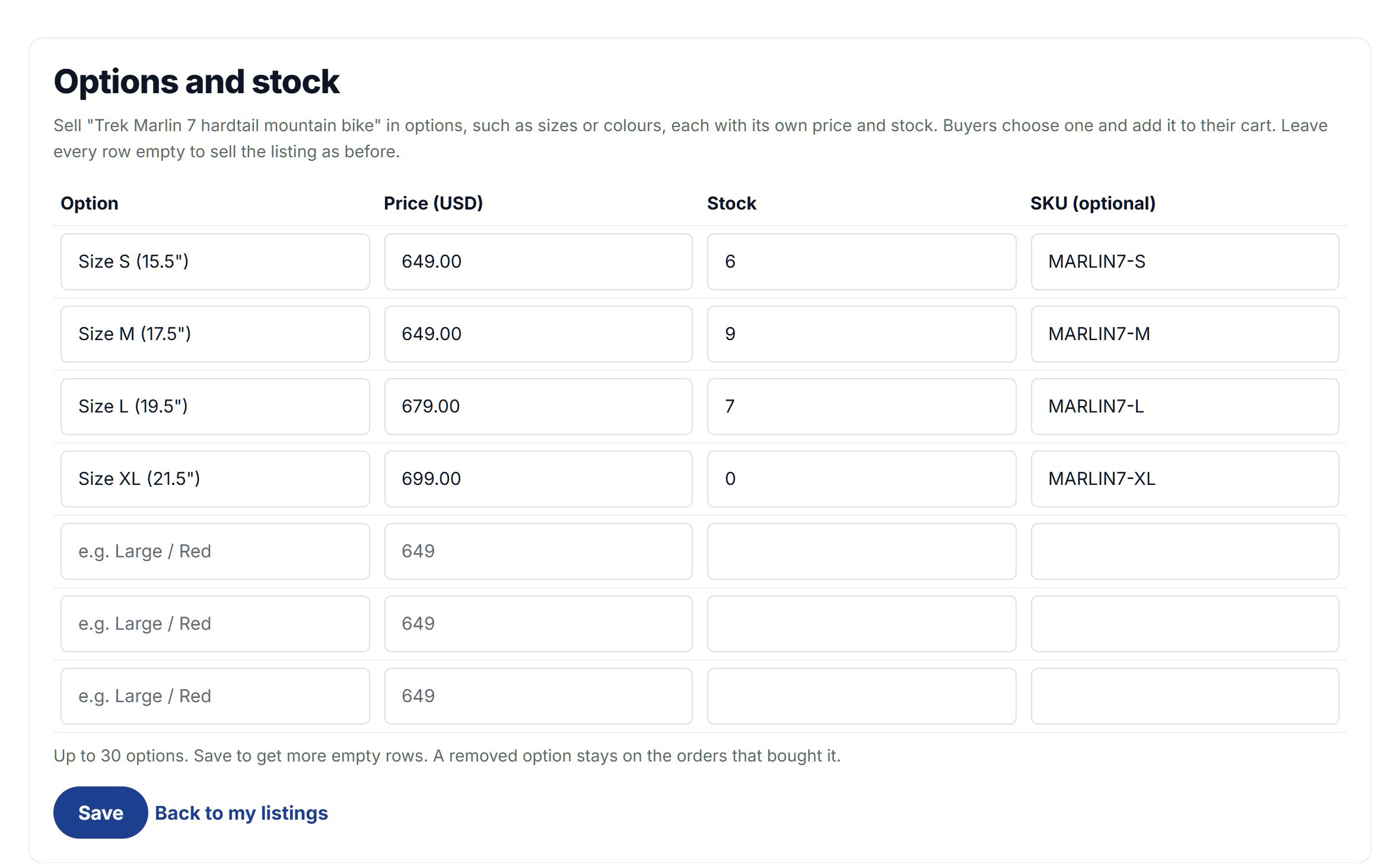
Buyers pay on the site with Stripe, can fill one cart with pieces from several makers, and each seller sets their own shipping, which matters because many jewelers ship small parcels with tracking and some insure higher-value pieces with their carrier.
- Featured listings suit makers launching a new collection and dealers with a standout estate piece.
- Seller memberships fit studios and dealers with large inventories, for example a lower commission in exchange for a monthly fee.
- Banner spaces suit bench jewelers who resize and repair, gem suppliers, jewelry schools and wedding businesses.
- A small buyer service fee can work later, once buyers come to you specifically for what they cannot find elsewhere.
Do not charge listing fees at the start. Makers list dozens of pieces, and fees per listing make them list only a few.
| Model | Works when | Switch it on |
|---|---|---|
| Commission per sale | Pieces sell regularly | From day one, below the big handmade sites |
| Featured listings | New collections and estate finds compete for attention | When categories run past one page |
| Seller memberships | Studios and dealers list in volume | Once a handful of sellers list every week |
| Banner spaces | Repairers, gem suppliers and schools want buyers | After traffic is steady |
| Buyer service fee | Buyers come for unique stock | Later, and kept small |
Recruit makers at fairs and dealers at estate sales.
A jewelry marketplace needs variety before buyers arrive: enough rings in common sizes, enough necklaces in different metals and prices, and a few pieces that make people stop scrolling. Plan for thirty or more active sellers before you invite buyers.
- Craft fairs and artisan markets. Walk the jewelry tables, collect cards and follow up with a short message offering to list their first pieces for them.
- Metalsmithing guilds, bead societies and jewelry classes. Teachers and advanced students often have more finished work than places to sell it.
- Antique malls and estate sale companies. Dealers there usually have jewelry they never put online because photographing and describing small items takes time.
- Makers on Instagram who sell through direct messages and struggle with taking payment and keeping track of orders.
- Gem and mineral shows, where cutters and setters sell loose stones and finished pieces.
Makers who keep stock in a spreadsheet can import it from a CSV file. For dealers, the AI listing from a photo helps: they take a picture, AI fills in a title, description, category and price, and they correct what it gets wrong, which matters with metals and stones.
Offer to list the first ten pieces for every new seller.
Be strict about how metals and stones are described.
Most jewelry disputes come from descriptions, not fraud: plated sold as solid, lab-grown stones sold as natural, "vintage" pieces made last year. Write description rules before the first listing goes live, and enforce them.
- Require the exact metal from the dropdown, and ban vague terms like "gold tone" passed off as gold.
- Require stone origin. If a seller does not know, "unknown" is an honest answer.
- Ask vintage dealers to say whether a metal was tested, and how.
- Approve new sellers' listings by hand, and use reports so buyers can flag a doubtful piece.
In the United States, the FTC publishes guides on how metals and gemstones should be described, and other countries have their own rules, including hallmarking requirements for precious metals in some places and limits on nickel in jewelry worn against the skin in the European Union. Check the rules where you operate and where your sellers ship. Materials like ivory, some corals and tortoiseshell are restricted in many countries; ban them unless you are sure of the law.
Returns and payment fraud
Set a clear returns policy: many sellers do not accept returns on pierced earrings or made-to-order and engraved pieces, which is fine if it is stated before purchase. Watch for buyers who order several high-value pieces at once on a new account, which can be stolen card use, and ask sellers to ship valuable orders with signature on delivery. The marketplace does not appraise or certify jewelry; say so in your terms.
Write for gift searches and for collectors who know the terms.
Jewelry searches split into two kinds. Gift buyers search by occasion and price, and collectors search by era, maker and material. Every listing, category and location has its own page, so you can serve both.
- "handmade sterling silver rings"
- "art deco engagement ring"
- "lab grown vs natural diamond"
- "vintage signed costume jewelry"
- "birthstone necklace for mom"
- "what does gold filled mean"
Set title patterns that put the metal and stone up front, for example "14k gold sapphire ring, size 6". That wording matches searches and also forces honest descriptions.
Pages worth writing
- A metals guide explaining solid gold, gold-filled, vermeil and plating, and how each wears.
- A ring size guide with a printable sizer and advice on resizing.
- Era guides for vintage buyers: how to recognize Victorian, Art Deco and mid-century pieces.
- Gift guides by occasion and budget, published a few weeks before each gift season.
- Maker profiles with photos of the studio, which also give sellers something to share.
Birthstone pages, one for each month, bring steady searches all year.

Time your launch to the gift calendar.
Jewelry sales follow gift seasons: the run-up to the winter holidays, Valentine's Day, Mother's Day, graduation, and the spring and summer wedding season. Launch at least six weeks before one of them, so sellers have time to list and search engines time to find the pages.
First community
Start with one group you can reach in person: the makers at one regional craft fair, one city's studio scene, or a circle of estate dealers. A tight first group of sellers recommends you to the next.
Partners
- Craft fair and artisan market organizers, who can mention you to every vendor.
- Bench jewelers who resize and repair, as a service you recommend for vintage rings.
- Jewelry schools and guilds, for makers and for buyers.
- Wedding planners and bridal shops, for alternative engagement rings and bridal party gifts.
Checklist
- Write the description rules for metals, stones and eras.
- Set up the metal, stone origin, size and era fields.
- Publish the returns policy, including pierced earrings and custom work.
- Sign up thirty or more sellers with a good spread of prices.
- Run test orders with a resize request and a return.
- Publish a gift guide for the next season and send it to every seller to share.
A worked example: Granite Coast Makers Market in Maine and New Hampshire.
Granite Coast Makers Market is a made-up marketplace, described here to show how this guide works in practice. It sells jewelry from makers along the coast of Maine and New Hampshire, a region with many small studios, a busy summer craft fair circuit and visitors who want to take home something made there. Most of its makers had sold only in person or through direct messages before.
How it started
The founder sold silver earrings at summer fairs for six seasons and noticed that customers kept asking the same question every October: where can I find your work now? She recruited makers she knew from three fair circuits, a metalsmithing guild and a bead society, listed their first pieces for them at a borrowed studio with a daylight lamp, and opened with forty-two makers and a little over nine hundred pieces, six weeks before the winter holidays. A small vintage section came later, run by two estate dealers she met at an antique mall. Her rule from the first day was that every piece is made by the person selling it, or is honestly old and described by a dealer who says how they know.
Categories
- Rings
- Stacking and everyday
- Engagement and wedding bands
- Earrings
- Necklaces and pendants
- Bracelets and cuffs
- Sea glass and beach stone
- Vintage and estate
- Signed costume
- Fine jewelry, metal tested
Who it serves
Buyers are summer visitors who met a maker at a fair and want another piece in winter, locals shopping for birthdays and holidays, couples looking for handmade wedding bands, and collectors of sea glass jewelry. Sellers are silversmiths, goldsmiths, bead artists and the two dealers, who fill in era, maker's marks and how each metal was tested.
How it makes money
Every sale goes through checkout with Stripe, and the site keeps a commission per sale set below what the makers had been paying on the large handmade sites once all fees were added up. Makers set their own shipping, mostly small tracked parcels, with signature on delivery for anything in solid gold. After a year it added a studio membership with a lower commission for makers who list every week, featured spots for new collections each spring, and banner spaces for a bench jeweler who resizes rings and a wedding venue on the coast. Listing stays free, which is the reason most of its makers keep their whole catalog on the site rather than a handful of bestsellers.
| Listing | Price | Key details |
|---|---|---|
| Hammered sterling stacking ring | $48 | Sterling silver, made to order in 5 days, sizes 4 to 10, can be resized |
| Sea glass drop earrings | $65 | Sterling ear wires, natural sea glass, pierced only, no returns |
| Solid 14k gold wedding band, 4 mm | $520 | Sizes 5 to 10, engraving available, ships with signature |
| Sapphire ring, about 1925 | $1,150 | 18k white gold tested by the dealer, stone origin unknown, size 6 |
| Beach stone pendant | $85 | Sterling bezel setting, 18 in chain, gift box included |
Your first 90 days, built around a gift season.
Jewelry buying peaks before gift seasons, so set your public opening six to eight weeks ahead of the next one and plan backward. The first weeks are about getting the description rules right, because most jewelry disputes begin with a word like "gold" used loosely. The middle of the plan is recruiting at fairs, guilds and estate sales, and listing pieces for makers who will not get around to it themselves. The final weeks go to test orders with a resize request, a gift guide, and a launch that every maker shares with their own followers.
Track two numbers as you go: how many sellers are active, and how many pieces sit in each price band. A site full of forty-dollar earrings with no rings over a few hundred dollars will lose the engagement shopper, and the reverse loses the gift buyer. Recruit for the gaps you see, not for the makers who are easiest to reach.
Keep a short weekly list of makers you met, makers who said yes, and makers whose first pieces are live. The gap between the second and third list is where most jewelry marketplaces stall, because makers mean to photograph their work and never find the afternoon. Closing that gap yourself, with a lamp and a phone at their studio, is the best use of your time in the first two months.
| Weeks | Focus | Done when |
|---|---|---|
| 1-2 | Description rules and fields | Metal, stone origin, ring size and era fields are live, and the rules on plated and lab-grown wording are published |
| 3-4 | First makers | Ten makers have agreed to join, recruited at fairs, guilds or classes you visited |
| 5-6 | Listing help | You have listed the first ten pieces for each new maker, with daylight photos and measurements |
| 7-8 | Vintage and estate | Two or more dealers have listed pieces with era, maker's marks and metal tested filled in |
| 9-10 | Test orders and policies | Test orders including a resize and a return are done, and the returns policy covers earrings and custom work |
| 11 | Soft opening | Makers' friends and past customers have placed real orders, and every issue they hit is fixed |
| 12 | Gift season launch | A gift guide is published, thirty or more sellers are active, and every maker has shared the launch |
Three ways to build a jewelry marketplace.
A jewelry marketplace lives on photos and precise wording. It needs large, sharp images that hold up when a buyer zooms in on a stamp, required dropdowns for metal and stone origin, ring size filters, a cart that holds pieces from several makers, and shipping set by each maker. It also needs a way to hold a new seller's first listings so you can check the wording before buyers see it, and seller profiles where a maker's story and reviews sit next to their work.
A custom build with developers makes sense if your plan depends on something unusual, such as a ring builder where buyers pick a setting and then a stone, or a link to a gem lab's report database. Both take months and need upkeep after launch.
A self-hosted script or WordPress plugin keeps costs low at first, and many shop plugins handle one seller well. Multi-seller jewelry stores are harder: commission splits, vendor shipping and moderation often come from separate add-ons, and you look after hosting, security and spam sign-ups yourself. Image-heavy jewelry pages also need fast hosting, or shoppers leave before the photos load.
A hosted builder such as Yclas covers checkout with commission, a multi-seller cart, custom fields for metals and stones, and listing approval, so you spend your weekends at fairs instead of on servers. In exchange you work within the features it offers. Whichever route you pick, test it with one real maker's catalog, stamps, stones and all, before you commit.
| Route | Fits when | Watch out for |
|---|---|---|
| Developers | You need a ring builder, gem lab lookups or a design tool | Months of work, upkeep, and image pages that must stay fast |
| Script or plugin, self-hosted | You already run a small shop and want control | Multi-seller add-ons that conflict, security patches and fake accounts |
| Selling on the big handmade sites only | You are testing whether makers will follow you at all | You own no customer list, and makers stay buried in the same crowded results |
| Hosted builder | Your time is better spent recruiting makers and dealers | Check that the fields and approval tools match your description rules |
What a jewelry marketplace costs to run.
The software is the smallest part of the bill. Most of the cost is your time in the first months: finding the first listings, answering questions and checking what gets posted.
Expect to spend on a daylight photo setup or lightbox to lend at fairs, tables at craft fairs where you recruit makers, and possibly an advisor familiar with jewelry description rules in your country.
| Cost | Typical range | On Yclas |
|---|---|---|
| Domain | $10 to $20 a year | Your own, with SSL included |
| Software and hosting | $0 to $100+ a month, plus plugins and updates | Marketplace $149 a month for checkout and commission |
| Design | $0 to $100 for a theme, or a designer | 109 looks included |
| Payment fees | About 3% per payment | Your Stripe or PayPal fees; Yclas takes nothing |
| Your time | 5 to 10 hours a week at the start | Finding listings, moderation, support |
Mistakes that tarnish jewelry marketplaces.
- Allowing "gold" as a loose word. A buyer who pays for gold and receives plated brass will not trust any other listing on the site. Make metal a required dropdown with exact terms, and edit titles that blur them before they go live. The same goes for "silver" on nickel-heavy alloys.
- Mixing in mass-produced pieces. Once a handmade site fills with drop-shipped jewelry, makers see their old problem again and leave. Ask new makers for studio or work-in-progress photos, and remove resellers posing as makers. A few honest product photos with a warehouse background are often the giveaway.
- Calling every old-looking piece vintage. Reproductions listed next to real estate jewelry damage both the buyer's trust and the honest dealer's sales. Give vintage its own section, require an era, and ask dealers how they dated each piece, whether by hallmarks, construction or a signed maker's mark.
- Photos without scale. Jewelry looks larger in a close-up, and "smaller than I expected" is one of the most common return reasons. Require a photo on a hand, ear or neck, and measurements in the listing. For earrings, the drop length and weight matter just as much, since heavy earrings are a common complaint.
- No ring size plan. Rings sold in one size with no resizing information lead to returns. Add a resizable checkbox, publish a ring size guide, and partner with a bench jeweler who can resize for buyers at a known price.
- Launching after the gift season. Opening in January means your first months are the quietest of the year, and early makers lose interest. Plan the opening for six weeks or more before the holidays, Valentine's Day or Mother's Day, so search engines have found your gift pages by the time shoppers start looking.
- Ignoring restricted materials. Ivory, some corals, tortoiseshell and certain feathers are restricted in many places, and one listing can cause trouble with payment providers. Ban them unless you are certain of the law where you and your sellers operate, and add their names to your banned words list.
- Listing fees that shrink catalogs. Makers have dozens of small pieces, and a fee per item makes them list only their bestsellers. Charge commission on sales and let catalogs grow, since variety is what keeps gift buyers browsing.
- Faceless seller profiles. People buying handmade jewelry want to know who made it, and a blank profile looks like a warehouse. Ask every maker for a studio photo and a short story, and show reviews on their profile. A maker with a face and a few kind reviews sells far more than one with a logo.
Jewelry terms every founder should know.
Makers, dealers and informed buyers use these terms, and so should your listings.
| Term | What it means |
|---|---|
| Sterling silver | An alloy of 92.5 percent silver, often stamped 925. |
| Karat (k) | The share of pure gold in an alloy, from 24k for pure gold down to 10k or 9k. |
| Gold-filled | A thick layer of gold bonded to a base metal, far thicker than plating. |
| Vermeil | Gold plating over sterling silver, with thickness rules that vary by country. |
| Hallmark | Official marks stamped on precious metal to show its content, required in some countries. |
| Maker's mark | A stamp that identifies the jeweler or workshop that made the piece. |
| Lab-grown | A stone made in a laboratory with the same chemistry as the natural stone. |
| Simulant | A material that looks like a gemstone but is chemically different, such as cubic zirconia. |
| Bezel setting | A rim of metal that surrounds and holds a stone. |
| Prong setting | Small metal claws that hold a stone, which can wear and loosen over the years. |
| Costume jewelry | Pieces made from non-precious materials, some of them signed and collectible. |
| Estate jewelry | Previously owned jewelry of any age, often sold after a death or a move. |
| Acid test | A common way to check gold content by applying acids to a scratch of metal. |
| Made to order | A piece made after the purchase, with a stated making time. |
The same steps for a jewelry marketplace on Yclas.
- Describe your marketplaceThe setup wizard writes the categories, an About page and example listings from one sentence.
- Add fieldsThe details buyers filter on, as dropdowns, numbers or checkboxes.
- Bring sellersInvite them, import their stock from a spreadsheet, or post for them.
- Set the rulesChoose moderation, verified sellers, reviews and reports.
- Take paymentsOn Marketplace, buyers pay on the site and you keep a commission, with Stripe.
What does it cost to get a jewelry marketplace started?
The biggest costs are your time and recruiting: fair tables, a photo kit, and a few ads before a gift season. You hold no stock, so there is no inventory to buy.
Do I need to check that the gold and stones are real?
You do not test pieces yourself and should not claim to. Make sellers describe metals and stones precisely, act on buyer reports, and remove sellers whose pieces are misdescribed.
Are there laws about how jewelry is described?
Yes, in many places. The US has FTC guides on metals and gemstones, and some countries require hallmarks or limit nickel. Check the rules where you operate and get advice if you are unsure.
Should I mix handmade and vintage?
You can, but label them clearly with a field or category, and never let reproductions be listed as vintage. Many sites start with one and add the other later.
How do I get makers to leave the big handmade sites?
Do not ask them to leave. Ask them to list here too, with a lower commission, fewer competing listings and help setting up their first pieces.
What about returns on earrings and custom pieces?
Let sellers refuse returns on pierced earrings, engraved and made-to-order pieces, as long as the listing says so before purchase. Everything else needs a clear return window.
Can I sell high-value pieces like diamond rings?
Yes, but ask sellers to ship them with signature on delivery and carrier insurance where available, and watch new accounts placing large orders. The marketplace itself does not insure parcels.
Should I allow custom orders and commissions?
Yes, through on-site messages and a made-to-order listing with a clear making time. Ask makers to agree the details in writing before they start, and to state that custom pieces cannot be returned. A deposit through a separate fixed-price listing can work for expensive commissions, if the maker explains it.
How do I stop makers from taking sales off the site?
You cannot stop it entirely, so make staying worthwhile: a fair commission, checkout that handles payment, reviews that build a maker's profile and featured spots for active sellers. If your rules forbid contact details in listings, enforce that consistently.
Do I need special shipping rules for jewelry?
Each maker sets their own shipping, but publish a minimum standard: tracked delivery on everything and signature on delivery above a value you choose. Some carriers limit cover for jewelry, so sellers should read their carrier's terms.
Can I sell loose gemstones and beads too?
A supplies category can bring makers to the site as buyers, which keeps them coming back. Use the same stone origin field and keep supplies apart from finished pieces, so gift shoppers do not land on bags of beads.
How should I handle engagement rings?
They are high-value and emotional, so ask for full details: metal, stone origin, carat weight, any lab report and ring size. Suggest buyers get an independent appraisal at their own cost, and state plainly that your site does not value or grade stones.
Related pages.
The parts of Yclas this leans on.
You have the plan. Now give your makers and dealers a jewelry marketplace of their own.
Describe your site in a sentence and the setup wizard writes the categories, example listings and a look. Free for 15 days, no credit card.
Start my marketplace