How to build a camera rental marketplace where photographers rent the lens they need for one shoot.
This guide covers a marketplace where photographers, filmmakers and small rental houses rent out cameras, lenses, lighting and audio gear: choosing a city and a kind of shooter, the specs renters filter on, daily and weekly prices with deposits, commission, the first owners, the rental fraud this niche is known for, the searches to rank for, and a launch around wedding and festival season.
Free for 15 days · No credit card · Plans from $19 a month
Connect gear-heavy photographers with shooters who need one more lens.
Camera gear is expensive, changes fast and spends most of its life in a bag. A wedding photographer owns a second body that only comes out in June. A filmmaker bought a cinema lens set for one feature. A hobbyist owns a 600mm wildlife lens used two weekends a year. On the other side, working shooters need a specific lens for one job, a backup body for a wedding, or a gimbal for a music video, and buying is not worth it.
The two sides
- Owners: working photographers and videographers, small production companies, hobbyists with high-end kit, camera stores, and small independent rental houses.
- Renters: wedding and event shooters, student filmmakers, YouTubers and content creators, travelers wanting a better lens for a trip, and people trying a lens before buying it.
Pick the angle
- One city with a creative scene. Most camera rentals are picked up in person, and cities with film schools, production work and busy wedding calendars have both sides.
- Stills or video. Cinema cameras, lens sets and lighting attract production crews with bigger budgets; stills lenses and bodies attract wedding and wildlife shooters.
- Mount or system. A site known for one mount system can build depth faster than one trying to cover everything.
Today renters use mail-order rental houses, local camera stores with a rental shelf, production Facebook groups, and friends. National peer-to-peer sites exist, but in many cities the local listings are thin. A local site with pickup across town fills the gap for last-minute jobs.
The renter's question is always the same: can I have this lens by Saturday morning. Answer it on the listing.
List gear by mount, format and what is in the case.
Camera renters are precise. A lens is useless if it does not fit the body, and a cinema camera is useless without the right media and batteries. Keep categories shallow: camera bodies, lenses, cinema cameras, lighting, audio, stabilizers and grip, drones, and accessories such as monitors and media.
The essential field is mount: Canon RF, Canon EF, Nikon Z, Nikon F, Sony E, Fujifilm X, Micro Four Thirds, L-mount, PL. Make it a dropdown so renters can filter on it. Add sensor format (full frame, APS-C, Super 35), focal length and maximum aperture for lenses, and recording resolution and codec for video bodies.
What is included matters as much as the item. List the number of batteries, chargers, memory cards or media, lens caps and hoods, filters and the case. A renter who arrives at a wedding with one battery will leave a bad review.
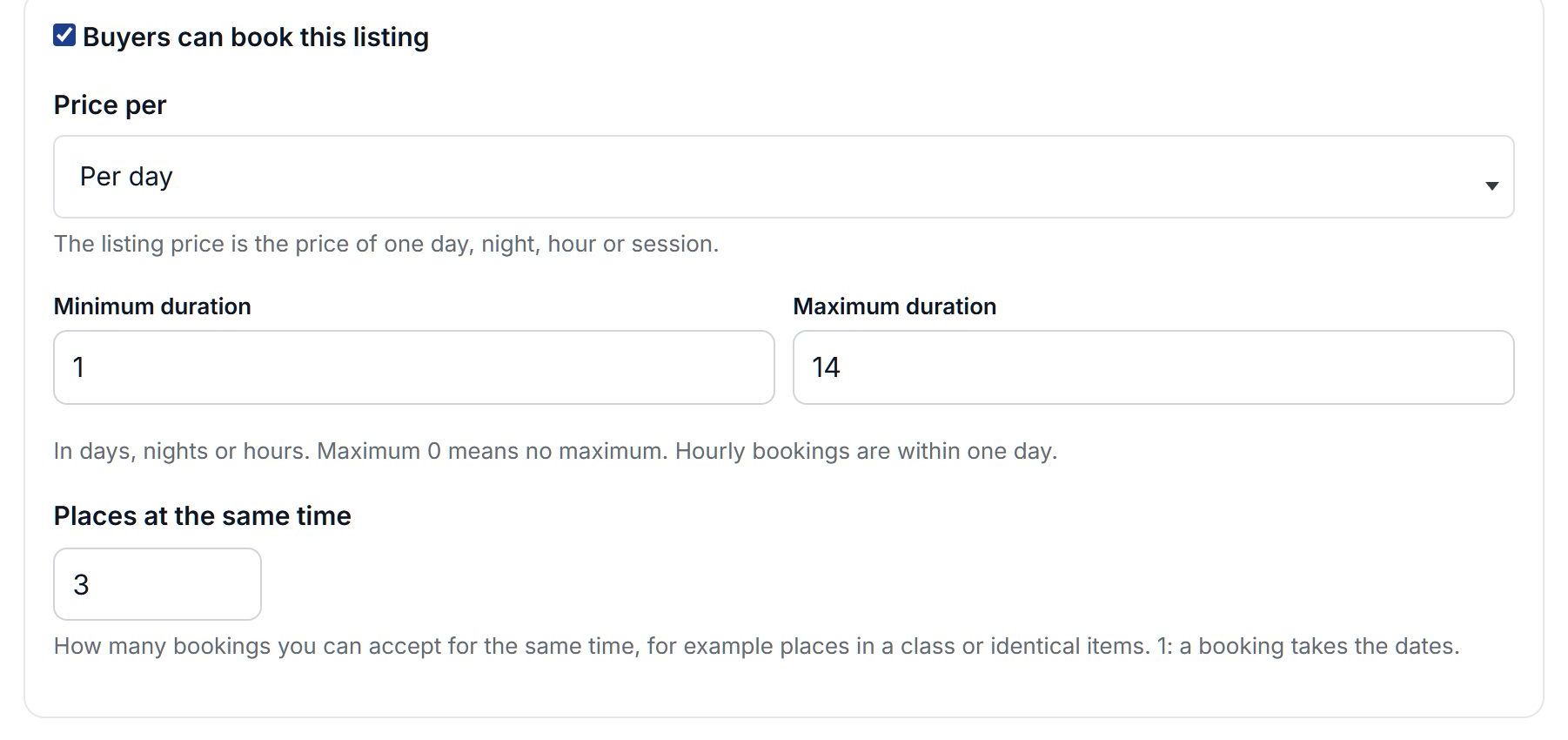
Rental terms need their own fields: daily price, weekly price, deposit, earliest pickup time, and whether the owner ships or offers pickup only. Note the shutter count on bodies so renters and owners both have a record.
| Category | Example listings | Fields renters filter on |
|---|---|---|
| Camera bodies | Full-frame mirrorless body with two batteries | Mount, sensor format, shutter count, batteries included, daily price |
| Lenses | 70-200mm f/2.8; 85mm f/1.4 portrait lens | Mount, focal length, maximum aperture, stabilization |
| Cinema cameras | Super 35 cinema camera kit with media | Mount, recording format, media included, weekly price |
| Lighting | Two-light LED kit with stands and softboxes | Output, battery or mains, color temperature range |
| Audio | Wireless lavalier pair; shotgun mic with boom | Channels, connector type, recorder included |
| Stabilizers and drones | Three-axis gimbal; camera drone with spare batteries | Payload, batteries included, deposit |
A mount dropdown is the most used filter on any camera rental site. Make it required for bodies and lenses.
Charge a commission that working photographers accept on gear they already own.
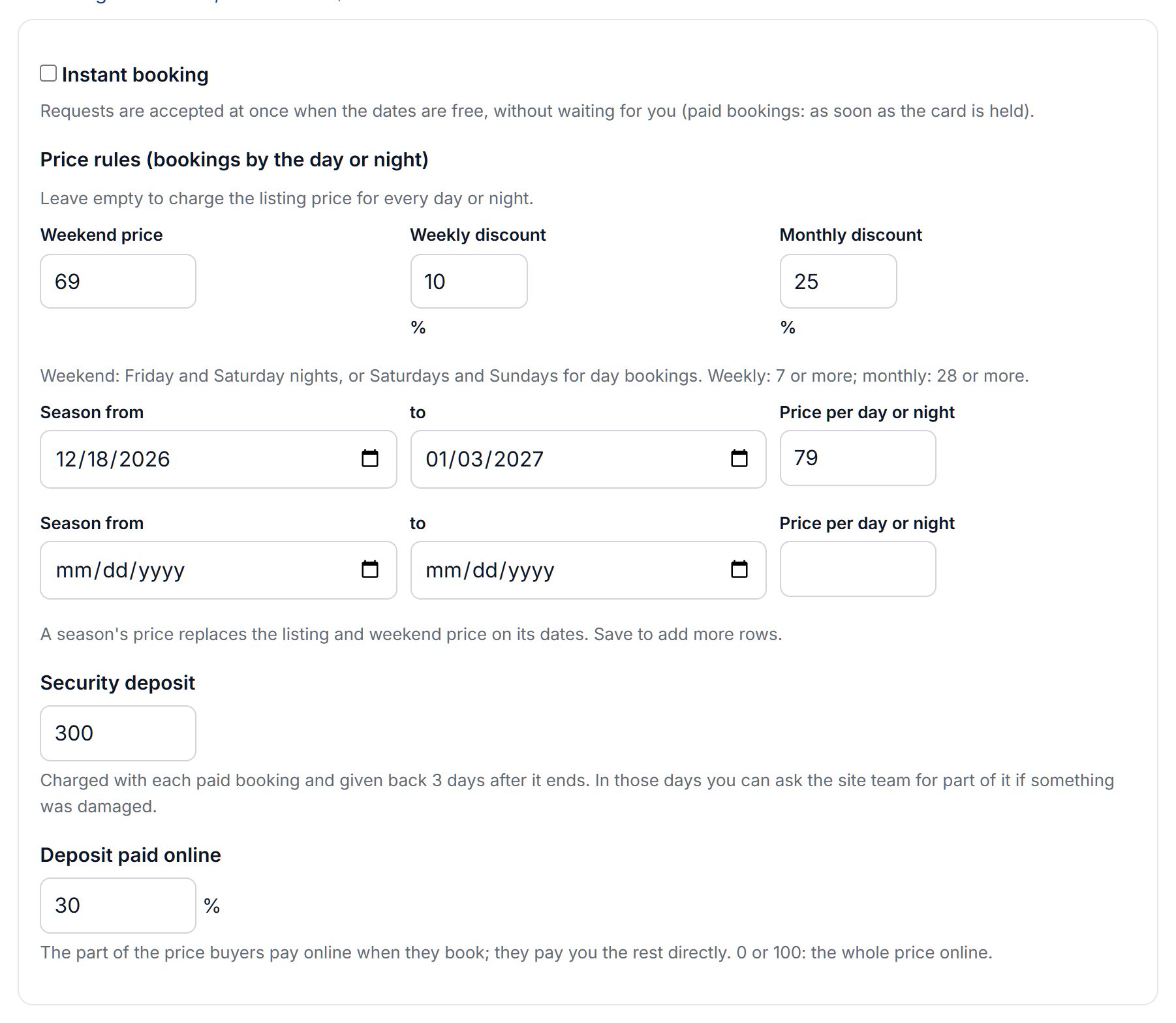
Renters book and pay on the site, owners are paid through Stripe, and you keep a commission per booking. Owners compare your share to two things: the cost of the lens sitting in a bag, and the depreciation of gear that loses value as new models arrive. For hobbyists, any income is welcome. For small rental houses, your commission has to be lower than the cost of finding the customer themselves.
Deposits are central in camera rental. A good lens costs more than many renters earn in a week, so a deposit close to the item's value is common for new renters, while owners may lower it for renters with good reviews. State the deposit on every listing.
A renter service fee works for short rentals, especially weekend bookings where the commission alone is small. Featured listings suit owners with in-demand lenses during wedding season. Owner memberships suit small rental houses and production companies listing a full kit. Banner spaces fit camera stores, repair shops, photography workshops and print labs.
| Model | Works when | Switch it on |
|---|---|---|
| Commission per booking | Renters pay through the site | From the first booking |
| Renter service fee | Short weekend rentals | Once bookings are regular |
| Featured listings | Several owners rent the same popular lens | Before wedding and festival season |
| Owner memberships | Small rental houses list a full catalog | When a few rental houses have joined |
| Banner spaces | Camera stores, repair shops and workshops want shooters | When you can show steady traffic |
Start with the photographers and small rental houses who own the most gear.
Renters search for a specific item, so a narrow catalog disappoints quickly. Begin with owners who have a lot of gear and keep it in good condition.
- Wedding and event photographers. They own backup bodies and lenses by necessity, and rent them out happily outside their busy weekends.
- Small production companies. Cinema cameras, lens sets and lighting kits that sit between projects.
- Small independent rental houses. They can import their catalog from a spreadsheet as a CSV and use your site as an extra storefront.
- Camera clubs and photography groups. Members often own wildlife, macro and astrophotography lenses that are rarely used.
- Film schools. Instructors and graduates own gear and know who in the city has more.
- Camera stores. Some rent gear already and may list it for wider reach.
Ask your first owners for real, recent photos of the actual item, including the serial number area for your own records, and record the condition: scratches on the barrel, dust in the lens, sensor cleanliness. Agree on rates and deposits together, and fill the calendars for the next few months.
A wedding photographer's backup kit can fill a whole category on day one.
Protect owners from rental fraud, the problem this niche is known for.
Camera gear is small, valuable and easy to resell, so renting it out attracts thieves who pose as renters. Rental houses have long warned about fake identities and stolen cards used to book expensive kits. Write rules for owners before the first booking.
- Renter identity. Owners should check ID at pickup and compare it to the booking name, and may ask new renters for references or a social profile showing real work. This is the owner's check; the site does not verify identity.
- Start small. Suggest owners rent only lower-value items to first-time renters and wait for reviews before handing over a full cinema kit.
- Shipping. Shipping to strangers adds risk. Many owners offer pickup only to new renters and ship only to repeat ones.
- Condition disputes. Scratches, fungus, sensor dust and dropped lenses are the usual arguments. Ask both sides to photograph the gear at handover and return and to test it together.
- Insurance. Owners should ask their own insurer whether renting out equipment is covered; many standard policies may not cover rental use. Renters on paid jobs often carry their own equipment cover. Check the rules where you operate, and do not suggest the site insures gear.
- Off-site deals. Renters who offer cash to skip the booking also skip the deposit. Warn owners about it.
Moderation tools help on the listing side: approve every new owner's listings, and hold suspicious ones for review. Ratings and reviews on both sides build trust over time.
Rank for the lens and camera searches shooters make before a job.
Camera rental searches are specific: "rent Sony 24-70 GM II", "Canon RF 70-200 rental near me", "cinema camera rental Atlanta", "rent a gimbal for a weekend" and "lens rental for wedding". Some searchers want to try before buying, so "rent before you buy" pages help too.
Pages to build
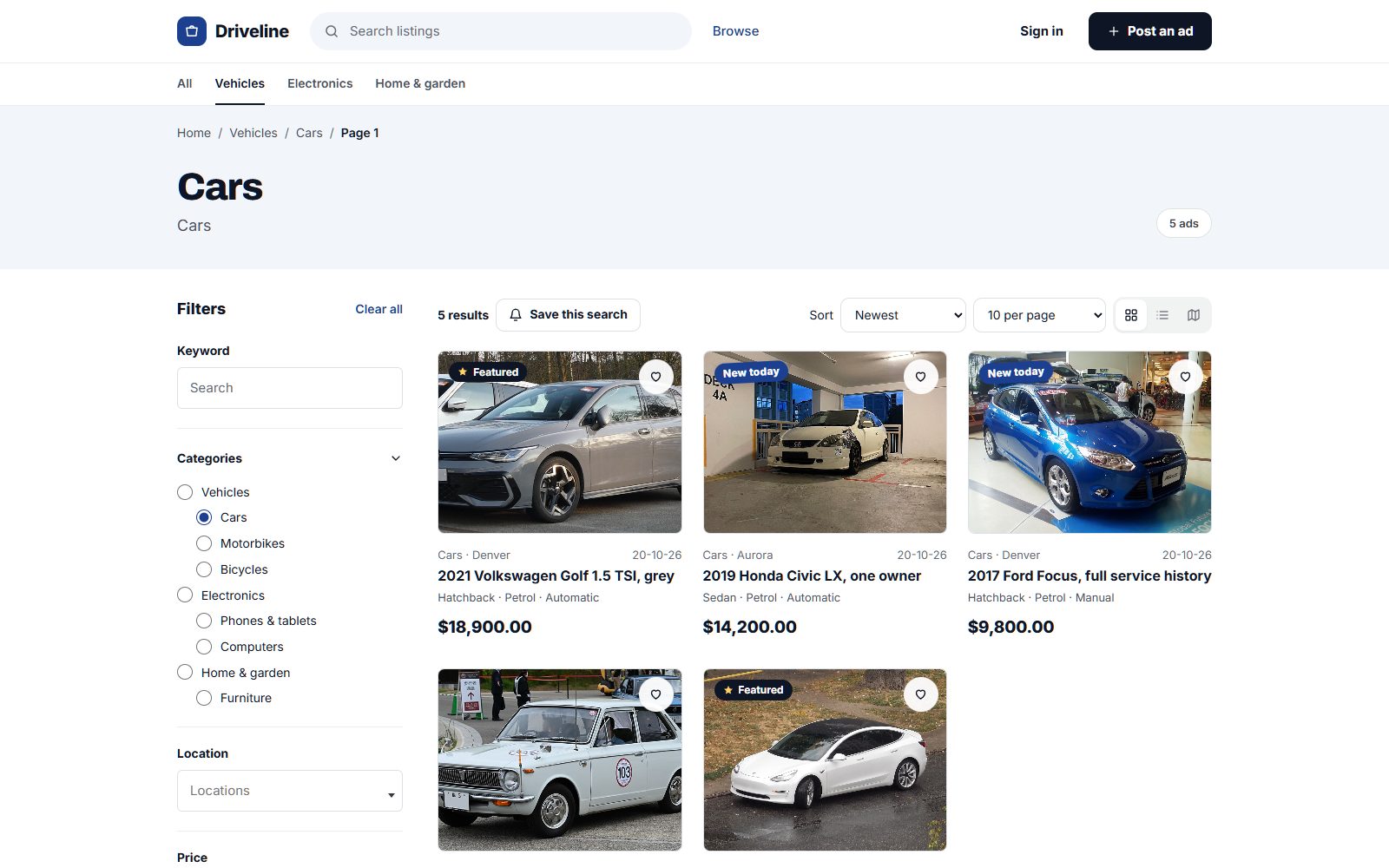
- Item and city pages: "85mm portrait lens rental in Denver", "Cinema camera rental in Austin". Every lens, body and neighborhood you cover ends up with a page of its own.
- Mount pages: everything available for Sony E, Canon RF or Nikon Z in your city.
- Shoot guides: what to rent for a first wedding, for a safari trip, for a music video, for a solar eclipse.
- Comparison pages: two popular lenses side by side, both bookable on your site.
Use the exact model names photographers type, including the version (II, III), and put the mount in every title. Write for the shooter who is booking on a Thursday for a Saturday job.
Launch before wedding season, in one city with a busy creative scene.
In many places wedding season runs from late spring to early fall, and festival and graduation season sits in the middle. Launch a couple of months earlier so owners' calendars are filled in when photographers plan their summer. Other moments worth planning for: film school project deadlines, holiday markets, and big events that bring travelers with cameras.
First steps
- One city with a film school, active wedding photographers and production work.
- Ten owners with full kits, including at least one small rental house.
- A partner camera store or repair shop that can inspect gear and recommend you.
- A meetup or photo walk to introduce the site to local shooters.
Launch checklist
- Mount, condition, included items, daily and weekly price and deposit on every listing.
- A handover and return checklist with photos and a quick test.
- Owner guidance on checking renter ID and starting new renters small.
- A note that owners should check their own insurance.
- Guides for wedding and travel shooters ready before the season.
After the first season, list the items renters searched for most and could not book, and ask your owners and local rental houses to fill those gaps.
A worked example: Peachline Glass Rentals in metro Atlanta.
Peachline Glass Rentals is a fictional site, invented to show how a camera rental marketplace fits together. It serves metro Atlanta, a city with steady film and television production, several film programs at colleges, a big wedding calendar from spring through fall, and a crowd of content creators who shoot every week. Gear moves between owners and renters in parking lots, studio lobbies and coffee shops across the city, so pickup points near the interstates matter more than a precise address. Traffic decides everything here: a lens forty minutes away at rush hour might as well be in another state.
Who it serves
Renters fall into three groups. Wedding shooters want a second body or a fast portrait lens for a Saturday. Students and indie crews need a cinema camera, a lens set and audio for a few days of a short film. Creators want a gimbal, lights or a wireless mic kit for one shoot. Owners include eight working photographers who rent between their own jobs, two small production companies, a retired photojournalist with a cupboard of long lenses, and one small rental house that uses the site as a second storefront.
Categories
- Stills
- Camera bodies
- Lenses by mount
- Cinema
- Cinema camera kits
- Cine lens sets
- Lighting and grip
- Audio
- Stabilizers and monitors
How it started
The founder, a wedding photographer, kept getting texts from colleagues asking to borrow her backup body. She listed her own kit first, then asked her second shooters and a film school instructor to list theirs. Before the first booking she wrote a handover checklist: power on, take a test frame at every focal length, check the sensor, count batteries and cards, and photograph the serial number area. New renters start with lenses under a set value and pick up in person; full cinema kits go only to renters with reviews.
How it makes money
Every booking is paid on the site with a deposit, and Peachline keeps a commission plus a small renter fee on weekend rentals. The rental house pays for an owner membership to list its whole catalog. A camera repair shop and a print lab share the banner spaces, and featured spots on 70-200mm and 24-70mm lenses sell before the fall wedding rush.
The rule that new renters start small cost a few bookings and saved the site's reputation.
| Listing | Price | Key details |
|---|---|---|
| 70-200mm f/2.8 zoom, Sony E | $45 per day, $160 per week, $1,500 deposit | Hood, both caps, tripod collar, pickup only for new renters |
| Full-frame mirrorless body | $65 per day, $220 per week, $2,000 deposit | Three batteries, two cards, charger, shutter count noted at handover |
| Super 35 cinema camera kit | $190 per day, $650 per week, $4,000 deposit | EF mount, two media cards and reader, monitor, cage, renters with reviews only |
| Three-light LED kit | $55 per day, $180 per week, $600 deposit | Stands, softboxes, battery or mains power, fits in a hatchback |
| Wireless lavalier pair | $25 per day, $80 per week, $350 deposit | Two transmitters, one receiver, cables for camera and phone |
The first 90 days of a camera rental marketplace.
A camera renter usually needs one exact item for one exact date. If it is not on the site, they book elsewhere and rarely come back to check. So the first ninety days are about depth in the items working shooters ask for most: standard zooms, portrait primes, telephotos for events, a couple of cinema kits, and the audio and lighting that small crews always forget.
Start about three months before your local wedding season or the busiest stretch of production work. Owners take a while to decide, especially about letting strangers use a lens worth more than their car payment, and they want to see your handover and fraud rules first.
Run the early bookings yourself where you can: introduce owner and renter, be at the first few handovers, and watch where the checklist slows things down. Count completed bookings with no dispute and returning renters, not visits. One theft in the first month can end the site, so do not loosen the start-small rule to grow faster. By week twelve you should know which three lenses carry the site, which owners reply within the hour, and which renters you would trust with a full cinema kit.
| Weeks | Focus | Done when |
|---|---|---|
| 1-2 | Set categories, a required mount dropdown, sensor format and included-items fields | A test lens listing filters correctly by mount and focal length |
| 3-4 | Write fraud and handover rules: ID at pickup, start-small values, photo and test checklist | Owner guide and checklist published and read by two working photographers |
| 5-6 | Recruit anchor owners: wedding photographers, a production company, a small rental house | At least 80 items listed, covering the three most common mounts |
| 7-8 | Soft launch through local photographer groups and the film school | Twelve bookings completed with handover photos on file and deposits returned |
| 9-10 | Publish mount pages, shoot guides and lens comparison pages | Eight guides live, each linking to bookable items |
| 11-12 | Fill gaps from searches with no results, add a repair shop or camera store partner | The five most searched missing items are listed and a partner sends renters |
How to build a camera rental marketplace: three routes compared.
Camera rental puts heavy demands on the details of each listing and on the booking itself. Renters filter by mount, focal length and sensor format, so you need dropdown and number fields that work as filters. Every item needs a calendar that blocks dates, a daily and weekly price, and a deposit that can be large. Owners also want to approve who rents expensive kits, and both sides lean on reviews more than in most rentals because the risk of theft is real.
Building with developers is worth it only for features no standard tool offers, such as bundles that book a body, lenses and audio as one kit with shared availability, or an integration with a rental house's stock system. Those take time to build and test, and payments with deposits are where custom code most often goes wrong.
A marketplace script or WordPress rental plugin on your own server gives you control and a lower start. Check that it supports many owners, per-item calendars, deposits and split payments together, not just one of them, and that you can keep it patched, since a site that handles payments for valuable gear is a target.
A hosted builder such as Yclas fits a founder whose time is better spent at photo walks and film school screenings. Booking calendars with daily or weekly prices and deposits, Stripe payments with a commission, custom fields as filters, spreadsheet imports for rental houses and reviews on both sides come built in. List the features you cannot live without, such as kit bundles, and check them before you commit.
| Route | Fits when | Watch out for |
|---|---|---|
| Custom build | You need kit bundles or a link to a rental house stock system | Long build time and deposit or payment bugs with expensive gear |
| Script or rental plugin on your server | You want control and can maintain a payment site | Plugins that handle rentals or many owners, but not both, and security updates |
| Hosted builder | You want to launch before wedding season and focus on owners | Confirm the features your gear mix needs before you invite owners |
| Listing page plus direct payment | You are testing interest with a few friends | No deposits or calendar, and owners exposed to fraud |
What a camera rental marketplace costs to run.
The software is the smallest part of the bill. Most of the cost is your time in the first months: finding the first listings, answering questions and checking what gets posted.
Camera rental adds a few niche costs: possibly a professional inspection or sensor clean for gear you feature, a conversation with an insurance broker about what owners should ask their insurers, and travel to meet owners and photograph kits. If owners ship gear, padded cases and tracked shipping are their cost, not yours.
| Cost | Typical range | On Yclas |
|---|---|---|
| Domain | $10 to $20 a year | Your own, with SSL included |
| Software and hosting | $0 to $100+ a month, plus plugins and updates | Marketplace $149 a month for checkout and commission |
| Design | $0 to $100 for a theme, or a designer | 109 looks included |
| Payment fees | About 3% per payment | Your Stripe or PayPal fees; Yclas takes nothing |
| Your time | 5 to 10 hours a week at the start | Finding listings, moderation, support |
Mistakes that sink camera rental marketplaces.
- Letting a new renter walk away with a full cinema kit. Rental fraud in this niche targets the most valuable, easiest to resell items. Set a value limit for first bookings and keep it, even when a smooth-talking renter has a rush job. Thieves often book late on a Friday precisely because they expect owners to cut corners under time pressure.
- Shipping to strangers. A shipped lens to an address you have never seen is the classic loss. Keep new renters on in-person pickup and allow shipping only for repeat renters an owner already trusts. When shipping does start, owners should use tracked, signed delivery and photograph the packed case.
- Leaving mount optional. A renter who books an EF lens for an RF body without an adapter loses the shoot and blames you. Make mount a required dropdown and add an adapter checkbox. A mount page per system also helps renters see at a glance what fits the body they already own.
- Skipping the handover test. Without a test frame, a sensor check and photos of the glass at pickup, every scratch and dust spot becomes an argument at return. Put the test in the checklist and ask both sides to do it together. Ten minutes in a parking lot saves a week of messages about who scratched a front element.
- No prep day between bookings. Owners need time to clean sensors, charge batteries and format cards. Back-to-back bookings on wedding weekends mean dead batteries and cards full of someone else's photos. A one-day buffer after every booking is a sensible default that owners can shorten for simple items.
- Forgetting the reset. Bodies come back with odd custom settings, and cards come back with the renter's private images. Ask owners to reset bodies and format cards after each rental, and tell renters to copy their files before return.
- Deposits that scare off working pros. A deposit equal to full value on every booking pushes reviewed, repeat renters to rental houses. Let owners lower deposits for renters with a record on the site. Reviewed renters are the ones who rent every month, so treat them as your best customers.
- Covering every mount and format at once. Ten lenses spread across nine mounts helps nobody. Start with the two or three systems your local shooters use and go deep before going wide.
- Ignoring the Thursday booking. Shooters book late in the week for weekend jobs. Owners who answer messages slowly lose those bookings, so encourage quick replies and nudge owners who leave messages unanswered for a day.
Camera rental terms every founder should know.
Owners and renters in this niche talk in shorthand, and these terms come up on almost every booking.
| Term | What it means |
|---|---|
| Mount | The fitting that joins a lens to a camera body, such as Sony E or Canon RF. |
| Glass | Photographers' slang for lenses. |
| Prime | A lens with one fixed focal length, usually faster and sharper than a zoom. |
| Crop factor | How much a smaller sensor narrows the view of a lens compared with full frame. |
| Shutter count | The number of photos a body has taken, a rough measure of its wear. |
| T-stop | A cinema lens rating of how much light actually passes through, used instead of the f-stop. |
| PL mount | A sturdy lens mount standard on professional cinema cameras and lenses. |
| Media | The memory cards or drives a camera records to, such as CFexpress or SD cards. |
| V-mount | A common battery plate type used to power cinema cameras, monitors and lights. |
| Cage | A metal frame around a camera body with points for mounting monitors, mics and handles. |
| Kit | A body or camera sold or rented with the lenses, batteries and accessories that make it usable. |
| Haze and fungus | Cloudiness or mold inside a lens that lowers image quality and is hard to fix. |
| COI | A certificate of insurance, which production renters often show to prove their equipment cover. |
The same steps for a camera rental marketplace on Yclas.
- Describe your marketplaceThe setup wizard writes the categories, an About page and example listings from one sentence.
- Add fieldsThe details buyers filter on, as dropdowns, numbers or checkboxes.
- Bring sellersInvite them, import their stock from a spreadsheet, or post for them.
- Set the rulesChoose moderation, verified sellers, reviews and reports.
- Take paymentsOn Marketplace, buyers pay on the site and you keep a commission, with Stripe.
What budget do I need to launch a camera rental marketplace?
You hold no gear, so the main costs are the site, meetings with owners and some local promotion to photographers. A partner camera store can reduce your marketing spend.
How do owners avoid renters who steal gear?
By checking ID at pickup, starting new renters with lower-value items, offering pickup rather than shipping to strangers, and waiting for reviews before renting full kits. These checks are done by the owner.
Who covers a dropped lens?
The renter, under the listing's terms, with the deposit covering most repairs. Owners should also ask their own insurer whether rental use is covered, since rules and policies vary.
Can I compete with mail-order rental houses?
Yes, on speed and range: same-day pickup across town and gear that rental houses rarely stock, from vintage lenses to niche cinema accessories. Small rental houses can also list with you.
Should I allow shipping?
Start with local pickup, where owners meet renters and check ID. Add shipping for repeat renters with good reviews once owners ask for it.
How large should the deposit be?
For new renters, close to the item's value is common, since lenses are easy to resell. Owners can lower it for renters with good reviews.
Do I need permits to run this?
Usually not for the site itself, but tax rules and any rules on rental businesses vary. Check the rules where you operate, and ask a local accountant about sales tax on rentals.
Should owners ask production renters for a certificate of insurance?
Many rental houses ask productions for proof of equipment cover before releasing larger kits, and owners on your site can do the same. It is the owner's check, so let each owner decide and note it on the listing.
Can renters take gear abroad?
Let owners decide on the listing. Travel adds risks of loss, customs questions and damage in transit, so many owners allow it only for repeat renters and ask them to check their own cover first.
Should the site list drones?
You can, but drone rules on registration and pilot certification vary by country and by use, and they apply to the person flying it. Ask owners to remind renters to check the rules where they fly before booking.
What if a shoot runs late and the renter cannot return on time?
Ask owners to state a late fee and how renters should ask for an extension through on-site messages. Extending a booking on the site keeps the calendar honest and the next renter informed. If another renter is already booked, the owner should say so early so the late renter can find a replacement.
How do I handle firmware and settings?
Ask owners to keep bodies on current firmware, reset custom settings after each rental and format cards. Renters should copy their files before return, because owners will wipe the media.
Related pages.
The parts of Yclas this leans on.
You have the plan. Now get your city's spare lenses booked.
Describe your site in a sentence and the setup wizard writes the categories, example listings and a look. Free for 15 days, no credit card.
Start my marketplace