How to build a trading card marketplace for singles, slabs and sealed product.
This guide covers how to build a marketplace for trading cards: choosing a game, sport or region, the set, condition and grading fields collectors filter on, commission and seller memberships for card shops, recruiting the first sellers at shows and game stores, fakes, resealed packs and condition disputes, and launching around set releases and card shows.
Free for 15 days · No credit card · Plans from $19 a month
Pick the game or sport, then serve its collectors better.
Trading cards cover very different worlds. Players of Pokémon, Magic: The Gathering and other card games buy singles to finish a deck, often for a few dollars each. Sports card collectors chase rookies, autographs and numbered parallels, and many buy graded cards in slabs. Sealed product, from booster boxes to collector tins, is bought to open or to keep.
Sellers include local game stores, sports card shops, breakers, collectors selling duplicates and people who found a childhood binder in the attic. Buyers want the exact card, in the condition they expect, at a price they can compare.
Large card platforms and eBay dominate the biggest games and sports in their home markets. Your space is where they are thin: a region, a language, a smaller game, vintage cards, or a community that prefers buying from people it knows.
Pick your angle
- One game, done better than anyone else, with every set and card number in your fields.
- One sport or era: vintage baseball, soccer stickers and cards, basketball from one decade.
- One country or language: Japanese-language cards, or a country where buyers pay heavy shipping and duties to buy abroad.
- Local trade for one city, with pickup at partner game stores.
Today the trade runs through card shows, game store trade nights, Facebook groups, Discord servers, live-stream breaks and the big platforms.
Players and collectors are different buyers. Decide which one you serve first.
Set, card number and condition are the whole search.
Card buyers search for one exact card. That means set, card number and variant must be in fields, not left to the seller's title. Keep categories to the game or sport and the product type, and put the rest in filters.
- Game or sport as the category, with set as a dropdown you maintain as new sets release.
- Card number and card name as text, and language as a dropdown.
- Variant: foil, holo, reverse holo, first edition, parallel, serial numbered.
- Condition for raw cards from a fixed scale: near mint, lightly played, moderately played, heavily played, damaged.
- Graded as a checkbox, then grading company, grade and certification number. The cert number lets buyers look the card up on the grader's own website.
- Sealed product type: booster box, booster pack, starter deck, collector box, case.
Ask for photos of the front and back of every card worth more than a few dollars, and of all sides of sealed product, so buyers can see the wrap.
| Category | Example listings | Fields buyers filter on |
|---|---|---|
| Card game singles | Rares, staples for decks, full-art cards | Set, card number, language, variant, condition |
| Sports singles | Rookie cards, autographs, numbered parallels | Player, year, set, serial number, condition |
| Graded cards | Slabs from the major grading companies | Grading company, grade, cert number |
| Sealed product | Booster boxes, packs, collector boxes, cases | Product type, set, language, wrap condition |
| Vintage | Older sets, early printings, childhood collections | Year, set, edition, condition |
| Lots and supplies | Bulk lots, binders, sleeves, deck boxes | Quantity, game, new or used |
In Yclas, each of these can be a custom field (text, number, dropdown, checkbox or date), required or optional, and shown as a search filter.
Keep fees low on cheap singles and fair on big cards.
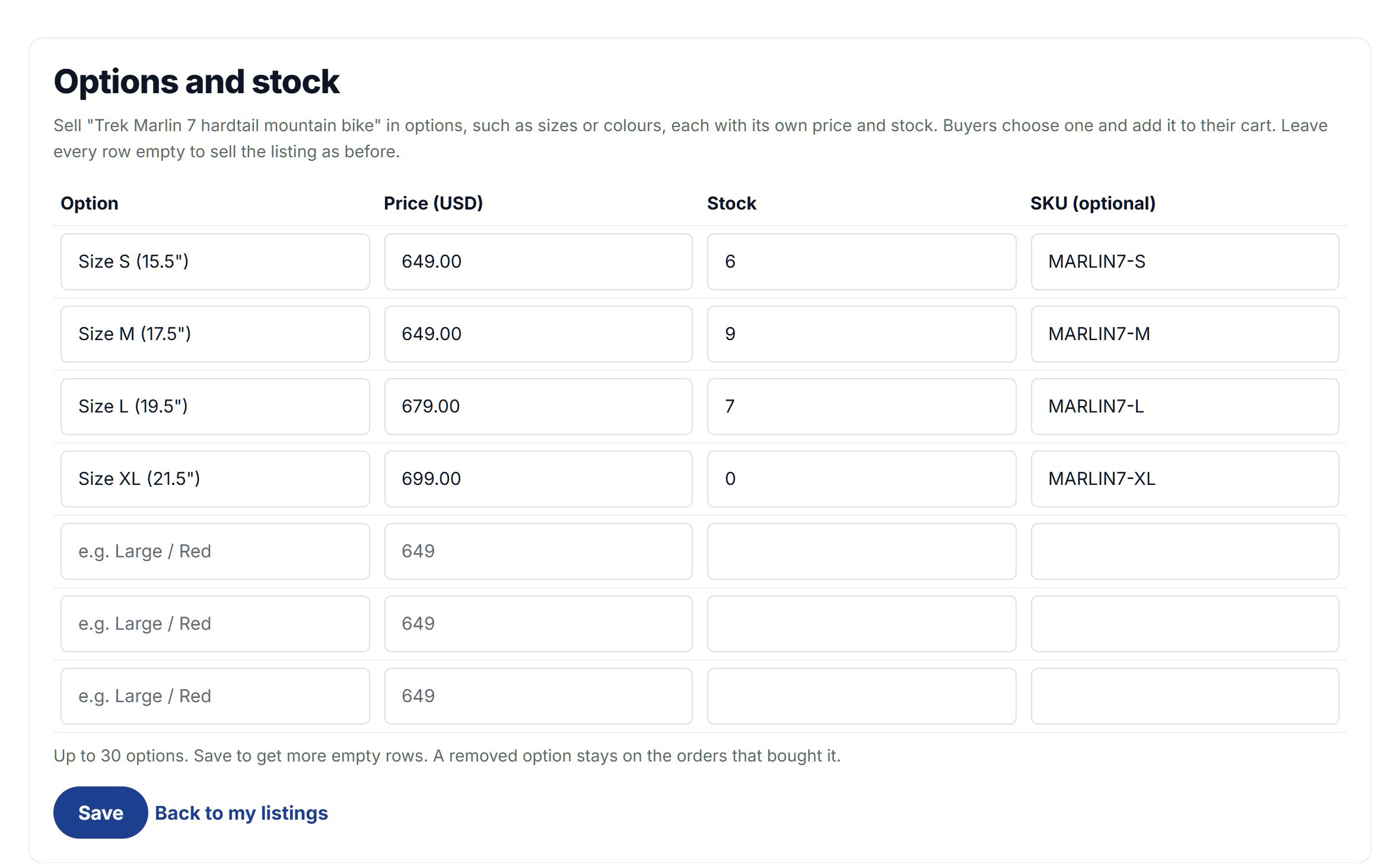
Card sales range from a single worth less than a coffee to a graded card worth thousands. A commission that suits one end can ruin the other. Many card sellers think in terms of total fees per sale, so publish a clear commission and show sellers an example on a small single and a large sale.
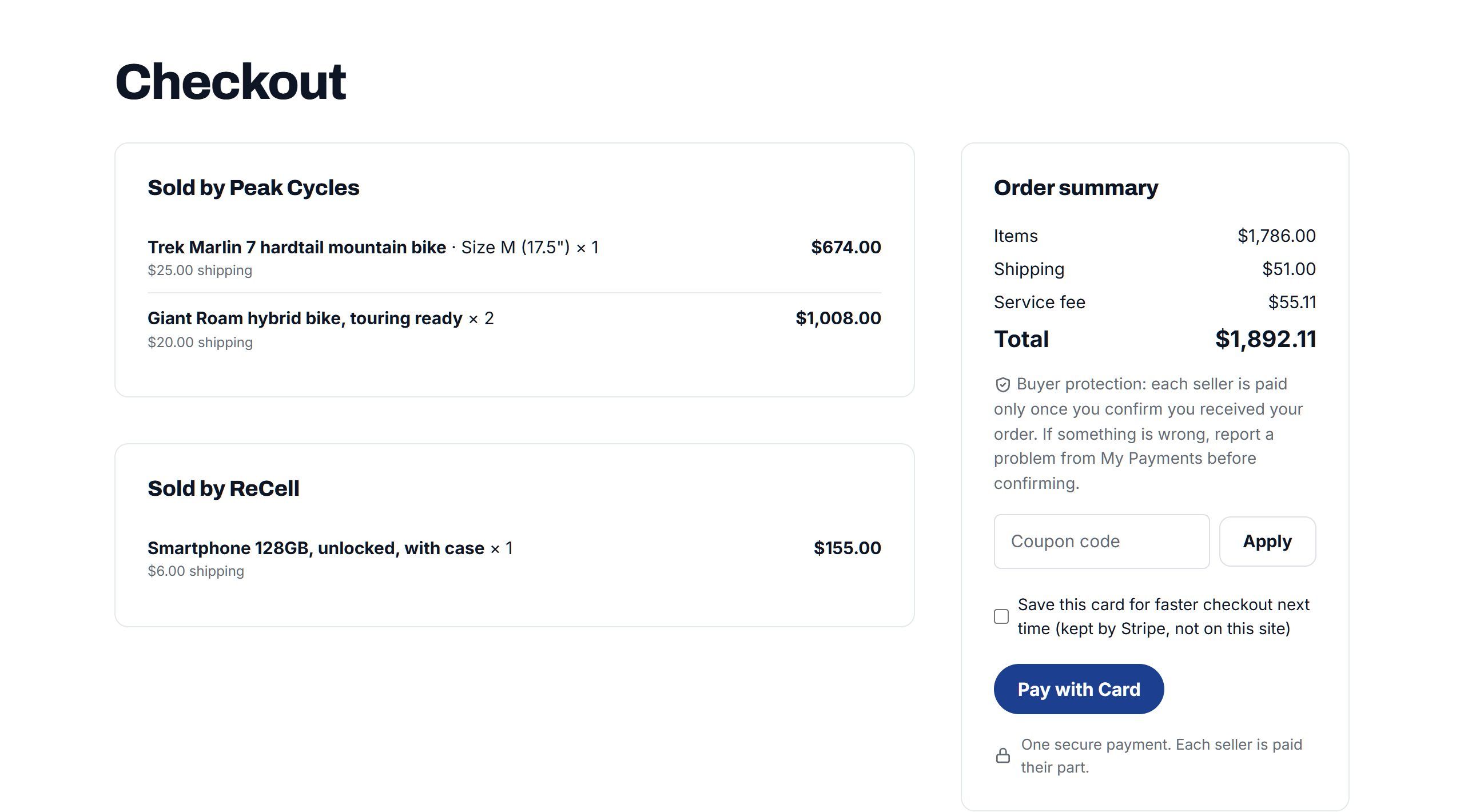
Buyers pay on the site with Stripe, and a cart with cards from several sellers matters a lot here, because players often need ten singles from ten different sellers to finish a deck. Each seller sets their own shipping, from a plain envelope for cheap singles to tracked, signed delivery for graded cards. An optional buyer service fee is common on card platforms, but keep it small or leave it off while you grow.
- Seller memberships fit game stores and card shops listing hundreds of singles.
- Featured listings suit chase cards, high grades and new sealed product on release week.
- Auctions with bidding and Buy now suit graded and vintage cards where prices move quickly.
- Banner spaces suit grading submission services, supply brands and local game stores.
Charge nothing to list. Card sellers list in bulk, and fees per listing make them list only their best cards.
| Model | Works when | Switch it on |
|---|---|---|
| Commission per sale | Cards sell through checkout | From the start, published with examples |
| Seller memberships | Stores list hundreds of singles | When the first shops are active |
| Auctions | Graded and vintage cards draw bidders | Once you have regular collectors |
| Featured listings | Chase cards compete on release weeks | With the first busy set release |
| Buyer service fee | Buyers rely on the cart across sellers | Later, kept small |
Start with game stores, card shops and show dealers.
A trading card marketplace lives or dies on depth. A player who cannot find the card they need will not come back. Aim for thousands of singles from a handful of stores, plus a few hundred graded cards or sealed items, before you promote the site to buyers.
- Local game stores. Most hold boxes of singles they never put online because listing card by card takes hours. Offer them a lower commission and help importing their stock.
- Sports card shops with graded inventory and display cases.
- Card show dealers. Walk the tables at regional card shows; many dealers sell only in person and would like an online channel between shows.
- Breakers and live-stream sellers, who end up with many cards their customers did not keep.
- Collectors and players with binders of duplicates, reached through trade nights, tournaments and Discord servers.
Stores often already keep their singles in inventory software that exports a spreadsheet. Import that CSV and they have hundreds of listings on day one. For individual collectors, keep the sell form short with set and card number required.
One game store's export can be worth more than a month of outreach.
Plan for fakes, resealed packs and condition arguments.
Counterfeit cards are common, especially for popular games and valuable rookies. Fake grading slabs exist too, with copied cert numbers. Resealed and "weighed" packs, where someone has opened or searched packs for the best cards and sealed them again, are a familiar problem with sealed product. Trimmed or altered cards sold as untouched show up in vintage. Say clearly in your terms that the marketplace does not authenticate or grade cards, and that sellers are responsible for what they sell.
What you can do
- Ban proxies, reprints and unofficial cards outside a clearly labeled category, or entirely.
- Require a cert number on every graded listing, and tell buyers to check it on the grading company's own site and compare the photos.
- Approve new sellers' listings, and hold sealed product priced well below market for review.
- Award verified seller badges to stores and dealers you have checked, and show reviews on seller profiles.
Condition and payment
Most disputes are about condition. Publish your condition scale with photos of each grade, and ask sellers to photograph front and back. Ask sellers to ship cards in sleeves and toploaders, and anything valuable with tracking and signature. Keep every payment on the site's checkout: requests to pay by a friends-and-family transfer or gift card are a common scam in card groups. Cards bought from abroad may owe import duties; check the rules where you operate.
Rank for card names, set lists and price checks.
Card collectors search for exact cards and prices constantly. A page for every listing, category and location means each single can rank for its own name and number, which is how most card sales start.
- "card name set number near mint"
- "japanese booster box for sale"
- "PSA 10 rookie card price"
- "how to spot fake pokémon cards"
- "game store near me that buys cards"
- "is my card worth grading"
Use a title pattern like "Card name, set, number, condition" or "Player year set, grade". It matches searches and makes listings easy to scan.
Pages worth writing
- Set pages listing every card in a set, with links to what is for sale. They bring steady searches long after release.
- Price guides drawn from sales on your own site, for your most traded cards.
- A condition guide with photos of whitening, scratches and centering, so buyers and sellers agree.
- Guides on spotting fakes and resealed packs, written as advice for buyers.
- Grading guides: when a card is worth submitting and how the process works.
Each new set release is a fresh round of searches. Have its page ready on release day.

Launch on a set release or at a card show.
The card calendar is full of launch moments. New sets in the big games release several times a year, with prerelease events at game stores the weekend before. Sports cards follow the seasons of each league, and the large national and regional card shows draw dealers and collectors in one place. The holidays bring sealed product buyers.
First community
Start with one game or sport, and one city or country. Partner with two or three game stores, and hold a trade night at one of them where players can list cards on the spot.
Partners
- Local game stores and sports card shops.
- Card show organizers, who can give you a table or a mention.
- Tournament organizers and league coordinators.
- Grading submission services and supply brands, for sponsored guides.
Checklist
- Write your rules on fakes, proxies and resealed product.
- Set up the set, card number, condition and grading fields, and your condition photo guide.
- Import singles from at least three stores.
- Publish the commission with worked examples.
- Run test orders, including a multi-seller cart and a graded card.
- Have the next set's page ready a week before it releases.
- Launch at a prerelease weekend or a card show.
A worked example: Prairie Singles Exchange in Alberta and Saskatchewan.
Prairie Singles Exchange is a made-up marketplace, sketched to show how this guide's advice works in one place. It serves card game players in Alberta and Saskatchewan, where game stores are spread across long distances and ordering singles from the United States often means slow shipping, currency conversion and surprise fees at the border.
How it started
The founder ran tournaments at a game store in Edmonton and watched players wait weeks for cards from across the border, sometimes missing the event they bought them for. She persuaded four game stores in Edmonton, Calgary, Saskatoon and Regina to export their singles inventory, imported close to fourteen thousand cards from their spreadsheets, and built a set dropdown she updates before each release. The site opened on a prerelease weekend, with every store announcing it at their tables and pinning it in their Discord servers. Players at the prerelease could check the site for the cards they had just missed, and several stores sold singles to players in other cities for the first time that weekend.
Categories
- Card game singles
- Pokémon
- Magic: The Gathering
- Other games
- Graded cards
- Sealed product
- Lots and supplies
Who it serves
Buyers are tournament players finishing a deck before a weekend event, parents buying cards as gifts, and collectors after graded cards they can receive without crossing a border. Sellers are the four stores, a sports card shop in Calgary that later opened a graded section, and players selling duplicates after each set release. Store owners also buy from each other when one runs short of a card that suddenly sees play. That trade between stores turned out to be one of the steadiest sources of sales in the first year.
How it makes money
Buyers pay on the site with Stripe, and the cart lets a player buy twelve singles from three stores in one checkout, with each store charging its own shipping, from a plain envelope for a few singles to tracked parcels for graded cards. The site keeps a commission per sale, published with worked examples on a two-dollar single and a graded card. A store membership with a lower rate came after the first quarter, followed by featured listings on release weeks and auctions for graded vintage cards. A grading submission service pays for a banner on the condition guide.
| Listing | Price | Key details |
|---|---|---|
| Full-art trainer, English, near mint | C$18 | Set and card number listed, sleeved, ships in a toploader |
| Mythic rare, foil, lightly played | C$42 | Set from the dropdown, English, front and back photos |
| Holo from a 1999 set, graded 8 | C$310 | Grading company and cert number listed, tracked and signed |
| Japanese booster box, sealed | C$165 | Factory wrap intact, photos of all six sides |
| Bulk commons lot, 1,000 cards | C$25 | Mixed sets, played condition, ships in a box |
Your first 90 days, one set release at a time.
Card players judge a marketplace with one test: is the card I need here, in the condition I want, at a fair price? Your first ninety days should go to depth in one game or sport, built mostly from store inventories, because individual collectors only follow once buyers are active. The second goal is clean data: set names and card numbers that match how players search, so filters return what people expect.
The card calendar makes the launch date easy to choose. Count back twelve weeks from a prerelease weekend or a regional card show, and plan for the coming set's page to be ready a week early. Stores are busiest in the weeks around a release, so ask for their inventory exports well before then, and do a test import of a small file first to catch column problems.
Measure depth, not just totals. Take the twenty cards most played in your game's current format and check how many are listed in each condition. Gaps in that list are what players notice first, and the stores you recruit can usually fill them within days. Repeat the check every two weeks, because the list changes as the format does.
| Weeks | Focus | Done when |
|---|---|---|
| 1-2 | Rules and set data | Rules on fakes, proxies and resealed product are live, and the set dropdown covers every current set |
| 3-4 | Store partners | Three or more stores have agreed to join and sent a test export of their singles |
| 5-6 | Imports | Store inventories are imported, with set and card number filled on every listing |
| 7-8 | Graded and sealed | A card shop or dealer has listed graded cards with cert numbers, and sealed product has six-side photos |
| 9-10 | Test orders and guides | A multi-seller cart order and a graded card order are complete, and the condition guide with photos is published |
| 11 | Trade night preview | Players at a partner store have listed and bought cards on the spot, and their feedback is fixed |
| 12 | Release launch | The next set's page is live a week early, and the site opens at a prerelease weekend or card show |
Three ways to build a trading card marketplace.
A trading card marketplace has demands most marketplaces do not. It may hold tens of thousands of listings worth a few dollars each, so imports from store inventories and quick search are essential. The cart must hold cards from many sellers in one order, set and card number must be precise filters, graded cards need cert number fields, and auctions help with vintage cards and high grades. Saved searches with email alerts matter too, because players wait for one card to appear at a fair price.
Developers building it for you makes sense if you need card data no package has, such as automatic set lists for every new release or prices pulled from past sales. That data work never stops, because new sets arrive several times a year in every major game.
A script or WordPress plugin you install yourself is cheap to start, but large catalogs of low-value singles strain cheap hosting, and multi-seller carts with shipping per seller often depend on stacks of add-ons. You also handle updates, backups and spam accounts, which card communities attract in numbers. Bots that scrape prices are another load to plan for.
A hosted builder such as Yclas provides spreadsheet imports, custom fields, a cart across sellers with shipping per seller, commission and auctions, so your time goes to stores, trade nights and set pages. You work within the features it has, and you plan your own routine for adding each new set. For a founder who already knows the stores and the players, this is usually the fastest way from idea to a working checkout.
| Route | Fits when | Watch out for |
|---|---|---|
| Developers | You need automatic set data or price history by card | Constant data upkeep with every new set, and a large build |
| Script or plugin, self-installed | You have technical skill and a modest catalog | Slow search on large catalogs, add-on conflicts and hosting limits |
| Group or server with a sales channel | You want to test whether local players will trade online | No checkout, so payment scams and disputes stay with the members |
| Hosted builder | Your plan is store imports and community, not custom code | Plan how you will keep set lists current before each release |
What a trading card marketplace costs to run.
The software is the smallest part of the bill. Most of the cost is your time in the first months: finding the first listings, answering questions and checking what gets posted.
Expect to spend on card show tables, help importing store inventories, and condition photo guides. Grading fees and shipping supplies are paid by sellers, not the marketplace.
| Cost | Typical range | On Yclas |
|---|---|---|
| Domain | $10 to $20 a year | Your own, with SSL included |
| Software and hosting | $0 to $100+ a month, plus plugins and updates | Marketplace $149 a month for checkout and commission |
| Design | $0 to $100 for a theme, or a designer | 109 looks included |
| Payment fees | About 3% per payment | Your Stripe or PayPal fees; Yclas takes nothing |
| Your time | 5 to 10 hours a week at the start | Finding listings, moderation, support |
Mistakes that bench trading card marketplaces.
- Trying to cover every game and sport. A shallow catalog spread over ten games means no player finds their card. Go deep in one, and add the next only when buyers keep asking for it. Depth in one game also makes your set pages and price guides far more useful.
- Free-text set names. Sellers will spell set names five different ways, and buyers searching for one will miss most of them. Keep a set dropdown, update it before each release, and require card numbers. Promo cards and special printings need their own entries too, or they end up filed under the wrong set.
- Fees that ignore cheap singles. If a seller keeps almost nothing on a card that sells for a dollar or two, they stop listing singles and players lose the depth they came for. Check your commission and card processing on the smallest sale before you publish them. Encouraging bundles of singles in one order also helps, since shipping and fees are then shared.
- Graded listings without cert numbers. Fake slabs often copy a real cert number, and without the number buyers have nothing to check. Require it, and tell buyers to compare the grader's own images with the seller's photos.
- Accepting sealed product with blurry photos. Resealed packs and boxes are hard to spot even with sharp photos. Require clear images of every side and the wrap seams, and hold sealed product priced well under market for review. A price that looks too good on a booster box usually is.
- Condition by opinion. One seller's near mint is another's lightly played, and every mismatch becomes a dispute. Publish a scale with photos of whitening, edge wear and scratches, and require front and back images on anything above a few dollars.
- Letting deals move into direct messages. Card groups are full of requests to pay by friends-and-family transfer or gift card. Keep payment in checkout, warn buyers in messages, and remove sellers who push payment elsewhere. Younger players are often the target, so say it plainly in your buyer guides.
- Missing release week. A set page that appears days after release has lost most of its searches to sites that were ready. Build each set page a week early and ask stores to list new cards on release day.
- Treating stores as just more sellers. Collectors come and go, but game stores hold the inventory and the players. Treat them as partners, with a lower rate, import help and a voice in your rules. A store that feels heard tells every player at its trade nights about you.
Card terms players and collectors use.
Players, collectors and store owners will expect you to speak their language.
| Term | What it means |
|---|---|
| Singles | Individual cards sold one at a time rather than in packs. |
| NM, LP, MP, HP | Near mint, lightly played, moderately played and heavily played: the usual condition scale for raw cards. |
| Raw | A card that has not been graded or put in a slab. |
| Slab | The sealed plastic case a grading company puts a graded card in. |
| Cert number | The unique number on a slab that can be looked up on the grading company's website. |
| Pop report | A grading company's count of how many copies of a card have received each grade. |
| Parallel | A version of a sports card with a different color or finish, often serial numbered. |
| Rookie card (RC) | A player's first recognized card, usually the most collected. |
| Chase card | A rare card that drives demand for a whole set. |
| Proxy | A stand-in copy of a card used in casual play, not an official printing. |
| Reseal | A pack or box that has been opened and sealed again to look new. |
| Break | A live-streamed opening of boxes where buyers pay for a share of the cards pulled. |
| Centering | How evenly a card's image sits within its borders, a key part of its grade. |
| Prerelease | An event at game stores before a set's official release, where players open the new cards first. |
The same steps for a trading card marketplace on Yclas.
- Describe your marketplaceThe setup wizard writes the categories, an About page and example listings from one sentence.
- Add fieldsThe details buyers filter on, as dropdowns, numbers or checkboxes.
- Bring sellersInvite them, import their stock from a spreadsheet, or post for them.
- Set the rulesChoose moderation, verified sellers, reviews and reports.
- Take paymentsOn Marketplace, buyers pay on the site and you keep a commission, with Stripe.
How much do I need to start a trading card marketplace?
Less than opening a shop, because you hold no cards. Your spending goes on card show tables, small ads in local groups and your time setting up store inventories.
Do I have to check that cards are real?
No, and you should not say you do. Make sellers responsible, require cert numbers on graded cards, review new sellers and point buyers to the grader's own lookup.
Should I focus on card games or sports cards?
Pick one to start. The buyers, fields and events differ, and a site that serves one group well grows faster than one that serves both badly.
How do I compete with the big card platforms?
Go where they are thin: a smaller game, a language, a country with high import costs, vintage cards, or local pickup through partner stores.
What commission should I charge on cheap singles?
Keep total fees on a small single low enough that sellers still bother listing it. Show sellers what they keep on a low-value and a high-value sale.
How do I handle condition disputes?
Publish a condition scale with photos, require front and back photos, and set a returns policy for cards not as described. Most arguments end when the photos are clear.
Are there legal issues with selling cards?
Selling counterfeit cards infringes trademarks and copyright in many countries, and cross-border sales can owe duties. Check the rules where you operate and remove listings that rights holders report.
How do I keep the set list up to date?
Add each new set to your set dropdown a week or two before release, once the full card list is announced. Ask your store partners to flag missing sets or variants, since they see new product before anyone else. Keep older sets in the list too, because players and collectors still buy from them years later.
Should I allow breaks and live-stream sales?
Selling spots in a break raises questions about chance-based sales that differ from place to place, so check the rules where you operate before allowing it. Selling cards that came out of breaks as normal listings is simpler and common, and breakers often have plenty of them.
Can buyers trade cards instead of paying?
Trades are a big part of card culture, but they happen outside checkout and you cannot protect either side. If you let members arrange trades through messages, say clearly that trades are at their own risk. Many sites point members to in-person trades at partner stores instead, where both sides can check the cards.
How do I handle orders of many cheap singles?
Let sellers combine cards in one envelope and set shipping per order, not per card. A simple rule, such as tracked shipping on orders above a set value, protects both sides without making cheap orders expensive. Ask sellers to sleeve each card and add a toploader or rigid holder so cards arrive without bends or dented corners.
Should I accept cards in other languages?
Yes, with language as a required field so buyers never receive a card in a language they did not expect. Language can also be your angle, for example Japanese-language cards, which some collectors prefer for print quality or art.
Related pages.
The parts of Yclas this leans on.
You have the plan. Now build the trading card marketplace your local players and collectors need.
Describe your site in a sentence and the setup wizard writes the categories, example listings and a look. Free for 15 days, no credit card.
Start my marketplace