How to build a toy marketplace parents and collectors both trust.
This guide covers building a marketplace for new, used and collectible toys where buyers pay on the site: choosing between parents and adult collectors, the details each side filters on, commission and fees, where the first sellers come from, recalls and small parts safety, fakes and missing pieces, the searches to target and a launch timed for the holiday season.
Free for 15 days · No credit card · Plans from $19 a month
Decide early whether you serve parents, collectors or both.
The word toy covers two very different markets. Parents buy for a child of a certain age, care about safety, price and condition, and often want used toys because children outgrow them fast. Adult collectors buy action figures, die-cast cars, building sets, vintage dolls and designer vinyl figures, and care about completeness, packaging and rarity. A site that serves both needs separate categories and filters, and many founders do better picking one.
On the selling side you will find small toy makers (wooden toys, handmade plush, educational games), independent toy shops with slow stock, parents clearing a playroom, and collectors who buy, sell and trade constantly. Makers want buyers who value craft over the cheapest option. Collectors want a place where a complete figure with all its accessories is not buried among broken lots.
Pick an angle
- Secondhand toys for families in one country, with clear age ranges and safety rules.
- Wooden and handmade toys from small makers.
- Vintage collectibles from one era, such as 1980s action figures.
- One collecting hobby: die-cast, building sets, model trains or designer toys.
Today the trade happens on eBay, Facebook Marketplace and parent groups, at toy fairs and collector shows, in Whatnot live sales and in garage sales on Saturday mornings. Watch where your chosen buyers already complain about the experience.
Parents and collectors want different things from the same toy. Choose which one you build for first.
Let parents filter by age and collectors filter by completeness.
Categories should follow the way buyers browse: by type of toy at the top, and a separate section for collectibles if you serve collectors. Keep them shallow and put the detail in fields that become search filters.
For families, the essential field is age range, as a dropdown that matches how toys are labeled (0 to 12 months, 1 to 3 years, 3 years and up, 8 years and up). Add a contains small parts checkbox and a battery type field, since coin and button cell batteries are a known risk for small children. Condition should be a dropdown with plain options: new in box, opened but unused, gently used, well loved.
For collectors, condition means something else. Use their terms: mint in sealed box, mint on card, loose complete, loose incomplete. Add fields for the toy line, year, manufacturer, box condition and a pieces included text field. A building set listed with all its pieces and the instructions sells far faster than one marked "probably complete".
Yclas custom fields can be text, numbers, dropdowns, checkboxes or dates, and you can make the age range and small parts fields required, so no family listing goes live without them.
| Category | Example listings | Fields buyers filter on |
|---|---|---|
| Baby and toddler | Stacking toys, push walkers, soft books | Age range, condition, small parts, material |
| Building and construction | Building sets, marble runs, magnetic tiles | Set number, pieces complete, instructions included, age range |
| Action figures and dolls | Vintage figures, fashion dolls, playsets | Line, year, carded or loose, accessories included |
| Die-cast and vehicles | Collector cars, model trains, RC cars | Scale, brand, packaging, battery type |
| Games and puzzles | Board games, jigsaw puzzles, card games | Players, age range, pieces complete, language |
| Handmade and wooden | Wooden trains, handmade plush, play kitchens | Maker, material, finish, age range |
Make age range and the small parts checkbox required in every family category.
Price your cut for small orders and seasonal peaks.
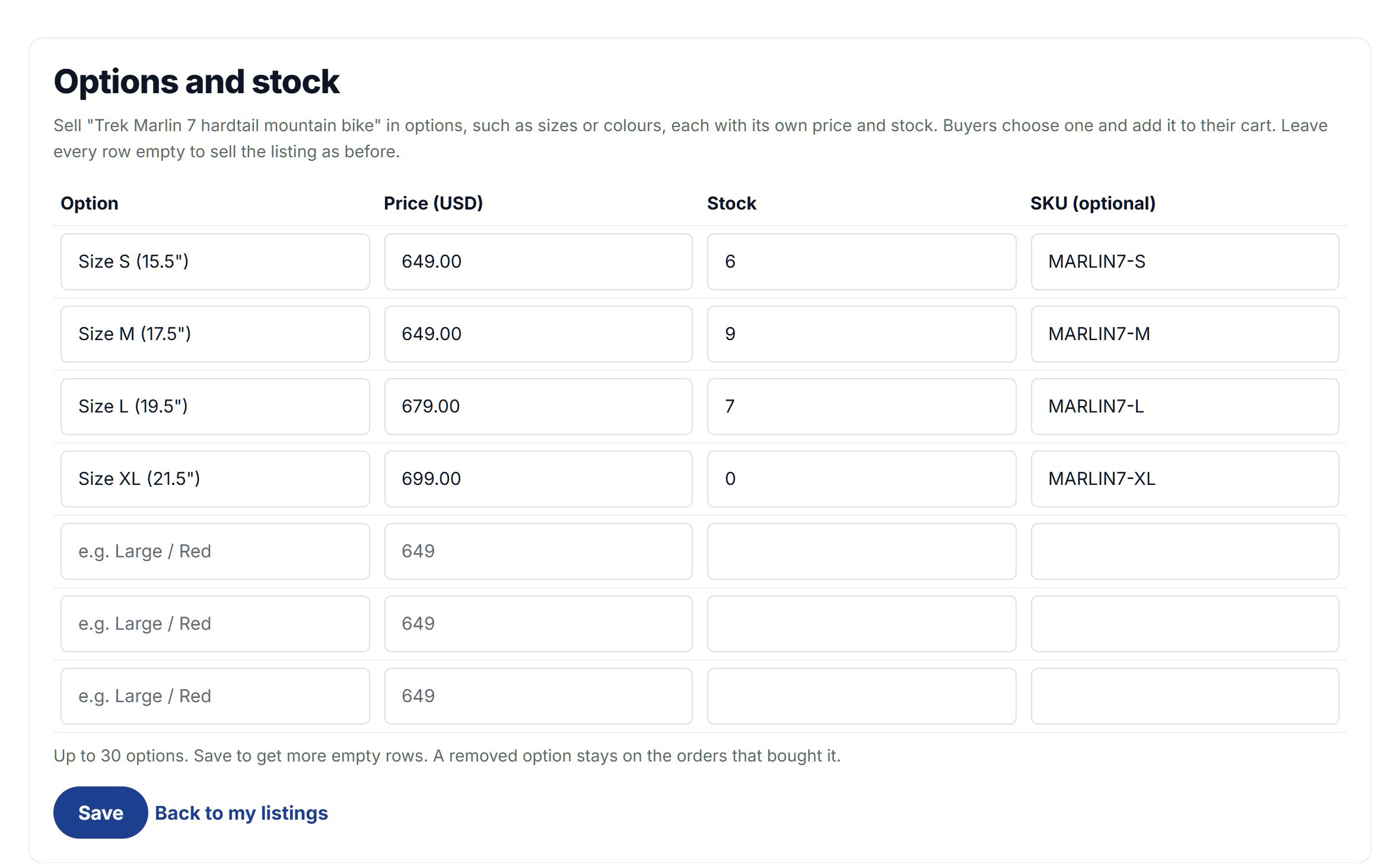
Buyers pay on the site with Stripe and you keep a commission on each sale. Toy orders are often small, so think about the total a buyer sees: a cheap used puzzle with high shipping looks bad next to the same puzzle at a garage sale. A cart that holds items from several sellers, with shipping set per seller, lets a parent buy a bundle from one seller and pay one shipping charge.
For collectors the picture is different. Prices are higher and a percentage commission earns well, but collectors compare your fees with auction sites closely. Start with a modest commission, below the main alternatives, and keep it the same for everyone at first.
An optional buyer service fee is worth testing only once you can point to what buyers get: checked listings, a clear returns policy, payment on the site.
Paid extras follow the calendar. Makers will pay for featured listings in the weeks before the holidays and before birthdays in the spring. Collectors with large stock buy bumps to push new arrivals. Seller memberships suit toy shops and makers who list every week. Auctions with bidding and Buy now fit rare vintage pieces. Banner spaces can be sold to toy fairs and collector shows.
| Model | Works when | Switch it on |
|---|---|---|
| Commission per sale | Parents and collectors pay on the site | At launch, kept modest because orders are small |
| Featured listings | Makers compete for holiday shoppers | From early autumn, once traffic is steady |
| Seller memberships | Shops and makers list new stock weekly | When a group of sellers lists every week |
| Auctions | Rare vintage toys with uncertain value | When collectors visit often enough to bid |
| Banner spaces | Toy fairs and collector shows want visitors | When you have regular traffic in one hobby |
Find the makers, shops and collectors with toys to sell.
Recruit sellers before you invite buyers. Where you look depends on the angle you chose.
- Handmade toy makers. Craft fairs, Christmas markets and makers on Etsy and Instagram. Many want a second place to sell that is only about toys.
- Independent toy shops. Ask about overstock and last season's lines. A shop with a few boxes of discontinued sets will often list them online gladly.
- Parent groups. Local buy and sell groups for parents are full of people clearing toys. A community organizer or a twins club can bring dozens of sellers at once.
- Collector shows and clubs. Toy fairs, die-cast clubs and building set user groups hold the serious collectors and dealers.
- Consignment and secondhand children's shops. They already check and clean used toys and may welcome an online channel.
Make listing quick. Parents will not fill in twenty fields for a used puzzle. With AI listing from a photo, the seller photographs the toy and AI suggests the title, description, category and price for them to check, and they then confirm the age range and small parts box. Shops and collectors with inventory in a spreadsheet can import it as a CSV file.
A parent who finds a full shelf for their child's age comes back. One toy per age range does not bring anyone back.
Take recalls, small parts and fakes seriously from day one.
Toys for children carry safety duties that most marketplaces do not face. In many countries it is not allowed to sell a recalled product, even secondhand, and rules on labeling, small parts warnings and materials vary. Check the rules where you operate, and consider asking a lawyer to read your seller terms.
Safety rules for the site
- Recalls. Tell sellers to check used toys, cribs, car seats and baby gear against the official recall lists in your country before listing. Remove any listing for a recalled item and explain why.
- Small parts. Toys with small parts, loose magnets or button cell batteries are a choking and swallowing hazard for children under three. Require the small parts checkbox and show a warning on those listings.
- Vintage toys. Old toys may contain lead paint or materials no longer allowed in children's products. Sell them as collectibles for adults and say so on the listing.
- Hygiene. Ask that used plush and bath toys be cleaned, or ban used plush for babies.
Fakes and disputes
Counterfeit collectible figures, knockoff building sets sold under the brand name and fake plush are common. Ask for photos of boxes, labels and markings, and remove sellers who list fakes as genuine. Most disputes are about missing pieces, so require a pieces included field and accept returns for sets sold as complete that are not.
Approve every listing at first, use banned words for recalled product names, and let AI hold suspicious listings for review. Keep payments on the site.
Target searches by age, toy type and collector line.
Toy searches split into two groups. Parents search "used toys for 2 year olds", "wooden toys handmade", "secondhand board games" and "montessori toys for toddlers". Collectors search "vintage action figures for sale", "complete set with instructions", "die-cast 1:18 for sale" and "how much is my old toy collection worth".
Pages to build
- Age pages. A page for each age range, with live listings and short notes on what children of that age play with.
- Toy type pages for wooden toys, puzzles, building sets, dolls and outdoor toys.
- Collector line pages for each popular line or era, with a short history.
- Buying guides. How to check a used toy for safety, how to clean secondhand toys, what to look for in a vintage figure.
- Value guides for collectors, built from sold prices on your own site once you have enough sales.
Gift guides do well before the holidays and before birthdays: best gifts for a three year old under a set amount, handmade gift ideas, gifts for adult collectors. Publish them in October, not December, so search engines have time to find them.
Set the SEO title pattern to put the toy name, brand or maker and age range or condition first. Every listing and category has its own page, so these patterns add up fast.

Launch before the holidays, with safety rules already in place.
The toy year peaks between October and December. Launch at least two months before that, so sellers have time to list and buyers can find you when they start shopping. Spring is the second season, with birthdays, spring cleaning and garage sales filling the market with used toys.
Launch checklist
- Pick one angle, such as secondhand toys for families in one country or one collecting hobby.
- Write the safety rules: recalled items banned, small parts warnings, cleaning standards for used toys.
- Sign up ten makers or shops and twenty parent or collector sellers, and help them list.
- Publish a recall checking guide and a used toy safety guide.
- Set up categories with required age range and small parts fields.
- Prepare two gift guides for the coming season.
Events and partners
Craft fairs and holiday markets are the best places to meet toy makers. Collector shows and toy fairs bring the hobby dealers. Parenting groups, nursery and preschool newsletters and secondhand children's shops can reach families. A spring toy swap day, where parents list what their children have outgrown, can bring a wave of listings at once.
Saved searches with email alerts are useful here: a collector waiting for one figure and a parent hunting a particular wooden kitchen both come back when it appears.
Have the safety rules written before the first family listing goes live.
A worked example: North Star Toy Trade, Minneapolis and St. Paul.
North Star Toy Trade is a made-up marketplace that shows one way to run a toy site for families. It covers the Twin Cities metro in Minnesota and focuses on good quality secondhand toys and new toys from small makers in the state. It does not try to serve adult collectors; vintage figures and sealed collectibles are politely turned away to keep the site simple for parents.
The founder is a parent of three who ran the toy table at a church rummage sale for several years. Every spring the same thing happened: families brought car loads of wooden trains, building sets and play kitchens in good shape, and most of it sold for a few dollars or went to a thrift store. Meanwhile, other parents paid full retail for the same toys a month later. Local buy and sell groups helped, but they were chaotic, with no age filters, no safety checks and frequent no-shows at pickup.
Categories
- Baby, 0 to 2 years
- Toddler and preschool, 2 to 5 years
- Pretend play
- Wooden toys
- Big kids, 6 years and up
- Building sets
- Games and puzzles
- Outdoor and ride-on (local pickup only)
- Minnesota makers (new, handmade)
The site serves parents and grandparents buying for children up to about ten, plus a dozen small makers of wooden toys and handmade dolls. Bulky items like balance bikes and play kitchens are pickup only, which suits a metro area where most buyers are a short drive from the seller.
How it started
Before opening to buyers, the founder recruited sellers at two school fundraisers, a mothers of multiples club and a holiday craft market, and set a simple rule: every listing needs an age range, the small parts box, and a note that the item was checked against the recall list. Within six weeks the site had about 600 listings, most created from a single phone photo.
How it makes money
A modest commission on shipped and paid orders is the base. Makers pay for featured listings from October to mid December, and a spring "outgrown it" week, promoted through preschool newsletters, brings a large wave of family listings each April. The founder skipped auctions entirely, since they make little sense for a used puzzle.
| Listing | Price | Key details |
|---|---|---|
| Wooden play kitchen with pots and pans | $75 | Ages 3 and up, gently used, local pickup only |
| Building set, space station, complete with instructions | $38 | Ages 8 and up, all pieces counted, small parts warning |
| Handmade cloth doll with two outfits | $42 | New, Minnesota maker, ages 3 and up, machine washable |
| Wooden train set, 52 pieces with bridge | $55 | Ages 3 and up, gently used, small parts warning |
| Stacking rings and shape sorter bundle | $14 | Ages 6 to 24 months, cleaned, no batteries |
Planning the first 90 days.
The first three months of a toy marketplace are mostly about two things that parents notice immediately: whether there are enough toys for their child's age, and whether the site looks safe. Collectors care about depth in their hobby instead, but the order of work is the same. Sellers and rules come before buyers.
Count backward from the season you want to catch. If the goal is the holiday rush, week one should start no later than early August so that week twelve lands before shoppers begin in late October. If you are aiming for spring clear-outs, start in January. Keep a short weekly list of how many live listings you have in each age range or collector line; the weakest one tells you where to recruit next. In family sites that is usually the eight to twelve range, because toys for older children are kept longer or handed down.
The table assumes a family focused site. A collector site swaps safety guides for completeness guides and parent groups for collector clubs, but follows the same rhythm.
| Weeks | Focus | Done when |
|---|---|---|
| 1 to 2 | Choose parents or collectors, set categories and required age and small parts fields | No listing can be saved without an age range and the small parts answer |
| 3 to 4 | Write safety rules, recall checking steps and a cleaning standard for used toys | The rules page is published and linked from the listing form |
| 5 to 6 | Recruit makers at craft markets and parents through two local groups | Ten makers and thirty parent sellers have signed up |
| 7 to 8 | Help sellers list and fill gaps in thin age ranges | Every age range has at least 50 live listings |
| 9 | Open to buyers through preschool newsletters and one parent group | The first 20 orders or pickups are complete without a complaint |
| 10 to 11 | Publish age pages, a used toy safety guide and a gift guide | All pages are live and each shows current listings |
| 12 | Review sales by age range, returns and empty searches | You have a recruiting list for the age ranges and toys buyers could not find |
Ways to build a toy marketplace.
A toy site needs a few things that general shop software often lacks. Required fields that cannot be skipped, such as age range and a small parts answer, are the most important, because they carry your safety rules into every listing. You also need a cart that mixes sellers, per seller shipping for bulky items next to small ones, a pickup option for ride-ons and play kitchens, and fast listing from a phone for parents who will not type much.
Hiring developers lets you design features like a recall check against an official list or a toy swap credit system. It also takes months and a budget most first time founders do not have, and you will maintain the code and payment security for as long as the site runs.
A marketplace script or WordPress plugin on your own hosting can work if you are technical. Check that it supports required custom fields per category and several sellers in one cart before you build on it, and plan time for updates and backups.
A hosted builder such as Yclas provides required custom fields as filters, listing from a photo, moderation that holds suspicious listings, and checkout with a commission per sale. You trade the freedom to invent unusual features for the time to recruit sellers before the season starts.
For toys, timing often decides the route: the holiday season does not wait for a custom build to finish.
| Route | Fits when | Watch out for |
|---|---|---|
| Custom development | You need recall list checks or swap credits built in | Cost, a build that can miss the holiday season, and ongoing maintenance |
| Self hosted script or plugin | You are technical and want to start cheaply | Missing required fields per category, multi-seller cart add-ons, security updates |
| Hosted builder | You want to launch before a season and spend time on sellers | Limited to the features the platform offers |
What a toy marketplace costs to run.
The software is the smallest part of the bill. Most of the cost is your time in the first months: finding the first listings, answering questions and checking what gets posted.
Set aside money for a lawyer to review your seller terms and toy safety rules, a stall at a craft fair or collector show, and printed cards. Card processing fees from Stripe are deducted from every order.
| Cost | Typical range | On Yclas |
|---|---|---|
| Domain | $10 to $20 a year | Your own, with SSL included |
| Software and hosting | $0 to $100+ a month, plus plugins and updates | Marketplace $149 a month for checkout and commission |
| Design | $0 to $100 for a theme, or a designer | 109 looks included |
| Payment fees | About 3% per payment | Your Stripe or PayPal fees; Yclas takes nothing |
| Your time | 5 to 10 hours a week at the start | Finding listings, moderation, support |
Mistakes that sink toy marketplaces.
- Mixing parents and collectors on one home page. A parent looking for a toddler puzzle does not want to scroll past sealed vintage figures, and a collector does not want baby rattles. Pick one audience for the front page and give the other its own section, or leave it out.
- Making the age range optional. Parents filter by age before anything else. Listings without it vanish from their searches and look careless. Require it in every family category, and use the same ranges printed on packaging so sellers do not have to guess which bucket a toy belongs in.
- Allowing recalled products to slip through. One listing for a recalled sleeper or toy can hurt a child and your reputation in the same week. Ask sellers to confirm a recall check, add banned words for well known recalled product names, and act quickly on reports. Car seats, cribs and sleepers deserve extra caution, and many family sites simply leave them out.
- Launching in December. By the time a new site is found, most holiday shopping is done. Launch in late summer or early autumn so makers and parents can list before buyers arrive.
- Letting shipping swallow small orders. A used puzzle that costs more to ship than to buy will not sell. Encourage bundles, set up local pickup, and ask sellers to group items by age range so families buy several at once. A seller who offers a bundle of five toddler toys for one shipping charge usually sells all five.
- Selling "probably complete" sets. Building sets, board games and puzzles missing a few pieces lead to the most returns. Require a pieces included field and accept returns when a set sold as complete is not.
- Ignoring knockoffs. Cheap copies of branded building sets and plush are sold under the original name on large sites. Ask for box and label photos, remove sellers who misrepresent brands, and tell buyers how to spot a copy. Collectors share lists of known fakes in their clubs, and those lists are worth asking for.
- Treating vintage toys as children's toys. Old toys may not meet today's safety standards. List them as collectibles for adults, say so clearly, and keep them out of baby and toddler categories.
- Charging makers for visibility before the season. A featured listing in a quiet month teaches makers that extras do not work. Start selling them in early autumn, once holiday traffic begins, and show makers how many visitors their category had the week before.
Toy trade terms to know before you launch.
These terms come up in seller questions, collector listings and safety rules.
| Term | What it means |
|---|---|
| Age grading | The age range a manufacturer prints on the package, based on safety and how children play at that age. |
| Small parts | Pieces small enough to be a choking hazard for children under three, which need a warning on the listing. |
| Recall | An official notice that a product is unsafe and should not be used or sold, published by safety authorities. |
| MIB | Mint in box: a collectible that is unused and still in its original box. |
| MOC | Mint on card: a carded action figure still sealed in its original blister pack. |
| NRFB | Never removed from box: the doll or figure has never been taken out, even if the box was opened. |
| Loose complete | A figure or set out of its packaging but with every accessory and piece it came with. |
| Knockoff | A cheap copy of a branded toy, sometimes sold under the brand name to mislead buyers. |
| Playworn | Used and showing normal wear from play, such as scuffs or faded paint. |
| Ride-on | A toy a child sits on, such as a balance bike or push car, usually too bulky to ship cheaply. |
| Open-ended toy | A toy without one set way to play, such as blocks, a favorite with parents and small makers. |
| Button cell battery | A small round battery that is dangerous if swallowed, so the battery compartment should need a screwdriver. |
The same steps for a toy marketplace on Yclas.
- Describe your marketplaceThe setup wizard writes the categories, an About page and example listings from one sentence.
- Add fieldsThe details buyers filter on, as dropdowns, numbers or checkboxes.
- Bring sellersInvite them, import their stock from a spreadsheet, or post for them.
- Set the rulesChoose moderation, verified sellers, reviews and reports.
- Take paymentsOn Marketplace, buyers pay on the site and you keep a commission, with Stripe.
How much should I budget before the first sale?
A few hundred dollars covers a domain, printed cards and a stall at one fair, plus a few hundred more if a lawyer reviews your terms. The real investment is the time spent recruiting sellers.
Can people sell used toys on my marketplace legally?
In many places yes, but recalled products are usually not allowed, and some items such as car seats have extra rules. Check the rules where you operate and ask sellers to check recall lists before listing.
Should I serve parents or collectors?
Pick one to start. Parents need age filters and safety rules; collectors need completeness, packaging and rarity details. You can add the other side later with its own categories.
How do I handle small parts and choking hazards?
Require a small parts checkbox on every listing, show a warning on listings that tick it, and ask sellers to state the age range printed on the packaging.
What commission works for toys?
Keep it modest, because many orders are small and shipping already adds to the total. Collectors selling rare pieces bring higher prices, where the same percentage earns more.
How do I deal with counterfeit toys?
Ask for photos of packaging, labels and markings, remove sellers who list fakes as genuine, and give buyers an easy way to report a listing.
Can my site compete with the big marketplaces?
Yes, by being narrower: honest condition, age filters, checked safety rules and sellers who know toys. Parents and collectors both prefer a site where they do not wade through unrelated items.
Should I allow used stuffed animals?
Many family sites allow them only if they have been washed, and some ban used plush in baby categories. Decide your rule before launch and say it on the listing form so sellers know.
Can sellers list toys that came free with fast food meals or magazines?
Yes, as long as they are described honestly and carry the right age range and small parts answer. Collectors sometimes look for complete sets of these, so a lot listing with a full checklist sells better than single pieces.
Do handmade toy makers need safety testing?
In many countries, toys made for children must meet safety standards and some makers need testing or certificates. The rules depend on where they sell, so ask makers to confirm they comply and check the rules where you operate.
How do I stop no-shows on local pickup?
Take payment on the site when the buyer commits, so a pickup is already paid. Ask sellers to agree a time in on-site messages, and remove buyers who repeatedly fail to collect.
Should I let parents swap toys instead of selling them?
Swaps are popular but hard to run fairly online, since nobody pays and either side can back out. Many sites start with paid listings and run a swap day in person as a community event that also brings in new sellers.
Related pages.
The parts of Yclas this leans on.
You have the plan. Now build the toy marketplace families and collectors come back to.
Describe your site in a sentence and the setup wizard writes the categories, example listings and a look. Free for 15 days, no credit card.
Start my marketplace