How to build a bike parts marketplace where every part fits the bike it is bought for.
This guide covers how to build a marketplace for bicycle components and spares: picking a riding scene, the fit standards buyers filter on, a commission that suits low-priced parts, where the first sellers come from, how to deal with fake carbon and stolen goods, and how to launch around the spring tune-up rush.
Free for 15 days · No credit card · Plans from $19 a month
Sell parts by fit, because that is how riders shop.
A rider looking for a part does not search for "a derailleur". They search for an 11-speed Shimano rear derailleur with a long cage that clears a 46-tooth cog. General sites make them scroll through hundreds of listings that do not fit, and the seller rarely states the axle spacing or the bottom bracket shell. A parts marketplace that asks for the fit details up front saves buyers from the most common and most expensive mistake in this hobby: ordering the wrong standard.
The two sides are clear. Sellers are riders parting out an old bike, shops clearing last season's stock, small makers of chainrings, bags or titanium bits, and co-ops with bins of used spares. Buyers are home mechanics, riders keeping an older bike alive, and people building up a frame.
Pick your angle
- One discipline: mountain bike parts, road and gravel, BMX, or vintage steel road bikes with their own threading quirks.
- One kind of goods: new old stock and vintage components, or small-batch parts from independent makers.
- One region, if you want local pickup of wheels and frames that cost a lot to ship.
Today this trade happens on eBay, Facebook Marketplace and groups, the buy and sell sections of riding sites and forums, and at spring bike swaps in parking lots and school gyms.
Ask for the fit standard on every listing. It is the whole reason a rider picks you.
Keep categories short and put the fit standards in filters.
Use one level of categories that a mechanic would recognize, and let fields carry the detail. The fields that matter differ by part, so set them per category: a wheel needs axle and freehub details, a crankset needs spindle and bottom bracket details, a fork needs steerer and travel.
- Speeds and brand on every drivetrain part, because 10, 11 and 12-speed parts rarely mix and Shimano, SRAM and Campagnolo shift differently.
- Wheel size as a dropdown: 700c, 650b, 29 inch, 27.5 inch, 26 inch, 20 inch.
- Condition with clear steps: new in box, new without box, used with light wear, used with heavy wear, for parts or repair.
- Weight in grams as a number field. Weight-conscious buyers sort by it.
- Material, with carbon as its own value so you can apply extra rules to it.
Add a required checkbox on carbon parts saying the part has not been crashed, and a text field for the original purchase year. Both cut arguments later.
| Category | Example listings | Fields buyers filter on |
|---|---|---|
| Wheels and hubs | Wheelsets, rear wheels, hubs, rims | Wheel size, axle standard (quick release, 12x142, Boost 12x148), freehub body (HG, XD, Microspline), brake type |
| Drivetrain | Derailleurs, cassettes, chains, shifters | Speeds, brand, cassette range, cage length |
| Cranks and bottom brackets | Cranksets, chainrings, BB cups | Bottom bracket standard (BSA threaded, PF30, BB86, T47), crank length, chainring teeth |
| Brakes | Disc calipers, rotors, rim brakes | Mount type, rotor size, hydraulic or mechanical, brand |
| Suspension and cockpit | Forks, shocks, stems, bars, seatposts | Travel, steerer (tapered or straight), seatpost diameter, bar clamp, shock size |
| Frames | Framesets, vintage frames | Frame size, material, wheel size, rear spacing, head tube type |
In Yclas, fields can be text, numbers, dropdowns, checkboxes or dates, required or optional, and each one shows as a search filter.
Price the commission for small parts and big frames alike.
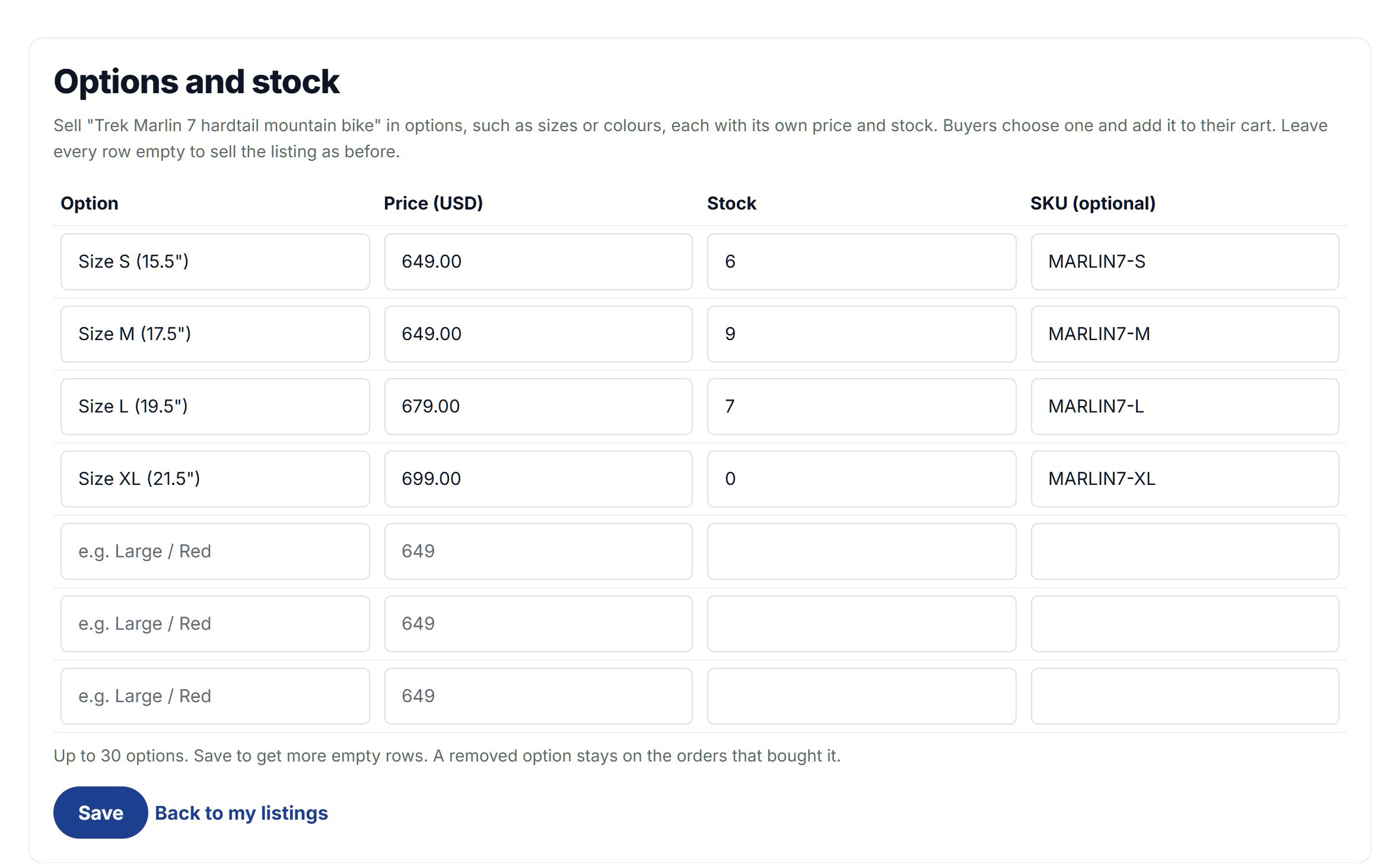
Bike parts range from a few dollars for a cable kit to a few thousand for a carbon wheelset. A single percentage handles both, but keep it modest: riders compare against selling for free in a local group, so the commission has to feel like a fair price for fit-checked buyers and safe card payment, not a toll.
- Commission per sale is the base. Start low while the catalog fills up, and say plainly what it is on the seller sign-up page.
- Buyer service fee: a small fee works once buyers trust the site, but on a ten-dollar part it looks large. Consider leaving it off until listings have higher average prices.
- Seller memberships suit shops and small makers who list dozens of items a month and want lower rates or a shop profile.
- Featured listings and bumps help a rider move a high-value frame or wheelset quickly before the season ends.
Keep listing free at the start. You need depth in every standard before buyers find the part they want, and a fee on listing is the fastest way to keep part-outs elsewhere.
| Model | Works when | Switch it on |
|---|---|---|
| Commission per sale | Buyers pay on the site with a card | From the first part sold, kept modest |
| Buyer service fee | Average order is well above a cable or a chain | After a few months of steady orders |
| Seller memberships | Shops and makers list in volume | When several sellers have more than a few dozen items |
| Featured listings and bumps | Frames, forks and wheelsets compete for attention | Before the spring rush |
| Banner spaces | Local shops and service businesses want riders' attention | Once traffic is steady month to month |
Find sellers with full parts bins and an end-of-season problem.
Bike people hoard parts. Almost every keen rider has a box of take-offs from an upgrade, and every shop has a back room of last year's stock. Your job is to give them a reason to list it with proper fit details.
- Bike shops with overstock, customer take-offs and trade-ins. Offer to load their inventory from a spreadsheet so they do not type every part by hand.
- Community bike co-ops that sell refurbished spares to fund their programs. They bring a lot of affordable used stock and goodwill.
- Small makers of chainrings, bags, titanium bolts, tools and frames who sell at events and on social media.
- Riders parting out bikes, found in local group rides, race clubs and trail associations. One post in a club newsletter can bring in dozens of listings.
- Vintage collectors who know which threading and spindle lengths go with which era and can write detailed listings.
Go to a spring bike swap with a laptop and a card that explains how the site works. Sellers who did not sell everything at the swap are your easiest first listings. Let sellers snap a photo of a part and have the AI listing tool suggest the title, category and price, then add the fit fields themselves.
Deal with fake carbon, stolen parts and fit disputes before they happen.
Counterfeit carbon frames, wheels and handlebars are the best-known risk in this trade. They look right in photos, carry well-known logos and can fail under load. Stolen bikes are also broken down and sold as parts, often in bulk.
- Counterfeits: ask for photos of serial numbers and any warranty card on frames and high-end carbon parts. Hold new sellers' carbon listings for review, and remove listings priced far below the usual range for that model.
- Stolen goods: ask for frame serial numbers on every frame and complete bike, and tell buyers to check them against stolen bike registries before paying. Treat new accounts selling many matching high-end parts as a warning sign.
- Crash damage: carbon can crack where nobody sees it. Make the crash checkbox required and the description of wear honest.
- Fit disputes: most returns come from wrong standards. Write a clear returns policy that separates "not as described" from "bought the wrong standard".
- Batteries and e-bike parts: shipping lithium batteries is regulated in many countries and carriers have their own rules. Before allowing them, check the rules where you operate and with the carriers your sellers use.
- Payment scams: keep payment on the site and tell buyers never to pay a seller off the site.
Rank for the exact part numbers and standards riders type.
Parts searches are precise and often include a model number. That suits a marketplace where every listing has its own page and title, because each part-out adds pages that match real searches.
- "used Shimano XT 12 speed derailleur"
- "Boost 110 front wheel 29"
- "T47 bottom bracket for 30mm spindle"
- "vintage Campagnolo Record crankset"
- "27.2 dropper post used"
Set your title pattern so brand, model and the key standard come first. Then build pages that help people buy the right thing:
- Compatibility guides: which freehub bodies take which cassettes, how to measure a seatpost, how to tell bottom bracket shells apart.
- Standard pages that group every listing for one axle, bottom bracket or wheel size, so a rider can browse only parts that fit.
- Price guides for popular groupsets and forks, built from your own sold listings.
- Upgrade articles: the cheapest way to go 1x on an older mountain bike, or what to look for in a used wheelset.
Riders share good compatibility answers in forums and groups. A clear guide gets linked for years.

Launch before the spring rush and fill one discipline first.
Demand for parts climbs in late winter and early spring as riders fix their bikes for the season. Sellers clear stock in late summer and fall, when shops make room for next year's models and racers sell their old setups. Start recruiting sellers in the fall and winter so the shelves are full when buyers arrive in spring.
First community
Choose one discipline or one city. A mountain bike parts site for one region can fill its categories through two or three trail associations and a handful of shops. Expand to the next discipline once each core category has real choice in the common standards.
Partners
- Bike co-ops and repair cafes that can list donated spares.
- Race promoters and clubs that can mention you in event emails.
- Independent mechanics who can write compatibility guides.
Checklist
- Fit fields set per category, with the key ones required.
- Rules on carbon, serial numbers and batteries written and published.
- Returns policy that covers wrong-standard purchases.
- At least one shop inventory imported and a few hundred parts live.
- Your table at the next spring bike swap booked.
A worked example: Ridgeline Parts Bin on the Colorado Front Range.
Ridgeline Parts Bin is an invented site, used here to show how the steps in this guide fit together for one real region. It serves riders along the Front Range of Colorado, from Fort Collins down through Boulder and Denver to Colorado Springs, an area with dense trail networks, busy gravel routes and a lot of riders who upgrade their bikes every couple of seasons.
Who it serves
Buyers are home mechanics keeping a five-year-old trail bike running, gravel riders converting road bikes, and parents building up kids' bikes from spares. Sellers are riders parting out after an upgrade, four independent shops with trade-in stock, a community bike co-op that funds youth programs from used parts, and two local makers, one of titanium bottle cages and one of frame bags.
Categories
- Mountain
- Wheels and hubs
- Forks and shocks
- Drivetrain
- Road and gravel
- Wheels and hubs
- Groupsets and drivetrain
- Frames and framesets
- Cockpit, seatposts and saddles
- Made locally
How it started
The founder worked weekends as a mechanic at a shop in Golden and kept hearing the same complaint: riders bought a used wheel online and found out at the workbench that the freehub or axle did not match. She set up required fields for wheel size, axle standard, freehub body and speeds before she recruited a single seller. Her first stock came from one shop's spreadsheet of take-offs, about two hundred parts, and from a table at a spring bike swap in a school parking lot, where she helped riders list what they had not sold by lunchtime.
The co-op came next. Its volunteers had bins of tested used derailleurs and brakes but no time to post them one by one, so she imported their list each month and the co-op shared the site with its members in return. By the end of the first winter the site had parts from about sixty sellers, most of them private riders who had heard about it on a group ride.
How it makes money
Buyers pay on the site and Ridgeline keeps a modest commission on each sale, set low enough that riders still prefer it to a free local group. Two shops pay for seller memberships with a lower rate and a shop profile. Riders selling forks and wheelsets before the spring rush buy featured listings, and a local suspension service rents the banner space on the mountain category pages.
The site's whole edge is one rule: no wheel or drivetrain part goes live without its fit details.
| Listing | Price | Key details |
|---|---|---|
| Shimano XT 12-speed rear derailleur, used | $70 | Long cage, light scuffs on the cage, shifts cleanly, take-off from a 2023 trail bike |
| 29 inch aluminum trail wheelset | $320 | Boost 110 front and 148 rear, XD driver, 6-bolt rotors not included, true and tensioned by a shop |
| RockShox Pike 140 mm fork | $390 | 29 inch, tapered steerer cut to 185 mm, Boost, lowers serviced last fall |
| Titanium bottle cage, new | $48 | Made in Boulder by a one-person shop, 28 grams, ships in a padded mailer |
| 1986 steel road frameset, 56 cm | $210 | Lugged, 126 mm rear spacing, Italian-threaded bottom bracket, frame serial number shown in photos |
The first 90 days of a bike parts marketplace.
Time the ninety days so they end just before your riders start fixing bikes for the season. For most northern regions that means starting in late fall, when racers sell last year's setups and shops clear stock, and opening to buyers in late winter.
The first month is about fit, not traffic. If your fields for axle, freehub, bottom bracket and speeds are wrong, every listing you import inherits the mistake, and fixing hundreds of parts by hand later is painful. Test them with a mechanic before you load anything.
The middle weeks are supply: shops, a co-op and riders parting out. Aim for depth in the common standards, such as 12-speed Shimano and SRAM, Boost wheels and threaded bottom brackets, before you worry about rare vintage parts.
Keep a running list of every shop and club you visit, who you spoke to and what they promised, because shop staff change and seasons blur together. Measure three numbers from the start: parts live per category, parts sold per seller, and searches that returned nothing. The empty searches tell you which standards to recruit for next, and they are more useful than any survey of riders.
| Weeks | Focus | Done when |
|---|---|---|
| 1-2 | Pick the discipline and region, write categories, and set fit fields per category with a mechanic | A test wheel, crankset and fork each show the right filters |
| 3-4 | Write rules for carbon, serial numbers, batteries and returns, and set commission and shipping per seller | Rules page and returns policy are published and one test order has gone through |
| 5-6 | Sign the first two shops and import their take-off and overstock spreadsheets | At least 200 parts are live with fit fields filled in |
| 7-8 | Recruit a co-op, a club and two local makers | Every core category has real choice in the common standards |
| 9-10 | Write three compatibility guides and set the listing title pattern | Guides are live and new titles start with brand, model and standard |
| 11 | Book a table at a spring swap and email club and trail association lists | The swap table is booked and two clubs have shared the site |
| 12 | Open to buyers and review every empty search | First outside orders shipped and a list of missing standards to recruit for |
Three ways to build a bike parts marketplace.
A bike parts marketplace needs more structure than most shops: different fit fields for each category, dropdowns that hold dozens of standards, number fields for weight and travel, checkout across several sellers with shipping set by each one, and bulk imports from shop inventories. Those needs decide which route makes sense.
Building it yourself with developers is worth it only if your idea depends on something packages do not do, such as a full compatibility engine that tells a rider whether a cassette fits their exact hub. That is a big data project on its own, because standards change every few years and someone has to keep the tables current.
A marketplace script or WordPress plugin on your own server gives you control and low early costs. Check before you commit that it handles per-category fields, card checkout split across sellers and commission per sale. Many plugins are built for a single store, and bolting on multi-seller payments is where projects stall. You also handle security updates and backups yourself.
A hosted builder such as Yclas suits a founder who would rather spend evenings at shops and swaps than on a server. Custom fields become search filters, spreadsheet imports load a shop's stock, and buyers check out with Stripe. Write your list of fit fields first and confirm each one can be set up before you choose.
On any route, have a working mechanic try to list a part and buy one before you open. If a mechanic gives up halfway through a listing, a rider with a box of take-offs will too.
| Route | Fits when | Watch out for |
|---|---|---|
| Developers build it | You need a real compatibility engine or a tie-in with a shop system | Ongoing cost of keeping standards data current, and a long build before the first sale |
| Script or plugin on your server | You are technical and want full control of fields and code | Multi-seller checkout, commission handling, updates, backups and spam |
| Hosted builder | You want to spend your time recruiting shops and riders | Confirm every fit field and import you need works before you commit |
What a bike parts marketplace costs to run.
The software is the smallest part of the bill. Most of the cost is your time in the first months: finding the first listings, answering questions and checking what gets posted.
Expect to spend on a stolen-bike check service if you want to verify serial numbers in bulk, and on postage scales and boxes if you plan to help small sellers ship. Payment processing fees come out of each sale, so set your commission with them in mind.
| Cost | Typical range | On Yclas |
|---|---|---|
| Domain | $10 to $20 a year | Your own, with SSL included |
| Software and hosting | $0 to $100+ a month, plus plugins and updates | Marketplace $149 a month for checkout and commission |
| Design | $0 to $100 for a theme, or a designer | 109 looks included |
| Payment fees | About 3% per payment | Your Stripe or PayPal fees; Yclas takes nothing |
| Your time | 5 to 10 hours a week at the start | Finding listings, moderation, support |
Mistakes that sink bike parts marketplaces.
- Making fit details optional. Sellers skip anything they can, and a wheel listed without axle or freehub details is useless to the buyer you built the site for. Make the standard fields required in the categories where they decide fit, even if it costs you a few listings. A short help text under each field, such as how to read the freehub type off the hub shell, keeps sellers from guessing.
- Copying a general marketplace's category tree. Deep trees with separate pages for every brand leave most of them empty. Keep one shallow level that a mechanic recognizes and let the filters do the sorting. Brand and model belong in fields and titles, where they help search, not in the menu.
- Treating carbon like aluminum. One counterfeit carbon bar that fails on a descent can end your reputation. Hold carbon listings from new sellers for review and ask for serial and warranty photos. A carbon wheelset at half the usual price is a reason to look closer, not a bargain to promote.
- Ignoring stolen parts. A new account listing several matching high-end forks and wheelsets in one week is a pattern bike theft forums know well. Watch for it, ask for frame serial numbers, and work with local stolen bike groups. Riders whose bikes are stolen search parts listings for their own components, and a site that answers their reports quickly earns goodwill across the whole local scene.
- Charging for every listing. Riders list cheap take-offs only if it costs nothing. A listing fee on a five-dollar chain tool kills the long tail of small parts that brings buyers back. Earn from the sale instead, and keep featured listings as the paid option for sellers who want speed.
- No rule for wrong-standard returns. Without one, every mismatched freehub turns into a fight between buyer and seller. Publish who pays return shipping in each case before your first order. Point sellers to it when they write their listings, so the standard they state is the one they will be held to.
- Opening in late spring. By then riders have already bought what they needed for the season. Recruit sellers through fall and winter and open before the first warm weekend.
- Trying to cover every discipline at once. A site with a handful of BMX, road, mountain and vintage parts each feels empty to everyone. Fill one discipline until a rider usually finds their standard, then add the next.
- Forgetting the people who fix bikes. Mechanics at shops and co-ops are the ones riders ask before they buy anything. If they do not know your site or do not trust its fit details, they will send customers elsewhere. Give them a reason to recommend you: a guide they helped write, or a shop profile that brings in repair work.
- Leaving shipping to chance. Wheels and frames are awkward to box and expensive to send. Give sellers packing guidance, let them set their own shipping, and offer local pickup for large items.
Bike parts terms you will use every day.
Mechanics and riders on your site will use these words without explaining them.
| Term | What it means |
|---|---|
| Take-off | A part removed from a new bike when the owner upgrades, often barely used. |
| Part-out | Selling a complete bike piece by piece instead of as a whole. |
| NOS | New old stock: an older part that was never fitted or used. |
| Groupset | The matched set of shifters, derailleurs, cranks, cassette, chain and brakes from one maker. |
| Freehub body | The part of a rear hub the cassette slides onto, such as HG, XD or Microspline. |
| Thru-axle | A thick axle that threads through the fork or frame, replacing the older quick release. |
| Boost | A wider hub spacing on mountain bikes, 110 mm at the front and 148 mm at the rear. |
| BSA threaded | The common English-threaded bottom bracket shell, also called BSA or English. |
| Press-fit | A bottom bracket whose bearings are pressed into the frame instead of threaded in. |
| Tapered steerer | A fork steerer tube that is wider at the bottom than the top. |
| Cage length | How long a rear derailleur's arm is, which limits the cassette range it can handle. |
| Rear spacing | The width between the rear dropouts, which must match the rear hub. |
| Dropper post | A seatpost that lowers and rises from a lever on the bars while riding. |
The same steps for a bike parts marketplace on Yclas.
- Describe your marketplaceThe setup wizard writes the categories, an About page and example listings from one sentence.
- Add fieldsThe details buyers filter on, as dropdowns, numbers or checkboxes.
- Bring sellersInvite them, import their stock from a spreadsheet, or post for them.
- Set the rulesChoose moderation, verified sellers, reviews and reports.
- Take paymentsOn Marketplace, buyers pay on the site and you keep a commission, with Stripe.
What does it cost to get a bike parts marketplace running?
Beyond the platform, the main early costs are a domain, a little design work and your time recruiting shops and co-ops. Card processing fees are taken per sale rather than up front.
How do I stop counterfeit carbon parts from being sold?
Require serial number photos on frames and high-end carbon, review new sellers' carbon listings before they go live, and remove listings that sit far below normal prices for the model. Ban sellers who list fakes.
Who pays for a part that does not fit?
Decide this in your returns policy before launch. A common approach is that the seller covers returns when the listing stated the wrong standard, and the buyer covers return shipping when they ordered the wrong standard themselves.
Can sellers list e-bike batteries and motors?
Possibly, but lithium batteries are subject to shipping rules that differ by country and carrier. Check the rules where you operate first, or allow batteries only for local pickup.
How do I compete with eBay and Facebook Marketplace?
Do not try to be bigger. Be the place where every listing states its axle, bottom bracket, speeds and wheel size, so a rider can find a part that fits in a minute.
What commission should I charge?
Start low enough that riders do not go back to free groups, and raise it only once buyers come to you on their own. Remember that a percentage on a cheap part is small, so seller memberships may matter more for shops.
Should I allow complete bikes too?
A few complete bikes help with search traffic and part-outs, but keep the focus on parts so filters stay useful. Ask for the frame serial number on every complete bike.
Should I let shops list new parts next to used ones?
Yes, as long as condition is a required field and new parts are clearly marked. New stock fills gaps in common standards, while used and vintage parts are what bring riders back to browse.
How should sellers ship wheels and frames?
Ask them to use a bike shop box or a wheel box, remove skewers and rotors, and pad the dropouts. Large items can also be offered for local pickup, which many riders prefer for frames because they can check the fit and look for damage first.
How many parts do I need before I open?
Enough that a rider searching a common standard usually finds something, which in practice means a few hundred parts across your core categories. Depth in popular standards matters more than a total count, so recruit for the gaps your empty searches show.
Do I need to check who my sellers are?
Check shops and makers before they go live and give them verified seller badges. For private sellers, watch for patterns such as many high-end parts from a new account, and hold their first listings for review.
Can I sell to riders in other countries?
You can, but customs, duties and return costs grow quickly for small parts. Start with domestic buyers and let sellers decide whether to ship abroad once you have steady orders at home.
Related pages.
The parts of Yclas this leans on.
You know the standards. Now build the parts marketplace riders wish they had.
Describe your site in a sentence and the setup wizard writes the categories, example listings and a look. Free for 15 days, no credit card.
Start my marketplace