How to build a local food marketplace that connects farms with nearby households.
This guide covers how to build a marketplace where local farms sell produce, eggs, meat and pantry goods for pickup or delivery: choosing an area, the fields shoppers filter on, a commission farms can accept, recruiting the first growers, food safety and labelling questions, and timing your launch to the growing season.
Free for 15 days · No credit card · Plans from $19 a month
Make it easy to buy from farms that are a short drive away.
Many people want to buy from local farms but cannot make the farmers market on a Saturday morning, and many farms have more to sell than one market stall can move. A local food marketplace lets households order during the week and collect at a set time and place, or have it delivered, while farms see what is sold before they harvest.
Sellers are vegetable growers, orchards, egg and poultry farms, livestock farms selling meat, dairies, beekeepers, and small producers of preserves, bread and flour. Buyers are families who cook at home, people who want to know how their food is raised, restaurants and cafés that buy local, and food co-ops.
Pick your angle
- One county or a ring of farms around one town. Pickup and delivery only work when distances are short.
- One kind of buyer: households, or restaurants and cafés buying wholesale.
- One kind of food: pasture-raised meat in bulk, or produce boxes from several farms.
Today local food is sold at farmers markets, at farm stands, through community supported agriculture shares, by text message lists, and in Facebook groups where farms post what they have each week.
Local food runs on a weekly rhythm: order window, harvest, pickup. Build the site around it.
Show what is in season, how it is sold and where to collect it.
Shoppers want to know three things quickly: is it available this week, how much do I get, and where do I pick it up. Keep categories to the kinds of food a home cook would expect and put the rest in fields.
- Unit: per pound, per bunch, per dozen, per pint, per box. Make it a dropdown so prices are comparable.
- Pickup location and day as dropdowns that match your real pickup points.
- Growing practices as checkboxes, written carefully: certified organic only when the farm holds certification, and neutral wording such as "no synthetic sprays" otherwise.
- Available until as a date field, so shoppers can filter out items whose season has ended.
- Farm location on the map, so shoppers can see how close their food is grown.
Meat shoppers want cut and weight, and bulk buyers want share size, such as a quarter or half. Add those fields only to the meat category.
| Category | Example listings | Fields buyers filter on |
|---|---|---|
| Vegetables and herbs | Salad mix, tomatoes, garlic, mixed boxes | Unit, growing practice, pickup day, available until |
| Fruit | Strawberries, apples, peaches, berries | Unit, variety, pick-your-own or picked, season |
| Eggs and dairy | Pasture-raised eggs, cheese, yogurt | Unit, animal, pasteurized or not, pickup location |
| Meat and poultry | Whole chickens, beef shares, sausages | Cut, weight, share size, frozen or fresh |
| Pantry | Honey, jams, flour, maple syrup | Size, ingredients, allergens |
| Bread and baked goods | Sourdough loaves, pastries | Bake day, ingredients, allergens |
Each field can be a dropdown, checkbox, number, date or text, required or optional, and works as a search filter.
Charge a commission farms can see in their price.
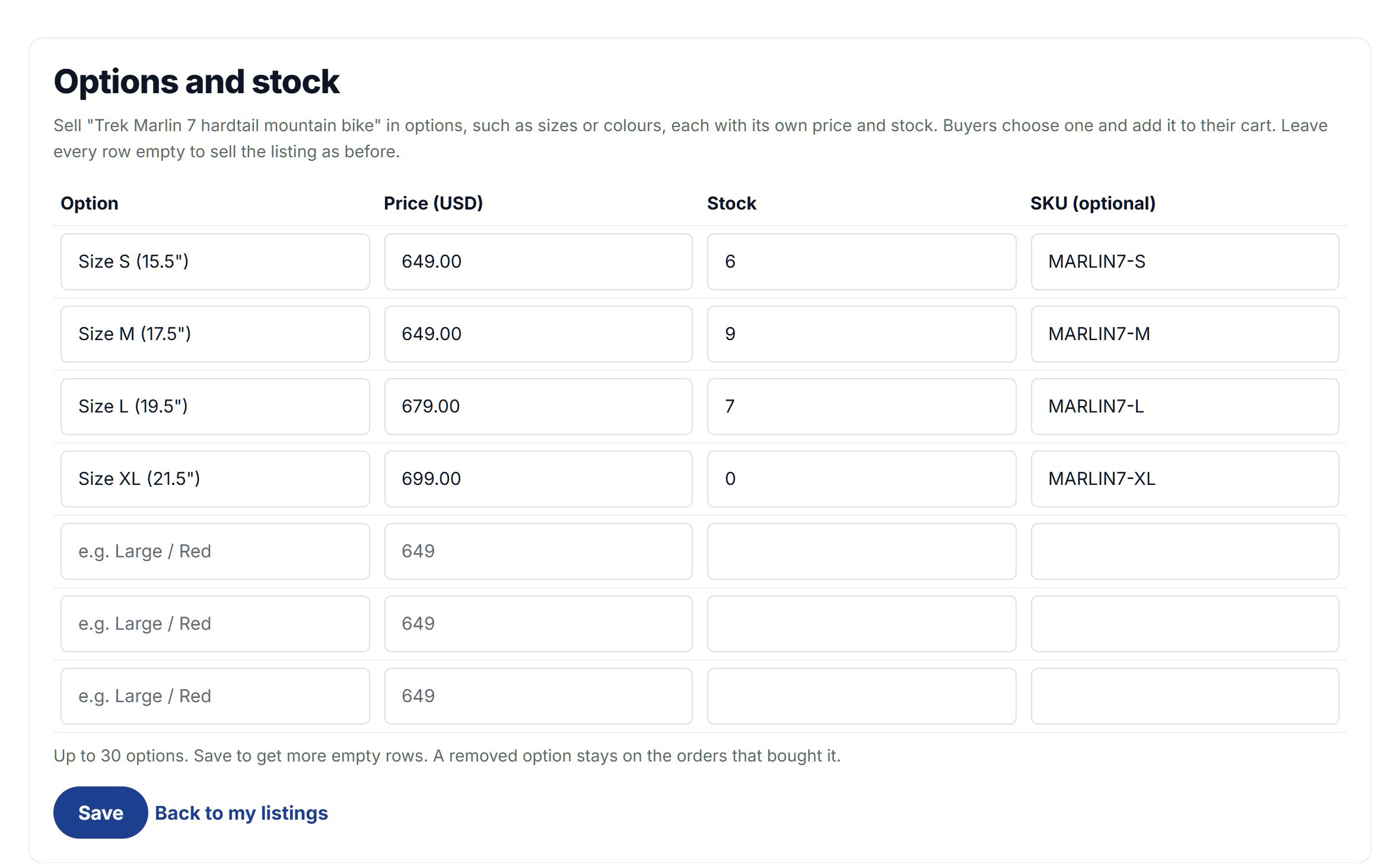
Farms already give up a share to grocery stores and distributors, and they know what a farmers market stall costs them in fees and time. Your commission works when it costs them less than a day at the market for the same sales, or reaches customers the market never would.
- Commission per sale: keep it plain and the same for every farm. Farms set their prices with it in mind.
- Buyer service fee: some local food marketplaces charge households a small fee per order to cover pickup costs. Explain what it pays for.
- Delivery charges: shipping is set per seller, so a farm can charge for delivery while pickup stays free.
- Seller memberships suit larger farms that list every week and want a lower rate.
- Featured listings help the first strawberries, a new batch of honey or a beef share announcement get noticed.
Expect thin margins at first. Many local food marketplaces start as a volunteer or side project and grow into a small business as order volume builds.
| Model | Works when | Switch it on |
|---|---|---|
| Commission per sale | Households order weekly through the cart | From the first order week |
| Buyer service fee | Pickup points have real costs such as rent or staff | Once weekly orders are steady |
| Seller memberships | Several farms list every week of the season | In your second season |
| Featured listings | First harvests and meat shares compete for attention | At the start of each crop's season |
| Banner spaces | Local food businesses and garden centers want shoppers | When traffic is regular year round |
Recruit farms at the market, the stand and the feed store.
Farmers are busy, and many do not enjoy computers. You will sign them up in person, and you may list their products for them at first.
- Farmers market vendors: talk to them at the end of market day, when they know what did not sell.
- Farm stands and pick-your-own farms along local roads, which often struggle to reach buyers on weekdays.
- Community supported agriculture farms with extra produce beyond their shares.
- Extension offices, farm bureaus and young farmer groups, which know which farms sell direct.
- Feed stores and hardware stores with bulletin boards where farms advertise eggs, meat and hay.
Make the weekly routine simple. Offer to load a farm's product list from a spreadsheet they send you, and show them how to take a photo of a crate and let the AI listing feature suggest the title, description, category and price for them to check.
You need range before you open: vegetables, fruit, eggs and at least one meat or dairy farm, so a shopper can fill a real basket.
Respect food safety rules and keep promises about freshness.
Food rules depend heavily on the food and the place. Meat often has to be processed in an inspected facility before it can be sold by the cut. Raw milk is legal in some places, limited in others and banned in some. Eggs, dairy, home-processed goods and anything that needs refrigeration often have their own rules. Check the rules where you operate with your local food authority or agriculture department, and only list categories that are clearly allowed.
- Labels and terms: "organic" is a regulated term in many countries. Only certified farms should use it, and your rules should say so.
- Cold chain: require coolers or refrigeration for meat, dairy and eggs at pickup points, and set a time limit for collection.
- Freshness and substitutions: weather changes harvests. Agree how farms handle missing items: refund the item, or offer a swap the buyer accepts.
- Refunds: produce that arrives spoiled should be refunded. Ask buyers for a photo and keep the process quick.
- Honest claims: verify farms you list as local and remove any seller reselling wholesale produce as their own.
Verified seller badges and farm profiles with photos of the farm help shoppers trust who grew their food.

Rank for local searches with the town and the season in them.
Local food searches are almost always tied to a place, and many are tied to a season. Each farm profile, category and location page can answer one.
- "farm fresh eggs near me"
- "local beef quarter share Wisconsin"
- "where to buy local strawberries in June"
- "raw honey from local beekeepers"
- "vegetable box delivery Asheville"
Set your title pattern to put the product, the farm and the town first. Then build pages for the way people search:
- Town and pickup point pages listing everything available for that pickup.
- Seasonal pages: what is in season this month in your area, with links to the farms that grow it.
- Farm profiles with the farm's story, how they grow or raise their food, and where they also sell.
- Guides: how a beef share works, how to store a vegetable box, how to cook what is in season.
Local news outlets and food bloggers often write about new ways to buy from farms, and a farm profile gives them something to link to.

Open with the first spring harvest and grow through the summer.
The growing season decides your launch. Recruit farms in late winter, when they plan their planting and have time to talk. Open to shoppers when spring greens, eggs and early crops arrive, so there is enough to buy each week, and expect the busiest weeks in summer and around Thanksgiving, when turkeys and holiday baking matter.
First community
Pick one town and one pickup point, such as a café, a church hall or a farm stand. Run a weekly order window, for example orders close on Tuesday night and pickup is Thursday afternoon. Add delivery and more pickup points once the first one is busy.
Partners
- A café or shop that hosts pickup and gains foot traffic.
- The farmers market association, as a complement rather than a rival.
- Local food banks that can take unsold produce.
Checklist
- Allowed food categories confirmed with your local food authority.
- Pickup point, day and cold storage arranged.
- Order window and substitution rules published.
- At least eight farms with a full basket of products.
- A test order picked up end to end.
A worked example: Ridge and Coulee Farm Basket in southwest Wisconsin.
Ridge and Coulee Farm Basket is a fictional marketplace, invented to show how the steps in this guide work together in one real place. It serves the Driftless Area of southwest Wisconsin, a region of steep valleys, small dairy and vegetable farms, orchards and Amish and Mennonite growers, where many farms sell at a Saturday market or a roadside stand and little else.
Who it serves
Buyers are families in La Crosse and the small towns around it who want local food during the week, a handful of restaurants and cafés that buy greens and eggs, and people who moved to the area for its farms but work shifts that clash with market hours. Sellers include six vegetable growers, an apple and berry orchard, two egg and poultry farms, a grass-fed beef farm that sells by the cut and in shares, a small creamery, a beekeeper and a bakery that mills local wheat.
Categories
- Vegetables and herbs
- Weekly mixed boxes
- Single crops
- Fruit
- Eggs, dairy and cheese
- Meat and poultry
- By the cut
- Shares and bulk
- Pantry and bakery
How it started
The founder managed a farmers market for three seasons and watched vendors pack unsold greens back into their trucks every week. She set up one pickup point in the back room of a café in La Crosse, with two chest freezers and a commercial fridge the café owner let her use, and a weekly rhythm: orders open Friday, close Tuesday at 8 p.m., farms harvest Wednesday, pickup Thursday from 3 to 7.
Before signing anyone she called the county health department and the state agriculture department to confirm which foods could be sold this way and what the pickup point needed. Eight farms joined in the first month, most of them vendors from her market. For the two farmers who did not use email, she typed their weekly availability into a spreadsheet on Monday evenings and imported it herself.
How it makes money
Households pay on the site when they order, and Ridge and Coulee keeps a commission on each sale, the same rate for every farm. A small buyer service fee on each order covers the café's share of the electricity and the founder's pickup-day helper. Two farms that sell every week of the season pay for memberships with a lower rate, and the beef farm buys featured listings when it opens bookings for quarter and half shares in the fall.
The pickup room, the freezers and a fixed weekly rhythm mattered more than anything on the website.
| Listing | Price | Key details |
|---|---|---|
| Weekly vegetable box, medium | $32 | Eight to ten items from three farms, pickup Thursday at the café, contents posted each Friday |
| Pasture-raised eggs | $6 | One dozen, mixed brown and blue, refrigerated at pickup, farm 14 miles away |
| Honeycrisp apples | $3 | Per pound, picked this week, orchard sells seconds for sauce at a lower price |
| Grass-fed ground beef | $9 | Per pound, frozen, processed at an inspected facility, farm sells quarter shares in the fall |
| Fresh cheese curds | $8 | 12 oz bag, made Wednesday at a local creamery, keep refrigerated, best within a few days |
The first 90 days of a local food marketplace.
In a local food marketplace the calendar is set by the farms. The best plan starts in midwinter, when growers order seed, plan their beds and have time for a long conversation at the kitchen table, and opens to households when spring greens, eggs and early crops come in.
The first weeks are mostly offline. You need to know which foods your area allows you to sell this way, where pickup will happen, how cold food stays cold, and who staffs pickup day. None of that is a website question, but each answer changes your categories, your fields and your rules.
The middle of the plan is recruiting farms and building a full basket. A household that can only buy lettuce will not come back next week. Aim for vegetables, fruit or preserves, eggs, and at least one meat or dairy farm before you open.
Finish with a dry run. Place real orders with friends and family, run a full order window and pickup day, and time how long packing and handing out orders takes. It is much better to find that the fridge is too small during a rehearsal than on your first busy Thursday. Ask your rehearsal buyers what confused them and change the wording on the site before the first public week.
| Weeks | Focus | Done when |
|---|---|---|
| 1-2 | Confirm allowed foods and pickup point rules with the local food authority and agriculture department | You have a written list of allowed categories and what the pickup point needs |
| 3-4 | Secure a pickup point, cold storage and a weekly order window | Host agreed, fridge and freezers in place, order and pickup days fixed |
| 5-6 | Set categories, unit, pickup, growing practice and available-until fields, and the substitution and refund rules | A test listing shows every filter and the rules page is published |
| 7-8 | Recruit farms at winter meetings, farm conferences and the market association | Six farms have agreed and their product lists are loaded |
| 9-10 | Fill the basket: eggs, meat or dairy, pantry goods, and write the first farm profiles | A shopper can fill a real weekly basket and eight farm profiles are live |
| 11 | Run a full rehearsal with friends and family orders | Orders packed and collected on time, with notes on what to fix |
| 12 | Open to households and announce through the farms, the host and local groups | First public order window closed and every order collected or refunded |
Four ways to build a local food marketplace, from spreadsheet to custom code.
Software is the smaller half of this business, but it still has to fit the weekly rhythm. A local food site needs per-farm listings with units such as per pound or per dozen, a cart that holds items from many farms in one order, a way for farms to charge for delivery while pickup stays free, fields for pickup point and day, and a quick way to update what is available each week, often for farmers who would rather send a list than log in.
Paying developers to build it makes sense if you need things like weighing items after harvest and charging the final weight, packing lists per pickup point, or routes for delivery drivers. Those are useful at a larger scale, but they are also expensive to build and maintain for a single town.
Installing a marketplace script or WordPress plugin on your own server keeps costs low if you are technical. Check that it handles many sellers with commission per sale and per-seller delivery charges, and that weekly updates are not painful. Food hubs that outgrow a basic plugin often find the gaps are in multi-farm payments and bulk updates. You also own hosting, backups and security updates during the busiest weeks of the season.
A hosted builder such as Yclas works for a founder who spends Thursdays handing out crates. Farms' product lists can be imported from a spreadsheet, the fields you need can be set up as filters, and households pay on the site with Stripe. Write out your weekly routine first and check that each step works before you choose.
Whatever you choose, test a full order week with two farms before inviting the rest.
| Route | Fits when | Watch out for |
|---|---|---|
| Developers build it | You need catch-weight pricing, packing lists or delivery routing | Cost and upkeep that a single town's orders may not cover |
| Script or plugin on your server | You are technical and want to adapt it yourself | Multi-farm payments, weekly bulk updates, hosting and backups |
| Hosted builder | You want to spend your time on farms, pickup and customers | Check that units, pickup fields and imports fit your weekly routine |
| Spreadsheet and messages | You are testing demand with a few farms and friends | Errors and missed payments grow fast once orders pass a few dozen a week |
What a local food marketplace costs to run.
The software is the smallest part of the bill. Most of the cost is your time in the first months: finding the first listings, answering questions and checking what gets posted.
Local food has costs other marketplaces do not: coolers or refrigeration at pickup points, possibly rent or staff for a pickup site, and delivery vehicle running costs if you deliver yourself. Talk to your local food authority before you open, since some setups need a permit.
| Cost | Typical range | On Yclas |
|---|---|---|
| Domain | $10 to $20 a year | Your own, with SSL included |
| Software and hosting | $0 to $100+ a month, plus plugins and updates | Marketplace $149 a month for checkout and commission |
| Design | $0 to $100 for a theme, or a designer | 109 looks included |
| Payment fees | About 3% per payment | Your Stripe or PayPal fees; Yclas takes nothing |
| Your time | 5 to 10 hours a week at the start | Finding listings, moderation, support |
Mistakes that empty a local food marketplace.
- Opening with only vegetables. A household wants eggs, fruit and something for dinner, not just greens. If they cannot fill a basket they go back to the supermarket. Recruit for a full basket before you open, even if it means fewer vegetable growers.
- Skipping the call to the food authority. Meat, dairy, eggs and anything kept cold have rules that differ by place, and a pickup point storing them may need its own permit. Finding out after launch can close you for weeks. Ask first and keep the answers in writing, with the name of the person you spoke to and the date.
- A pickup point without cold storage. Coolers in a hot church hall do not keep chicken safe for four hours. Arrange refrigeration and freezers, set a pickup window, and decide what happens to orders that are not collected. A cheap thermometer in each fridge, checked and noted on pickup day, also shows inspectors and buyers that you take it seriously.
- No fixed order window. Farms need to know what is sold before they harvest. Letting people order anytime leads to promised items that are already gone. Pick a closing time and stick to it every week. Households get used to a rhythm quickly, and a reminder email the evening before the window closes keeps orders steady.
- Asking farmers to do everything online. Many will not log in on a Monday night after a long day in the field. Take their lists by text or spreadsheet at first and import them, then show the farms that want more control how to edit their own listings.
- Loose use of "organic". Where the word is regulated, a farm that uses it without certification exposes itself and your site. Let only certified farms use it and offer neutral options such as "no synthetic sprays" for the rest.
- Treating the farmers market as the enemy. Market managers know every farm in the area and can make your recruiting easy or hard. Present yourself as the weekday channel and offer to promote market days on your site.
- Unclear substitution rules. Hail and heat change harvests overnight. Without a published rule, a farm will swap kale for chard and the buyer will feel cheated. Refund missing items by default and allow swaps only with the buyer's agreement.
- Running pickup day alone. Packing, checking off and handing out orders takes longer than founders expect, and one sick day cancels a week. Find a helper or a volunteer rota before your orders grow.
- Letting resellers pass as farms. A seller who buys wholesale produce and lists it as their own harvest undercuts real farms and breaks the promise of your site. Visit every farm before it goes live, or at least ask for photos of fields and animals, and remove anyone who cannot show where the food comes from.
Local food terms you will use every day.
Farmers, market managers and food inspectors will use these words with you.
| Term | What it means |
|---|---|
| CSA | Community supported agriculture: members pay a farm ahead of the season for a regular share of its harvest. |
| Food hub | A business that gathers products from several farms and sells them on to households, shops or restaurants. |
| Aggregation | Collecting products from many farms in one place before orders are packed and handed out. |
| Order window | The days and hours when shoppers can place orders for the next pickup. |
| Drop site | A pickup point where orders are left for buyers to collect, such as a café or a church hall. |
| Cold chain | Keeping chilled or frozen food at a safe temperature from the farm to the buyer. |
| Hanging weight | The weight of a beef or pork carcass before it is cut, often used to price shares. |
| Quarter or half share | Buying a quarter or half of an animal's meat at once, usually at a lower price per pound. |
| Inspected processing | Meat cut and packed at a facility checked by a food safety authority, often required for sale by the cut. |
| Custom-exempt | In the US, meat processed for the animal's owner rather than for retail sale, usually marked not for sale. |
| Seconds | Fruit and vegetables with cosmetic flaws sold more cheaply, often for sauce, jam or canning. |
| Catch weight | Pricing by the actual weight of each item, such as a whole chicken, rather than a fixed price. |
| Certified organic | Grown under a certification program with inspections, where the word organic is regulated. |
| Extension office | A public agricultural advice service, often linked to a university, that knows local farms and rules. |
The same steps for a local food marketplace on Yclas.
- Describe your marketplaceThe setup wizard writes the categories, an About page and example listings from one sentence.
- Add fieldsThe details buyers filter on, as dropdowns, numbers or checkboxes.
- Bring sellersInvite them, import their stock from a spreadsheet, or post for them.
- Set the rulesChoose moderation, verified sellers, reviews and reports.
- Take paymentsOn Marketplace, buyers pay on the site and you keep a commission, with Stripe.
How much does it cost to start a local food marketplace?
The online side is small. The real costs are physical: a pickup point, coolers, and your time on order day. Many start with one borrowed space and a few coolers.
Can farms sell meat and raw milk on my site?
It depends on where you operate. Meat often needs inspected processing before it is sold by the cut, and raw milk rules range from allowed to banned. Check with your local authorities before you allow either.
Do I need a license to run a pickup point?
Possibly, especially if you store meat, dairy or eggs. Check the rules where you operate with the local food authority before you open.
How do I get farmers to use a website?
Meet them in person, list their first products for them, and keep the weekly update simple, even if that means a spreadsheet they send you. Show them their first orders quickly.
Will I compete with the farmers market?
Present yourself as an extra sales channel for weekdays and for shoppers who cannot attend. Many farms sell at both, and markets often welcome anything that brings farms more income.
How should I handle substitutions and missing items?
Publish a rule before launch. Most local food sites refund missing items automatically and only offer swaps that the buyer accepts.
What should the commission be?
Set it so a farm earns more for the same time than at a market stall. Keep it the same for every farm and explain what it pays for.
Should I sell to restaurants as well as households?
Restaurants buy larger amounts and order every week, which helps farms, but they expect wholesale prices, invoices and reliable quantities. Many local food marketplaces start with households and add a restaurant category once supply is steady, with its own minimum order and pickup or delivery day.
What happens to food that is not collected?
Decide before launch. Most sites keep chilled items until the end of the pickup window, then donate them or let the farm take them back, and do not refund buyers who miss pickup without notice.
Can I deliver instead of running a pickup point?
You can, but delivery adds vehicles, routes, time and cold storage on the road. Many sites start with a pickup point and let farms that already deliver set their own delivery charge.
How do I handle prices that change with the harvest?
Let farms update prices and availability each week before the order window opens, and keep units fixed so buyers can compare. Items sold by weight, such as whole chickens, can be listed at a fixed price for a stated weight range.
Is this a full-time job?
At first it is often a part-time job with one very busy day a week, plus recruiting and messages in the evenings. It becomes a full-time business only when order volume and the number of pickup points grow enough to pay for it.
Related pages.
The parts of Yclas this leans on.
You know the season and the farms. Now build the marketplace your town will order from every week.
Describe your site in a sentence and the setup wizard writes the categories, example listings and a look. Free for 15 days, no credit card.
Start my marketplace