How to build a school uniform marketplace parents trust with their children's school.
This guide covers building a marketplace where parents resell outgrown uniforms within one school or a group of schools: picking the schools and getting their blessing, the size and item details parents filter on, a commission that can also support the parent association, finding the first sellers, child privacy and safety rules, the searches parents make, and a launch timed to the back-to-school rush.
Free for 15 days · No credit card · Plans from $19 a month
Start with one school community where uniforms are required and outgrown fast.
School uniforms are a strange product. They are bought new at a high price from a single supplier, worn for a year or two, then outgrown while still in good shape. Every family at the school needs them and nobody outside the school does. That is why a general marketplace works badly: a parent searching for a size 10 plaid jumper with one school's crest will not find it among thousands of unrelated clothes, and a seller has no way to reach the forty families who actually want it.
Pick the scope
- One school. A private, parochial or charter school with a strict uniform. The tightest community and the easiest start.
- A group of schools with the same uniform. Schools in one diocese, one network of charter schools, or a district with a common dress code.
- One town. All schools in one place, with a school dropdown on every listing.
Today the trade runs through the parent association's used-uniform sale, a rack in the school office, class chat groups and hand-me-downs between friends. Those work for the parents who know about them, on the one day a term the sale is open. A site lets families buy and sell all year, and lets new families find sizes before the first day.
The other side of the market is the same parents a year later. That symmetry is useful: every buyer becomes a seller once their child grows.
Talk to the school and the parent association before you build. Their support decides whether parents hear about you.
Let parents filter by school, item and size in one step.
Categories follow the uniform list the school sends home: everyday uniform, gym clothes, outerwear, formal items like blazers, shoes, and accessories such as ties and hair ribbons. Inside each, size is everything. Children's sizes vary between suppliers, so ask sellers for the size on the label and, for the items that matter most, a measurement: chest for blazers, waist and inside leg for pants.
If the site covers more than one school, make school a required dropdown on every listing, so a parent never sees another school's colors. Ask whether name labels have been removed, because many parents want that before buying. Condition should be simple: new with tags, like new, good, worn but usable. Some uniforms changed design over the years; a field for "current style" or "old style" saves arguments.
Price is simple too: ask sellers to show what the item cost new from the supplier, so buyers see the saving at a glance and sellers price fairly.
| Category | Example listings | Fields parents filter on |
|---|---|---|
| Everyday uniform | Navy polo with crest, youth M; plaid jumper, size 10 | School, item, size, condition, current or old style |
| Pants and skirts | Khaki pants, waist 26; pleated skirt, size 12 | Size, waist, length, fit |
| Gym clothes | PE shirt and shorts set, youth S | School, size, house or team color |
| Outerwear and blazers | Wool blazer with crest, chest 32 in | Chest measurement, size, condition |
| Shoes | Black school shoes, size 4 | Size, width, condition |
| Accessories | Striped tie; hair ribbons; school backpack | School, item, condition |
A required "name label removed" checkbox avoids a common complaint and keeps children's names off the site.
Keep fees small and consider sharing them with the school community.
Parents buy used uniforms to save money, so a large cut feels wrong here. A small commission per sale covers the site's costs, and many founders will choose to give part of it to the parent association, which makes the school far more willing to promote the site. Say openly how fees are used; parents in one school talk to each other.
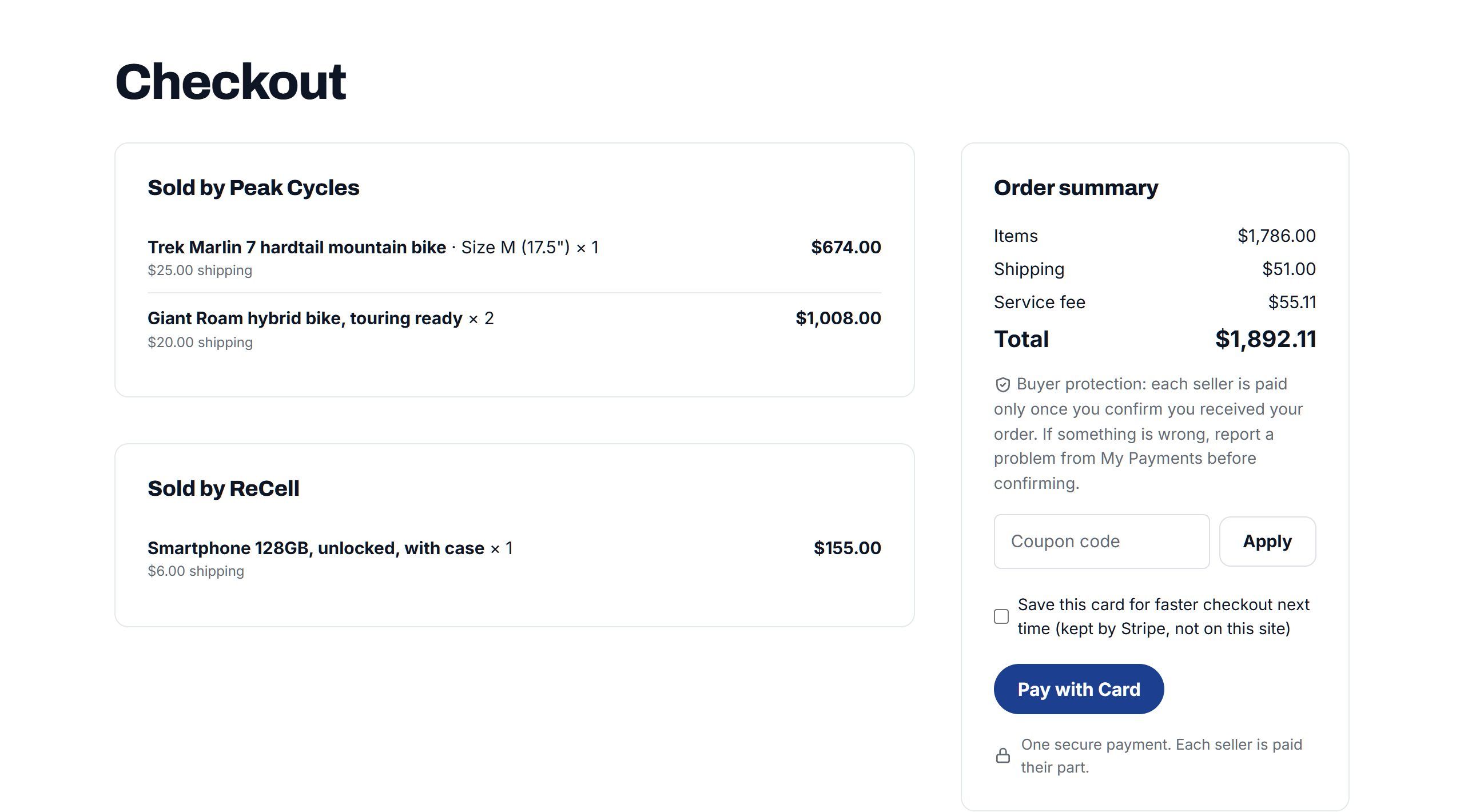
Most sales are handed over at school pickup or at the office, so shipping per seller will usually be zero or a small amount for families who mail items. Checkout means the buyer pays before the handover, which removes the awkward cash exchange at the school gate.
Other options are modest. A buyer service fee of a small fixed amount works if parents see real savings on new prices. Featured listings rarely matter in a single school but can help in a town-wide site in August. Banner spaces fit local businesses that serve families: tutors, children's shoe stores, after-school programs. Seller memberships hardly fit a site where each family sells a few items a year.
| Model | Works when | Switch it on |
|---|---|---|
| Small commission per sale | Parents pay on the site before handover | From the first sale |
| Share of fees to the parent association | The school promotes the site to families | Agree it before launch |
| Small buyer service fee | Used prices are far below new prices | After the first back-to-school season |
| Banner spaces | Family-focused local businesses want parents' attention | When several schools or many families use the site |
| Featured listings | A town-wide site has many sellers in August | Only once categories are crowded |
Collect the outgrown uniforms sitting in closets right now.
Almost every family at a uniform school has a bag of outgrown items at home. The work is getting them listed before the next school year starts.
- The parent association's used-uniform sale. Offer to list the leftover stock from the last sale, or to run the next one online.
- Families of graduating students. Their children will never wear the uniform again, and they often have a full set in several sizes. Ask the school to mention the site in end-of-year messages.
- Class parent representatives. One message in each class chat group reaches every family quickly.
- The school's lost property. Unclaimed items are sometimes given to the uniform sale; with the school's agreement they can be listed too.
- Families with several children. They buy and sell the most, and will tell other parents.
Busy parents will not write long descriptions. The AI listing from a photo helps: a parent photographs a folded blazer, the AI fills in the title, description, category and price, and the parent checks it and adds the size. Run a "listing evening" at the school, where parents bring bags of uniforms and list them together with a volunteer.
Ask graduating families first. They have the most stock and no reason to keep it.
Protect children's privacy and keep handovers safe.
A site tied to a school has to be careful with anything that identifies children. Write the rules down and moderate them strictly.
- No photos of children. Items photographed laid out or on a hanger only. Remove any listing showing a child, a child's face, or a child wearing the uniform.
- No children's names, classes or schedules. Name labels removed or covered, and no listing text such as "my son in 3B can bring it on Tuesday".
- Adult accounts only. Sellers and buyers are parents or guardians. Children should not message strangers through the site.
- Handover on school grounds or a public place. Suggest the school office or pickup time, with the school's permission.
- School logos. The crest belongs to the school. Ask permission to use its name and logo on the site, and do not let anyone sell unofficial copies of crested items.
- Hygiene and condition. Items washed before sale, no damaged or stained items sold as "good". Set a short returns policy for items that are not as described.
- Payment scams. Tell parents to pay only through checkout and never send money by other routes to someone they have not met.
Personal data and children's privacy rules vary by country and state, so check the rules where you operate, especially if you collect anything beyond parents' contact details.
Be the page parents find when they search for their school's uniform.
Most search traffic will be very local and very specific. Parents search with the school's name: "St. Mary's uniform used", "Lincoln Academy uniform sale", "second hand school blazer size 12", "uniform exchange near me" and "where to buy cheap school uniform". Because few sites cover any one school, a good page for a school can rank quickly.
Pages to build
- One page per school, listing every item on its uniform list with what is available now.
- Item and size pages: "Navy blazers, chest 30 to 34 in".
- A uniform guide per school: what is required, what is optional, which items wear out fastest, and which sizes run small.
- A back-to-school checklist with typical used and new costs for a full set, written with parents' own numbers.
Give the school office a short paragraph and the address to include in its welcome pack for new families. That one mention, repeated every year, often sends more visitors than any search ranking.

Launch at the end of the school year, sell in August.
The calendar of a school uniform marketplace is fixed. Families clear out outgrown items as the school year ends, and buy in the weeks before the new year starts. A second, smaller peak comes mid-year when children grow or new families arrive. Launch in the last month of the school year, collect stock over the summer, and let the buying peak find a full site.
First steps
- Meet the principal, the parent association and the official uniform supplier if there is one. Explain that you resell used items only.
- Agree what share of fees, if any, goes to the parent association.
- Hold a listing evening before the summer break.
- Ask the school to include the site in the new family welcome pack.
Launch checklist
- School dropdown and size fields required on every listing.
- Rules on photos, children's names and handovers published and enforced.
- Every new listing approved by hand during the first season.
- Handover points agreed with the school.
- Saved searches with email alerts promoted, so parents hear when their size is listed.
After the first year, add the next school in the same diocese, network or town.
A worked example: Next Size Up, four parish schools in greater Cincinnati.
Take Next Size Up, a fictional school uniform marketplace for four Catholic elementary schools in the suburbs north of Cincinnati, Ohio. The schools share one plaid, one navy sweater and one official supplier, so a jumper outgrown at one school fits a child at any of the others. Only the crest on the sweaters and polos differs, which is why every listing names its school.
How it started
The founder was the parent volunteer who ran her school's used-uniform sale in the gym twice a year. Each sale lasted three hours, drew a line at the door, and left eight bins of unsold items that sat in a closet until the next sale. Parents who worked during the sale never got a chance to buy, and new families who enrolled in July missed it entirely. She asked the principal for permission to try selling the leftover bins online over one summer, photographed every item on a folding table in the library, and opened with two hundred listings. The other three schools asked to join before Christmas, after their own parent associations heard how much of the leftover stock had sold.
Categories
- Everyday uniform
- Polos and blouses
- Jumpers and skirts
- Pants and shorts
- Layers
- Sweaters and cardigans
- Fleeces and blazers
- Gym and sports
- PE shirts and shorts
- Team warm-ups
- Accessories
- Ties and hair ribbons
- Shoes
Who it serves
Buyers are parents of growing children, new families who need a full set before the first day, and grandparents who help with school costs. Sellers are mostly the same families a year later, plus families of eighth graders leaving for high school, who sell everything at once.
How it makes money
Next Size Up keeps a small commission on each sale and gives a fixed part of it to the parent association of the seller's school, which is why every school newsletter mentions the site in August. A small fixed buyer fee per order covers card charges on cheap items like ties. Two local businesses, a children's shoe store and a tutoring center, pay for banner spaces in the back-to-school weeks. The founder does not expect a salary from four schools; she plans to grow to a dozen in the same area before it pays her properly.
Handover happens at the school office, in a labeled bag, on two set afternoons a week agreed with each school secretary. Over the summer, when the offices close, families meet at the parish hall on Saturday mornings instead, with a volunteer checking names against orders.
| Listing | Price | Key details |
|---|---|---|
| Plaid jumper, girls size 8 | $14 (about $48 new) | Current style, name label removed, like new |
| Navy V-neck sweater with crest, youth L | $18 (about $55 new) | Wool blend, light pilling on cuffs, good condition |
| Boys' khaki pants, waist 24, two pairs | $10 for both | Adjustable waist, hemmed once, good condition |
| PE shirt and shorts set, youth S | $8 | Green house color, washed, name label removed |
| Navy blazer with crest, chest 30 in | $35 (about $110 new) | Old style buttons, crest intact, dry-cleaned |
The first 90 days: from the principal's office to a full summer site.
A school uniform marketplace has one calendar and it is not negotiable. Families clear closets in the last weeks of the school year and buy in the weeks before the new one. So start your 90 days about two months before the year ends: the first month for permissions and rules, the second for collecting stock while families are still at school every day, and the third for the summer, when listings keep arriving and new families start looking.
Do not skip the permissions phase to save time. Without the principal and the parent association, you cannot use the school's name, put a flyer in the newsletter or hand items over at the office, and those three things are most of your marketing. Bring a one-page summary of how the site works, how children's privacy is protected and what the parent association receives. Ask, too, who at the school should approve wording that mentions it.
Count progress in listings per size, not in total listings. Fifty polos in size small and none in large looks full on paper and empty to most parents. Keep a simple chart of sizes by item, and ask families with older children to fill the gaps before August.
| Weeks | Focus | Done when |
|---|---|---|
| 1-2 | Meet the school and the parent association | The principal has agreed to the school's name and crest on the site, and the parent association has named a contact |
| 3-4 | Set rules and the fee share | Photo, privacy and handover rules are written, and the share of fees for the parent association is agreed |
| 5-6 | List the leftover sale stock | Every item from the last used-uniform sale is photographed, sized and online |
| 7-8 | Hold a listing evening | Thirty families have listed at least one item, with volunteers helping on the night |
| 9-10 | Reach graduating families | The end-of-year message from the school mentions the site, and eighth-grade families have listed full sets |
| 11-12 | Prepare for August buyers | The site is in the new family welcome pack and the most common sizes have stock |
Ways to build it, judged by privacy, moderation and running costs.
A uniform marketplace is small, local and run by one parent or a few volunteers, so the right route is the one that needs the least looking after. At the same time it carries more responsibility than its size suggests, because it sits next to a school and children. Two features matter more than any design: approving every listing before it goes live, and a required school dropdown so families never see another school's crest.
Building it yourself with developers rarely makes sense for one school. It may make sense for a company serving hundreds of schools, with features like a uniform list per school that marks what is in stock. For a first school, it is time and money spent before you know whether parents will list.
Installing a classifieds or marketplace script, or a WordPress plugin, on your own server can be cheap, but a volunteer-run server that nobody updates is a risk on a site that holds parents' names and addresses. If you go this way, make sure someone is responsible for updates and backups.
A hosted builder such as Yclas removes the server work and lets you approve every listing before it is published, which suits a site where a photo of a child must never slip through. You work within its features, which for most schools is enough, and the hours saved go into the school relationships that make the site work.
A parents' chat group is not a route but a stopgap: it works for a term, then buried messages, cash at the gate and missing sizes push families back to buying new.
| Route | Fits when | Watch out for |
|---|---|---|
| Custom build | You plan to serve many schools with per-school uniform lists | Paying for software before one school has proven the idea |
| Script or plugin on your own server | A parent with technical skills will maintain it long term | Unpatched software holding families' contact details |
| Hosted builder | Volunteers run the site and need moderation without server work | Working within its features rather than custom school tools |
| Parents' chat group | You are testing interest for one term | Lost posts, cash handovers and no search by size |
What a school uniform marketplace costs to run.
The software is the smallest part of the bill. Most of the cost is your time in the first months: finding the first listings, answering questions and checking what gets posted.
Costs are low: printed flyers for the school office and the parent association, perhaps a table at the school fair, and your time at a listing evening. If you share fees with the parent association, plan that share before setting your commission.
| Cost | Typical range | On Yclas |
|---|---|---|
| Domain | $10 to $20 a year | Your own, with SSL included |
| Software and hosting | $0 to $100+ a month, plus plugins and updates | Marketplace $149 a month for checkout and commission |
| Design | $0 to $100 for a theme, or a designer | 109 looks included |
| Payment fees | About 3% per payment | Your Stripe or PayPal fees; Yclas takes nothing |
| Your time | 5 to 10 hours a week at the start | Finding listings, moderation, support |
Mistakes that stop parents trusting a uniform marketplace.
- Launching in September. By the first week of school, families have already bought new. Open before the school year ends, collect over the summer, and be full when August shopping starts. A September launch can still work for the smaller mid-year peak, but it wastes the year's best weeks.
- Going ahead without the school. A site using a school's name and crest without permission can be asked to take it down, and the school will not mention it to families. Get agreement first, even if it takes weeks, and keep the principal's reply on file.
- Letting a single photo of a child through. One listing showing a child in uniform, with the school's name beside it, is enough to lose the parent association's support. Approve every listing by hand and reject any photo with a person in it, even an adult holding the item.
- Listing sizes without measurements. A size 10 from one supplier fits like a 12 from another, and children grow between seasons. Ask for chest, waist or length on the expensive items, or parents will buy, find the fit wrong and ask for a refund.
- Allowing copies of crested items. Someone will offer cheaper unofficial polos with a sewn-on logo. That puts you in conflict with the school and its supplier. Only allow genuine used items, and remove copies at once.
- Charging fees that eat the saving. A parent who saves $10 on a used sweater will notice a few dollars of fees. Keep fees small, show the new price next to the used price, and say clearly where any fee share goes.
- Competing with the parent association's sale. If you set up against the volunteers who run the used-uniform sale, they will tell every parent to ignore you. Offer to list their leftover stock and share fees with them instead.
- Turning the school office into a warehouse. Bags of uniforms left for collection with no system will soon annoy the secretary. Agree set handover times, labeled bags and a limit on how long items can wait. Thank the office staff often; their goodwill is worth more than any feature.
- Accepting stained or worn-out items. A buyer who receives a shirt with a stained collar will not buy again. Set a minimum condition, ask for photos of collars and cuffs, and remove items that do not meet it. Washed, folded and photographed in daylight should be the standard for every listing.
School uniform terms parents and founders run into.
Words from uniform lists, supplier catalogs and parent chats that your fields and rules should use.
| Term | What it means |
|---|---|
| Crest | The school's emblem, embroidered or printed on blazers, sweaters and polos. |
| Official supplier | The store or company a school appoints to sell its new uniform items. |
| Uniform policy | A school's written list of required and optional items, colors and styles. |
| Dress code | Looser rules on what students may wear, often used by public schools instead of a full uniform. |
| Jumper | In American uniform lists, a sleeveless dress worn over a blouse. |
| Peter Pan collar | A rounded collar that lies close to the neckline, common on girls' uniform blouses. |
| Husky and slim sizes | Wider or narrower cuts of children's sizes, which change how an item fits. |
| Youth and adult sizing | Separate size scales; older students often move from youth XL to adult S or M. |
| Current style | The design a school requires now, as opposed to an older version still being worn out. |
| Spirit wear | Optional school-branded clothing sold for events and casual days, separate from the uniform. |
| House color | A team color assigned to students, often used on gym shirts in schools with a house system. |
| Free dress day | A day when students may skip the uniform, often for a small donation to a cause. |
| Uniform exchange | A swap or resale of used uniforms run by parents or the school. |
The same steps for a school uniform marketplace on Yclas.
- Describe your marketplaceThe setup wizard writes the categories, an About page and example listings from one sentence.
- Add fieldsThe details buyers filter on, as dropdowns, numbers or checkboxes.
- Bring sellersInvite them, import their stock from a spreadsheet, or post for them.
- Set the rulesChoose moderation, verified sellers, reviews and reports.
- Take paymentsOn Marketplace, buyers pay on the site and you keep a commission, with Stripe.
What does it cost to start a uniform marketplace for one school?
Very little beyond the site, some flyers and your evenings. The main investment is time spent with the school and parent association, which is also what makes the site work.
Do I need the school's permission?
To use the school's name and crest, yes, you should ask. Even where it is not strictly required, the school's support decides whether families hear about the site.
How do I keep children safe on the site?
No photos of children, no names, adult accounts only and handovers at school or in public. Approve listings by hand and check the privacy rules where you operate.
Can I make real money from one school?
Probably not much from one school alone; most founders treat the first school as a model and add more schools in the same area. Many share part of the fees with the parent association.
What about the school's official supplier?
You sell used items between families, which is different from selling new uniforms. Talk to the supplier anyway: some are happy for used items to circulate because it keeps families at the school.
How do buyers and sellers swap items?
Most hand over at pickup time or leave items at the school office, with the school's agreement. Sellers can set a shipping price for families who prefer the mail.
What sells best?
Expensive items with crests, such as blazers, sweaters and jumpers, and full sets in common sizes. Shoes and gym clothes sell too, but at lower prices.
Can families give items away for free?
Some families just want outgrown items to go to someone who needs them. Many sites keep a donation rack at the school office or a free day at the listing evening for that, while the online marketplace handles sales. A school counselor can also quietly pass donated sets to families who need them.
Does this work for public schools with a dress code?
It can, but plain navy polos and khaki pants are sold everywhere, so the case is weaker. It works best where items carry a crest, a set plaid or a color only one school uses.
Can the official supplier sell new items on the site?
That is up to you and the school. Some sites welcome the supplier as a seller of new items so families can fill gaps in one place; others keep to used items so the site stays about saving money. Either way, agree it with the school first, because the supplier usually has a contract with it.
What happens when the school changes its uniform?
Add a current or old style field, agree with the school how long older items may still be worn, and tell parents clearly. Old style items often still sell for families with younger children during the change-over years, usually at a lower price that sellers should be told to expect.
What do I do with items that do not sell?
Agree a time limit, such as one school year, after which unsold items are returned to the seller or given to the parent association's donation rack. That keeps the site fresh and the office closet empty. Tell sellers the rule when they list, so nobody is surprised when an item comes back.
Related pages.
The parts of Yclas this leans on.
You have the plan. Now help your school's families pass uniforms on.
Describe your site in a sentence and the setup wizard writes the categories, example listings and a look. Free for 15 days, no credit card.
Start my marketplace