How to build a pre-owned watch marketplace collectors will buy from.
This guide covers how to build a marketplace for pre-owned watches: choosing a corner of the collector market, the reference, condition and box and papers fields buyers filter on, commission on high-value sales, recruiting independent dealers and collectors, handling fakes, frankenwatches and stolen pieces without claiming to authenticate, and launching around collector meetups.
Free for 15 days · No credit card · Plans from $19 a month
Serve the collectors and dealers who trade on trust.
The pre-owned watch trade runs on reputation. Independent dealers, collectors upgrading their collection, watchmakers selling restored pieces and families selling an inherited watch all want buyers who understand what they are looking at. Buyers want a specific reference, in a specific condition, ideally with box and papers, from a seller they can check up on.
Large global platforms list a huge number of watches, mostly from dealers, with fees that suit expensive pieces. Forums and Reddit sales threads work for enthusiasts but leave payment to the two parties, which is where most scams happen. A focused marketplace sits between the two.
Pick your angle
- One price band: affordable mechanical watches, or the mid-range where many collectors spend most of their money.
- One style or era: vintage chronographs, dive watches, military watches, Japanese brands, or independent watchmakers.
- One country or region, with sellers who can meet in person and buyers who avoid import duties and long shipping.
- Watches plus parts: straps, bracelets, original boxes and spare parts for collectors and watchmakers.
Today the trade happens on the big platforms, on eBay, in forum sales corners, at collector meetups and through dealers' own Instagram accounts.
Collectors buy the seller first and the watch second.
Make the reference number the center of every listing.
Collectors search by brand and reference number, then narrow by condition, year and what comes with the watch. Keep categories broad, by style, and let fields do the work.
- Brand as a dropdown and model as text.
- Reference number as a required text field. It is the most useful single piece of information on a watch listing.
- Year as a number, with a checkbox for "approximate" on vintage pieces.
- Box and papers as a dropdown: full set, papers only, box only, watch only. Papers is one of the first filters serious buyers use.
- Movement: automatic, manual wind or quartz.
- Case size in millimeters, case material and lug width for anyone changing straps.
- Last service as a date, and condition from a fixed list: unworn, excellent, light wear, visible wear, needs service.
- Original parts: a checkbox for whether dial, hands and bezel are original, and a text field for anything replaced.
Require photos of the dial, caseback, clasp, side profile, and the papers with any personal details covered.
| Category | Example listings | Fields buyers filter on |
|---|---|---|
| Dive watches | Steel divers, vintage skin divers, tool watches | Reference, case size, water resistance, box and papers |
| Chronographs | Racing chronographs, vintage manual-wind chronographs | Movement, year, original parts, last service |
| Dress watches | Gold and steel dress pieces, small vintage watches | Case material, case size, condition |
| Field and military | Issued military watches, field watches | Year, issue markings, original dial |
| Independent and microbrands | Small-batch watches from independent makers | Brand, edition, box and papers |
| Straps, parts and boxes | Bracelets, original boxes, crowns, links | Lug width, brand, fits reference |
With Yclas custom fields (text, numbers, dropdowns, checkboxes or dates, required or optional) every one of these can be a search filter.
Price your commission for watches that sell for thousands.
Watch sales are few and valuable compared with most marketplaces. A modest percentage on a single sale can be meaningful income, and a percentage that looks small to a buyer can look large to a dealer selling a watch worth several thousand dollars. Many marketplaces in this space use a lower rate on high-value items, or a cap; whatever you choose, publish it before sellers list.
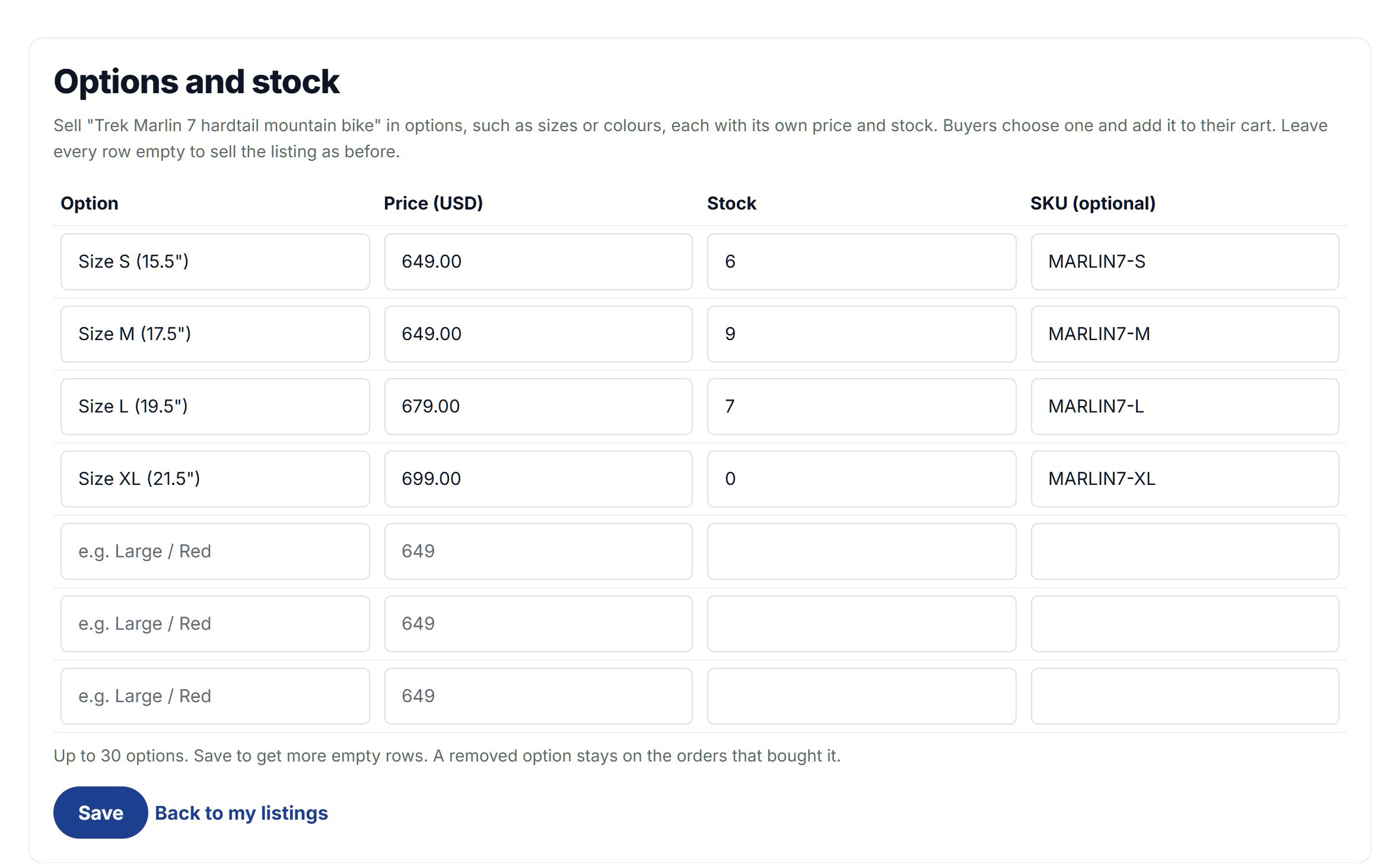
Buyers pay on the site with Stripe, and each seller sets their own shipping, which for watches usually means tracked, signed delivery and the seller's own carrier insurance. Card payments on expensive items carry chargeback risk, which is one more reason to keep good records of every sale.
- Seller memberships fit independent dealers who list many watches and want a lower commission in return for a monthly fee.
- Featured listings suit a rare reference or a full-set vintage piece.
- Banner spaces suit watchmakers, strap makers, watch winder brands and insurers who cover collections.
- Auctions with bidding and Buy now work for rare pieces where the price is hard to set.
Keep listing free. Watch buyers need a deep selection to compare, and a dealer will only list their whole stock if it costs nothing until something sells.
| Model | Works when | Switch it on |
|---|---|---|
| Commission per sale | Watches sell through the site | From day one, with a published rate or cap |
| Seller memberships | Dealers list their whole inventory | When several dealers list regularly |
| Featured listings | Rare pieces compete for attention | Once categories fill up |
| Auctions | Pieces with no clear market price | When you have collectors bidding |
| Banner spaces | Watchmakers and strap makers want collectors | With steady traffic |
Start with independent dealers and serious collectors.
Buyers will not trust an empty watch marketplace. You need a few known dealers early, because their names tell collectors the site is real, and then private sellers who follow them.
- Independent pre-owned dealers, including those who sell mostly on Instagram. Many want a second channel with lower fees than the big platforms.
- Watchmakers and repair shops, who often have restored watches and spare parts, and who meet sellers every week.
- Collector meetups and watch clubs. Go to the local meetings, listen, and invite members who sell regularly.
- Forum sellers with long sales histories, who already trade carefully and would value payment through a proper checkout.
- Estate jewelers and pawn shops with watches they rarely sell to the right audience.
Dealers usually have inventory in a spreadsheet; import it from a CSV file and then ask them to add the photos. Check every early dealer yourself: their address, their history, their reviews elsewhere. Your first sellers set the tone, and one bad dealer early can sink the site.
Ten dealers you have vetted are worth more than a hundred you have not.
Expect fakes, frankenwatches and stolen watches, and plan for each.
The watch market has some of the best counterfeits in any trade, and also subtler problems: real watches with replaced dials, hands or movements, called frankenwatches, redialed vintage pieces sold as original, and stolen watches. State clearly in your terms that the marketplace does not authenticate watches, that sellers are responsible for what they list, and that misdescribed pieces lead to removal.
Rules and moderation
- Ban replicas, "homage" pieces using another brand's name, and anything sold as "style" of a famous model.
- Approve every listing from a new seller, and hold anything priced well under market for review.
- Require the reference number and a statement of which parts are original.
- Use verified seller badges for dealers you have checked, and show ratings and reviews on every seller profile.
Advice for buyers
- Have a watch checked by an independent watchmaker or authentication service, at their own cost, especially for expensive pieces.
- Check the serial number against stolen watch registers where they exist.
- Pay only through the site's checkout, never by wire transfer or through a third-party "escrow" link sent in a message. Fake escrow sites are a known scam in this market.
Agree a returns policy for watches that arrive not as described, and ask sellers for video of the watch running before shipping. Selling counterfeits is illegal in many countries, and so is knowingly selling stolen goods; check the rules where you operate.
Rank for reference numbers, prices and buying questions.
Watch buyers do a lot of research before they spend. They search for reference numbers, prices, and questions about what to buy, and they read long articles. Every listing, category and location has its own page, and a listing with the reference number in its title can rank for that exact search.
- "pre-owned dive watch with box and papers"
- "vintage chronograph for sale"
- "how to spot a fake watch"
- "what is a frankenwatch"
- "watch service cost"
- "best automatic watch under 1000"
Use a title pattern like "Brand Model Reference, year, full set". It reads well and covers the words buyers type.
Pages worth writing
- Reference guides for the models your sellers list most: production years, variations, what to check.
- Price guides based on what has sold on your own site, updated each quarter.
- Buying advice: box and papers, service history, original parts, and how to inspect a watch in person.
- Care guides: water resistance, service intervals, winding, which give watchmakers a natural place to advertise.
Long articles take time to rank, so start writing two months before launch.

Launch through the clubs and meetups where collectors already gather.
Watch collecting is social. Collectors meet at club evenings and brand events, and they talk about new releases every spring, when the big Geneva fair and brand launches bring a wave of attention and trade-ins. Year-end bonuses and the holidays bring more buyers, as do graduations and milestone birthdays.
First community
Start with one city or country where you can attend the meetups yourself. Offer the local club a short talk on buying pre-owned safely, and use it to invite sellers.
Partners
- Independent watchmakers, who can recommend the site and offer inspections to buyers at their own price.
- Watch clubs and collector groups.
- Strap makers and microbrands, who can sponsor guides.
- Local jewelers who take watches in trade and want to sell them on.
Checklist
- Write your rules on replicas, replaced parts and stolen goods.
- Set up the reference, box and papers, original parts and service fields.
- Vet and sign up at least five dealers with real stock.
- Publish the commission, its cap if any, and the returns policy.
- Run two test sales end to end, with signed shipping.
- Write three reference guides and one buying guide.
- Announce at a club meetup and in the forums your sellers use.
A worked example: Sound and Spring Watch Exchange around Puget Sound.
Sound and Spring Watch Exchange is a made-up marketplace, sketched here to show the advice in this guide working together. It covers the Puget Sound region of Washington, where an active watch club scene, a few independent watchmakers and many people buying their first serious mechanical watch all meet. Many of those buyers had been put off by forum sales threads, where payment is left to two strangers and a scam can cost a month's pay.
How it started
The founder bought and sold through forum sales threads for a decade and once lost money to a fake escrow link. He opened with two promises: every dealer on the site is checked in person, and every payment goes through the site's checkout. He signed six independent dealers and two watchmakers he knew from club evenings, imported their stock from spreadsheets, and opened with about three hundred watches, most priced between a few hundred and a few thousand dollars. The first public mention was a short talk on buying pre-owned safely at a club meeting, followed by a sign-up sheet for sellers. Within a few weeks, club members who had only ever sold on forums asked to join, because they wanted the checkout and a public record of their sales.
Categories
- Dive and tool watches
- Chronographs
- Dress and vintage
- Vintage, 1950s to 1970s
- Modern dress
- Japanese brands and microbrands
- Straps, bracelets and parts
Who it serves
Buyers are first-time collectors moving up from quartz, enthusiasts trading within the club, and people who want to see a watch on the wrist before paying, which local sellers arrange through on-site messages before the buyer checks out. Sellers are the vetted dealers, watchmakers selling serviced pieces, and private collectors who build up reviews from earlier sales. Private sellers have their first three listings approved by hand, and any listing priced well under the going rate for its reference waits for a second look.
How it makes money
Buyers pay on the site with Stripe, and the site keeps a commission per sale with a published cap on expensive watches, so dealers know their worst case before they list. Each seller sets shipping, almost always tracked and signed with the seller's own carrier insurance. After six months it added a dealer membership with a lower rate, featured listings for full-set vintage pieces, auctions for two or three rare watches a month, and a banner for a watchmaker who offers pre-purchase inspections at his own price.
| Listing | Price | Key details |
|---|---|---|
| Steel automatic diver, 40 mm, 2019 | $2,350 | Full set, serviced 2024, bracelet with all links |
| Manual-wind chronograph, about 1968 | $3,900 | Original dial and hands, service receipts, watch only |
| Japanese automatic field watch, 38 mm | $310 | Box and papers, light wear, 20 mm lug width |
| Microbrand bronze diver, numbered edition | $720 | Unworn, full set, edition number on the caseback |
| Steel bracelet, 20 mm, original to the brand | $260 | Fits listed references, all links, light polishing |
Your first 90 days, earning trust before traffic.
Trust is what a watch marketplace sells, so the first ninety days are about earning it before any buyer arrives. That means writing strict rules, checking every dealer yourself, and building listings that hold up to collectors who will zoom in on the dial and count the minute markers. Speed matters less than getting the first sellers right: one bad dealer in the first month is remembered for years in a small collector scene.
Tie your opening to a moment when collectors talk and trade, such as a regional club meetup, the spring release season or the run-up to the holidays. Use the middle weeks to write the reference and buying guides that will bring search visitors later, since long articles take months to be found. Keep a record of every dealer check you make, with the date and what you looked at, so you can show sellers and buyers how vetting works when they ask.
Expect the dealer checks to take longer than you plan. Some dealers trade under a name that differs from their company, some work from home by appointment, and a few will decline to be checked at all. Those who decline are a useful signal in their own right, so let them go and spend the time on the next name on your list.
| Weeks | Focus | Done when |
|---|---|---|
| 1-2 | Rules and fields | Rules on replicas, replaced parts and stolen goods are published, and the reference, box and papers and original parts fields are required |
| 3-4 | Dealer vetting | Six or more dealers have been checked by address, trading history and outside reviews |
| 5-6 | Inventory import | Dealer stock is imported and each watch has dial, caseback, clasp and side photos |
| 7-8 | Watchmakers and collectors | Two watchmakers and a dozen private collectors with a sales history have listed |
| 9-10 | Test sales and guides | Two signed-delivery test sales and one return are complete, and three reference guides are live |
| 11 | Soft opening | Club members have bought through checkout and their questions are answered in a buyer FAQ |
| 12 | Club launch | You have presented at a club meetup, published the commission and its cap, and the first outside sale has gone through |
Three ways to build a watch marketplace.
A watch marketplace has a short list of hard requirements: checkout on the site so payments never move to wire transfers, a commission you can publish with a cap or a lower rate for expensive pieces, required fields for the reference number and original parts, detailed photo galleries, seller profiles with reviews, and a way to approve new sellers' listings before they go live. Auctions help with the occasional rare piece, and saved searches with email alerts matter, because collectors wait months for one reference in the right condition.
Building with developers fits a founder planning something specific, such as an in-house inspection service with its own workflow, or a price history database by reference number. It is a long project, and payments involving many sellers and high values carry real risk if done badly.
Installing a classifieds or marketplace script, or a WordPress plugin, on your own server costs little to start, but watches attract skilled scammers, and an out-of-date plugin is an easy way in. You also handle spam, backups and payment setup, and an account takeover on a dealer profile can do lasting damage. If you go this way, plan for two-step sign-in for sellers and regular updates from day one.
A hosted builder such as Yclas provides Stripe checkout with commission, custom fields, listing approval, verified seller badges and auctions, leaving you free to vet dealers and write guides. You accept its feature set in return for not running the technical side, which for most founders in this niche is a good trade: the work that builds a watch marketplace is meeting dealers, not patching servers.
| Route | Fits when | Watch out for |
|---|---|---|
| Developers | You plan in-house inspections or a price database by reference | Cost, time, and the security burden of high-value payments |
| Script or plugin on your server | A technical partner will keep the server patched for you | Outdated plugins, account takeovers and keeping payments secure |
| Forum sales corner or group | You only want to test interest among a club | No checkout, so payment scams stay with the members |
| Hosted builder | You want to focus on vetting dealers and writing guides | Confirm you can publish the commission rate and cap you plan |
What a watch marketplace costs to run.
The software is the smallest part of the bill. Most of the cost is your time in the first months: finding the first listings, answering questions and checking what gets posted.
Budget for vetting dealers, attending collector meetups and writing reference and price guides. Shipping insurance and independent inspections are paid by sellers and buyers, not by the marketplace.
| Cost | Typical range | On Yclas |
|---|---|---|
| Domain | $10 to $20 a year | Your own, with SSL included |
| Software and hosting | $0 to $100+ a month, plus plugins and updates | Marketplace $149 a month for checkout and commission |
| Design | $0 to $100 for a theme, or a designer | 109 looks included |
| Payment fees | About 3% per payment | Your Stripe or PayPal fees; Yclas takes nothing |
| Your time | 5 to 10 hours a week at the start | Finding listings, moderation, support |
Mistakes that stop watch marketplaces.
- Letting anyone sell on day one. A single dealer who ships a fake or a redialed watch can end your reputation in a small collector scene. Vet early dealers yourself and approve new sellers' listings before they appear, even when it slows growth. A slower start with clean sales beats a fast one with a scandal.
- Making the reference number optional. Without it, buyers cannot compare prices or check which variation they are looking at, and listings miss the searches that matter most. Require it, and question listings where it does not match the photos. A mismatch is often an honest typo, and sometimes the first sign of a frankenwatch.
- Allowing payment outside checkout. Wire transfers, friends-and-family payments and escrow links sent by message are where watch buyers lose money. Put a warning on listings and in messages, and remove sellers who push buyers off the site. Repeat the warning in your buyer guides, because new collectors often do not know the pattern.
- Treating homages and replicas as a gray area. Collectors read any hesitation as tolerance of fakes. Decide your homage policy, ban anything with another brand's name or logo, and write the rule where sellers see it when they list.
- Ignoring replaced parts. A watch with a service dial or replacement hands is worth less, and buyers feel cheated when they find out after paying. Make sellers state which parts are original and what has been changed, and when. Service paperwork, where it exists, should be photographed for the listing.
- One percentage for every price. A rate that suits a watch worth a few hundred dollars can push a dealer with a much more expensive piece to sell elsewhere. Publish a cap or a lower rate above a set price before dealers list.
- Leaving shipping to chance. Unsigned parcels lead to lost watches and arguments nobody can settle. Set a minimum: tracked, signed delivery and the seller's own carrier insurance on valuable pieces, with photos of the packed box. Ask sellers to keep those photos until the buyer confirms the watch arrived as described.
- Accepting thin listings. Three blurry photos and a line of text will not sell a watch to a collector. Require dial, caseback, clasp and side photos, a running video on request, and the date of the last service. Good listings also answer the questions collectors always ask, such as whether the bracelet has all its links.
- Skipping content. Watch buyers research for weeks before they spend. A marketplace with no reference or buying guides misses those visitors entirely, so start writing well before launch and add a guide every month.
Watch terms you will hear every day.
Collectors and dealers expect these words to be used correctly on your site.
| Term | What it means |
|---|---|
| Reference number | The maker's code for a specific model and configuration, usually engraved on the case. |
| Full set | The watch sold with its original box, papers and often extra links or tags. |
| Papers | The original warranty card or certificate from the sale, usually showing the serial number. |
| Movement | The mechanism inside the watch: automatic, manual wind or quartz. |
| Caliber | The maker's name or number for one specific movement. |
| Lug width | The gap between the lugs, which decides which straps and bracelets fit. |
| Frankenwatch | A watch assembled from parts of different watches, often sold without saying so. |
| Redial | A dial that has been refinished or repainted, which lowers the value of vintage pieces. |
| Service dial | A replacement dial fitted by the brand during a service, genuine but not original to the watch. |
| Homage | A watch that copies the look of a famous model under its own brand name. |
| NOS | New old stock: an older watch or part that was never sold or used. |
| Patina | The aging of a dial, hands or lume over time, prized by many vintage collectors. |
| Lume | The luminous material on the hands and markers that glows in the dark. |
| Unpolished | A case that still has its factory edges and finish, which collectors pay more for. |
The same steps for a watch marketplace on Yclas.
- Describe your marketplaceThe setup wizard writes the categories, an About page and example listings from one sentence.
- Add fieldsThe details buyers filter on, as dropdowns, numbers or checkboxes.
- Bring sellersInvite them, import their stock from a spreadsheet, or post for them.
- Set the rulesChoose moderation, verified sellers, reviews and reports.
- Take paymentsOn Marketplace, buyers pay on the site and you keep a commission, with Stripe.
How much does it take to launch a watch marketplace?
Mostly time: vetting dealers, writing guides and going to meetups. You never hold watches, so there is no stock to finance, though a small budget for events and ads helps.
Do I need to authenticate the watches?
No, and never claim you do. Make sellers responsible, require reference numbers and original-parts statements, and encourage buyers to use an independent watchmaker or authentication service.
How do I avoid stolen watches on the site?
Vet dealers, ask for proof of purchase on expensive pieces, and suggest buyers check serial numbers against stolen watch registers. Remove any listing reported stolen and cooperate with police.
What commission works for expensive watches?
Many sites use a lower percentage on high-value items or cap the fee. Publish your rate clearly, and make sure dealers can still earn their margin after it.
How can I compete with the big global watch platforms?
Pick a price band, style or country they treat as one of many, vet every seller, and write the guides collectors in that corner want to read.
Should I allow homage watches?
Homages that carry their own brand are legal in many places, but anything using another brand's name or logo is a counterfeit. Many marketplaces put homages in a separate category or ban them to avoid confusion.
What about shipping and customs?
Sellers set their own shipping, usually tracked and signed, with their own carrier insurance. Cross-border sales may carry import duties; check the rules where you operate and tell buyers who pays them.
Should I allow private sellers or only dealers?
Start with vetted dealers, then open to private sellers with clear rules: approval of their first listings, required photos and a visible review history. Many collectors prefer buying from fellow enthusiasts, so private sellers add depth once the rules are in place. Watch the first few sales from each new private seller closely.
How should I handle watches that need a service?
Let sellers list them under a needs service condition, with honest details about what is wrong. Buyers who know watches often look for them, and a clear label avoids disputes with buyers who expected a working piece. Ask the seller to say whether the watch runs, keeps time or needs parts, since a service can cost far more for some movements than others.
Can buyers see a watch in person before paying?
On a local site, yes: buyer and seller can arrange a viewing through on-site messages, and the buyer then pays through checkout. Suggest meeting at a watchmaker's shop or another public place with cameras, and remind both sides never to hand over a watch before the payment shows as complete.
What photos should I require on every listing?
The dial straight on, the caseback, the clasp, the side of the case, and the papers with personal details covered. For vintage pieces, add close views of the dial and hands, and ask sellers for a timing video when a buyer requests one.
Do I need to verify serial numbers?
You cannot check every one, but ask sellers of expensive watches to share the serial number with serious buyers, who can check it against stolen watch registers. Avoid publishing full serial numbers on listings, since they can be copied onto fakes. A photo with part of the number covered is a common compromise.
Related pages.
The parts of Yclas this leans on.
You have the plan. Now build the watch marketplace collectors will recommend.
Describe your site in a sentence and the setup wizard writes the categories, example listings and a look. Free for 15 days, no credit card.
Start my marketplace