
How to build a farm equipment classifieds website that farmers and dealers use.
This guide covers how to build a farm equipment classifieds website for tractors, implements and farm machinery: picking the region and machinery to focus on, the fields farmers filter on, how the site earns money, where the first 100 machines come from, how to keep fake tractor listings out, which searches to target, and how to launch around the farming year.
Free for 15 days · No credit card · Plans from $19 a month
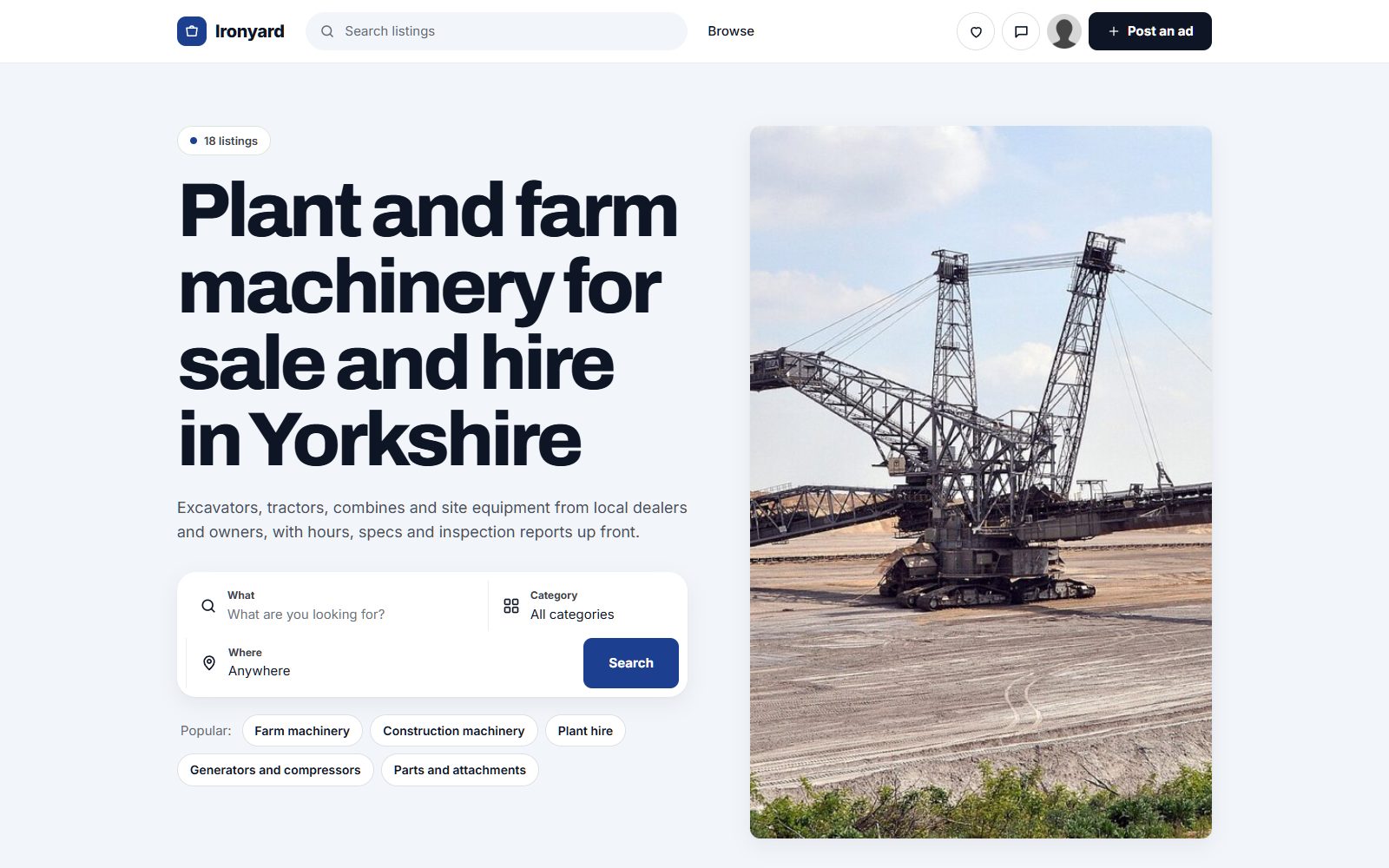
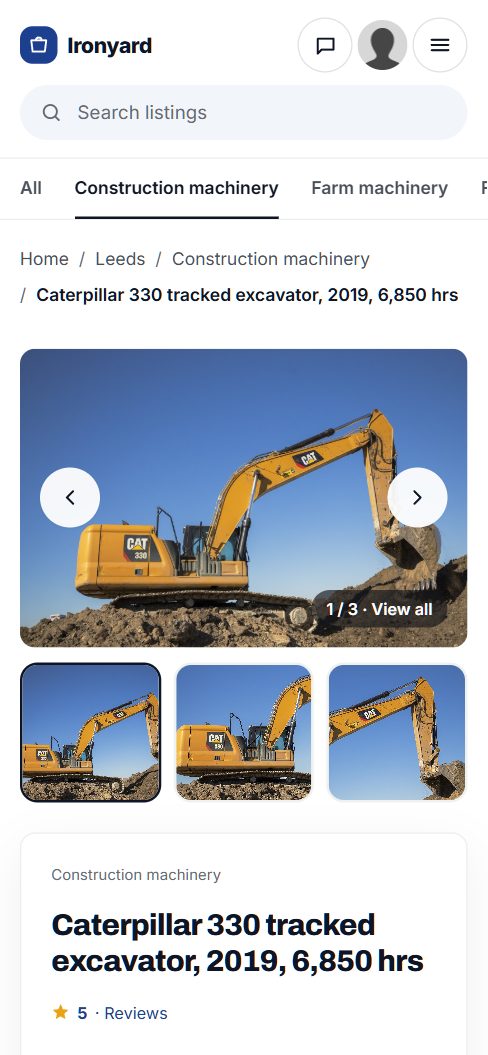
Serve one farming region and the machinery it runs.
Farm equipment is local in a way most people outside farming miss. What a farmer needs depends on the crops, the size of the farms and the ground: a dairy region buys mowers, rakes, balers and feed wagons; a grain region buys planters, combines and grain carts; a vineyard area needs narrow tractors. A site focused on one region and its kind of farming feels relevant from the first visit.
Angles to choose from
- A region: a state, a province, or a group of counties within hauling distance.
- A farm type: small acreage and hobby farms, livestock, row crops, orchards and vineyards.
- A machine type: compact tractors, vintage tractors for collectors, hay equipment, or parts and attachments.
- A buyer: young farmers starting out, small farms wanting older machines without complex electronics, or custom operators.
Today most used farm equipment moves through dealer lots full of trade-ins, farm auctions and dispersal sales, national listing sites such as TractorHouse and Fastline, ag newspapers, Craigslist and Facebook Marketplace, and talk at the co-op. Small farmers and hobby buyers often find the national sites built for dealers and big machinery.
A buyer within an hour's drive is worth ten across the country. Hauling a combine is expensive.
Use the categories farmers use and the numbers they check.
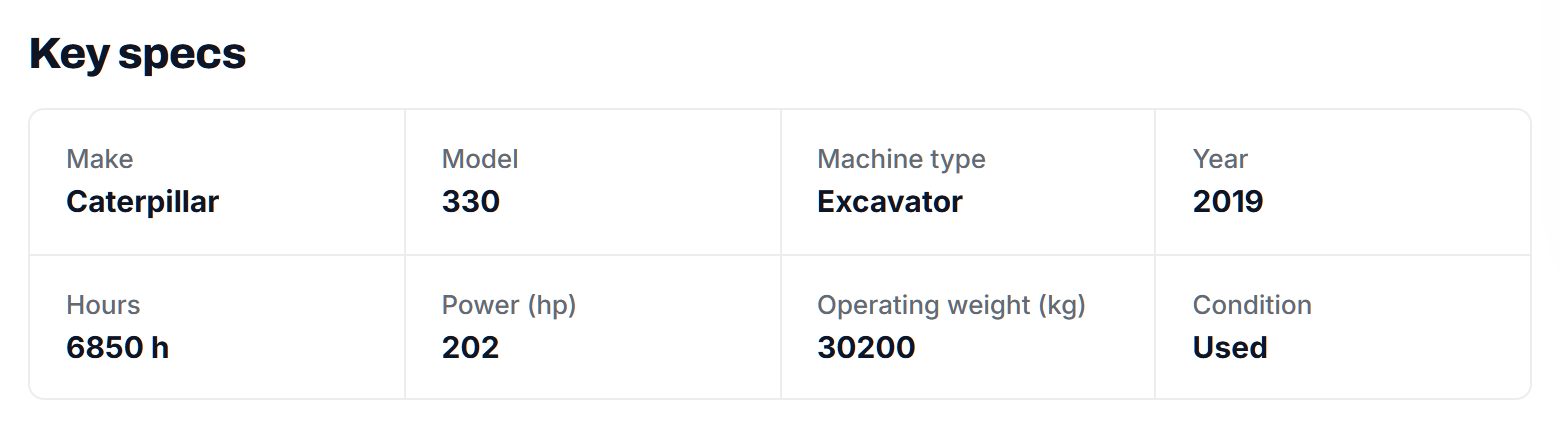
Farmers sort machinery by job: tractors, harvesting, tillage, planting, hay, spraying, livestock. Use those as categories and keep subcategories few. Hours and condition decide value, so make them required fields.
- Hours on the engine as a number, plus separator hours for combines.
- Horsepower, with PTO horsepower where the seller knows it.
- Drive: 2WD, MFWD or 4WD.
- Transmission: gear, powershift, hydrostatic or CVT.
- Cab or ROPS, and whether the cab has air conditioning.
- Working width for implements and headers, and rows and row spacing for planters.
- Hitch and hydraulics: three-point hitch category and number of rear remotes.
For hay equipment, ask for bale type and size, and the bale count where the baler records it. For everything, ask for the serial number, which buyers and their lenders will want to see. A tire condition field, as a percentage, helps too: new tractor tires are a large cost, and buyers price it in.
| Category | Example listings | Fields buyers filter on |
|---|---|---|
| Tractors | Utility, row crop, compact and 4WD tractors | Make, model, year, hours, horsepower, drive, transmission, cab or ROPS |
| Harvesting | Combines, headers, grain carts | Engine and separator hours, header width, crop type, rotary or conventional |
| Tillage and planting | Discs, cultivators, planters, drills | Working width, rows, row spacing, fold type |
| Hay and forage | Mowers, rakes, balers, tedders | Bale type and size, bale count, working width |
| Sprayers and spreaders | Trailed and self-propelled sprayers, manure spreaders | Tank size, boom width, hours |
| Livestock equipment | Feed wagons, gates, chutes, stock trailers | Capacity, condition, pickup location |
| Parts and attachments | Loaders, buckets, tires, weights | Fits make and model, condition |
Yclas field packs set up equipment in one click; add farm fields such as PTO horsepower and separator hours on top.
Start free for farmers, charge dealers and auctioneers later.
Farmers are careful with money and wary of paying to list one machine on a site they have not seen sell anything. Let private sellers post free while you build stock, and make the case to businesses first.
Equipment dealers are the natural paying sellers. They have yards full of trade-ins and already pay for advertising. A seller membership with all their stock, a profile with their location and a verified badge is easy to sell once they get calls. Featured listings suit high-value machines such as tractors and combines, especially in the weeks before a season when buyers are looking.
Farm auctioneers and estate dispersal sales are a second group: they need to show many lots before a sale date, and an online auction with bidding and Buy now can reach bidders who cannot attend. Banner spaces suit the businesses farmers deal with all year: seed and feed suppliers, ag lenders, tire shops, repair shops and haulers.
Dealers pay for calls. Track how many calls and messages each dealer gets before you ask them to pay.
| Model | Works when | Switch it on |
|---|---|---|
| Free private listings | You need stock and farmers who trust the site | From day one |
| Dealer memberships | Dealers list many trade-ins at once | When a few dealers say the site sends them buyers |
| Featured listings | Tractors and combines compete before the season | Before spring work and before harvest |
| Auctions with bidding and Buy now | Dispersal and estate sales need a sale date | When auctioneers want online bidders |
| Banner spaces | Seed, feed, lenders and repair shops want local farmers | When you can show visitor numbers |
Fill the site from dealer yards, auctions and the co-op.
Farm equipment for sale is in plain sight: on dealer lots, at the edge of a field with a sign on it, in sale bills for upcoming auctions. Bring it together in one place.
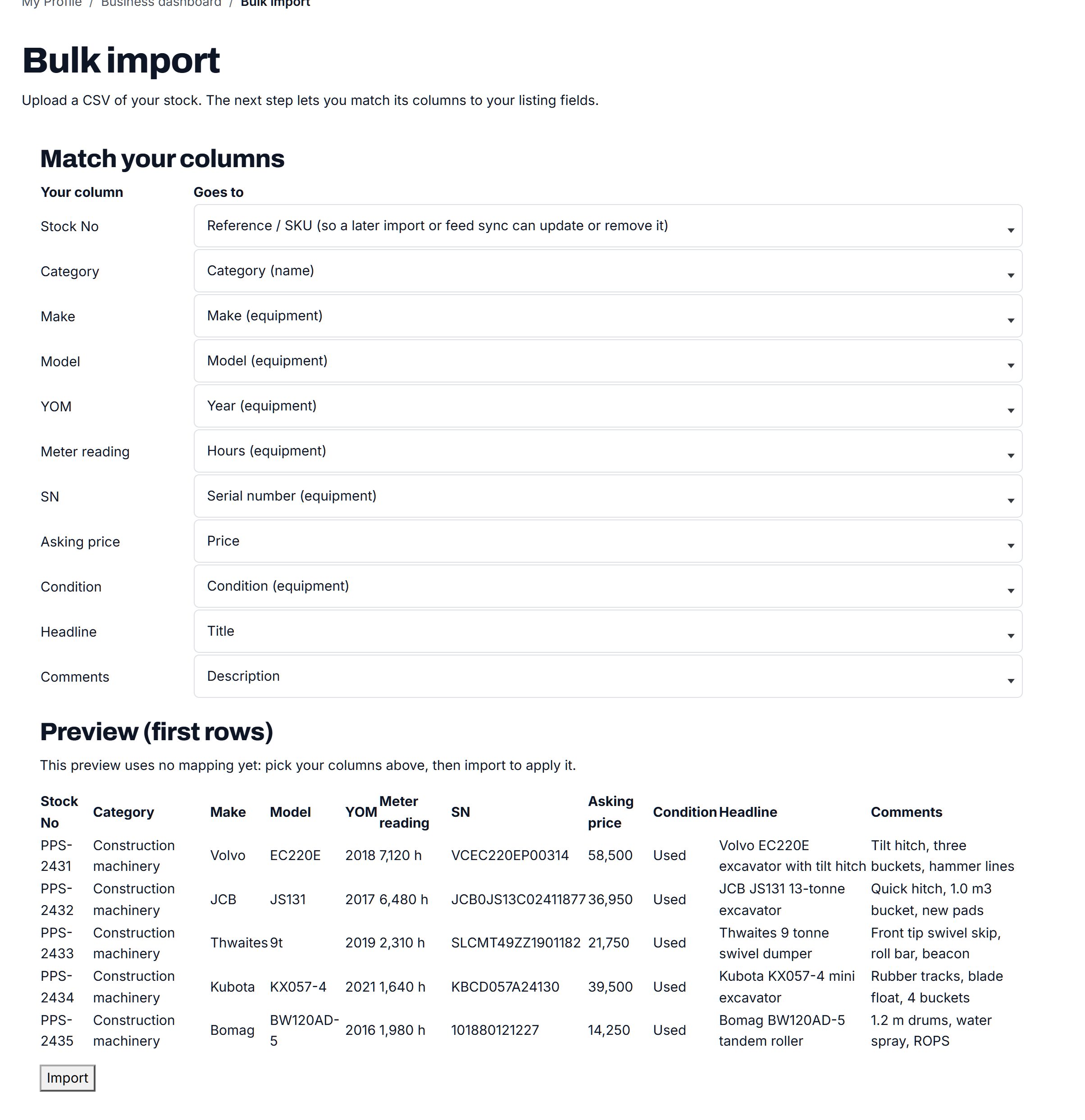
- Dealers. Most keep a stock list of used equipment. Ask for it as a spreadsheet and import it, so every machine appears with hours and specs filled in.
- Auctioneers. Sale bills list dozens of lots. Offer to post upcoming auctions and their main items, which brings buyers back each week.
- Retiring farmers and estates. Families selling a whole line of equipment need help listing it. Offer to do it for them.
- Co-ops, farm stores and ag papers. Notice boards in farm stores carry for-sale cards. Ask permission to list those sellers, and leave cards of your own.
- Repair shops and salvage yards. They have used parts, tires and attachments, and they know who is selling.
- Vintage tractor clubs. Collectors buy and sell old tractors and parts all year, and they turn up at every threshing show.
Many farmers find posting online a chore. Show them how to take a photo and let AI fill in the title, description, category and price for them to check, or post for them over the phone at first.
Keep fake tractor listings and stolen machines out.
Farm machinery has its own well-known scam: a clean, late-model tractor listed at a fraction of its value, often with free delivery, from a seller who says they are away, recently widowed or moving abroad. Payment goes to a fake shipping or escrow company. These listings appear on most farm equipment sites, and farmers lose real money to them.
Stolen equipment is the second risk. Compact tractors, GPS receivers and displays, trailers and attachments are taken from farms and resold far away. Liens are a third: a machine may still be financed when it is offered for sale.
Rules and checks
- Approve every listing at first. Look hard at prices far below similar machines and at sellers who will not talk on the phone.
- Ask for the serial number on tractors, combines and GPS equipment.
- Verify dealers and auctioneers and give them a verified seller badge.
- Let AI hold suspicious listings for review, and ban phrases that show up in the scams.
Advice for buyers
See the machine running before paying, compare the hour meter with the wear on pedals and seat, check the serial number with a dealer of that brand, ask about liens and get a bill of sale. Never pay a shipping or escrow company the seller chose. Lien searches and the rules on farm equipment sales differ by state and country, so check the rules where you operate.
Rank for the make, model and region searches.
Farmers search by make and model and often by area: "John Deere 5075E for sale", "used Kubota tractor near me", "New Holland round baler for sale", "used combines for sale in Iowa", "Massey Ferguson 135 for sale". They also search for answers: "how many hours is a lot for a tractor", "what size tractor do I need for 20 acres".
Pages to build
- Make and model pages for the brands common in your region, with titles like "Used Case IH tractors for sale".
- Location pages by state and county, since hauling distance matters.
- Auction pages listing upcoming farm sales in your area, updated every week.
- Price guides built from your own sold listings: what older utility tractors with high hours ask in your area.
Content ideas: a used tractor inspection checklist, a guide to sizing a tractor for a small farm, what to check on a used combine, and a hay equipment guide for new livestock owners. Set title patterns that add year, make, model, hours and town to every listing title.
Small-acreage owners ask the most questions online. Answer them and they become your buyers.
Launch before the season, one county at a time.
Start where you know farmers: one county or a handful of counties with the same kind of farming. Get two dealers and one auctioneer listing, then tell farmers through the places they already go: the co-op, the feed store, the ag paper and the county fair.
The farming year sets your timing. Winter is buying season for many farmers, with time to plan and dealers clearing trade-ins, and it is when large shows such as the National Farm Machinery Show in Louisville run each February. Demand for planting and tillage equipment peaks before spring work, hay equipment before first cutting, and combines and grain carts in the weeks before harvest. Late summer brings field days and shows such as the Farm Progress Show. Avoid launching in the middle of planting or harvest, when nobody has time to look.
Launch checklist
- Hours, horsepower, drive and serial number as fields on tractors.
- At least 100 real machines, with two or more dealers among the sellers.
- A safety page about fake tractor listings and shipping scams.
- Upcoming auctions listed for your area.
- Make and county pages with their own titles.
- Saved searches with email alerts, so a farmer hears when the right baler comes up.
A worked example: a farm machinery site for small dairy and hay farms.
Take Ridge and Valley Farm Iron, a made-up site for southwest Wisconsin. The area is hilly, the farms are smaller than in the grain belt, and many of them run dairy cows, beef or hay, with a growing number of hobby and organic farms alongside. Buyers want mid-size tractors with loaders, hay equipment, and older machines they can fix themselves. Hauling a tractor across the state for one sale makes little sense when a neighbor two valleys over has what they need.
Categories
- Tractors
- Utility tractors under 100 hp
- Compact tractors
- Vintage tractors
- Hay and forage
- Mowers and conditioners
- Rakes, tedders and balers
- Dairy and livestock equipment
- Parts, tires and attachments
- Upcoming farm auctions
How it started
The founder grew up on a dairy farm and works part time at a farm store, where the notice board is covered in handwritten for-sale cards. She asked the store manager whether she could photograph the cards and call the sellers, and listed the first 35 machines that way. Two dealers in nearby towns sent spreadsheets of their used trade-ins, and a local auctioneer agreed to let her post his sale bills. The auction listings turned out to be the hook: farmers started checking the site every week to see what was coming up, and saw the private listings on the way. Within two months, sellers were calling her before putting a card on the store board.
Hours, horsepower, drive and serial number are required on tractors, and bale size and type on balers. A shed-kept checkbox matters more here than she expected, since buyers know what years outdoors do to a baler. Listings without it get noticeably fewer questions.
How it makes money
Farmers list free. The two dealers pay a monthly membership covering their used stock, with a profile page and a verified badge. Featured listings sell well in the weeks before first cutting, when hay equipment is in demand. The auctioneer pays to feature each sale, and a feed mill and an ag lender rent banner spaces. She keeps the price of a featured listing low enough that a farmer selling a single rake will still consider it.
Weekly auction listings bring farmers back on a schedule, and every visit shows them the private sales too.
| Sample listing | Price | Key details |
|---|---|---|
| 2008 John Deere 5525 MFWD with loader | $38,500 | 3,100 hours, open station, three-point hitch, two rear remotes, tires at about 60 percent |
| New Holland BR7060 round baler | $22,000 | Net wrap, 4x5 bales, around 9,000 bales on the counter, always shedded |
| 1952 Farmall Super M | $4,200 | Runs well, repainted, new rear tires, suits a collector or light chores |
| Kuhn GMD 700 disc mower | $7,500 | Nine-foot cut, low acres, needs one guard replaced, pickup near Viroqua |
| Dairy dispersal auction with full equipment line | Sold by auction | Sale date and lot list posted, online bidding on equipment, preview day the week before |
Ridge and Valley Farm Iron and these listings are fictional and only show how farm fields read in practice.
Your first 90 days with a farm equipment site.
A farm equipment site has to earn trust from people who prefer to do business face to face. Plan the first three months around that: be seen at the places farmers already go, list machines for those who would rather not do it themselves, and show results to dealers before asking them for anything.
Pay attention to the farming calendar when you set dates. The quiet months after harvest and through winter are the best time to sign up dealers and auctioneers, and to post for farmers who finally have time to talk. Planting and harvest are the worst time to ask anyone for anything, so use those weeks to write guides and tidy listings instead. If your 90 days cross a busy season, move the outreach tasks around it rather than pushing through.
Keep a list of every farmer, dealer and auctioneer you speak to, with the machines they mentioned and when they might sell. Equipment decisions often follow a harvest result, a retirement or a change in the herd, and a call at the right time brings in listings that never reach any other site. Note the auction dates in your area as well, since sale days are the easiest place to meet many farmers at once.
| Weeks | Focus | Done when |
|---|---|---|
| 1-2 | Pick the counties and farm type, set up categories and machine fields | Hours, horsepower, drive and serial number are required on tractors, and hay and harvest fields are in place |
| 3-4 | Dealers and their used stock lists | Two dealers have sent spreadsheets, and their machines are live with specs filled in |
| 5-6 | Auctioneers and sale bills | One auctioneer is posting upcoming sales, and the site shows at least two auctions in your area |
| 7-8 | Farm stores, co-ops and private sellers | You have visited five farm stores, left cards, and listed 30 or more machines for farmers |
| 9-10 | Safety page and first guides | The fake tractor warning is published, along with a used tractor inspection checklist |
| 11 | County pages and saved searches | Each launch county has its own page, and buyers are signing up for email alerts |
| 12 | Review and first paid offer | 100 machines are live, and the dealer with the most calls has been offered a membership |
Weigh the ways to build a farm equipment site.
Farm equipment listings are long on specifications and short on patience. A farmer checking the site from the cab of a tractor on a slow phone connection needs fast pages, clear filters for hours and horsepower, and listings that dealers can load in bulk. Use those needs to judge each way of building it.
Having developers build it lets you add things like a live feed from dealer management systems or detailed auction catalogs with lot numbers. It suits a company with dealers already signed up and a budget for a long project. For a founder still proving that farmers in one region will use the site, it takes money and months that would be better spent at farm stores and sales.
Setting up a classifieds script or WordPress plugin on your own hosting keeps the starting cost low. Test it on a phone over a weak connection, check that range filters work for hours and horsepower, and make sure dealer spreadsheets can be imported rather than typed. Plan for the updates, backups and spam control too.
Going with a hosted builder such as Yclas gives you categories, custom fields, imports, moderation and paid extras ready to configure, with the hosting looked after. The limit is that you build within the platform's features, so confirm that it covers the machine fields and auction listings your region needs, and that dealers can send stock as a spreadsheet.
Farmers will not care which route you took. They will care whether the tractor they called about is still for sale.
| Route | Fits when | Watch out for |
|---|---|---|
| Developers build it | Dealers are already committed and you need live feeds from their systems | High cost and long timelines before you know farmers will use it |
| Script or plugin you host | You are comfortable running a server and want control | Slow pages on rural connections, and filters that do not handle hours or horsepower ranges |
| Hosted builder | You want the site running before the next buying season | Check that machine fields and auction listings fit your region before you commit |
What a farm equipment classifieds site costs to run.
The software is the smallest part of the bill. Most of the cost is your time in the first months: finding the first listings, answering questions and checking what gets posted.
Farm-specific costs are mostly local promotion: ads in ag papers and auction sale bills, a table at county fairs and farm shows, and printed cards for co-ops and feed stores. Budget for fuel and time driving to dealers and auctions, since that is where most early listings come from.
| Cost | Typical range | On Yclas |
|---|---|---|
| Domain | $10 to $20 a year | Your own, with SSL included |
| Software and hosting | $0 to $100+ a month, plus plugins and updates | Starter $19 a month, Professional $99 |
| Design | $0 to $100 for a theme, or a designer | 109 looks included |
| Payment fees | About 3% per payment | Your Stripe or PayPal fees; Yclas takes nothing |
| Your time | 5 to 10 hours a week at the start | Finding listings, moderation, support |
Mistakes that sink farm equipment sites.
- Building for the grain belt when your farmers milk cows. A dairy and hay region needs balers, mowers and loaders front and center, not combines and 40-foot planters. Shape categories and guides around the farming that actually happens in your area, and ask a local dealer which machines turn over most often.
- Expecting farmers to post everything themselves. Many will not, at least at first. Offer to list for them over the phone, or from a few photos sent by text, and let the results convince the rest. Send each seller the link once the listing is up, since a farmer who shows it to a neighbor brings the next listing.
- Leaving hours and serial numbers optional. A tractor without hours is hard to price, and one without a serial number is hard to check for liens or theft. Require both and explain why on the listing form: buyers and their lenders will ask for them anyway, and a listing that already answers sells faster.
- Launching in the middle of planting or harvest. Nobody reads a new website when the crop is waiting. Launch in the quiet season, and have the stock in place before buyers start planning.
- Ignoring auctions. Farm auctions are where much used equipment changes hands, and their sale bills bring farmers back weekly. Treat auctioneers as partners, not competitors, and post their sales as early as they will let you.
- Letting fake tractor listings stay up. The too-cheap late-model tractor with free delivery is the scam farmers know best, and one of them on your site tells every visitor you are not watching. Approve listings at first, and remove scams within hours of a report.
- Covering too wide an area. A buyer in one corner of the state does not want a baler four hours away. Start with a handful of counties, and add new ones only when the first are full and buyers there find a real choice in each main category.
- Charging dealers before they get calls. Dealers already pay for advertising and know what it is worth. Track the calls and messages each dealer receives, and offer a membership when the numbers make the case. A dealer who sees a baler sold through your site in a week rarely needs more persuading.
- Forgetting the small-acreage buyer. Hobby farmers and new landowners ask the most questions and often buy older compact and utility tractors. A sizing guide and a glossary win them early, and they become regular buyers and sellers. Many of them trade up within a few years, so the same people return to sell what they bought.
Farm machinery terms worth knowing.
Dealers, auctioneers and farmers use these terms constantly, often in abbreviated form.
| Term | What it means |
|---|---|
| PTO | Power take-off: the shaft that transfers engine power from a tractor to an implement. |
| PTO horsepower | The power available at the PTO shaft, lower than engine horsepower and more useful for sizing implements. |
| MFWD | Mechanical front-wheel drive, a tractor whose front axle can be driven for extra traction. |
| ROPS | Rollover protective structure: the frame that protects the operator on tractors without a cab. |
| Three-point hitch | The rear linkage that mounts and lifts implements, sized in categories by tractor size. |
| Rear remotes | Hydraulic outlets at the back of the tractor that power cylinders and motors on implements. |
| Separator hours | The hours a combine's threshing system has run, separate from engine hours. |
| Hydrostatic | A transmission that uses hydraulic pumps for smooth speed changes without shifting gears. |
| Shedded | Kept indoors when not in use, which slows rust and weather damage. |
| Sale bill | The printed or online list of items in an upcoming farm auction, with date and terms. |
| Dispersal sale | An auction that sells off a farm's whole herd or equipment line, often at retirement. |
| Trade-in | A used machine a dealer took in part payment for a new one, the main source of dealer used stock. |
| Lien | A lender's claim on a machine that still secures a loan, which can follow the machine to a new owner. |
| Loader | A front-mounted lifting arm with a bucket or forks, one of the most requested tractor options on small farms. |
The same steps for a farm equipment classifieds site on Yclas.
- Describe your nicheThe setup wizard writes the categories, an About page and example listings from one sentence.
- Add fieldsSwitch on a field pack or add the fields your buyers filter on.
- Fill itImport dealer spreadsheets, invite sellers and post your own.
- Set the rulesChoose moderation, banned words and AI checks.
- Go liveChoose a plan, connect your domain, switch on paid listings when it is time.
How much does it cost to start a farm equipment classifieds website?
The software and a domain are a modest monthly cost. Most of the cost is time spent visiting dealers, auctions and farm stores, plus some local advertising.
How do I compete with TractorHouse and Craigslist?
Focus on one region and its kind of farming, list local auctions, and make it easy for small farmers and hobby buyers to find older machines nearby.
How do I get dealers to list?
Ask for their used stock list, import it for them and pass on the calls it brings. Charge only once they see results.
Should farm auctions be on the site?
Yes. Upcoming auctions bring farmers back each week, and auctioneers can become paying sellers once they use online bidding.
How do I stop fake tractor listings?
Approve listings, question prices that are too low, ask for serial numbers, verify dealers, and warn buyers never to pay a shipping or escrow company the seller chose.
Do I need to deal with titles or sales tax?
When owners sell their own machines, the paperwork is between buyer and seller, usually a bill of sale. Rules on sales tax, liens and registering road-going equipment vary, so check the rules where you operate before you take payments yourself.
When should I start charging?
Before a busy buying season, once dealers are getting calls: dealer memberships first, then featured listings. Keep private listings free.
Should I include vintage and antique tractors?
Yes, in their own category. Collectors buy and sell all year, they travel to threshing shows and club events, and their listings add steady traffic outside the busy farm seasons.
How do I reach farmers who are not online much?
Go where they already are: farm stores, co-ops, the ag paper and auction days. Offer to list their machines for them, and send them the link afterward so they can show neighbors. A printed card at the feed store with a short web address helps the farmers who rarely browse find you.
Should I list new equipment from dealers?
Used equipment is the core, since that is where farmers search hardest for value. New machines can appear in dealer profiles, but keep the categories focused on used stock so private sellers are not buried.
Can I run online bidding for farm auctions?
Auctions with bidding and Buy now can carry some lots online for auctioneers who want it. Agree on terms, deposits and pickup with the auctioneer first, and check the rules where you operate for running auctions. Start with a few lots from one sale rather than a whole auction.
How do I price featured listings for farmers?
Look at what dealers and auctioneers in your area already pay for ads in the ag paper, and set your featured price well below that. Raise it only when featured listings clearly bring more calls. Featured listings before first cutting and before harvest are the easiest to sell, since buyers are already looking.
Related pages.
The parts of Yclas this leans on.
You have the plan. Now build your farm equipment site.
Describe your site in a sentence and the setup wizard writes the categories, example listings and a look. Free for 15 days, no credit card.
Start my classifieds site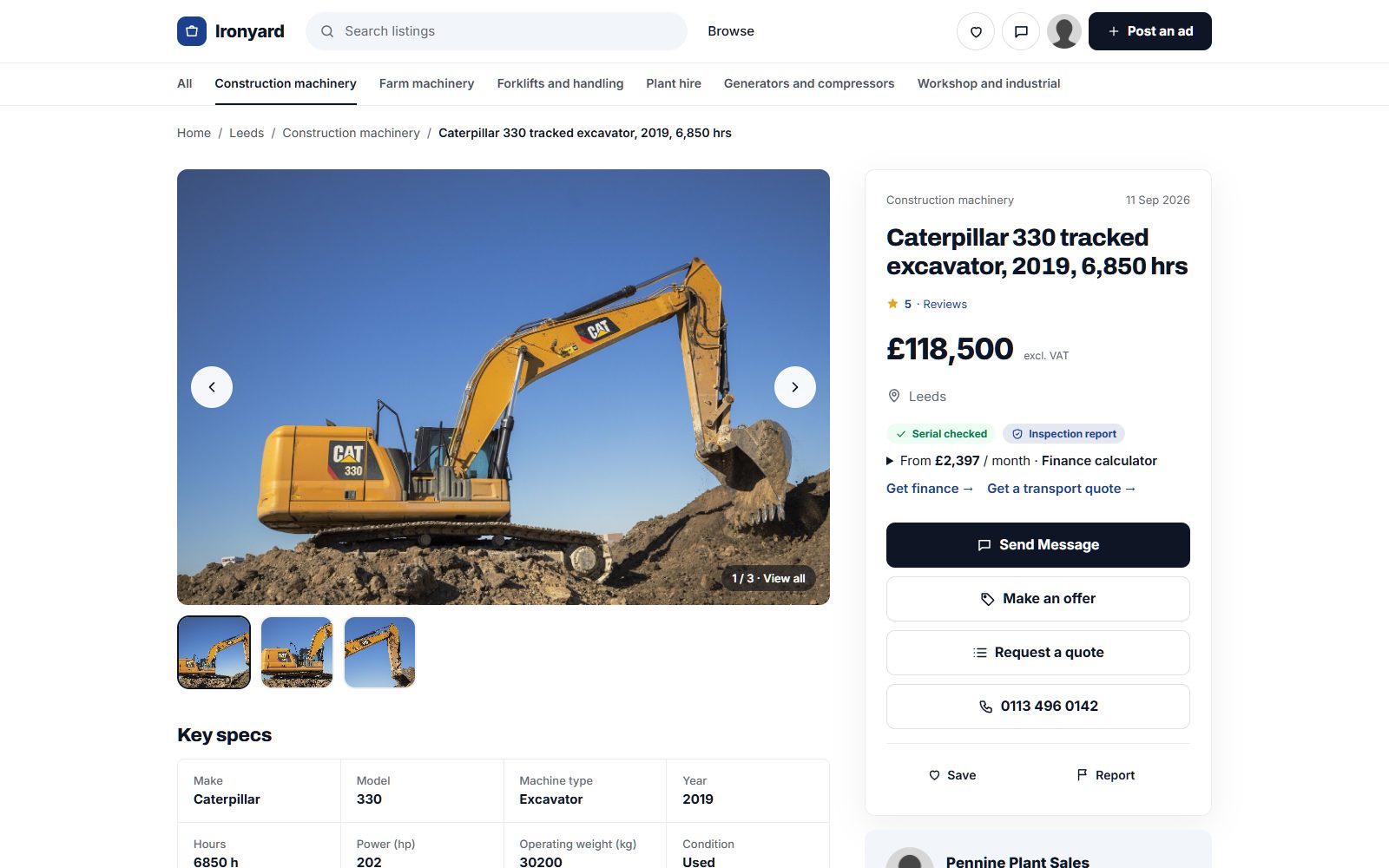
Photo credits
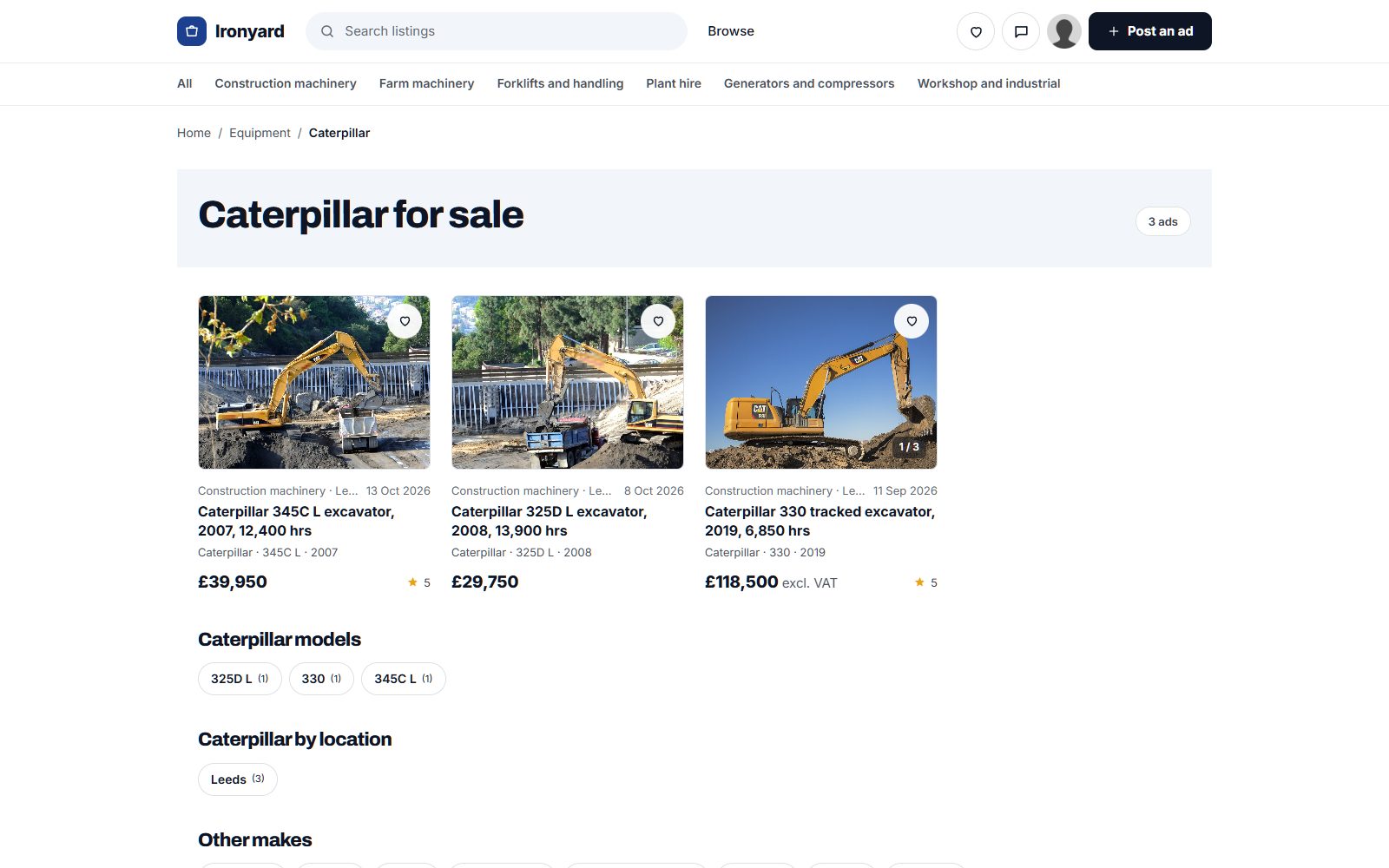
The screenshots show demo sites with made-up sellers. Their photos come from Wikimedia Commons, some cropped or with signs and plates blurred; these ones are under Creative Commons licences:
- Caterpillar 330 excavator on a pile of dirt by Matthew T Rader, CC BY-SA 4.0
- Excavator, Sany, 2021 Changsha International Construction Equipment Exhibition, Picture2 by Huangdan2060, CC BY 3.0
- JCB backhoe loader with hydraulic breaker, 2019 Szigetszentmiklós by Globetrotter19, CC BY-SA 3.0
- Polaris ATV Winch (53034864566) by Tony Webster, CC BY 2.0
- Round baler 3070 by Flominator, CC BY-SA 3.0
- Heavy equipment 2022 by Lowcarb23, CC BY-SA 4.0