In 2008 a student in Vilnius counted her clothes before moving flat: about 300 items, and room for only 1001. She listed her spare clothes on a website a friend built in two weeks. It had no "buy" button1.
That student was Milda Mitkute, and the site became Vinted. In 2024 it made €813 million in revenue17. In 2025 revenue rose 38% to about €1.1 billion, with net profit of €62 million, on a global business volume of €10.8 billion (FashionUnited).
Vinted's first sellers cost nothing: one wardrobe, then an email to friends. And the company almost closed in 2016 for one reason: it started charging the people who bring the listings. Both lessons apply to any small marketplace today.
The short version
- The founder listed her own clothes first, then emailed friends to add theirs before telling the public. About 150 items became about 750 in a week3.
- It stayed free, simple and social for years, and new countries were started by keen users, not by the company.
- A seller fee nearly killed it: organic growth fell to almost zero1. Making listing free again, and charging buyers a small protection fee instead, saved it.
- Lesson for you: list your own stock, ask friends personally, and never charge your first sellers.
At a glance
- Founded
- 2008, Vilnius, Lithuania, as manodrabuziai.lt ("my clothes")1,19
- Founders
- Milda Mitkute and Justas Janauskas1
- Country
- Lithuania, then Germany (Kleiderkreisel, 2009), Czech Republic (2011)3,9
- Category
- Second-hand clothes, peer to peer (people selling to people)
- First-seller tactic
- The founder listed her own wardrobe, then emailed friends to add theirs before launch2,3
- Where it is now
- Europe-wide (it left Canada in early 2024)11; 2024 revenue €813.4m, net profit €76.7m17; free to list, buyers pay a protection fee15
Part of the guide Marketplace case studies
The cold-start problem: no listings, no money, one small country
Every marketplace has two sides: sellers who bring the listings (supply) and buyers who come to look (demand). A new site has neither. Buyers don't visit an empty site, and sellers don't list where no buyers visit. This is the "cold start".
In Lithuania in 2008, second-hand clothes moved through flea markets, charity shops, swaps between friends and general classifieds. Nothing was built for a young woman who wanted to sell a dress she wore once. For Mitkute's parents' generation in Soviet Lithuania, you bought second-hand because you had no money16.
Two things helped. First, the problem was personal and common. Mitkute was sure "every girl has the same issue as I do", she told the BBC1. Janauskas doubted it. So they asked the other guests at the party, and within minutes he was convinced1. Second, Lithuania is small. Word travels fast through friends, universities and local media.
There was no money. Both founders kept day jobs for about three years2,5. Servers cost €10 a month at first, tracked in a spreadsheet. At about 30,000 users they cost €200 a month, two fifths of Mitkute's €500 monthly salary at a PR agency2.
How they got the first sellers
Move 1: The founder was the first seller
Mitkute photographed and uploaded her own clothes over a weekend2. Accounts differ on the number: more than 100 items in one interview2, about 150 in another3. She sold 40 of them in the first week1.
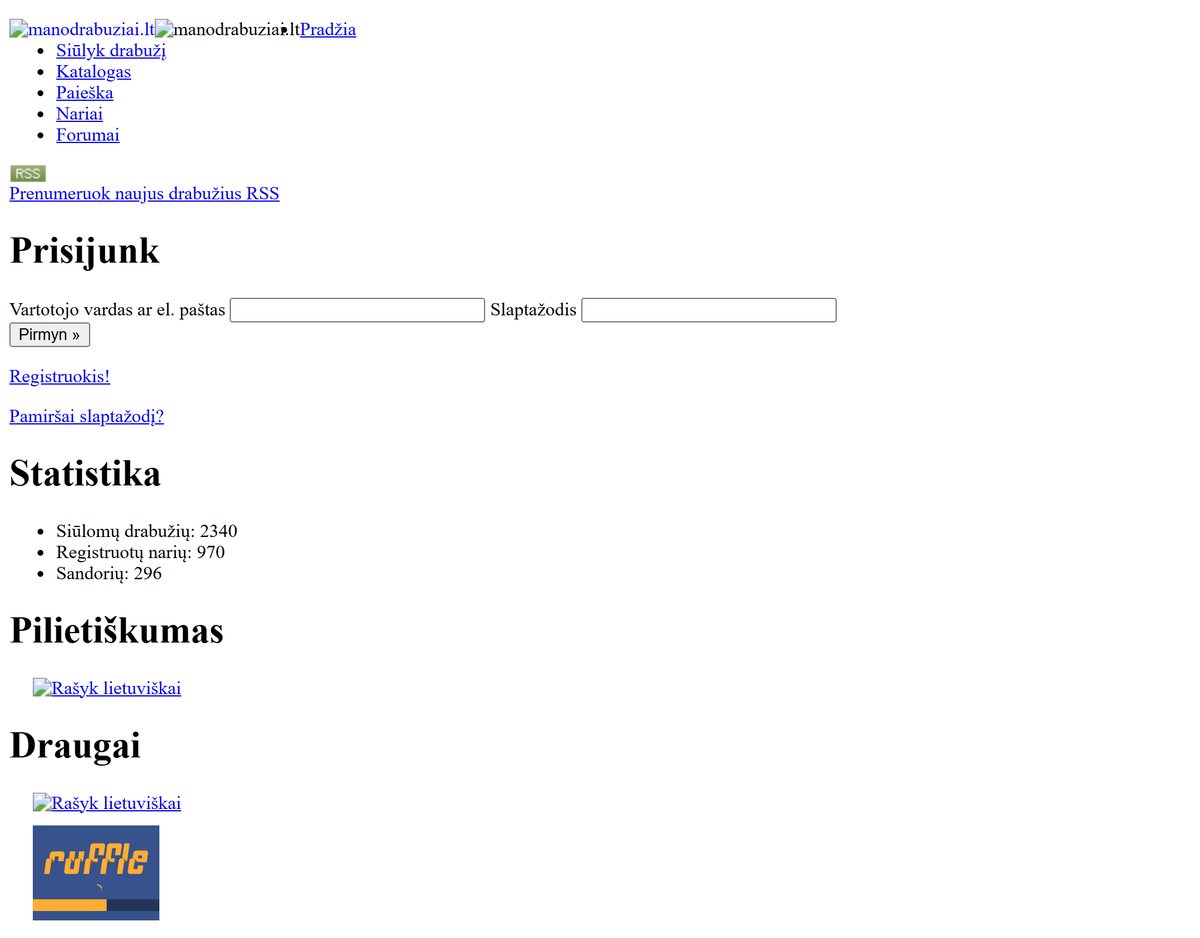
The oldest Internet Archive capture of the site, from September 2008, fits that story. It shows 102 items and 63 members, 97 of the items in women's clothing, and a note that the site is still being built19.
Why it worked: a marketplace's first buyer needs something to look at. A founder who lists her own stock solves that without asking anyone. It also tested the whole flow (photo, description, contact, hand-over) on real items. The test found a real gap: no buy button. Friends pointed it out and Janauskas added it soon after1.
Your own inventory is the cheapest supply you will ever get. It costs you an afternoon, not a sales pitch.
Not sure how many listings "not empty" means for your site? Work it out before you start asking people.
Calculator
How many listings do you need at launch?
Visitors leave a category that looks empty. Pick how many listings a category page needs to look alive, for the categories and places you launch with.
Too many weeks? Launch with fewer categories or one area first, and add more as listings come in. More free tools →
Move 2: An email to friends before launch, so the site never looked empty
Before telling the public, the founders emailed their friends and asked them to add items, so the catalogue would be bigger on day one2. Mitkute put numbers on it in 2025: she listed about 150 items, and friends added about 600 more within a week3.
One founder's wardrobe became about 750 listings because each friend added a few items. Nobody was paid. The ask was small (a few things you don't wear) and personal (from a friend, not a company).
Why it worked: the friends had the same problem as Mitkute. They weren't doing her a favour so much as using a tool they also needed. When your site solves the seller's own problem, the first ask is easy.
Here is a message you can adapt for that first personal ask. Send it one by one, not as a group blast.
Template
Outreach message to recruit your first sellers
Use this to contact people already selling on other sites, in groups or in shops; personalise the first line every time and offer what you can really deliver.
Send no more than one follow-up to people who did not reply, and keep a list of who asked not to be contacted. More free tools →
Move 3: Friends who knew journalists, then free press
Some of those friends had studied journalism. Within hours of the email, radio stations and newspapers were calling2. Members joined every hour and news portals asked for interviews5.
The story was easy for local media: a student's simple idea, a website, something readers could use the same day. A local paper or radio show will run that kind of story for free.
Why it worked: press brought buyers and new sellers at the same time. In clothes, many buyers also become sellers, because everyone has a wardrobe. So each new member could add supply.
What the counter does show is that listings grew fast once friends joined: 102 items in September 2008, 1,130 in late October, 2,340 in December and 3,247 in early January 2009, with 434 completed deals19. That is between two and three listings per member.
The site's own homepage counter, as saved by the Internet Archive. From the founder's 102 items to more than 3,200 once friends and press joined. Source 19.
Show the numbers
| Date | Items for sale | Members |
|---|---|---|
| 18 Sep 2008 | 102 | 63 members, site still being built |
| 26 Oct 2008 | 1,130 | 578 members |
| 10 Dec 2008 | 2,340 | 970 members |
| 5 Jan 2009 | 3,247 | 1,207 members |
Move 4: One type of seller, and listing in under five minutes
The first version was built for women, mostly in their twenties: the founder's own group3. In December 2008, 2,034 of the 2,340 items were women's clothing19. A small men's section existed, but men's clothing only took off after German users asked for it3.
Mitkute said that if posting an item took a seller more than five minutes, they would probably give up3. For years there was no payment system and no shipping: buyers and sellers sorted that out themselves3. The product was a listing, a photo and a way to talk.
Why it worked: a narrow first audience means your first sellers know each other, so Move 2 repeats itself. Fast listing means a seller with ten items posts ten, not two.
Move 5: Build a community, not a shop
Kleiderkreisel, the German version, let members swap, sell or give away clothes6. The forums were busy from the first year: the October 2008 homepage invites members to its newly created forums19. Janauskas said in 2015 that Vinted had the strongest social side of its peers, with users browsing without a goal, for example on the bus4. When the company later upset users, he spent a week in the Kleiderkreisel forums answering questions himself4.
Why it mattered: a community gives sellers a reason to come back when they have nothing to sell. They browse, comment and swap. That habit kept supply flowing for years without a marketing budget.
Move 6: Let keen users launch new places for you
The jump to Germany wasn't planned. Sophie Utikal, a guest from Munich couchsurfing with Janauskas, saw him coding one night and asked what he was building4. She wanted it in Germany. He did the technical work; she promoted it to her friends4. Mitkute's account says two German women met through Couchsurfing offered to run it as volunteers3.
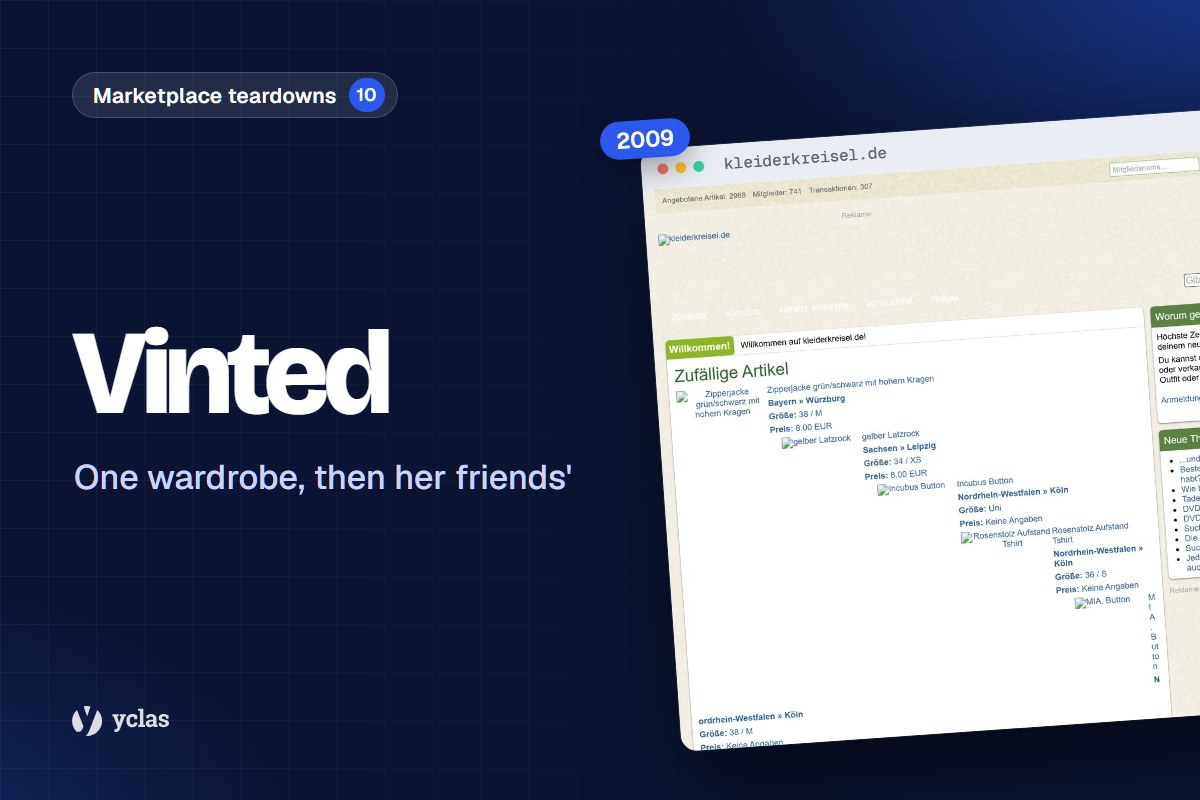
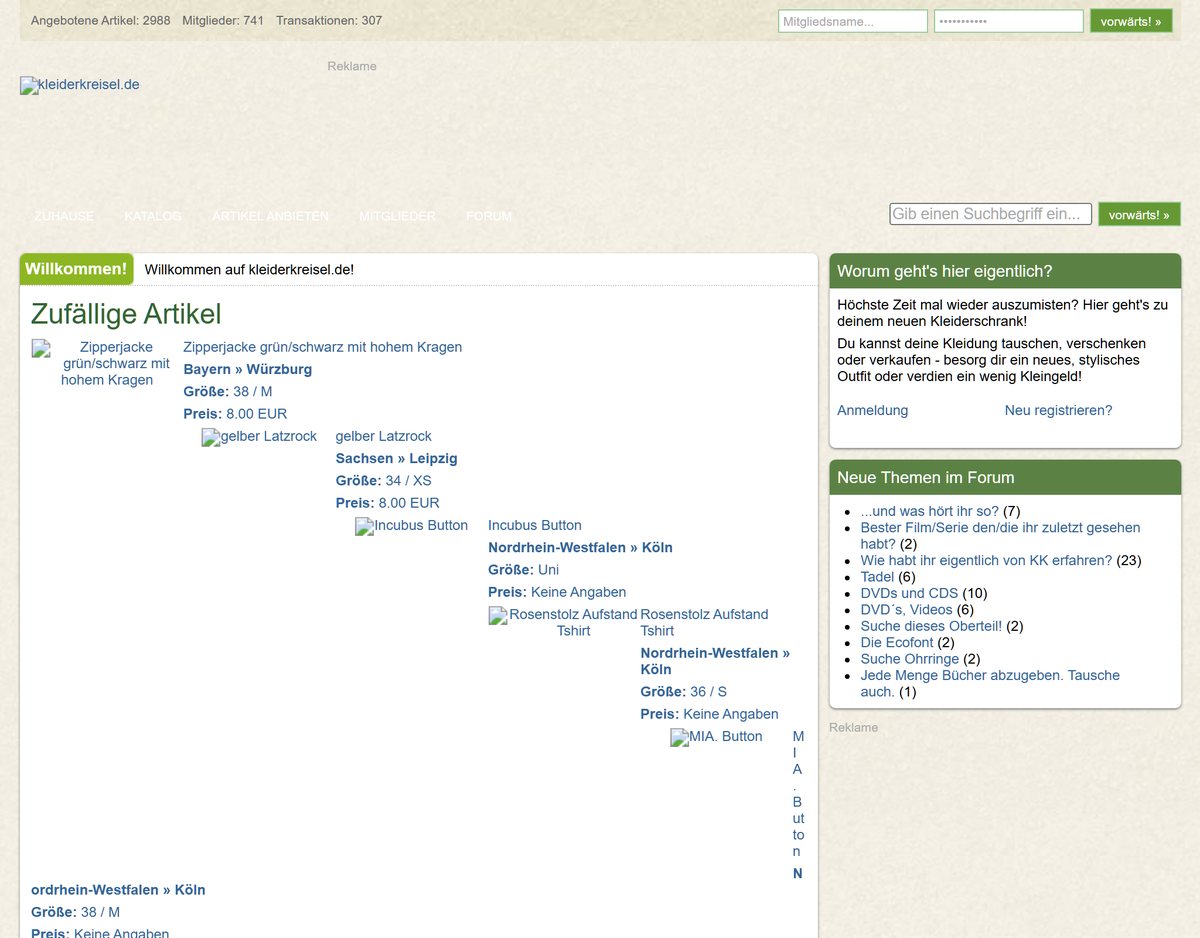
Kleiderkreisel ("clothes circle") launched in 20091. Its counter shows 357 items and 204 members in September 2009, and 224,315 items and 38,254 members by January 201120. Germany reached nearly 2 million members without advertising, Mitkute says3, and it was the company's largest market by 20154.
The Czech Republic followed in 2011 as VotočVohoz.cz. By 2013 it had about 500,000 unique monthly users, 95% of them women9.
Why it worked: each new country started the way Lithuania did. Local people with the problem recruited their own friends. The founders only supplied the software.
What doesn't transfer: you probably won't open new countries. But the same move works for new towns, niches or categories. Find one keen user there and give them the tools.
What went wrong: a seller fee and too many countries
Charging sellers almost killed it
For six or seven years Vinted was free to use and earned money from banner ads3. In Germany in 2014, ads and other services covered only about 20% of costs; investors paid the rest7. Accel put in €5.2 million in 2013, Insight €20 million in 201414.
Then Vinted added fees on sales. In Germany, from late 2014, sellers who sold through the new payment system paid 10% of the price plus €0.50 per sale4,7. Buyers could avoid the system by messaging the seller7. Users protested, some deleted their accounts, and many moved to a free rival, kleiderkorb.de7. A petition against the fee got more than 13,000 signatures4. The company let German sellers opt out of the service4, and in August 2016 sales paid by bank transfer became free again8.
Sources differ on the exact model in the years that followed. Mitkute remembers an optional buyer-paid commission of 12 to 14% that few used3. Plantenga describes a seller fee of around 20%, eBay style10. Everyone agrees on the result:
"Our organic growth it was instantly almost zero." Milda Mitkute, BBC World Service1
Plantenga told Insight that sellers left, and the company had nine to twelve months before it would close10. Mitkute remembers seven or eight1.
Before you set prices, compare the ways of charging side by side. Vinted's story is the difference between a fee every seller must pay and a fee the buyer chooses to pay for safety.
Calculator
Which way of charging earns more for your marketplace?
The same sellers and listings, charged four different ways. Change the numbers to your market: the share who pay is the honest guess that decides it.
Revenue a month for each model on its own. Many marketplaces mix them: free listings with paid promotions is the most common start, because it keeps listings coming in. More free tools →
Expanding too wide, too early
By 2015 Vinted had more than 140 staff in six offices, from Vilnius to San Francisco4. Mitkute says it launched in about ten markets at once, mostly run by volunteers3. In the US it charged sellers 19%4. In 2016 the company had about $14 million in the bank and was burning cash fast; Insight and Accel had written their stakes down to zero12.
How supply turned into demand: free for sellers, then TV
Thomas Plantenga, a manager living in New York, got the call from investor Insight in May 201612. He planned to stay five weeks and never flew back11. His fixes, in the order that matters for a small marketplace:
- Listing became free for sellers. The seller fee went; buyers pay a buyer protection fee instead, covering safe payment, support and refunds11. In 2019 that was 5% plus 7 cents per item15. His reasoning, to TNW: "We needed to support the sellers first to attract buyers." Old users came back11.
- Trust and shipping before marketing. The team automated moderation and focused on trust and safety12. Vinted's Adam Jay told the Guardian that removing seller fees and building in-app shipping is what made growth take off16. Mitkute credits shipping discounts with carriers in France for making the paid protection worth it to buyers3.
- Focus. Offices in San Francisco, London, Munich and Paris closed, and staff went from 240 to 15012. Two markets got the attention: Germany and France12. The US app kept running but wasn't promoted14.
- Then TV. Only after the basics worked did Vinted advertise heavily1,10. By 2019 it made about 120 TV spots a year in a rented hangar in Vilnius and measured each campaign with its own models15.
- Sept 2008manodrabuziai.lt shows 102 items and 63 members while still under construction19.
- Jan 20093,247 items, 1,207 members, 434 deals19.
- 2009Kleiderkreisel launches in Germany through volunteers3,4.
- Dec 2010The Lithuanian site passes 334,000 items and 71,000 members19.
- Late 2014Seller fee in Germany; protests and a 13,000-signature petition4,7.
- May 2016About $14m in the bank; Plantenga arrives and drops the seller fee12.
- 2017$360m of items sold on the platform12.
- 201925m members, 180m listings, €1.3bn of sales expected; €128m raised at over €1bn13.
- 2023First annual profit, €17.8m11,17.
- 2024Revenue €813.4m, net profit €76.7m17.
One figure explains why free listing mattered so much. In 2019 about 75% of Vinted's new users had never bought or sold second-hand clothes before13. Plantenga said Vinted wasn't taking users from eBay or Leboncoin15. A free, fast way to list brought in people who weren't sellers anywhere yet. Supply grew because trying cost nothing, and more listings brought more buyers.
The playbook: 8 moves for a small marketplace
Be your own first seller. The founder's wardrobe was Vinted's first catalogue. Post 20 to 50 real items yourself, or from family and colleagues, with good photos, prices and locations, before you ask any stranger.
Ask friends to add a few items each before you go public. Vinted's friends turned about 150 listings into about 750 in a week. Send a personal WhatsApp message to 20 to 30 people who have the problem your site solves, and ask for three to five items each.
Pick one narrow seller group and solve their problem. Vinted started with women in their twenties in one city. Choose one group (used tractor owners in one region, parents of young children in one town, landlords in one district) and make every page speak to them. Add others when they ask.
Never charge your first sellers. Vinted's growth fell to almost zero when it charged sellers, and recovered when listing became free. Keep listing free until buyers come steadily. Later, earn from optional extras or business sellers, not from a fee every new seller must pay.
Make listing take under five minutes. Time a post from a phone. Remove every field a buyer doesn't need to decide. A seller with ten things should post all ten in one sitting.
Get free local press with a simple story. Write a short note to five local outlets, Facebook group admins or community newsletters: who you are, what problem the site solves, how many listings it has. A real number ("80 tractors for sale in our county") is a story.
Find a keen user in each new place and give them the tools. Germany came from a couchsurfer. When someone from another town or niche writes to you, ask if they would invite their own network, and give them a link, a poster and a message to forward.
Fix trust and delivery before you spend on ads. Vinted spent on TV only after moderation, payments and shipping worked. Before paying for ads, check that listings are real, contact works, spam is removed and buyers can see how to pay or collect safely.
Try this this week
- Post 30 listings yourself in one 2-hour session. Your own items, or items from family and friends with permission. Real photos, real prices, location filled in.
- Message 25 people personally by Wednesday. Ask each to post 3 items this week. Target: 10 yeses, 30+ new listings by Sunday.
- Time one new listing on your phone (10 minutes). If it takes over 5 minutes, remove or make optional at least 2 fields.
- Check your fees (15 minutes). If new sellers pay anything to post their first listings, make it free for at least 3 months.
- Post in 3 local groups (Facebook, WhatsApp, a forum or subreddit) where your sellers already are, following each group's rules. Include a real listing count. Time box: 1 hour.
- Write to 5 local media or community contacts with a three-sentence story and your listing count. Time box: 45 minutes.
- Put up 5 printed posters where your sellers go: a laundry, a farm supply store, a school notice board, a gym. Time box: one trip.
Doing it on Yclas
- Your first 30 listings: use posting from a photo with AI: take a photo and the listing is filled in for you to check. Items already on Facebook or WhatsApp? Add listings from text turns pasted posts into draft listings; a spreadsheet goes in with CSV import.
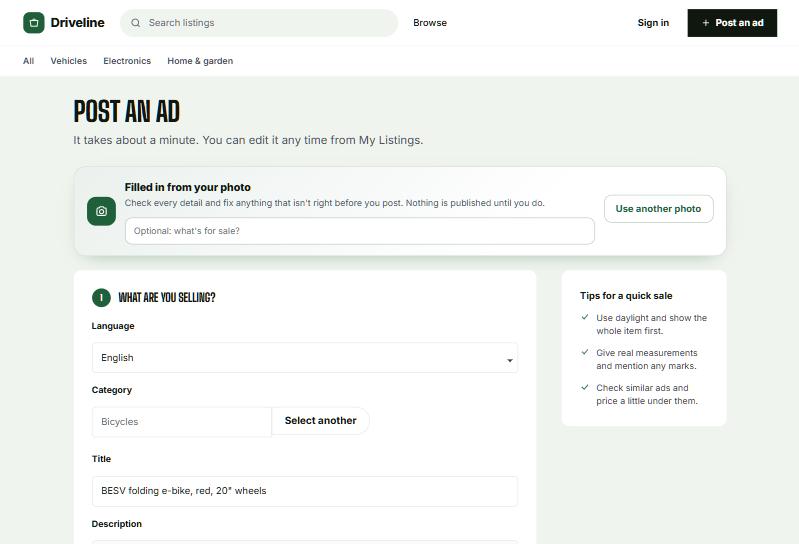
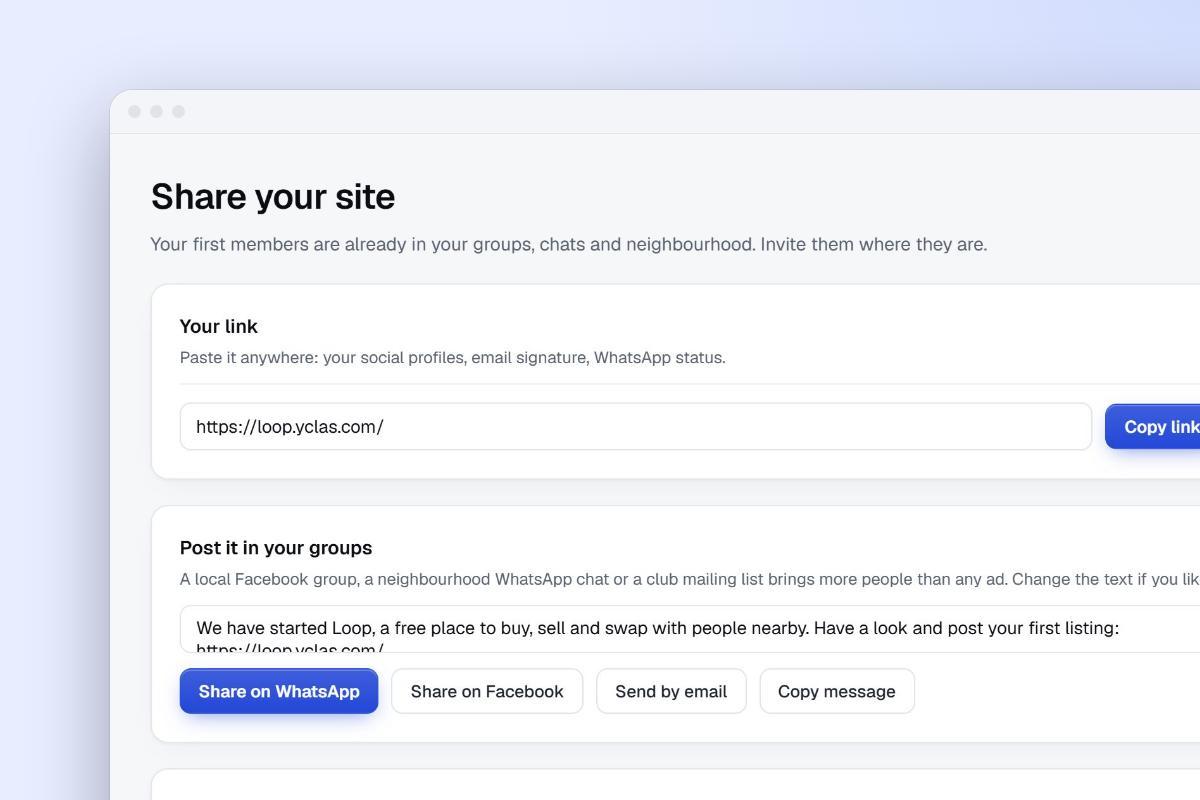
- The email to friends: Share your site (admin panel) gives you a ready group message for WhatsApp, Facebook or email, a QR code and a printable A4 poster.
- Personal asks: Recruit sellers (admin panel) gives each person a personal invite link (/join/...), keeps a timeline of who you contacted and drafts invites with "Write it with AI". It also lists searches on your site that found nothing, so you know whom to ask next.
- One niche, fast listing: set categories and custom fields for your niche only (size and brand for clothes, hours and year for machinery), and keep everything else short.
- Free first, paid later: keep posting free, then add featured listings or paid plans for sellers once buyers arrive. The member email digest of new listings brings buyers back when new stock arrives.
For a different take on the same community-first start, see what made Craigslist successful, and how OLX grew across many countries at once.
Sources
- Vinted creator: How my idea became a billion dollar online business — BBC Bitesize / World Service Witness History (2025) — https://www.bbc.co.uk/bitesize/articles/zttrp9q
- Vinted cofounder Milda Mitkute shares the shopping app's path from 2 a.m. house party startup to $3.8B success — Business Insider via Yahoo News (2024) — https://ca.news.yahoo.com/vinted-2-m-house-party-061801598.html
- Milda Mitkute (cofondatrice de Vinted) "Quand j'ai créé Vinted, jamais je n'aurais imaginé rencontrer un tel succès" — Journal du Net (2025) — https://www.journaldunet.com/retail/1538657-milda-mitkute-cofondatrice-de-vinted/
- The story behind secondhand online marketplace Vinted, one of Lithuania's star startups — Tech.eu (2015) — https://tech.eu/2015/01/15/vinted-profile/
- Vinted founder: From a Shy and Insecure Girl to a Global Clothing Player — NB Forum — https://nbforum.com/?p=15841
- Kleiderkreisel expandiert über den großen Teich — FashionUnited Deutschland (2014) — https://fashionunited.de/v1/leads/kleiderkreisel-expandiert-ueber-den-grossen-teich/201409104311
- Kleiderkreisel: Nutzer reagieren wütend auf neues Bezahlsystem — FashionUnited Deutschland (2014) — https://fashionunited.de/v1/leads/kleiderkreisel-nutzer-reagieren-wuetend-auf-neues-bezahlsystem/201410314446
- Gebührenumstellung: Kleiderkreisel wieder kostenfrei — OnlinehändlerNews / Händlerbund (2016) — https://ohn.haendlerbund.de/themen/unternehmen-maerkte/27208-gebuehrenumstellung-kleiderkreisel-wieder-kostenfrei
- Z nenápadné burzy oblečení až k prvnímu miliardovému startupu v Litvě — CzechCrunch (2019) — https://cc.cz/z-nenapadne-burzy-obleceni-az-k-prvnimu-miliardovemu-startupu-v-litve-vinted-ma-silnou-stopu-i-v-cesku/
- Part of the fabric of society: how Thomas Plantenga is making Vinted the Amazon of secondhand — Insight Partners (2025) — https://www.insightpartners.com/ideas/part-of-the-fabric-of-society-how-thomas-plantenga-is-making-vinted-the-amazon-of-secondhand/
- How Vinted became the first profitable pre-loved clothing marketplace (Thomas Plantenga interview) — TNW (2024) — https://thenextweb.com/news/vinted-ceo-thomas-plagenta-interview-second-hand-fashion
- Behind the turnaround that netted Vinted €50 million — TechCrunch (2018) — https://techcrunch.com/2018/09/04/behind-the-turnaround-that-netted-vinted-e50-million/
- Vinted, the second-hand clothes marketplace, raises $141M at a $1B+ valuation — TechCrunch (2019) — https://techcrunch.com/2019/11/27/vinted-the-second-hand-clothes-marketplace-raises-141m-at-a-1b-valuation
- Fashion resale, a booming market: interview with Thomas Plantenga, CEO of Vinted — FashionUnited (2019) — https://fashionunited.uk/news/retail/fashion-resale-a-booming-market-interview-with-thomas-plantenga-ceo-of-vinted/2019102245875
- Thomas Plantenga (Vinted) "La France est le premier marché de Vinted" — Journal du Net (2019) — https://www.journaldunet.com/retail/1441002-thomas-plantenga-ceo-de-vinted/
- The Vinted phenomenon: how one woman sold her clothes – and created a billion-dollar company — The Guardian via Yahoo (2024) — https://uk.style.yahoo.com/vinted-phenomenon-one-woman-sold-050057095.html
- Vinted's parent company sees profit soar by 330 percent — FashionUnited (2025) — https://fashionunited.uk/news/business/vinteds-parent-company-sees-profit-soar-by-330-percent/2025042981341
- Vinted — Wikipedia (lead only, figures confirmed above) — https://en.wikipedia.org/wiki/Vinted
- manodrabuziai.lt homepage, captures of 18 Sep 2008, 26 Oct 2008, 10 Dec 2008, 5 Jan 2009 and 29 Dec 2010 — Internet Archive (2008-2010) — https://web.archive.org/web/20081210042706/http://www.manodrabuziai.lt/
- kleiderkreisel.de homepage, captures of 17 Sep 2009, 3 Dec 2009 and 1 Jan 2011 — Internet Archive (2009-2011) — https://web.archive.org/web/20091203025207/http://www.kleiderkreisel.de/