In March 1999, a young IT consultant in Wellington, New Zealand, put a website live on one PC in his father's office. He had bought the server on his credit card and spent an estimated $12,000 in total. He kept his day job at Deloitte and wrote the code at night and at weekends.2
The site was Trade Me. It started with 20 members, all friends and family of the founder, Sam Morgan. It took five months to reach 1,000.2
Seven years later, Australian publisher Fairfax bought it for NZ$700 million in cash. By then it had over 600,000 items for sale, against about 14,000 on eBay's New Zealand site.8,2
The first moves were ordinary: free listings, letterbox drops, a TV consumer show, and a stubborn focus on one small country. A one-person marketplace can copy every one of them.
The short version
- Trade Me started with the founder's friends and family, and kept listing free until people came back on their own.
- The founder marketed with his time: letterbox drops, office emails, a painted car and a TV consumer show about safe trading.
- It treated trust as product work (usernames, escrow, rules agreed with the police) before charging for anything.
- Every new category opened with supply already attached: 2,500 dealer cars on Motors' first day. eBay arrived two years late and never caught up.
At a glance
- Founded
- March 1999, Wellington2,3
- Founder
- Sam Morgan; first staff were his sister Jessi (operations), Rowan Simpson (software) and Nigel Stanford (design)1
- Country
- New Zealand
- Category
- General auctions and classifieds, later Motors (2003), Property (2005), Jobs (2006)3,11
- First-seller tactic
- Free to join and free to list, friends and family first, letterbox drops and a signwritten car, then a TV consumer show2,3,4,5
- Where it is now
- Sold to Fairfax 2006 (NZ$700m + NZ$50m earn-out), listed on the NZX 2011, bought by Apax Partners for about NZ$2.56bn in 20193,8
Part of the guide Marketplace case studies
The cold-start problem: a small country, a newspaper habit and eBay on the way
New Zealand in 1999 was a small, spread-out market. People sold second-hand goods through newspaper classifieds and Trade and Exchange, a classifieds magazine. You waited for the Saturday paper, and there were no photos.6
The often-told origin story fits that world. Morgan was reportedly looking for a second-hand heater for a cold Wellington flat. The listings he found online were days behind the paper, so everything had gone by the time he called.3,6 Trade Me's own people tell this story, but treat it as the legend it has become. RNZ adds a plainer reason: he wanted to learn to code.6
Three problems stood in the way:
- Few people were online, and fewer trusted it. Home internet was slow and new. Paying a stranger for something you had never seen sounded mad. Early investors found it hard to believe it would work.1,6
- Free competitors already existed. In August 1999 Morgan pointed out that Yahoo, Amazon and most of the top ten auction sites were free, so Trade Me had to be free too.5
- eBay was the obvious future winner. It was the global giant of online auctions, and it was moving into new countries.
Morgan's answer to eBay was a theory. His father, the economist Gareth Morgan, said Sam had studied overseas auction sites first. He concluded that one auction site tends to win each market. So the plan was simple: be first.7
How they got the first sellers
Move 1: Make it free, and start with people who will list because you asked
When Trade Me launched there were no fees for buyers or sellers. Morgan wanted members first and money later.2 In August 1999 he was asked why the site was growing. His answer was one line:
"The fact that we made it free." Sam Morgan, iStart interview, August 19995
The first 20 members were friends and family.2 Trade Me's own history says it had twenty registered users within two days; Wikipedia puts the first week at 155. The sources disagree, but the scale is the same: tens, not thousands.3,11
Friends listed because they were asked personally, and because listing was free, nobody had a reason to say no. The site was never empty.
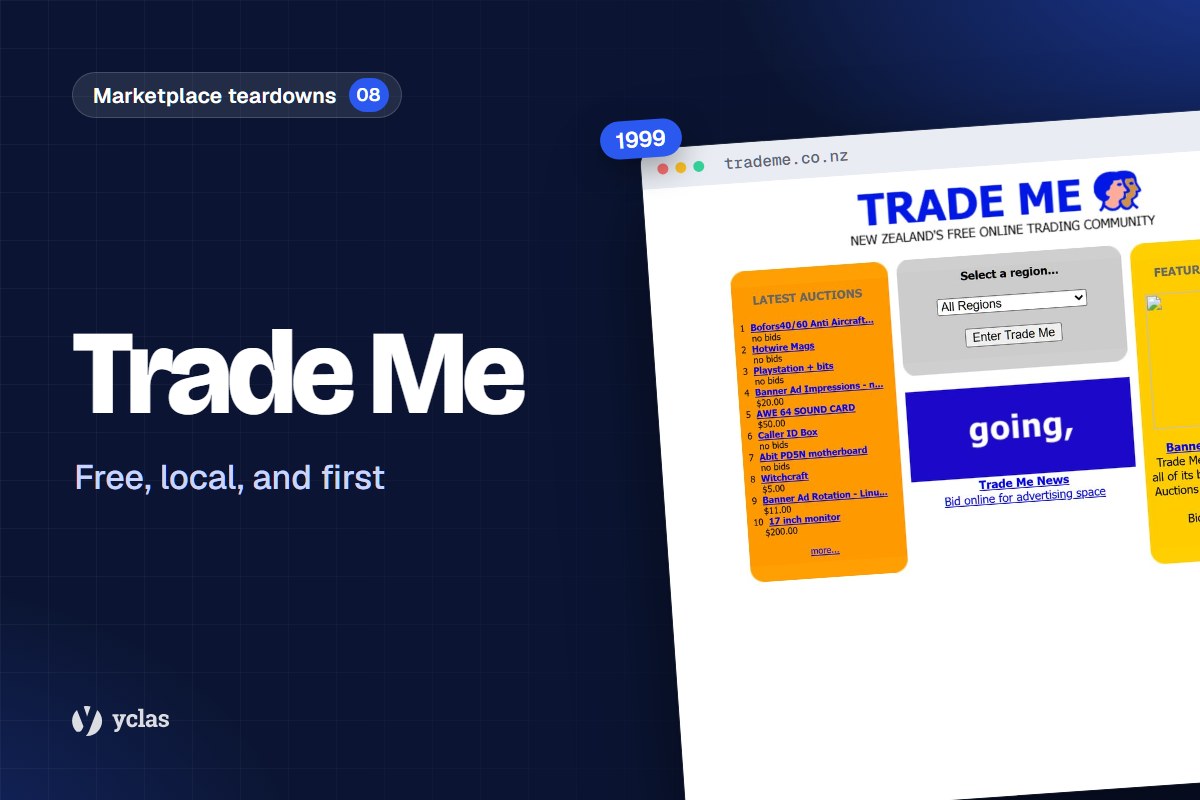
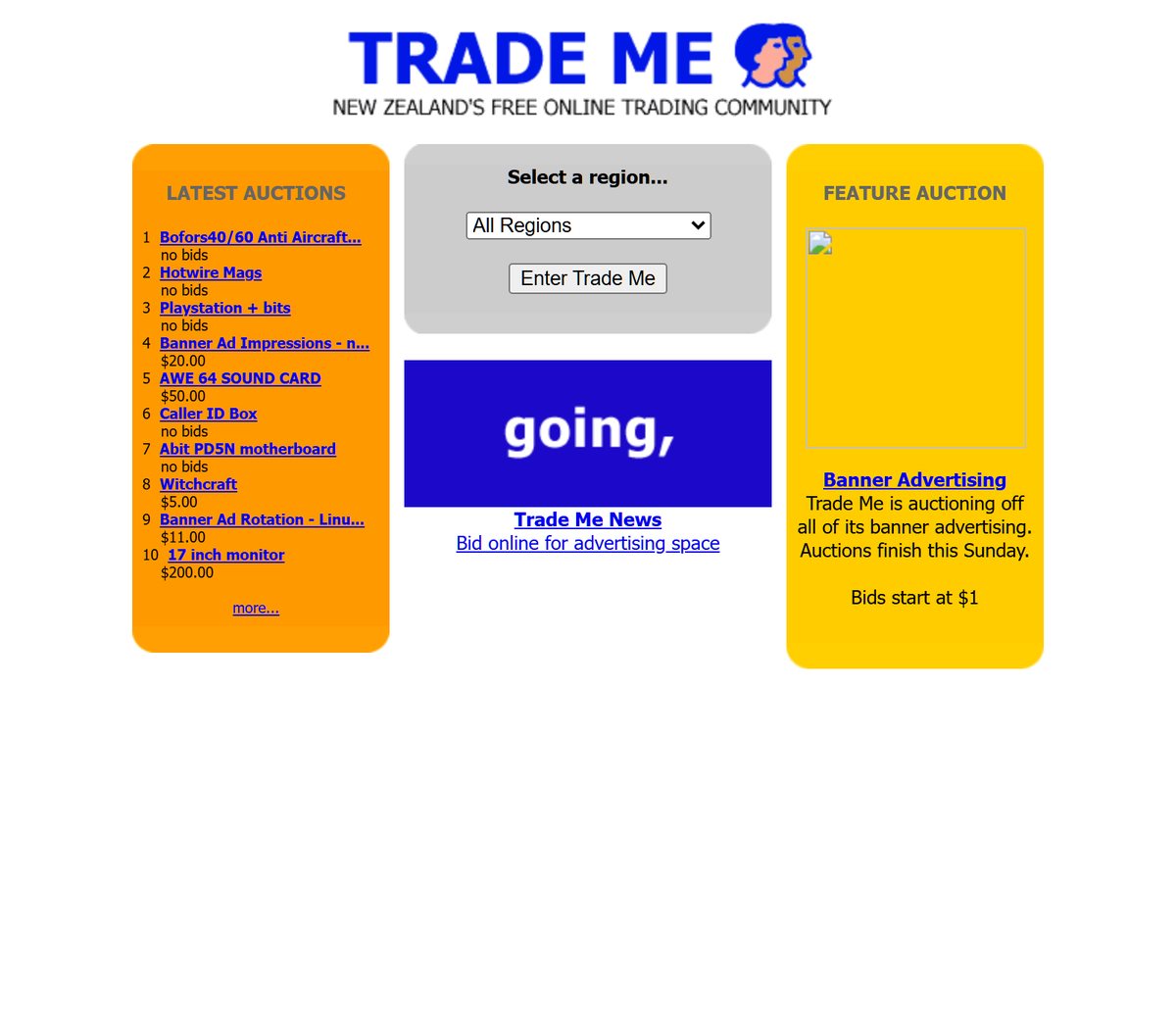
The early catalogue was mostly, in Rowan Simpson's words, geeks trading computer parts.1 An Internet Archive capture from April 1999, about a month after launch, shows exactly that: a sound card, a motherboard, a 17-inch monitor, a PlayStation, most with no bids. One "auction" is Trade Me selling its own banner space, with bids starting at $1.22 Not glamorous, but real supply.
By August 1999 there were about 3,500 registered users, about 2,000 sessions a day, 1,200 registrations in the previous 30 days and more than 50 new sign-ups a day. Morgan said the growth from March to August came with no marketing push at all.5
The catch: it was slow. 1,000 members took five months.2 Do not expect your first season to look like a hockey stick.
If you are not sure how many listings "not empty" means for your site, work it out before you start asking.
Calculator
How many listings do you need at launch?
Visitors leave a category that looks empty. Pick how many listings a category page needs to look alive, for the categories and places you launch with.
Too many weeks? Launch with fewer categories or one area first, and add more as listings come in. More free tools →
Move 2: Be the marketing department yourself
Morgan avoided paid advertising. He said Trade Me's brand was defined by its community.2 Instead he did things that cost time, not money:
- Letterbox drops in Wellington.
- Emails around offices, which in 1999 was where most people had internet access.
- A bright green Holden with Trade Me painted on the sides, driven around Wellington.2
It worked because the site was local: a flyer in a Wellington letterbox pointed to items for sale in Wellington, a far stronger message than "a website where you can buy things".
From August 1999 Morgan worked on Trade Me full time and started to spend on marketing. He said sign-ups picked up from that point.5 At around 1,500 members, he sold 50% of the company to AMR & Associates (now Movac). SmartCompany and Wikipedia say about NZ$75,000; Simpson remembers $100,000. Either way, it was little money for half a company.2,3,1
Move 3: Borrow attention from television with a story about trust
Morgan pitched a story to Fair Go, a long-running New Zealand TV consumer show. The site ran on one server, so the team hurried to rent a bigger one before the episode aired. They watched with family and friends, with the count of users online projected for everyone to see. It was the first time Trade Me had more than 1,000 people on the site at once.4
The angle, in Simpson's later account: Morgan offered to talk about safe buying and selling online.1
A consumer show will not advertise your website, but it will run a story about a worry its viewers share, with you as the person who has thought about it.
Move 4: Remove the fear before you charge for anything
Trust was the real barrier, and Trade Me treated it as product work, not as a slogan.
- Escrow early. In August 1999 Morgan was about to launch an escrow service (later SafeTrader), taking 5% of the money held. He said 80% of reported internet fraud at the time was auction related.5
- Usernames instead of email addresses. In Simpson's first year the team hid members' email addresses behind usernames, and added photo uploads and automatic bidding.4
- Work with the authorities. Trade Me agreed rules with the Police, the tax office (IRD), Customs, NZ Post and the banks, instead of fighting them.1
- Close the door on fraud from abroad. After tracing fraud to members in Romania, Trade Me banned sellers outside New Zealand and Australia in 2005. Simpson contrasts this with eBay, which was adding countries at the same time.2,1
The common thread, in Simpson's summary: most people are honest, and reputations are earned.1 The site gave honest people tools to prove it.
Move 5: Fold in a niche site that had already made the calls
In 1999 Rowan Simpson was trying to move back to Wellington and hated flat-hunting by phone. So he built Flathunt, a rental listings site. To get listings, he phoned every property manager and real estate agent he could find and asked them to list. A few said yes, and the site slowly grew. After about three months it covered its costs, but could not pay him a salary.4
Over lunch with Morgan, a school friend, and Phil McCaw of AMR, they did a deal around Flathunt. Simpson became Trade Me's first employee outside the Morgan family. What caught his eye was a Trade Me billboard: "Only Turkeys Pay For Classifieds".4
Two lessons: phoning every agent one by one works even for a side project, and buying or partnering with a small vertical that already has suppliers beats building that category from zero.
Move 6: Open each new category with supply already attached
Trade Me later moved into the big newspaper categories one at a time: Motors, then Property, then Jobs.1 Each launch followed the same rule: never open a category empty.
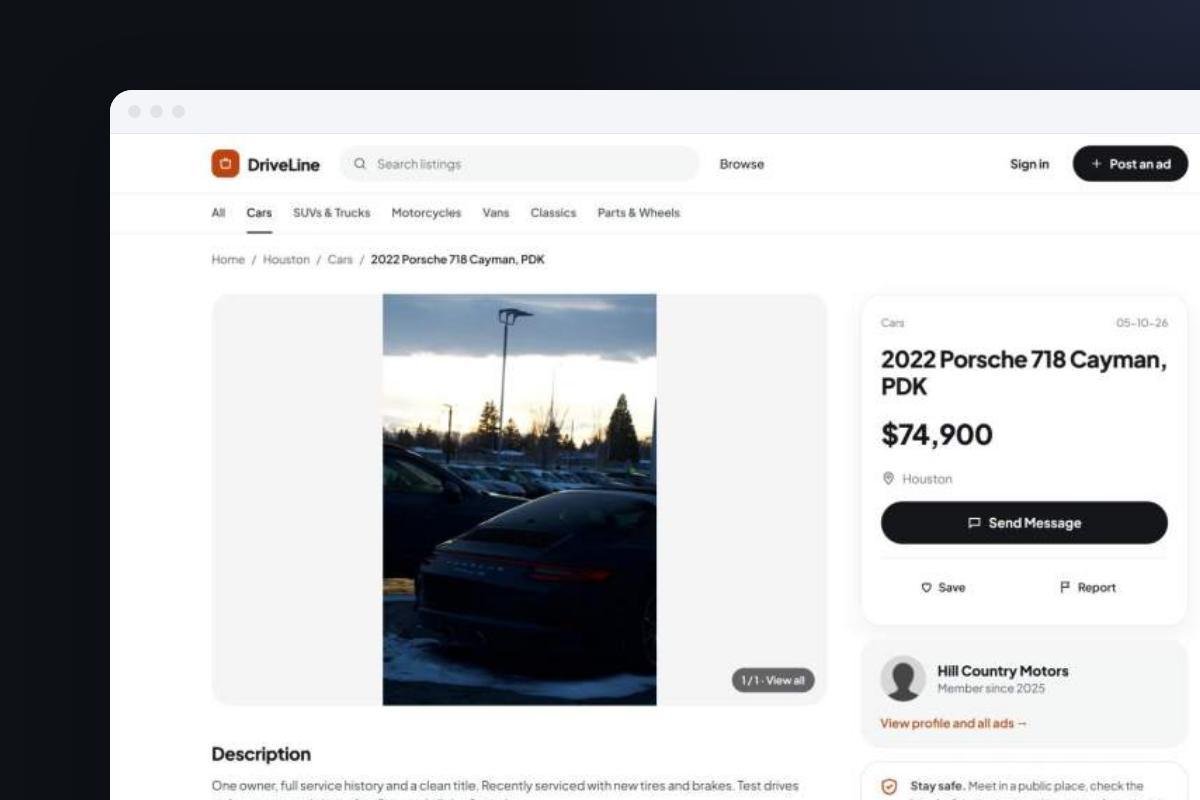
Motors (August 2003). Trade Me Motors was a joint venture with AutoBase, a network of car dealers. On launch day it combined 2,500 dealer listings from AutoBase with the 1,600 private car listings already on Trade Me (4,100 in all), and over 500 more came the next day.9,10 Listings were free until 15 September, then a flat $19.95 per car with free relisting until sold.9,10
Trade Me Motors did not open empty: most day-one cars came from one dealer network. Sources 9, 10.
Show the numbers
| Source | Car listings | Notes |
|---|---|---|
| AutoBase dealers | 2,500 | launch day, via the joint venture |
| Private sellers | 1,600 | already listed on Trade Me |
| Added on day two | 500+ | the day after launch |
For attention, Trade Me bought a 2002 Mini Cooper and auctioned it with a $1 reserve.10 AutoBase's director said views of his dealers' cars on day one were ten times their usual traffic.9
Morgan also changed the product for the category instead of forcing auctions on it. Buyers want to inspect a car first, he said, so success fees did not fit; Motors offered flat-fee classifieds as well as auctions.9 Ten months later Trade Me reported over 200 car sales a day and 11,000 cars live.12
Property (June 2005). Trade Me Property launched with over 1,500 properties, at $50 to list, open to agents and private sellers. The Real Estate Institute said it was no threat to agents. But Trade Me already had nearly 2 million visitors a month, against about 131,000 for the institute's own site.13 Within six months over 1,000 agents were listing, double the forecast, and listings passed 12,000.14
Both categories opened with thousands of listings and grew several times over within months. Sources 9, 10, 12, 13, 14.
Show the numbers
| Moment | Listings | Notes |
|---|---|---|
| Motors, launch day (Aug 2003) | 4,100 | 2,500 dealer + 1,600 private cars |
| Motors, ten months later (Jun 2004) | 11,000 | cars live, 200+ sales a day |
| Property, launch (Jun 2005) | 1,500+ | agents and private sellers |
| Property, six months later | 12,000+ | 1,000+ agents listing |
The lever was not a better product for agents. Trade Me already had the buyers, so the agents followed.
One dealer with 20 listings fills a new category in a day. Send them this pitch.
Template
Pitch to a local partner to promote your marketplace
Send it by email or message to an association, club, shop or community group whose members are your buyers or sellers; change the offer to something you can really give them.
Partners say yes more often when you hand them finished content to share than when you ask them to write about you. More free tools →
What didn't work, or what they got wrong
- The advertising model. Listings were free and banner ads were supposed to pay the bills. They did not. Morgan later said he was about six years too early on internet advertising.2,3 The "only turkeys pay" slogan left the team without a clear business model for a long time, and shareholder loans kept the company going.1
- The fix was gradual fees, not a paywall. Trade Me first charged for optional extras: priority placement, bold titles and photos. In September 2000 it added a success fee of 1.9% to 5.9% of the sale price.2 Wikipedia calls the success fee the turning point that saved the company.3 Sellers complained, as they did at every later fee rise, but the site kept growing.15
- Features nobody used. In the first year the team built bidding by text message. Simpson says nobody used it apart from the team.4
- Nearly losing the team. In 2001 three of the four original team members left for jobs in the UK, and Nigel Stanford ran the site alone for a time.1
- Free is not a moat on its own. In October 2012 a well-funded rival, Wheedle, launched with a flat $1 fee on items sold over $20 to undercut Trade Me. It crashed in its first days, relaunched, and closed in 2014 with about 80,000 members.16,17
When you do start charging, start with extras, the way Trade Me did. Compare the options on your own numbers first.
Calculator
Which way of charging earns more for your marketplace?
The same sellers and listings, charged four different ways. Change the numbers to your market: the share who pay is the honest guess that decides it.
Revenue a month for each model on its own. Many marketplaces mix them: free listings with paid promotions is the most common start, because it keeps listings coming in. More free tools →
How supply turned into demand
Trade Me's buyers came from the same place as its sellers: the same people, the same towns, and their friends. Joining and listing were free, so every seller was also a potential buyer, and every sale gave both sides a story to tell. Morgan's own summary of growth: build something good enough that people tell their friends.2
The numbers show the flywheel turning:
- March 1999Live with 20 members, all friends and family.2
- August 1999About 3,500 registered users, 50+ sign-ups a day.5
- March 20006,000 auctions a month.2
- September 2000Success fee introduced.2
- 2001About 100,000 members, and profitable.3,6
- 2003250,000 auctions a month.2 In July, 398,000 unique visitors and 300,000+ auctions in the month.10
- 2005Most visited website in New Zealand; 1 million members.3,14
- March 20061.2 million members, 50,000 new a month, 600,000+ items live.8
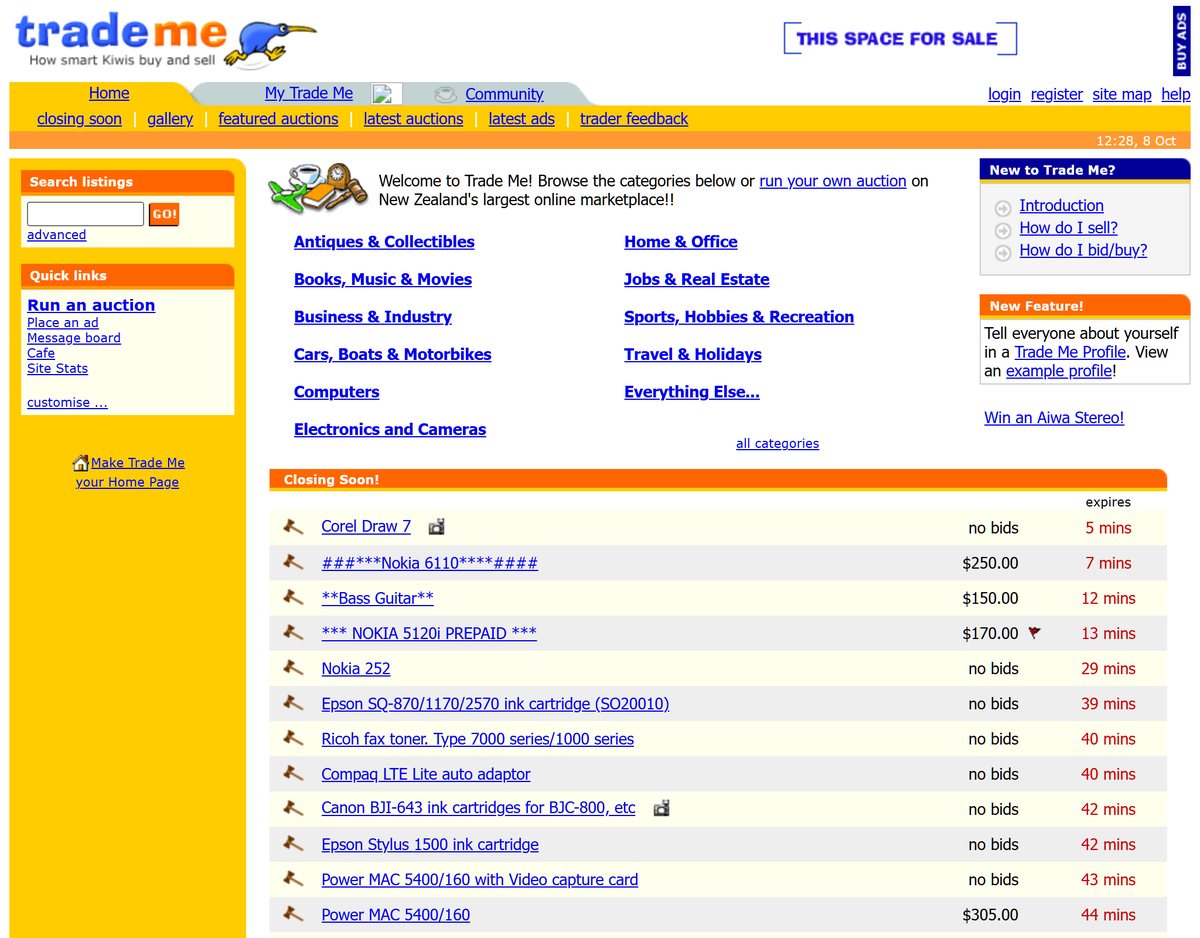
By October 2000 the homepage called itself New Zealand's largest online marketplace, with categories for cars, jobs and real estate, a message board and a site stats page.23
In the year before the sale Trade Me made a profit of about $26 million, and Fairfax paid about 15.6 times expected 2007 earnings (EBITDA).8,21 At that point it had about 1.2 million members in a country of about 4 million, and over 60% of New Zealand's web traffic.8
eBay arrived two years too late
eBay launched ebay.co.nz on 26 March 2001, with a partnership with the Xtra portal and a charity auction of rugby star Jonah Lomu's boots. Its local site had just over 5,000 New Zealand items. Morgan called it "just a marketing thing", a New Zealand front page on eBay.com.18
By then Trade Me had two years of local listings, local trust work and local habits. RNZ's later verdict: eBay flopped because the market was already full.6 Five years later, eBay's site still had only about 14,000 items.2
Why could a global giant not catch up? Mostly local liquidity: the chance that a listing finds a buyer quickly. A New Zealand buyer wanted items near enough to collect or cheap to post. Trade Me had them; eBay's New Zealand pages did not. Add first-mover advantage in a winner-takes-most market7, trust work built for New Zealand1, and sellers who were already used to selling there before any fee arrived.
At the sale, the average visit lasted 19 minutes and users came back 3.9 times a week.8 The message board, set up so members could help each other use the site, grew to more than 25,000 posts a day by 2011.19,20 Simpson's view: the real competitor for attention was television, not other websites.1
The playbook: eight moves a small marketplace can copy
Start with people who will list because you asked them. Trade Me's first 20 members were the founder's friends and family.2 Ask everyone you know who sells in your niche, by name, and the WhatsApp and Facebook groups where people already know you.
Keep listing free until the site is useful. Trade Me charged for extras first and added a success fee 18 months after launch.2 Keep basic listings free until buyers come back on their own. Charge first for optional extras such as featured listings, not for the right to list.
Be the most local option, not the biggest. eBay had more of everything except New Zealand.18 Pick one town, region or niche and be complete there. Facebook Marketplace covers everything; your site should cover one thing better, with the categories and fields buyers in that niche search for.
Market with your time, where your buyers physically are. Letterbox drops, office emails and a painted car cost almost nothing.2 Today: QR posters in shops and garages, a stand at a local fair or trade show, and visiting dealers in person.
Pitch a story about trust, not about you. Trade Me got on a TV consumer show by talking about safe online trading.1,4 Offer local media or a big community page a short guide to avoiding scams in your niche, with your site named in it.
Do the boring trust work early. Usernames instead of emails, escrow, and rules agreed with the police came before the big growth.1,4,5 Safety tips, checks on new listings and blocking scam patterns cost you hours, not money.
Open new categories with supply already attached. Motors launched with 2,500 dealer listings on day one; Property with 1,500.9,13 Before you add a category, find one dealer, agent or association with a stock list and bring it in on launch day.
Watch what people search for and do not find. Trade Me followed its users into Motors, Property and Jobs, the categories newspapers made money from.1 Your empty search results are a list of what buyers want. Recruit sellers for those first.
For lessons 1 and 7, start from a message that works.
Template
Outreach message to recruit your first sellers
Use this to contact people already selling on other sites, in groups or in shops; personalise the first line every time and offer what you can really deliver.
Send no more than one follow-up to people who did not reply, and keep a list of who asked not to be contacted. More free tools →
Try this this week
- Write to 30 people by name (friends, family, colleagues, group members) in 1 hour, and ask each to list two items. Target: 20 new listings by Sunday.
- Post 20 listings yourself in 2 hours, from items you can photograph or from sellers who agree you can copy their Facebook posts. Target: no empty category on your home page.
- Print 50 posters or flyers with a QR code and put them up in 10 local places your buyers and sellers visit (shops, garages, notice boards, a farm supply store). Time box: one afternoon.
- Call or visit 10 businesses with stock (dealers, agents, shops) in 2 hours and offer to load their stock for free. Target: one business with 20+ listings.
- Share your site in 5 WhatsApp or Facebook groups where you are a real member, with a short message and three of your best listings, not a bare link. Time box: 30 minutes.
- Write a one-page "how to buy safely" guide for your niche in 1 hour and send it to 3 people: a journalist, a radio host and a community page admin.
- Check your searches with no results for 15 minutes and pick the top 3 to recruit sellers for next week.
Doing it on Yclas
- Recruit sellers (admin panel > Recruit sellers): find local businesses to invite, send each a personal invite link (/join/...), keep a timeline of who you contacted, and use "Write it with AI" for the first draft. Its list of searches that returned nothing covers lesson 8.
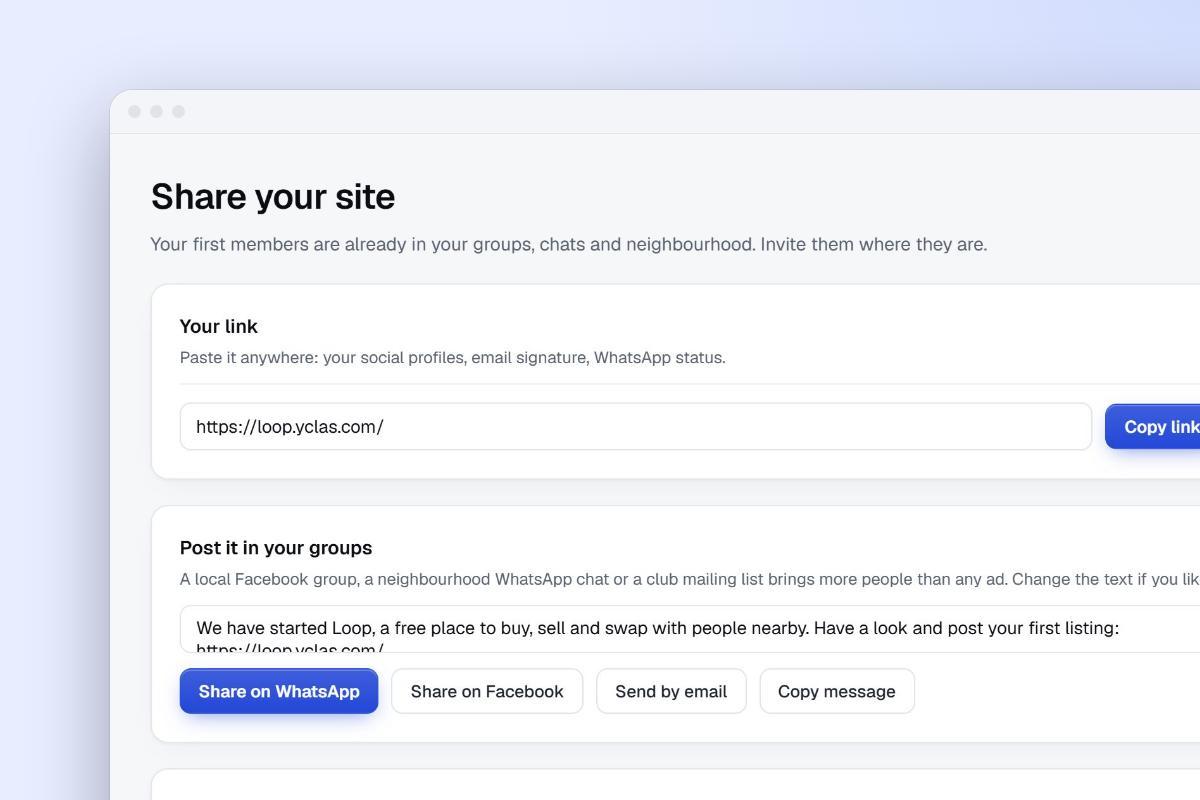
- Share your site (admin panel > Share your site): a ready group message for WhatsApp, Facebook or email, a QR code and a printable A4 poster for the letterbox-drop and poster steps.
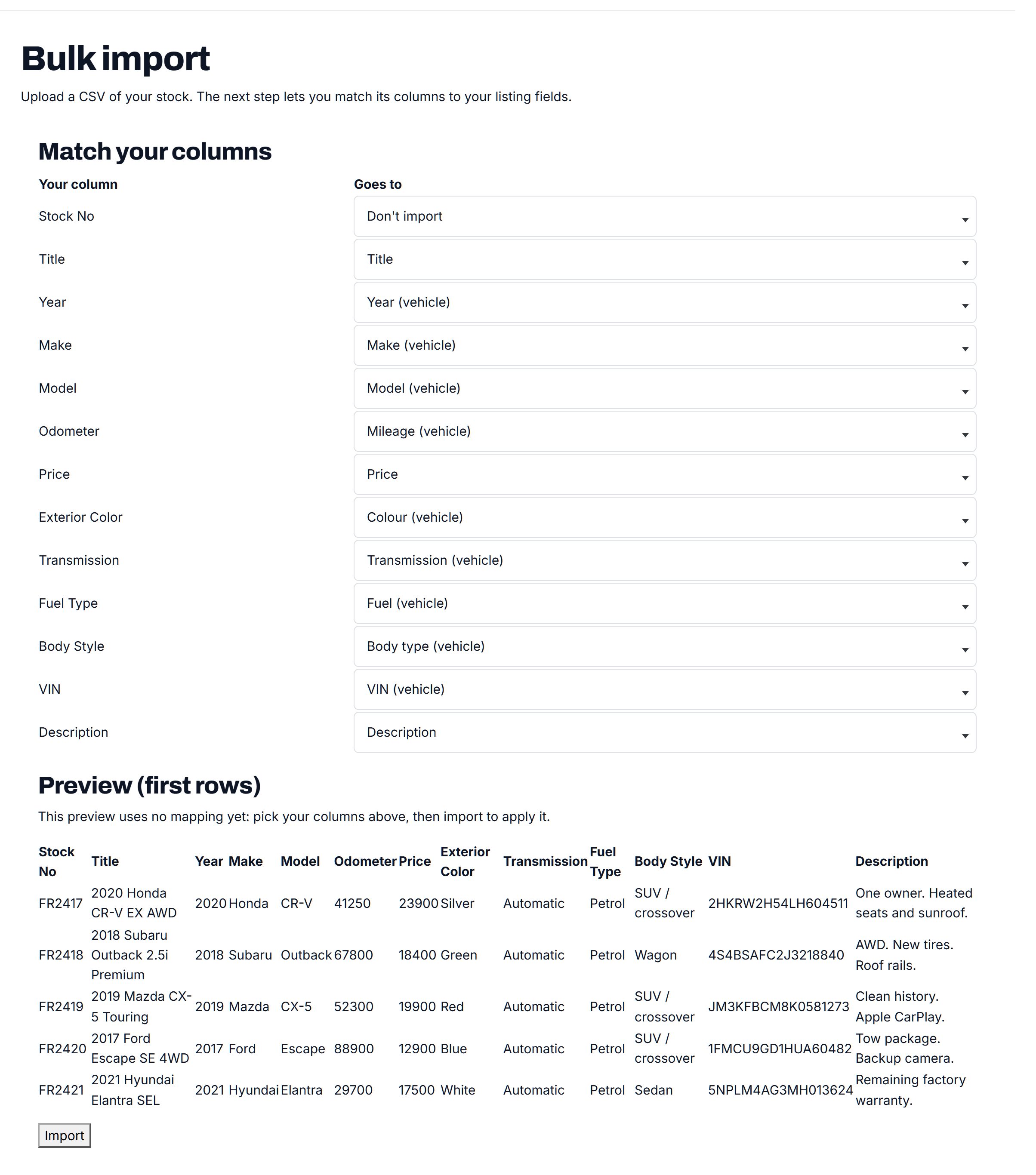
- Importers: CSV import, import from another platform and "Add listings from text" (see the box under Move 6): the Trade Me Motors move at small scale.
- Posting from a photo with AI makes it easy for friends and first sellers to list: they take a photo and the listing is filled in for them.
- Custom fields and categories per niche let you be the most complete site for one thing, the way Motors had its own car details and Property its own search.
- Featured listings and paid plans for sellers are there for later, when you are ready to charge for extras the way Trade Me did in 2000. The member email digest of new listings gives buyers a reason to come back.
For more on how other classifieds sites grew, see our pieces on Craigslist and OLX.
What does not transfer: Trade Me had the luck of timing. In 1999 most New Zealanders were coming online for the first time, and there was no Facebook Marketplace. You will not get a market to yourself. What you can still get is a niche or a town where you are the most complete and most trusted place to buy and sell.
Sources
- In the beginning, we had no idea: on the birth and growth of Trade Me — The Spinoff (Rowan Simpson, 2019) — https://thespinoff.co.nz/business/08-05-2019/in-the-beginning-we-had-no-idea-on-the-birth-and-growth-of-trade-me/
- Deal of a lifetime (Emily Ross) — SmartCompany (2007) — https://www.smartcompany.com.au/?p=5626
- Trade Me — Wikipedia (accessed 2026) — https://en.wikipedia.org/wiki/Trade_Me
- In the beginning… — Rowan Simpson's blog (2009) — https://rowansimpson.com/2009/03/22/in-the-beginning/
- Sam Morgan's e-Business strategy, an iStart exclusive (interview of August 1999, David McNickel) — iStart (2006) — https://istart.com.au/news-items/sam-morgans-e-business-strategy-an-istart-exclusive/
- It'll never catch on (Eyewitness) — RNZ (2018) — https://www.rnz.co.nz/national/programmes/eyewitness/audio/2018638189/it-ll-never-catch-on
- Sam Morgan - the boy's done good (Leah Haines) — NZ Herald (2006) — https://nzherald.co.nz/nz/sam-morgan-the-boys-done-good/UMLNSZSRQ6CK73XZVJHGG5WRAE
- Fairfax To Acquire Trade Me (press release) — Scoop (2006) — https://www.scoop.co.nz/stories/BU0603/S00071.htm
- Top ranked websites join forces to sell cars online (Richard Wood) — NZ Herald (2003) — https://nzherald.co.nz/technology/top-ranked-websites-join-forces-to-sell-cars-online/HF3VVG5IBGCTGGFL3IS7K25LWM
- $1 reserve Mini Cooper up for grabs (Trade Me press release) — Scoop (2003) — https://scoop.co.nz/stories/BU0308/S00179/1-reserve-mini-cooper-up-for-grabs.htm
- Our Story (archived timeline) — Trade Me — https://www.trademe.co.nz/About-Trade-Me/Our-Story
- Kiwis selling 200 cars per day online (Trade Me press release) — Scoop (2004) — https://scoop.co.nz/stories/BU0406/S00199/kiwis-selling-200-cars-per-day-online.htm
- Net no threat, say estate agents as TradeMe turns to property (NZPA) — NZ Herald (2005) — https://nzherald.co.nz/business/net-no-threat-say-estate-agents-as-trademe-turns-to-property/SFMSIVT6PXAFUKO2CFHYDJ5XAE
- Real Estate & New Goods – Keys To Growth (Trade Me press release) — Scoop (2006) — https://www.scoop.co.nz/stories/BU0601/S00080.htm
- Trade Me Math 101 — Rowan Simpson's blog (2011) — https://rowansimpson.com/2011/01/30/trade-me-math-101/
- Trade Me challenger hit by teething problems — RNZ (2012) — https://www.rnz.co.nz/news/business/117206/trade-me-challenger-hit-by-teething-problems
- Wheedle wheedled — Kiwiblog (2014) — https://www.kiwiblog.co.nz/2014/07/wheedle_wheedled.html
- eBay opens website for New Zealanders (Simon Hendery) — NZ Herald (2001) — https://nzherald.co.nz/business/ebay-opens-website-for-new-zealanders/KCYHV6DD3EQSX4P7VDAS7TY62U
- Message board tweaks — Trade Me announcements (2011) — https://www.trademe.co.nz/community/announcements/post/1012/message-board-tweaks
- Changes to our message board — Trade Me announcements (2020) — https://www.trademe.co.nz/community/announcements/post/1780/changes-to-our-message-board
- Going once, going twice … sold: the inside story of Trade Me's $750m sale (Rowan Simpson, book extract) — NZ Herald (2025) — https://nzherald.co.nz/business/book-extract-how-to-be-wrong-a-crash-course-in-startup-success/ZQQGP4CYOZB4FM7CZJWNMWDTGM
- Trade Me homepage, 22 April 1999 — Internet Archive capture — https://web.archive.org/web/19990422062834/http://www.trademe.co.nz/
- Trade Me homepage, 7 October 2000 — Internet Archive capture — https://web.archive.org/web/20001007233135/http://www.trademe.co.nz/