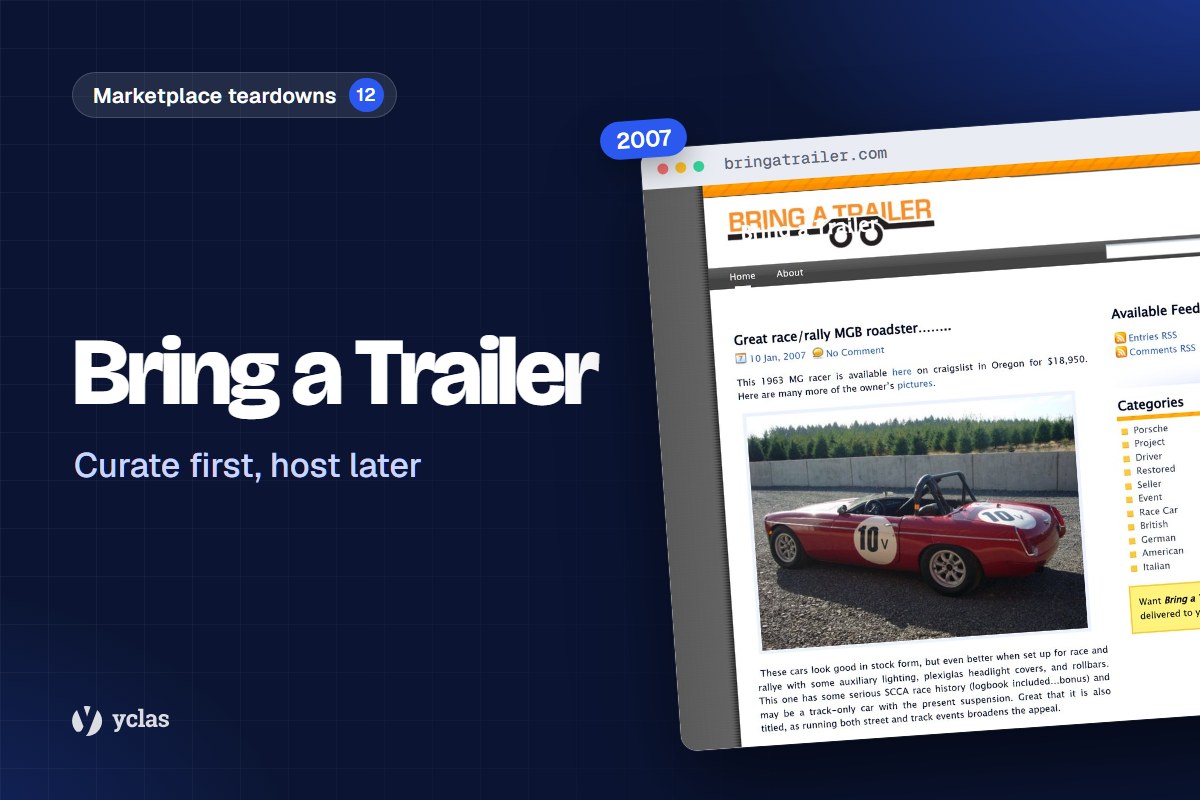
In 2007 a BMW employee in California spent his evenings in the basement, looking through online car ads. He looked at about 50 cars, picked the best one, and wrote a short post about it with the photos and a link to the seller's ad on eBay or Craigslist. One car a day. No listings of his own, no fees, no business model.3,4
That blog is now Bring a Trailer (BaT), the largest online auction site for collector and enthusiast cars. In 2025 it sold more than $1.7 billion of vehicles in 49,486 auctions, and it has 1.65 million registered users.11
The surprising part is the order. For its first years BaT was an audience with no inventory. Sellers arrived only when readers asked to list their own cars with it. Auctions came seven years after the first post.
If you run a vehicle, machinery or equipment site, this is the most useful story in the series. It is the clearest example of building the buyers first, with zero sellers, and letting supply come to you.
The short version
- BaT started as a blog that picked one good car a day from other people's ads. It needed no sellers to begin.
- Readers started sending in finds, then asked to list their own cars. Sellers came because the buyers were already there.
- Public comments from experts became the inspection, and saying no to weak cars kept the quality high.
- The fee came late and only on success: about $125 when a car sold, later 5% of an auction.
At a glance
- Founded
- 2007, as a blog1,3
- Founders
- Randy Nonnenberg (cars and content) and Gentry Underwood (technology and design), friends from Stanford1,2
- Country
- United States (San Francisco Bay Area)5
- Category
- Collector and enthusiast cars, later trucks, motorcycles, parts and memorabilia11
- First-seller tactic
- Feature other people's ads for free, build a reader community, then let readers list their own cars for a small fee1,4,8
- Where it is now
- Owned by Hearst since 2020; over $1.7bn sales and 1.65m registered users in 20259,11
Part of the guide Marketplace case studies
The cold-start problem: too many listings, not too few
In 2007 the used car market online belonged to eBay Motors, Craigslist and the big classified sites. Supply was not the problem. For an enthusiast, the problem was the opposite of an empty site: too many listings, most of them bad, many of them misleading.
Nonnenberg has described the online listings of that time as something you had to sift through to find the good cars. He has also said that a lot of what is claimed online is simply not true.1,6
He was the person his friends asked when they wanted to buy an old car. He had read car classifieds since the print days, and he emailed friends the interesting, checked listings he found.2 Underwood, a designer who later co-founded the email app Mailbox (bought by Dropbox in 2013), told him he was wasting that effort and should share it publicly.12 It reportedly took Underwood about a year to convince him.7
So BaT's question was not "where do we get listings?" It was "why would anyone come to us instead of eBay?" Their answer was taste and trust.
The name comes from a phrase in classified ads: "bring a trailer" is what sellers write about project cars that don't run.2,7
How they got the first sellers
Move 1: Be the filter, not the inventory
For the first years BaT was a simple WordPress blog with an email newsletter.8 Nonnenberg looked at around 50 listings a day and posted the best one, with a short write-up, the photos and a link back to the original ad.4
The cars were not exotic for the sake of it. He looked for cars that were interesting, special or rare, or an ordinary car in unusually good condition.2
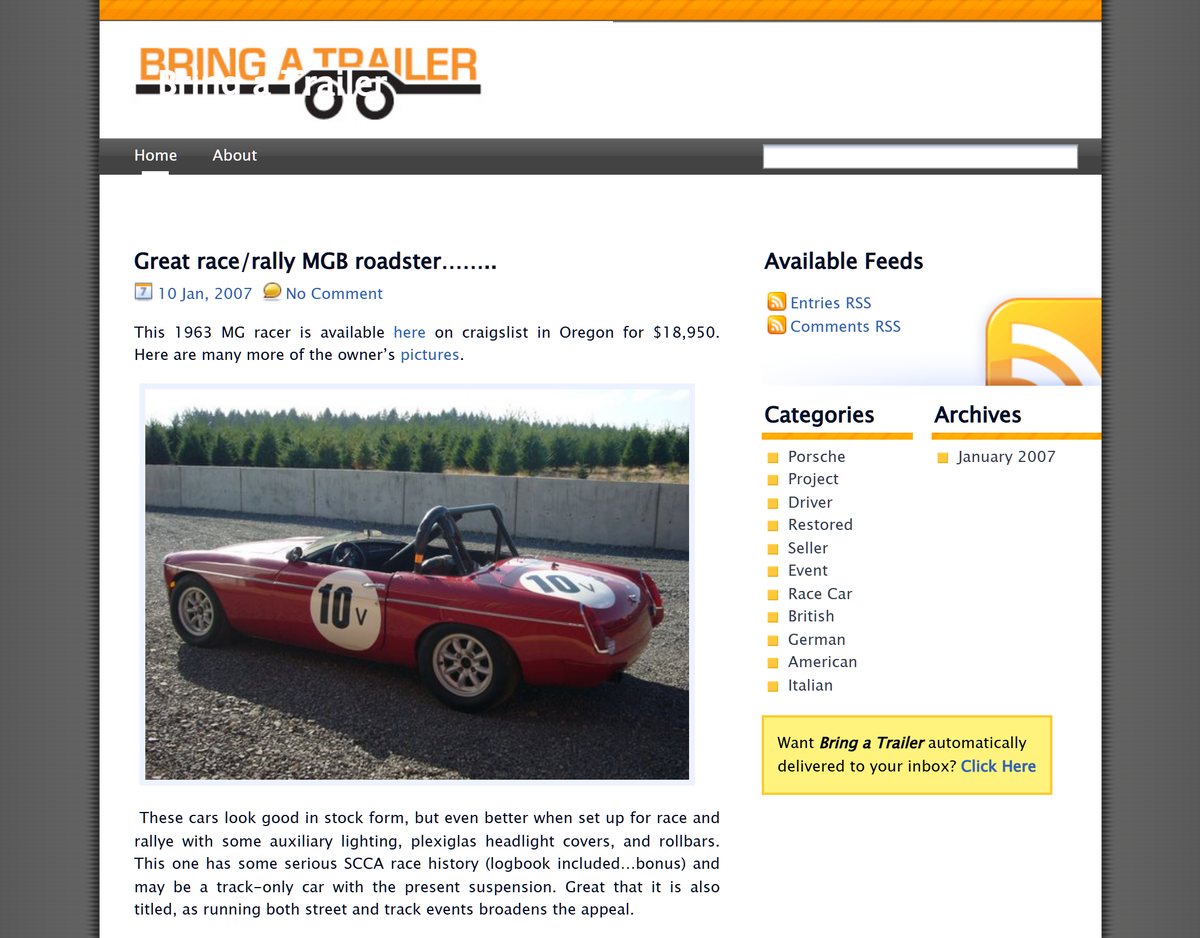
Mechanically, this is supply without sellers. Every eBay and Craigslist seller in the country was, without knowing it, supplying content to BaT. BaT added what those sites lacked: someone who knew cars, telling readers which car was worth their time and why.
It was slow. Nonnenberg kept his job at BMW and ran BaT as a side project, with no business model at the start.2,1 He described the early years like this:
"You're kind of speaking into an empty room for a pretty long time." Randy Nonnenberg, InsideHook2
Why it worked: it cost nothing but time, no seller had to agree to anything, and every post was useful on day one. A reader got value from the first post, not from the thousandth.
Move 2: Turn readers into scouts
The first big change was not a feature. Readers began emailing in cars they had found themselves. Nonnenberg's job moved from searching listings to reading his inbox. He told the Wall Street Journal: "That changed my whole world."1
This is a simple loop. The more people read BaT, the more people scouted for it. Better finds brought more readers. It also showed which readers cared enough to act: the future sellers and buyers.
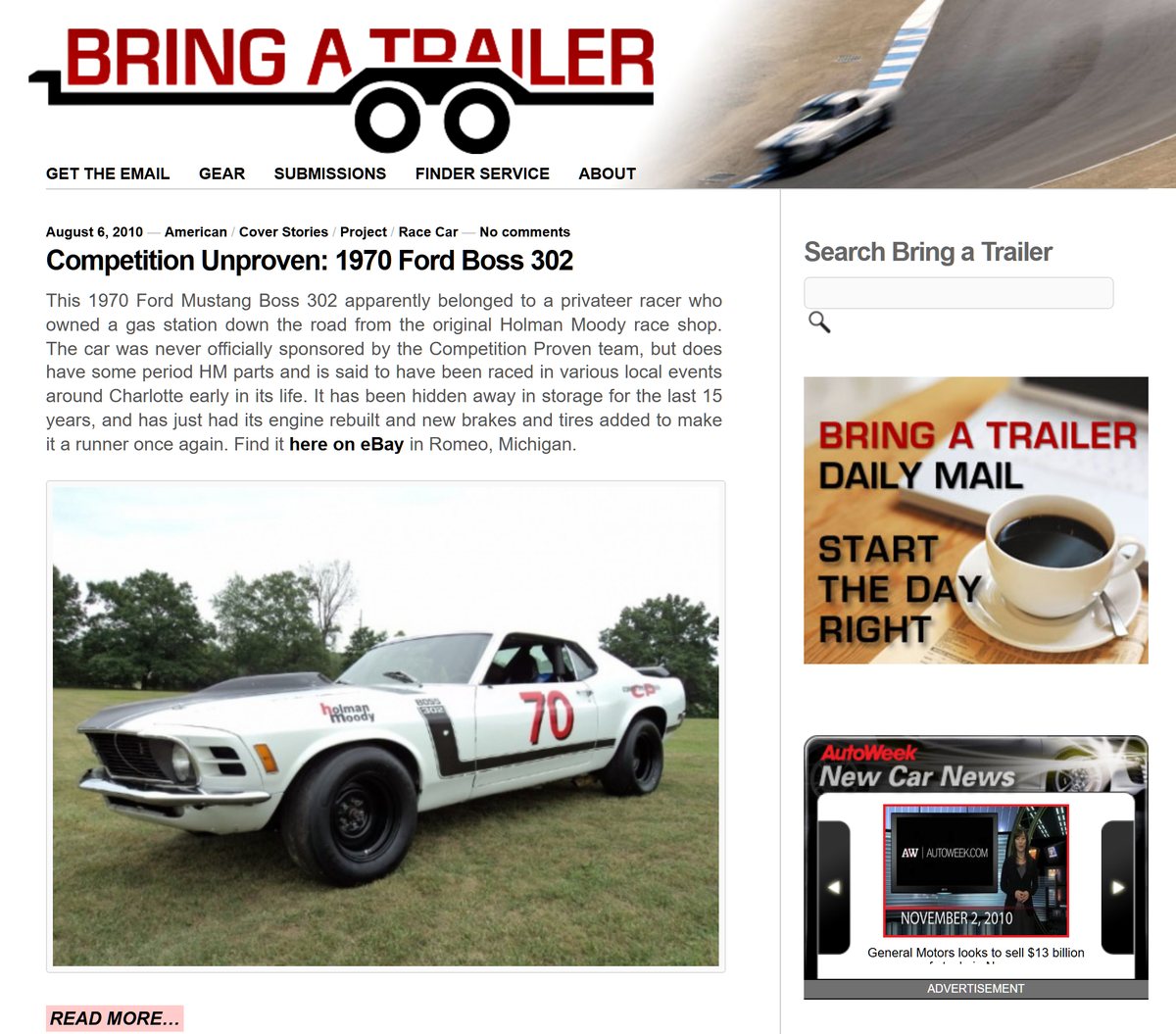
By 2010 the homepage was full of finds credited to readers by first name and initial, thanking them for the tip.16 The audience grew through the newsletter: Motoring Research reports that sign-ups grew steadily in the years after 2007.6
Move 3: Let sellers ask, then charge only on a sale
Once there was an audience, sellers came by themselves. Readers asked whether BaT could list their cars directly, instead of linking to a Craigslist ad.1,6 BaT said yes with "BaT Exclusives": cars for sale only on BaT, at a fixed asking price, like a classified ad.10 In 2010 an Exclusive listed the car's price, and interested buyers wrote to BaT's own email address.16
The money was modest. According to the Wall Street Journal, Nonnenberg could charge $125 when a car sold: the first time the site made money.1 The New York Times describes early sellers paying a small check and closing deals on an online handshake.5
Sources differ slightly on the start date. Classic Motorsports says BaT began selling classified-style listings in 2010, while BaT's president Howard Swig recalls Exclusives starting around 2008 or 2009.13,8 Nonnenberg left BMW in 2010 to work on BaT full time.1,6
By July 2014, BaT had listed more than 900 cars as Exclusives.10 That is roughly 900 sellers in about five years. Small by eBay standards, but each was a car the community wanted.
Why it worked: sellers chose BaT because the buyers were already there. BaT never had to persuade a nervous seller to try an empty site. And the fee came only on a sale, so the seller paid only when BaT delivered.
Move 4: Make the comments the inspection
Nonnenberg has said they did not start the site planning to build a big community.4 But when he featured a car, people who had owned that model added what they knew: what breaks, what to check, what the right price is. By 2010-2012, each new post was getting 50 or more comments.6
The comments became BaT's trust system. On eBay a buyer had to trust the seller's description. On BaT, dozens of knowledgeable strangers questioned the description in public, and the seller answered in public.6 The New York Times wrote that this community of unpaid, knowledgeable commenters set BaT apart from rivals like eBay early on.5
BaT protected the comments carefully:
- Rules that ask for useful criticism. One rule says anyone can call a car bad, but real value comes from saying what is wrong and how to fix it.2
- Staff comment under their own names.2
- Readers flag comments that are not constructive, a system in place since the early days.8
- One strike. People who break the rules can be removed.2
"The commenting community is really the most important part of B.A.T." Randy Nonnenberg, InsideHook2
The community also met offline. BaT held barbecues for frequent commenters, and about 80 BaT "alumni" came to a 2019 gathering at Laguna Seca.5,6
Why it worked: in used vehicles, the main fear is buying a hidden problem. Public comments from experts reduce that fear better than any badge. And they are free content that keeps people on the site.
This moderation policy template gives you a starting text you can cut down to those five lines:
Template
Moderation and content-removal policy
Publish this so users know how listings are checked, how to report one and how to appeal a decision; fill in your timings and contact points.
A starting point, not legal advice: have it checked for your country. More free tools →
Move 5: Seed the new format with your own cars
Fixed prices had a problem (see below), so in 2014 BaT built an auction system. On July 23, 2014 it launched with three cars: a 1970 Mustang Boss, a 1991 BMW M3 and a 1964 Alfa Romeo coupe.5 According to Swig, those first three cars were owned by Bring a Trailer itself.8
The format was a weekly event: a six-day preview with comments open, then a 24-hour auction. Bidders had to register a credit card, and a late bid reset the clock to stop last-second "sniping". The fee was 5% of the sale price, capped at $5,000, against up to 20% in combined fees at physical auction houses.10
Bring a Trailer's seller fee at the auction launch, against the combined fees at physical auction houses. BaT's 5% was capped at $5,000. Source 10.
Show the numbers
| Where you sell | Fees (% of sale price) | Notes |
|---|---|---|
| Physical auction houses | up to 20% | combined fees, Autoblog 2014 |
| Bring a Trailer | 5% (max $5,000) | Autoblog 2014 |
Early on there were about 25 auctions a week.8 By 2019, the Los Angeles Times reported 275 a week.9
Why it worked: a new format has its own cold start. No seller wants to go first. By using its own cars, BaT showed real results to its audience before asking anyone else to take the risk.
Move 6: Say no, and keep every result online
BaT has always been picky. In 2014 it said anyone could apply, but it would only accept cars its staff would want to own, at realistic prices.10 Staff check the car and its VIN, and check first-time sellers too.2 Classic Motorsports has reported that the team turns down more than half of the cars submitted.13
BaT also keeps every listing online after it ends, including bids, comments and auctions where the reserve was not met. Nonnenberg disliked how listings on other sites disappeared as if they had never existed.1 Over time those records became a price database for collector cars: people check BaT results to see what a car is worth.
Why it worked: rejecting weak cars kept the daily selection as good as the original blog. And the archive turned every past sale into a reason to come back.
What didn't work
Fixed prices. BaT Exclusives ran into a pricing problem. BaT itself said in 2014 that setting the right price was one of the hardest parts.10 Nonnenberg explained that if a seller priced too low, there was an unmanageable rush of buyers; too high, and nobody came.6
Swig remembers a 1965 Mustang Fastback where 48 people said in the first hour that they would buy it.8 First come, first served was clunky, and as requests to list grew, the classified-style format became unworkable.6,8 Auctions solved it: the audience sets the price.
Speed. It took years: seven from the first post to the first auction. BaT's president joked that its overnight success took about 12 years.8 Nonnenberg himself said the early operation was not very buttoned-up.5
Trust is never finished. As BaT grew, the comments that built trust also became a place for disputes. In 2022 commenters spotted links between a seller and a bidder on a Nissan 240SX auction, and BaT withdrew the listing.14 A community that checks sellers will also check you.
How supply turned into demand: buyers first, sellers second
At BaT, demand came first. The blog and newsletter built the buyers, and the sellers followed because that is where the buyers were. The steps are clear:
- 2007The blog starts: one car a day, linked from eBay and Craigslist.3,4
- 2008-2010Readers ask to list directly. BaT Exclusives begin, about $125 per sale.1,8,13
- 2010Nonnenberg quits BMW. Posts get 50+ comments, and the homepage mixes reader tips with Exclusives.1,6,16
- July 2014Auctions launch with 3 BaT-owned cars, after 900+ Exclusives.5,8,10
- 20187,718 auctions in the year.6
- 2019About 11,000 cars listed, around 70% sold, 2 million monthly visitors, 100,000 registered bidders; sales $230m-$248m (sources differ).5,1
- 2020Hearst Autos (Car and Driver, Road & Track, Autoweek) buys BaT. Sales $412m.9,1
- 2022Sales pass $1bn.1
- 2025Over $1.7bn, 49,486 auctions, 81% sold, 1.65m registered users.11
Value of vehicles sold on Bring a Trailer. 2019 sources differ ($230m-$248m); the lower figure is shown. Sources 1, 5, 11.
Show the numbers
| Year | Sales ($m) | Notes |
|---|---|---|
| 2019 | $230m-$248m | NYT / WSJ, sources differ |
| 2020 | $412m | WSJ |
| 2022 | over $1bn | WSJ |
| 2025 | over $1.7bn | The Shop, 2026 |
Hearst left the site and the team largely as they were.7 The staff grew from about two dozen in 2020 to just under 200 in 2026.5,8
Liquidity (the chance that a listed item actually sells) is the number that matters most here. Around 80% of BaT auctions sell.1,11 On most general classifieds sites, many listings never sell at all. A high sell rate is what makes sellers pay to list, and BaT got it from years of picking only cars the audience wanted.
Before you charge sellers, check your own reply rate and sell-through here:
Calculator
Is your marketplace working yet?
Liquidity means a listing finds a buyer. Count last month on your site: the listings that were live, how many got at least one reply, and how many sold.
Work these out every month and compare areas and categories: put your effort where they rise, not where traffic is biggest. More free tools →
The playbook: eight moves a small vehicle site can copy
What transfers, and what doesn't: you probably won't run auctions, and you won't build a $1bn business in seven years. But the first three moves cost nothing, and they are exactly what a one-person vehicle or equipment site can do this month.
Build an audience before you have sellers. An empty site has nothing to offer; a site that picks the best finds has something on day one. Start a daily or weekly "best finds" post for your niche: five good tractors, trucks or boats for sale in your region, with a two-line opinion each. Share it in local Facebook and WhatsApp groups and in your newsletter.
Curate other people's listings honestly. Link to the original ad, write your own short description, and don't copy the seller's photos without asking. Better: message the seller ("I featured your truck, want it listed on our site for free?"). Every seller you feature is a warm lead, because you have already sent them attention.
When a seller you featured agrees to list with you, send them this template so their listing answers the questions your readers ask:
Template
A classified ad that answers the buyer's questions
Use it whenever you post an item or service; replace every bracket and delete any line that does not apply.
Write the title last, after the details, using the exact words you would type if you were searching for this item yourself. More free tools →
Ask your readers to be your scouts. Readers who send you finds are your most engaged users. Add a line to every post: "Seen a good one? Send it to us on WhatsApp." Thank them by name. The ones who send finds are the ones who will list their own vehicles.
Let sellers come to you, then make it easy. When someone asks "can I list mine with you?", say yes, fast. Keep it free at first, or charge only on success, as BaT did with $125 per sale. Payment can wait until your sell rate is good.
Make knowledge public. In vehicles and machinery, buyers fear hidden faults. Ask sellers for the details experts want (hours, mileage, service history, VIN or serial number, known problems), and invite experts in your community to ask questions in public. Comment yourself, under your own name. Remove anyone who is rude, quickly.
Be picky, even when small. One good listing with real photos and details does more than ten vague ones. Send sellers a short checklist before you publish. Saying no to a bad listing protects the buyers who trust you.
Seed a new format with your own stock. If you add something new (featured listings, a "deal of the week", a dealer section), put your own items, or a friendly dealer's, into it first so the first users see it working.
Keep the record. Don't delete sold listings: mark them sold and keep them visible, with the price if the seller agrees. Over time "what did this sell for?" becomes a reason to visit, and a reason for sellers to trust your prices.
Try this this week
- Pick your 50. In 3 sessions of 30 minutes, look at about 50 listings in your niche on Facebook Marketplace, local classifieds and dealer sites. Choose the best 5.
- Publish one "best finds" post with those 5 by Friday: one photo or link each, two lines of opinion, and a link to the original. Share it in 3 local Facebook or WhatsApp groups.
- Write to the 5 sellers you featured within a day of posting. Tell them, and offer a free listing on your site. Target: 2 yes.
- Write to 20 more sellers (private sellers with good ads, small dealers, repair shops), 5 a day for 4 days. Target: 5 new listings this week.
- Add a "send us a find" line with your WhatsApp number to every post and to your homepage: 15 minutes.
- Write a 5-line comment and listing policy in 30 minutes: what a seller must include, what a useful comment is, and that rude or spam comments are removed.
- Answer every question on your listings within 24 hours, under your own name, for 7 days in a row.
Doing it on Yclas
- Recruit sellers (admin panel > Recruit sellers): keep the sellers you featured in the contact timeline, send each a personal invite link (/join/...), and use "Write it with AI" for the first message. The list of searches that returned nothing tells you what your buyers want and you don't have yet: use it to choose next week's finds.
- Share your site (admin panel > Share your site): the ready group message for WhatsApp and Facebook, plus the QR code and A4 poster for garages, parts shops, farm suppliers and car meets.
- Add listings from text: when a seller agrees, paste their Facebook or WhatsApp post and get a draft listing to check with them, instead of typing it again.
- Custom fields and categories: add the fields buyers ask about (year, mileage or hours, VIN or serial, service history, known faults), so every listing answers the expert questions up front.
- Member email digest: the email of new listings is your newsletter, like BaT's early daily email.
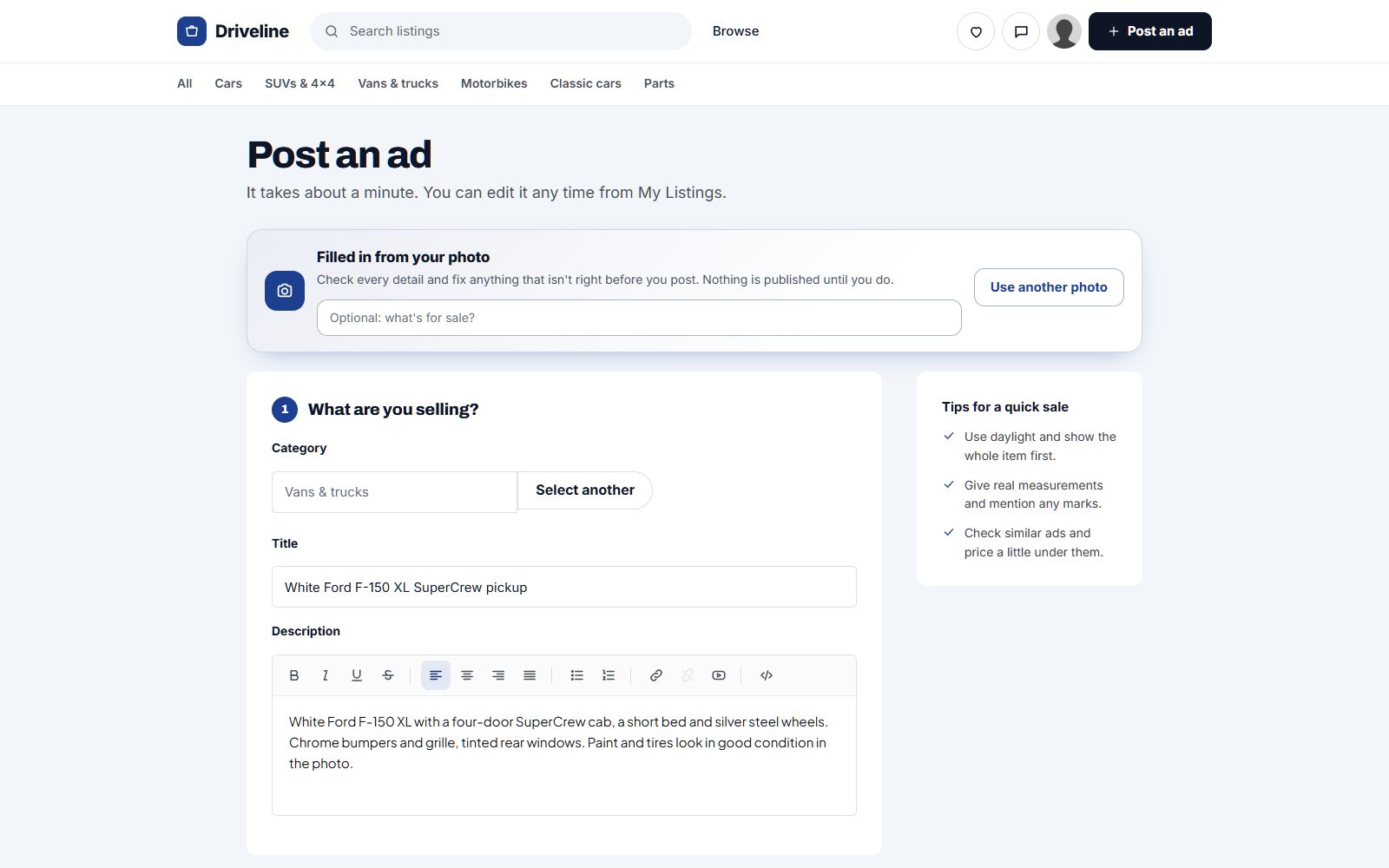
- Posting from a photo with AI lets a seller at a car meet list in a minute. Featured listings and paid seller plans can wait until your listings sell reliably.
What all 12 have in common
This is the last article in the series. Here is each company's first-seller move in one line, from Craigslist to Bring a Trailer:
- Craigslist: an events email to friends, where readers started adding jobs, items and apartments.
- Blocket: one region, free ads, and a copy of the supermarket notice board.
- Leboncoin: copied Blocket exactly: free ads, ads by area, every ad checked.
- Avito: free posting in two cities, cheap search ads, then TV once supply existed.
- Kijiji: launched in French in Quebec, where Craigslist was weak.
- Gumtree: served one expat community in London with free ads and guides.
- OLX: cheap search ads in many countries, plus teams signing up dealers.
- Trade Me: free to list, friends and family first, letterbox drops.
- Wallapop: the founder's own flea-market photos, then one-minute listing from a phone.
- Vinted: the founder's own wardrobe, then her friends'.
- Reverb: the founder's guitar shop, then other dealers met face to face.
- Bring a Trailer: picked one car a day from other sites until sellers asked to join.
Read down the list and the same patterns keep coming back:
- They started narrow. One city, one community or one category.
- The founders did things that don't scale. Answering every email, posting listings themselves, calling dealers, picking one car a day by hand. The first sellers came one by one.
- Listing was free, or cheap, at the start. They charged later, for extras or on success, once buyers were reliably there.
- Trust was the product. Moderation, a real person answering, community comments, careful selection. Buyers came back because they believed what they saw.
- The community did part of the work. Readers who send tips, members who answer questions, sellers who tell their friends.
- It took years. The ones that won kept going through the empty-room phase.
You don't need a TV budget for any of this. You need a niche, a few hours a week, and the patience to get the first 10 sellers yourself.
Sources
- How One Guy's Car Blog Became a $1 Billion Marketplace, Ben Cohen — The Wall Street Journal, republished by Fox Business (2023) — https://www.foxbusiness.com/markets/how-one-guys-car-blog-became-1-billion-marketplace
- Inside the Greatest Vintage Car Cult on the Internet, Benjamin Samuel — InsideHook (2019) — https://www.insidehook.com/article/vehicles/inside-the-greatest-vintage-car-cult-on-the-internet-bring-a-trailer
- Listen to us chat with Bring a Trailer co-founder Randy Nonnenberg, David Tracy — The Autopian (2022) — https://theautopian.com/listen-to-us-chat-with-bring-a-trailer-co-founder-randy-nonnenberg-about-how-he-built-his-empire-how-he-used-to-be-a-bmw-engineer-and-about-this-amazing-ex-mclaren-rv
- Randy Nonnenberg interview — The Apex by Custodian (2021) — https://apex.custodian.club/randy-nonnenberg
- A Chatty Auction Site Is Taking the Classic Car World by Storm, Robert C. Yeager — The New York Times, syndicated by Artdaily (2020) — https://artdaily.com/news/121603/A-chatty-auction-site-is-taking-the-classic-car-world-by-storm
- Bring a Trailer: Exclusive insight into the auto auction company, John Redfern — Motoring Research (2019) — https://www.motoringresearch.com/america-news/bring-a-trailer-exclusive-insight-into-the-auto-auction-company/
- True Car-nnoisseur, Kevin Marks — Punch Magazine (2022) — https://punchmagazine.com/bring-a-trailer/
- Bring a Trailer Started as a Craigslist Blog. It Created an Industry (podcast with Howard Swig), Joel Feder — The Drive (2026) — https://www.thedrive.com/podcast/bring-a-trailer-started-as-a-craigslist-blog-it-created-an-industry
- Bring a Trailer — Wikipedia (citing the Los Angeles Times 2019 and Autoweek 2020) — https://en.wikipedia.org/wiki/Bring_a_Trailer
- BringATrailer launches classic car auctions, Chris Bruce — Autoblog (2014) — https://www.autoblog.com/2014/07/24/bringatrailer-classic-car-auctions/
- Bring a Trailer Sees Record Growth In 2025 With Over $1.7B in Sales — The Shop (2026) — https://theshopmag.com/news/bring-a-trailer-record-growth-2025/
- Gentry Underwood (author bio, co-founder of Mailbox, now part of Dropbox) — TechCrunch — https://techcrunch.com/author/gentry-underwood/
- Bring a Trailer: Today's Auction Company for Today's Auction Shopper — Classic Motorsports (2019) — https://classicmotorsports.com/articles/bring-trailer-todays-auction-company-todays-auctio
- Bring A Trailer Auction Of 590-Mile S14 Goes South After Curious Commenters And Shill Bidding — The Drive (2022) — https://www.thedrive.com/news/44979/bring-a-trailer-pulls-590-mile-nissan-240sx-auction-over-shill-bidding-and-its-a-real-mess
- Bring a Trailer homepage, January 2007 — Internet Archive capture (2007) — https://web.archive.org/web/20070113222446/http://bringatrailer.com/
- Bring a Trailer homepage, August 2010 — Internet Archive capture (2010) — https://web.archive.org/web/20100806121251/http://bringatrailer.com/