Kijiji is the site Canadians use to sell a sofa, find a flat or hire a babysitter, the way Americans use Craigslist. You would expect a story of a giant, eBay, spending its way to the top. It wasn't.
In 2005 the Canadian launch was run, at first, by one person: Janet Bannister, a product manager at eBay Canada. She had very little budget, ran it like a startup inside the company, and paid for some of the search ads on her own credit card5,6.
And she did not start in Toronto, Canada's biggest city. Kijiji opened first in French, in Quebec City and Montreal, where Craigslist had little presence5,1. Nine months later it went national. About a year after that, eBay said Kijiji had more visitors in Canada than Craigslist7.
Then the same company, with far more money and a mass email to millions of eBay users, launched Kijiji in the United States. It never came close to Craigslist there and was renamed in 20108,12. Same product, same owner, opposite results. The difference is the part a small marketplace can copy.
The short version
- Kijiji Canada started with one manager, a tiny budget and search ads, not with eBay's millions.
- It launched in French, in two Quebec cities where Craigslist was weak, and ran there for nine months before going national.
- Posting was free for individuals, the site was one page per city, and it chose a clear audience: families.
- The same product launched in 200+ US cities at once, against Craigslist's habit, and failed. Win one small area first.
At a glance
- Founded
- Launched 28 February 2005 in Canada, China, France, Germany, Italy and Japan; in Canada first in Quebec City and Montreal1,18
- Founders
- Built as a start-up inside eBay by a small team of employees2,18; Canadian launch led by Janet Bannister5,6
- Country
- Canada (Quebec first, the rest of Canada from November 2005)18
- Category
- General local classifieds: items, housing, jobs, services, community
- First-seller tactic
- Launch in French where Craigslist was weak; free listings for individuals; city sites; search ads bought on a shoestring1,5
- Where it is now
- Canada's leading classifieds site; owned by Adevinta since eBay transferred its classifieds business in June 202117,18
Part of the guide Marketplace case studies
The cold-start problem: Craigslist was strong, but not in French
Cold start is the moment when a marketplace has no buyers because it has no listings, and no listings because it has no buyers.
Kijiji's cold start in Canada had three parts.
1. The obvious competitor was already there. Craigslist was the model everyone copied. By early 2005 it had about 5 million unique visitors a month and more than 2.5 million ads a month, mostly in the US3. eBay itself owned 25% of Craigslist, bought in August 20042,3.
In Canada, though, the Globe and Mail notes that Craigslist was much less developed than in the US5.
2. Canadians were not buying online the way eBay expected. Bannister had run the eBay.ca website since 2003. She saw that Canadians visited eBay at least as often as people in other countries, but completed purchases only about half as often5. Her reading of the data:
"Canadians spend a ton of time online … but they prefer to transact offline." Janet Bannister, Globe and Mail5
That is a description of classifieds. People wanted to find things online, then meet, look, pay in cash and carry it home.
3. In Quebec, the alternatives were paid or in English. Quebec already had a local classifieds site, LesPAC, founded in 199616. LesPAC only made posting free for consumers in most categories in March 2017, more than ten years after Kijiji arrived16.
Craigslist offered English-language sites. eBay's head of classifieds later explained the bet: eBay did not believe Craigslist would succeed abroad "with an English-only site" (Jacob Aqraou, TechCrunch)10.
So the opening was clear: a free, French-language, local site in a province where the American leader spoke English and the local leader charged.
How they got the first sellers: six moves
Move 1: Start from how people already trade, not from a product
Bannister did not start with "let's copy Craigslist." She started with a number from her own site: Canadians browsed but did not buy online5. Her conclusion, as the Globe and Mail reported it, was that eBay should adapt to local habits instead of trying to change them5.
eBay already had a classifieds platform being prepared for Europe under the Kijiji name, with no plans for Canada. Bannister asked for it. As she tells it, the answer was that she could take the platform and launch it in Canada if she wanted6. She also said that without her earlier years and relationships at eBay in California, the idea would probably not have been approved5.
Why it worked: the first sellers on a classifieds site are people who already sell things locally: a used crib, a sofa before a move, a babysitting service. Bannister's data told her those people existed in large numbers. She gave them a place that matched what they already did, instead of asking them to learn eBay-style shipping and online payment.
Move 2: Launch in the corner the leader is not serving
Kijiji Canada opened first in French, in Quebec City and Montreal, in February 20055,18. The Globe and Mail's explanation is short: Craigslist had little presence there5.
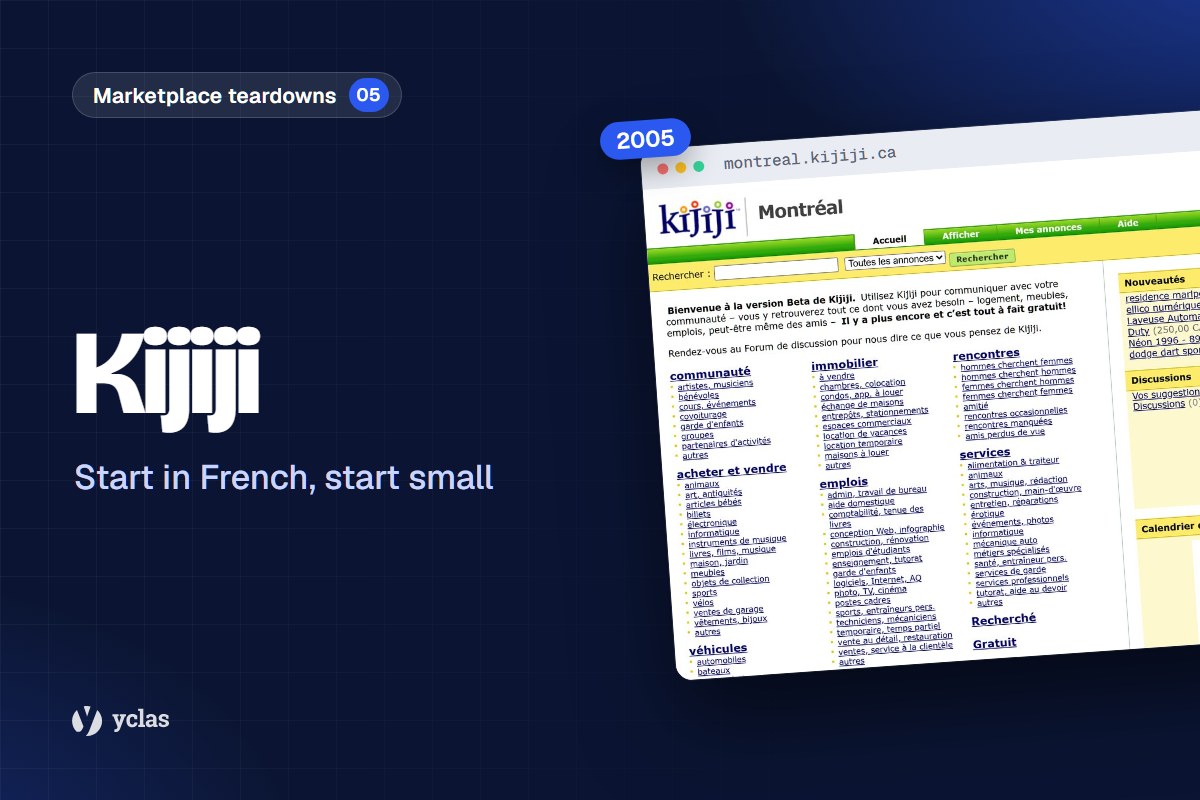
The early site shows how local it was. In March 2005 the kijiji.ca front page offered only two Canadian choices, Montréal and Québec, next to the other launch countries19. The Montreal page was entirely in French, labelled as a Beta, told visitors it was completely free, and invited them to a discussion forum to say what they thought20.
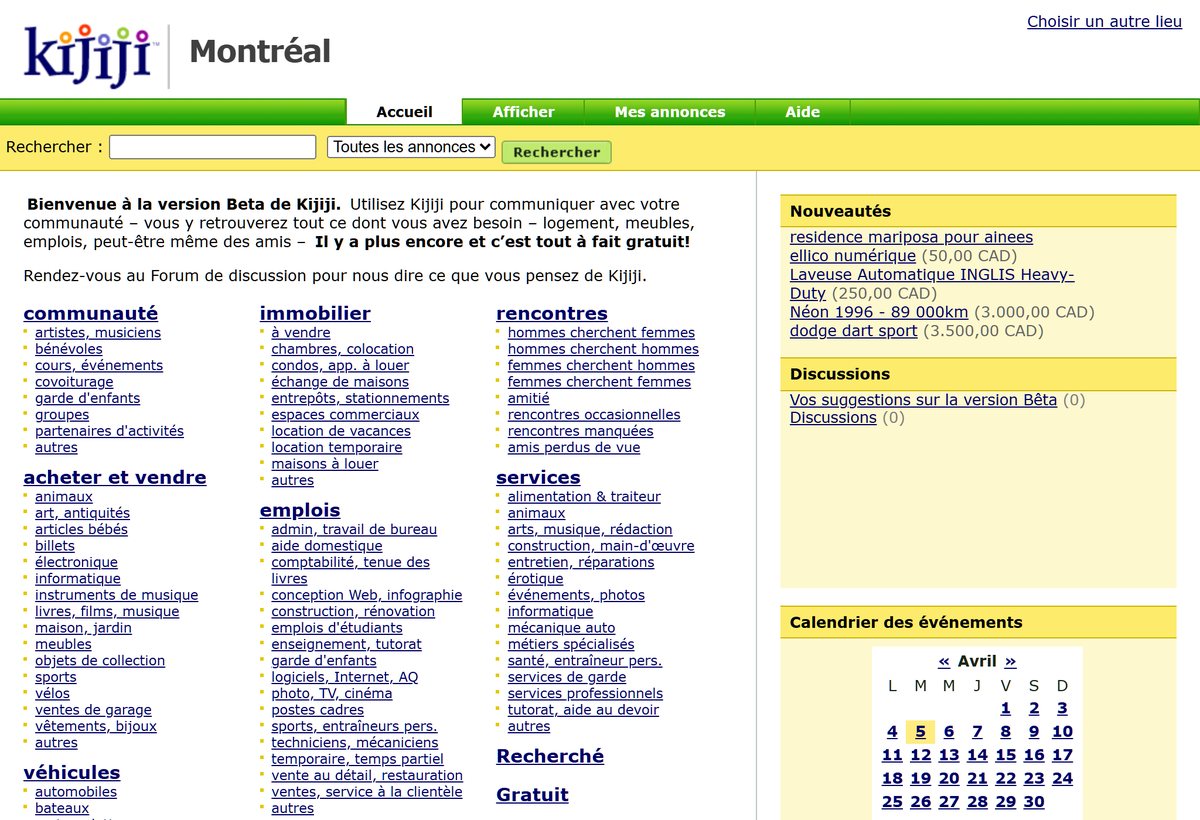
Starting in Quebec did three things at once:
- No head-to-head fight. French speakers had no free, French-first option from a big brand. Kijiji did not need to pull anyone away from Craigslist.
- A dense, small area. Two cities in one province, with one language and one media market, meant every listing was relevant to most visitors. Density (many listings for the same small area) is what lets a buyer find something on the first visit.
- A real test before spending. Bannister went on maternity leave in April 2005. When she came back in November, the business was doing well enough to launch nationwide5. Quebec was a nine-month test that proved the model before eBay showed Kijiji to the whole country.
Notice what eBay did not do in Canada: open every city at once with equal effort. The US launch two years later did exactly that, with 262 cities8.
Move 3: Take ready-made software and run it like a startup
Kijiji was not built from scratch for Canada. It came from Marktplaats, eBay's Dutch classifieds site, and its concept was rolled out abroad under the Kijiji name4,18. The launch version had city sections with items for sale, property, jobs, courses, babysitters, personals and a community section2. The Associated Press's launch story used a babysitting service in the Montreal suburbs as its example listing3.
eBay described the sites as intensely local, the opposite of eBay, where geography did not matter3. It also told investors the launch would not have a material impact on its 2005 revenue1. In other words, nobody expected much.
That suited a tiny team. Bannister worked alone at first, then hired as the business grew6. Executives were sceptical and gave scant resources, but also a lot of freedom5.
Why it worked: the expensive part, the software, already existed. The scarce part, a person who understood the local market and cared about it, was what Canada had. For a small marketplace this is the reverse of most startup advice: do not spend your first months building. Use ready-made software and spend your time on the market.
Move 4: Buy the searches people already make
The one marketing tactic the press recorded from Kijiji Canada's launch is keyword advertising: Bannister bought search ads, and paid for some of them on her own credit card5. No figures for the spend were ever published.
The logic is simple. Someone in Montreal types "appartement à louer" or "poussette usagée" (used stroller) into a search engine. That person wants to buy or rent right now, locally. An ad that sends them to a page full of local listings turns a search into a visit. Enough visits turn into replies, and replies keep sellers posting.
Later, in the US, Kijiji used the same tool more aggressively: it bought ads on searches for Craigslist-related terms, including the name of Craigslist's founder, Craig Newmark8. Its general manager said most users still came by word of mouth8.
Why it worked: search ads in 2005 were cheap compared with TV or print, and could be bought one city and one phrase at a time. That matched a two-city launch with no budget.
Before you spend anything, check what a small search-ad budget could bring you, and what each seller would cost.
Calculator
What will paid ads bring your marketplace?
Use the cost per click your ad platform shows for your keywords and country, and your own sign-up rate once you have one.
Compare the cost per seller with what a seller brings you over a year: ads pay off when it is clearly lower. More free tools →
Move 5: Free for individuals, one site per city
Individuals could list and search on Kijiji for free from day one1. The site was organised by city, with more than 50 city sites across the six launch countries1,4. By 2014 Kijiji Canada ran more than 100 local sites across the country13.
Free posting matters most at the start. A seller who posts for free on an empty site loses nothing if nobody calls. A seller asked to pay on an empty site simply leaves. In Quebec, where the local leader charged consumers to post, "free and in French" was a clear reason to try the newcomer16.
City sites matter for buyers. A buyer in Quebec City does not want a sofa in Toronto. One page per city, filled with nearby listings, made the site feel full even when the national total was small.
How full is "full"? Work out how many listings your first area needs before a visitor finds something on the first visit.
Calculator
How many listings do you need at launch?
Visitors leave a category that looks empty. Pick how many listings a category page needs to look alive, for the categories and places you launch with.
Too many weeks? Launch with fewer categories or one area first, and add more as listings come in. More free tools →
Move 6: Decide who the site is for
Craigslist had a reputation as an open, anything-goes site. Kijiji positioned itself against that. In 2007 its general manager, Jacob Aqraou, said the site was focused on the "young family model"8.
In practice that meant deleting ads with adult content and revealing photos8, using eBay's software to detect nudity in photos11, and showing pictures in search results by default11. In 2010 Kijiji removed its Personals section in Canada and the US18. The Globe and Mail described Kijiji as a more family-friendly alternative to Craigslist12.
Why it worked in Canada: families have a steady flow of things to sell (outgrown clothes, cribs, bikes, furniture) and to buy. A site where a parent is happy to browse with a child nearby gets both sides of the market. Where Craigslist was not yet the habit, Kijiji could become "the family one" first.
Write your rules down before the first bad listing arrives; this template gives you a starting set to edit.
Template
Posting rules for your classifieds site
Publish this as your posting rules page and link it from the post-an-ad form; adjust the prohibited list to your country's laws and your niche.
Check your country's rules on items such as weapons, animals, alcohol and medicines before publishing. More free tools →
What didn't work: the same playbook failed in the US
The same product, with more money, failed in the US. Kijiji launched in more than 200 US cities in mid-20077. eBay sent 15 to 20 million emails to eBay users who fit the young-family profile8.
By November 2007 it was the number two US classifieds site, with 1.8 million visitors against Craigslist's 20 million. Its average visitor stayed about three minutes, compared with more than an hour on Craigslist8.
Kijiji's US launch against Craigslist, months after 200+ cities and 15-20 million emails. Source 8.
Show the numbers
| Site | Visitors | Notes |
|---|---|---|
| Craigslist | 20 million | NYT report via Taipei Times |
| Kijiji US | 1.8 million | same report; visitors stayed about 3 minutes vs over an hour |
The general manager admitted that only about half of one person's time had gone into the US launch9. In March 2010 eBay renamed the US site eBay Classifieds; a BGC Partners analyst told Reuters that Kijiji had gone nowhere in the US12.
The lesson is not "eBay did it badly." In the US, Craigslist was already the habit in every city, and no email blast changes a habit. In Quebec, Kijiji arrived before that habit formed.
Some international sites closed or changed. Kijiji China became Baixing and Kijiji India became Quikr in 2008, and the Hong Kong and Taiwan sites closed in 201518. Canada became, in Bannister's later words, the most successful country on the platform6.
The name was not her choice. Bannister objected to the name Kijiji, which means "village" in Swahili; it was imposed from above5. It did not stop the site, which suggests the name matters much less than the listings behind it.
A note on the "overtook Craigslist" claim. eBay said in 2007 that Kijiji had passed Craigslist in Canadian visitors in the fall of 20067. A Time magazine piece in mid-2008 still described the two as roughly level in Canada11. By 2010, Reuters described Kijiji as number one in Canada12. The lead was real, but it took a few years to become undisputed.
How supply turned into demand: from two cities to a national habit
- Feb 2005Launch in French in Quebec City and Montreal; free for individuals1,5.
- Nov 2005Launch across the rest of Canada5,18.
- Fall 2006eBay says Kijiji passed Craigslist in Canadian visitors7.
- Nov 2006About 1.5 million unique visitors a month and about 500,000 listings7.
- 2014About 14 million unique visits a month, 6.5 million live ads, 100+ local sites, used by nearly 50% of Canadian internet users13.
- Oct 201616 million unique visitors a month, 2 new ads every second, 1 billion page views a month14.
- Jun 2021eBay completes the transfer of its classifieds business, including Kijiji, to Adevinta17.
Sources measure visitors differently: the Globe and Mail reported more than 11 million monthly visitors in January 20165, while its October 2016 report gave 16 million unique visitors14.
From the Quebec launch to a national habit. Source 7 (November 2006), (source 14) (October 2016).
Show the numbers
| When | Unique visitors a month | Notes |
|---|---|---|
| Nov 2006 | about 1.5 million | with about 500,000 listings |
| Oct 2016 | 16 million | 2 new ads every second |
Three things turned early listings into buyers:
- Listings brought searches, searches brought replies. Every free listing is a page that can appear when someone searches for that item in that city. Keyword ads started the flow; the growing pile of local listings kept it going.
- Word of mouth among the target group. Kijiji's general manager said most users arrived by word of mouth8. Families selling to families tell other families.
- Owning the second-hand habit. By its tenth anniversary Kijiji was publishing its own "Second-Hand Economy" research, estimating that Canadians spend close to $30 billion a year on second-hand goods13,15. By then the site was not just a place to post; it was how the country talked about buying used.
Monetisation came later and gently. Free ad limits per category and Kijiji for Business arrived around 2016, registration to post became mandatory in 2017, and a separate Kijiji Autos site launched in 201818. Rules and fees came after the habit, not before.
The playbook: seven lessons for a small marketplace
Find the gap in behaviour, not just the gap in the market. Bannister saw that Canadians browsed online but preferred to pay offline. Talk to 10 people in your niche and ask how they bought or sold the last thing. If the answer is "a Facebook post, then cash on pickup", build for that: contact buttons and local pickup, not online checkout.
Start where the big player is weak. Kijiji picked French-speaking Quebec because Craigslist served it poorly. Look for the language, region, town or category that Facebook Marketplace and the national sites serve badly. A tractor-parts site in one farming region, a Portuguese-language site for a migrant community, a site for one island: small, but yours.
Make one area full before opening the next. Kijiji ran in two cities for nine months before going national; the US launch opened 262 cities at once and stayed thin. Choose one town or one category. Do not promote a second until the first has new listings every day and replies within hours.
Keep posting free for individuals until the site is busy. Free posting made trying Kijiji risk-free while the local rival charged. Charge private sellers nothing at the start. Add paid featured listings or business plans later, as Kijiji did with business accounts and posting limits ten years in.
Buy intent, not awareness. Bannister spent her tiny budget on search ads, where people were already looking for an item in a city. Skip general brand ads. Post your listings into the local groups where people ask "anyone selling…?", make each listing page findable on Google, and if you pay for anything, pay for searches like "[item] for sale [town]".
Choose who your site is for, and moderate for them. Kijiji's "young family" focus meant removing adult content and showing photos by default. Write down your typical buyer and seller in one sentence, then remove every listing that would make that person leave. In a small market, a clean, trusted site beats a bigger, messy one.
Use ready-made tools; spend your time on people. Kijiji Canada used a platform built in Europe and put its energy into the local market. Do not spend months on custom software. Spend the hours on calls, visits and messages to sellers.
What does not transfer: eBay's name opened doors with partners and the press, and eBay's engineers built the search and photo tools.
Try this this week
- Pick your "Quebec" (30 minutes). Write one sentence naming the one area, language or category you will win first, and why the big sites serve it badly. Promote nothing outside it for the next three months.
- Ask 10 people how they last bought or sold (2 hours). Write down the channel (Facebook, WhatsApp, word of mouth, a shop) and whether they paid online or in person.
- Post 20 real listings in your chosen area (2 hours), your own or from sellers who agree, so the first visitor sees a full local page.
- Message 30 local sellers (1 hour) who already post in Facebook groups or on Marketplace, inviting them to post the same item on your site for free. Target: 5 who post this week.
- Share 10 listings in 3 local groups (30 minutes) on Facebook or WhatsApp where people ask "anyone selling…?", with a link to each listing.
- Write 5 posting rules (30 minutes) that protect your typical buyer (no duplicates, real photos, real prices, no off-topic ads) and remove every listing that breaks them.
- If you spend money, spend under $20 over 7 days on one search ad for one phrase in one town, for example "used tractor parts [region]", and count the visits and replies it brings.
Need words for those 30 messages? Start from this template and make each one personal with the seller's name and item.
Template
Outreach message to recruit your first sellers
Use this to contact people already selling on other sites, in groups or in shops; personalise the first line every time and offer what you can really deliver.
Send no more than one follow-up to people who did not reply, and keep a list of who asked not to be contacted. More free tools →
Doing it on Yclas
- Recruit sellers (admin panel > Recruit sellers): find local businesses in your chosen area, send each a personal invite link (/join/...) with an invite message from "Write it with AI", and keep a timeline of who you contacted. Its list of searches on your site that returned nothing shows which items buyers want and you do not yet have.
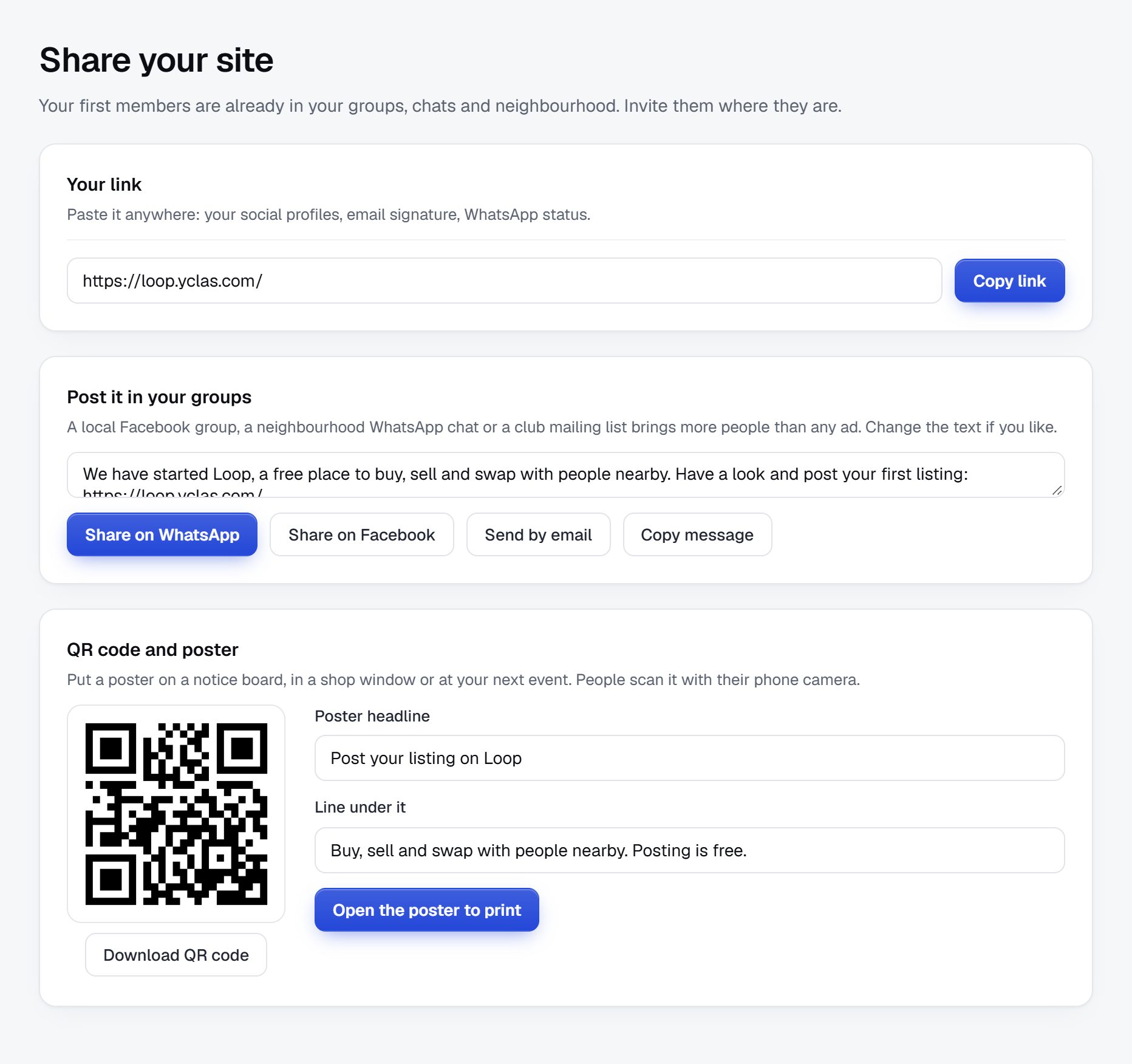
- Share your site (admin panel > Share your site): a ready group message for WhatsApp, Facebook or email to post in local groups, plus a QR code and a printable A4 poster for shops, schools and community boards in your first town.
- Add listings from text: paste a list of posts from a Facebook or WhatsApp group (with the sellers' permission) and get draft listings, so your first 20 listings take minutes.
- Posting from a photo with AI: a seller takes a photo and the listing is filled in, which keeps posting as easy as Kijiji's free, short form.
- Custom fields and categories: set up categories and fields for your niche and language first, and add more only when your searches-with-no-results list asks for them.
- Featured listings and paid plans for sellers, for later, once the site is busy, plus the member email digest of new listings to bring buyers back each week.
For how Craigslist itself grew, see What has made Craigslist so successful as an online classified platform, and for the wider North American picture, the top classified websites in the USA.
Sources
- eBay launches local on-line classified ad service — The Globe and Mail (2005) — https://www.theglobeandmail.com/technology/ebay-launches-local-on-line-classified-ad-service/article20420224
- eBay launches classifieds service (Kijiji) — The Register (2005) — https://www.theregister.com/2005/03/09/ebay_classifieds/
- eBay launches international classified ad site (Rachel Konrad, AP) — Mail & Guardian (2005) — https://mg.co.za/friday/2005-03-10-ebay-launches-international-classified-ad-site/
- Marktplaats als Kijiji naar buitenland — Adformatie (2005) — https://www.adformatie.nl/carriere/marktplaats-als-kijiji-naar-buitenland
- How Kijiji's Canadian founder became a trailblazing venture capitalist (Sean Silcoff) — The Globe and Mail (2016) — https://www.theglobeandmail.com/report-on-business/careers/careers-leadership/janet-bannister-real-ventures-lunch/article28329625/
- Venture capital world clicks for former online shopping exec — Communitech News (n.d.) — https://communitech.ca/technews/venture-capital-world-clicks-for-former-online-shopping-exec.html
- Does Craigslist care about Kijiji? Unlikely — Mathew Ingram (2007) — https://mathewingram.com/work/?p=1511
- eBay's Kijiji looks to take on Craigslist (New York Times report) — Taipei Times (2008) — https://www.taipeitimes.com/News/worldbiz/archives/2008/01/01/2003395191
- In restless pursuit of Craigslist's success (New York Times report) — MultifamilyBiz (2007) — https://www.multifamilybiz.com/news/417/in_restless_pursuit_of_craigslist039s_success
- Kijiji talks smack about Craigslist: "We will be No. 1 in the U.S." — TechCrunch (2008) — https://techcrunch.com/2008/02/27/kijiji-talks-smack-about-craigslist-we-will-be-no-1-in-the-us/
- Taking aim at Craigslist (Anita Hamilton) — Time (2008) — https://time.com/archive/6904397/taking-aim-at-craigslist/
- eBay rebrands U.S. Kijiji site (Reuters) — The Globe and Mail (2010) — https://www.theglobeandmail.com/technology/ebay-rebrands-us-kijiji-site/article1366438/
- Kijiji: Using proprietary data to cement a brand leadership position — Proof Strategies (2015) — https://getproof.com/work/kijijis-need-to-lead/
- Letgo smartphone app looks to disrupt online classifieds market in Canada — The Globe and Mail (2016) — https://www.theglobeandmail.com/amp/report-on-business/letgo-smartphone-app-looks-to-disrupt-online-classifieds-market-in-canada/article32588433/
- Here's how big the Kijiji economy has become in Canada (Jamie Sturgeon) — Global News (2016) — https://globalnews.ca/news/2550501/heres-how-big-the-kijiji-economy-has-become-in-canada
- The evolution of online shopping in Quebec: LesPAC is now free for consumers — LesPAC / Newswire (2017) — https://newswire.ca/news-releases/the-evolution-of-online-shopping-in-quebec---lespac-is-now-free-for-consumers-615091874.html
- eBay completes transfer of eBay Classifieds to Adevinta (Form 8-K, exhibit 99.1) — eBay Inc. / SEC (2021) — https://www.sec.gov/Archives/edgar/data/1065088/000155278121000551/e21453_ex99-1.htm
- Kijiji — Wikipedia (accessed 2026), used for the timeline and its cited eBay press release of 8 March 2005 — https://en.wikipedia.org/wiki/Kijiji
- kijiji.ca home page, 3 March 2005 — Internet Archive capture — https://web.archive.org/web/20050303064928/http://www.kijiji.ca/
- montreal.kijiji.ca home page, 9 April 2005 — Internet Archive capture — https://web.archive.org/web/20050409033714/http://montreal.kijiji.ca/