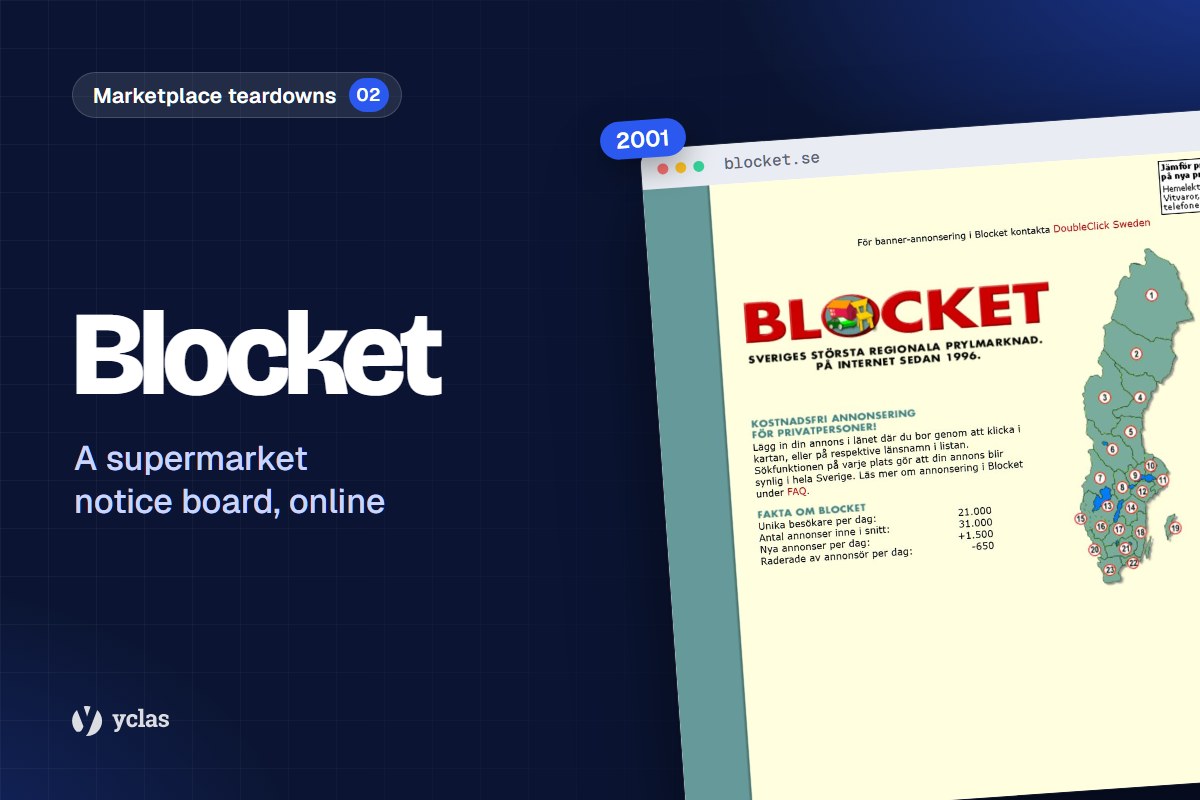
In 1996 Henrik Nordström looked at the notice board in the Ica supermarket in Fjälkinge, a Swedish village of about 1,700 people1,22. People pinned up notes there to sell a pram, a sofa, a car. He decided to put that board on the internet.
Seven years later his site, Blocket, had two employees and almost a million visitors a month. A media group that had tried and failed to build its own rival paid SEK 183 million (about EUR 19 million) for it1,3,5.
No investors, no TV ads, no clever tech. Just a few simple moves that any small classifieds site can still copy in 2026. Here they are.
The short version
- Blocket copied a habit people already had: the supermarket notice board. Nobody needed instructions.
- It started in one region, Skåne, and only opened the rest of Sweden a year later.
- A person checked every ad before it went live. That trust is what buyers came back for.
- Posting was free until Blocket was the default. Then a small fee paid for the checking.
At a glance
- Founded
- 1996, Fjälkinge (Kristianstad municipality, Skåne), Sweden1,4
- Founder
- Henrik Nordström, through his company Multimediaverkstan AB. Pierre Siri became CEO and co-owner in December 20014
- Category
- General classifieds: second-hand goods, then cars, homes, jobs
- First-seller tactic
- One region only, a copy of the supermarket notice board, free ads, and links from partner sites1,3
- Trust tactic
- Every ad checked by a person before it went live, paid for by a small listing fee from 20016,7
- Where it is now
- Owned by Vend (formerly Schibsted Marketplaces). The concept has been exported to more than 40 countries13
Part of the guide Marketplace case studies
The cold start: newspapers, a yellow paper and a supermarket wall
In 1996, a Swede who wanted to sell a used bike had three options. A classified ad in the local paper (paid, and gone after a day). Gula Tidningen, a printed buy-and-sell paper. Or a note on a supermarket notice board1.
None was great. Newspaper ads cost money. Notice boards were free but only reached people who shopped at that one store. And very few Swedes were online yet.
So Nordström had the problem every marketplace has. Buyers only come if there are listings. Sellers only post where buyers look. He had no money, no brand and no newspaper behind him, and the Stockholm IT crowd looked down on the little country site from Skåne7.
One honest note: Nordström was famously media-shy and refused interviews3. There is no founder memoir or podcast. What we know comes from press at the time of the sale, the Internetmuseum (Sweden's museum of internet history), Schibsted's filings and later business press. Where the sources are thin, I say so.
How they got the first sellers
Move 1: Copy the notice board people already used
Blocket did not invent a new behaviour. It moved an existing one online.
The notice board already had the right shape: one item per note, a short description, a price and a phone number. Blocket kept that shape. Even the name was an instruction manual. Block is Swedish for notepad, and Nordström wanted an image that new internet users would understand at once: the pad you write your shopping list on1.
The mechanics were as basic as it gets. In the early years, sellers wrote their ad and sent it in by email3. No accounts, no auctions, no cart. You described your thing, gave a price and a contact, and a buyer phoned you.
If you had ever pinned a note on a supermarket wall, you already knew how to use Blocket. The lower the learning cost, the more of your neighbours will try it.
Move 2: Win one region before the whole country
Blocket launched for Skåne only, the southern region where Nordström lived. The rest of Sweden came in late 19971,4.
This matters more than it looks. Second-hand goods are local: nobody drives 600 km for a used pram. A buyer in Malmö does not care how many ads exist in Stockholm. What makes a classifieds site feel alive is the number of ads near you.
A few hundred ads spread over all of Sweden would have looked empty. The same few hundred in one region looked like a busy notice board. Nordström also knew the area: its towns and what people there sold.
Liquidity (the chance that a listing finds a buyer, or a search finds a listing) comes from density in a small area, not from big totals. Blocket got dense first, then got big.
Before you choose your own "Skåne", work out how many listings it takes to look busy there.
Calculator
How many listings do you need at launch?
Visitors leave a category that looks empty. Pick how many listings a category page needs to look alive, for the categories and places you launch with.
Too many weeks? Launch with fewer categories or one area first, and add more as listings come in. More free tools →
Move 3: Free to post, paid for by banners and link partners
Posting on Blocket was free at the start, unlike newspaper ads1. That was the hook for sellers: no cost, no risk, and the ad stayed up for longer than a day.
How did a free site pay its bills? With banner ads on the site3. Traffic grew through the free ads and through cross-linking with other websites. Banner partners also gave Blocket ad space on their own sites, which brought more visitors3.
The early growth loop was simple:
- Free ads attract sellers.
- Sellers send friends and family to look at their ads.
- Partner sites link to Blocket and bring more buyers.
- More buyers make the next seller's ad sell faster.
There was no TV budget and no sales team. By 2003 the whole company was two people1.
In the early web, links from other sites were how people found anything, and Blocket traded for them instead of paying. The 2026 version is the local Facebook group, the WhatsApp community and the town's own websites.
When you write to those partners, start from a pitch that says what they get back.
Template
Pitch to a local partner to promote your marketplace
Send it by email or message to an association, club, shop or community group whose members are your buyers or sellers; change the offer to something you can really give them.
Partners say yes more often when you hand them finished content to share than when you ask them to write about you. More free tools →
Move 4: A person checks every ad before it goes live
This is the move Blocket became known for, and the one copied most.
In 2005, CEO Pierre Siri told Realtid that 12 to 15 staff reviewed every incoming ad, in shifts from 7 in the morning until midnight, every day6. Years later, a Blocket spokesperson told SVT the same: all ads are reviewed before they are published12.
Pre-moderation (checking an ad before it appears, not after someone complains) does three jobs at once:
- It keeps out scams and junk. Around 2010 the CEO at the time, Martin Frey, put the share of dishonest deals at under one in a thousand7.
- It keeps search useful. Ads in the wrong category, ads mixing several items, or ads for banned things get rejected.
- It protects the work. In 2005 Blocket went after a site that copied its ads, arguing its staff had spent time checking them6.
The catch is cost: someone has to read every ad. Affärsvärlden put it plainly. The fee Blocket started charging in 2001 is what paid for reviewing every ad7.
On a classifieds site, trust is the product. A buyer who gets scammed once does not come back. A buyer who finds clean, real, local ads every time builds a habit.
Write down what you check before you start, so the rules are the same every time.
Template
Moderation and content-removal policy
Publish this so users know how listings are checked, how to report one and how to appeal a decision; fill in your timings and contact points.
A starting point, not legal advice: have it checked for your country. More free tools →
Move 5: Keep it simple, and do not redesign
Asked in 2003 why little Blocket beat the media giants, Pierre Siri kept it short1.
"Simplicity is the answer." Pierre Siri, Blocket CEO, to Computer Sweden in 20031
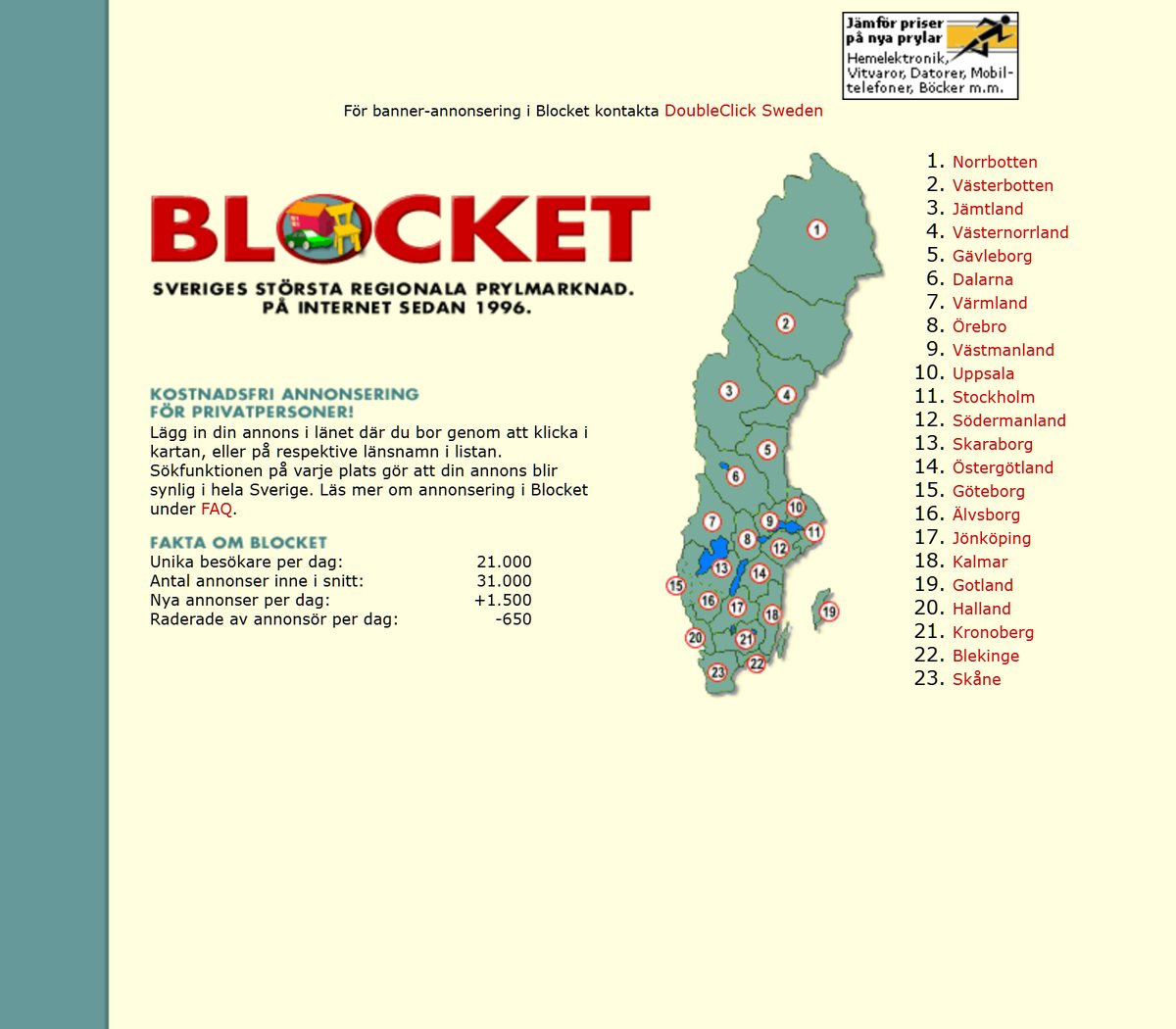
The design had not changed since 19961. That was a product decision, not laziness. A seller could post in a minute. A buyer picked a region and a category and saw a plain list. The pages loaded fast on slow dial-up.
Seven years without a redesign also meant seven years in which no regular user had to relearn anything.
Most founders add features when growth is slow; Blocket kept removing friction and let the number of ads do the selling.
What went wrong: banners died and fees cost a quarter of the ads
The banner model collapsed. When the dot-com bubble burst in the early 2000s, banner sales stopped3. A free site funded by display ads suddenly had no income.
Charging cost a quarter of new ads. In August 2001 Blocket started charging private sellers to post4. At first they paid SEK 20 per ad by calling a premium-rate phone number3. Before the change, Blocket got about 1,200 new ads a day at its peak, and roughly a quarter of that flow was lost3. (Blocket's own homepage in June 2001 claimed more, 1,500 new ads a day23, so the exact peak depends on who counted.)
It is easy to tell the Blocket story as "free listings won". In Sweden it is closer to the opposite. Blocket grew while free, then survived by charging a small fee per ad, and that fee paid for the checking that made it trusted.
By 2008 sellers paid SEK 10 to 110 per ad for two months, depending on the category10. Only in May 2022 did Blocket make private ads free again in categories like home, electronics and hobbies, where they had cost SEK 15 to 30 each, to compete with other platforms11.
The fee worked because by 2001 Blocket was already where Swedes looked. Losing a quarter of new ads hurt, but the other three quarters kept it ahead. Charging before you have that position is a very different bet.
Schibsted's own attempt failed. In 2001 Nordström and Siri reportedly asked about SEK 90 million in talks with Schibsted8. Schibsted walked away and built its own service, Finnmer, which did poorly and was put on ice1,3. About two years later the price had doubled: Schibsted paid SEK 183 million in December 20033,5. A big media group with money and newspapers could not out-build a two-person site that already had the sellers.
How supply turned into demand: the ads were there, and they were real
Buyers came to Blocket for one reason: the ads were there, and they were real.
- 1996Blocket opens for Skåne only. Posting is free1.
- Late 1997The rest of Sweden is added4.
- June 2001The homepage counts 21,000 visitors a day and 31,000 live ads23.
- August 2001Private sellers start paying SEK 20 per ad. About a quarter of new ads are lost3,4.
- September 2003934,000 unique visitors in the month and over 110,000 ads3.
- December 2003Schibsted buys Blocket for SEK 183 million. It has two employees1,5.
- 2006Schibsted buys the last 18.2% for SEK 297 million and launches Leboncoin in France9,16.
At the sale, Blocket expected SEK 34 million in revenue for 2003 and about SEK 13 million profit, a margin of roughly 38%3.
Kristianstadsbladet also compared its audience with Sweden's price-comparison sites, the big web names of the day3:
Blocket against the two best-known price-comparison sites, as reported at the time of the Schibsted sale. Source 3.
Show the numbers
| Site | Unique visitors | Notes |
|---|---|---|
| Blocket | 934,000 | September 2003, Kristianstadsbladet |
| Kelkoo | 346,000 | Swedish visitors, same article |
| Pricerunner | 264,000 | Swedish visitors, same article |
A site built on a notice-board idea had almost three times their audience.
The tipping point is visible in the order of events. Free ads built the supply. Once almost every Swede who wanted to sell something used Blocket, buyers had no reason to look elsewhere, and sellers had no reason to post elsewhere, even after it cost money. That is a network effect (each new user making the site more useful for everyone else) in practice.
What came after shows how strong that position was:
- 2006: the last 18.2% valued the whole company at SEK 1.6 billion9.
- 2008: revenue SEK 408.5 million, operating profit SEK 239.2 million, with just under 20 staff. Schibsted had already taken out more in dividends than it paid. An analyst at Redeye compared it to a piano that plays itself10.
- 2015: revenue SEK 874 million, profit SEK 445 million, and nearly 8 in 10 Swedes had bought or sold something on Blocket1.
From a two-person site at the sale to a SEK 874 million business. 2003 was the expected figure at the time of the sale. Sources 1, 3, 10.
Show the numbers
| Year | Revenue (SEK m) | Notes |
|---|---|---|
| 2003 | 34 | expected, Kristianstadsbladet; 2 employees |
| 2008 | 408.5 | Realtid; just under 20 staff |
| 2015 | 874 | Internetmuseum; profit SEK 445m |
How Blocket became Schibsted's template
Schibsted did not just keep Blocket. It turned it into a recipe18.
In April 2006, Schibsted launched Leboncoin in France with a partner, Spir Communication16. Schibsted's own 2010 filing says Leboncoin was based on the concept of its Swedish success, Blocket19. Its first CEO, Olivier Aizac, summed up the idea as "an online yard sale"15. The recipe was Blocket's: local, simple, and in France free for private sellers. By June 2007 Leboncoin had 550,000 ads online17. It is the next article in this series.
Other Schibsted sites built on the same concept include segundamano in Spain (2005) and Subito in Italy (2007)19, and Tori in Finland (2009), which Vend says was inspired by Blocket13. By 2009 Realtid counted six countries where Schibsted had copied the model10. By 2015 Schibsted had Blocket-concept sites in 14 markets outside Sweden19. Its international classifieds were spun off as Adevinta in 2019, and today Blocket's owner says the concept has reached more than 40 countries13.
(Avito in Russia, article 4, is a separate story: two Swedes, Jonas Nordlander and Filip Engelbert, founded it in 2007, and it was not a Schibsted site21.)
What Schibsted exported was not "free" or "paid". It was the shape: local first, very simple, and trusted. The pricing changed by country.
The playbook: 7 Blocket lessons for a small site
1. Copy a habit people already have. Blocket was a supermarket notice board online, so nobody needed instructions. Find where your sellers post today: a Facebook group, a WhatsApp community, a board at the feed store, a forum. Make your form feel like that, with the same few fields and the same words.
2. Win one place before you go wide. Blocket was Skåne-only for its first year. On a general site, pick one town or region and make it busy before you open the rest. On a niche site (tractors, horses, camper vans), pick one sub-niche or one region. Twenty ads in one town beat two hundred spread across a country.
3. Keep posting free until you are the obvious place. Blocket only charged once it was the default, and still lost a quarter of new ads. Keep basic listings free while you build supply. Charge first for extras (featured placement, more photos, business accounts).
4. Check every ad by hand while you are small. Pre-moderation is cheap at ten ads a day, and it is your strongest trust signal. Check category, photo, price and one item per ad. Write back when you fix or reject something.
5. Borrow traffic instead of buying it. Blocket grew on link swaps and partner banners. Ask the hardware store, the breed club, the car club or the town news page to link to you. Offer something back: a free business listing, a banner, a mention in your member email.
6. Keep it boring and fast. Blocket did not redesign for seven years. Every extra field on the form loses some sellers; every extra click on the home page loses some buyers. Spend that time getting listings instead.
7. Your listings are your product. Buyers came to Blocket because the ads were real and nearby. Measure live listings in your main area and how fast new ones arrive, not design or features. Our own data at Yclas points the same way: a site with 5 or more live listings is far more likely to become a lasting business than one with 0 to 4.
Try this this week
Sized for one person with a few hours and almost no budget.
- Pick your "Skåne" (30 minutes, Monday). Write down one town, region or sub-niche to focus on for the next 90 days, and put it first on your home page.
- Visit 3 real notice boards (2 hours). Supermarket, farm supply store, community centre. Message 10 of the sellers there to offer a free online listing, and pin your own poster next to their notes (ask the store first).
- Write to 30 sellers where they already post (1 hour a day, 3 days). Local Facebook Marketplace, Facebook groups and WhatsApp communities in your area. A short, personal message offering to list their item for free.
- Post 20 listings for sellers who say yes (2 hours). With their permission, create the listing for them and send them the link.
- Check every new ad within 4 hours, all week. Category, photo, price, contact. Reply to each seller with a thank-you and one tip to sell faster.
- Ask 2 partners for a link (30 minutes). One local business and one community page or club. Offer a free featured listing in return.
- Count on Friday (10 minutes). Live listings in your focus area, and new ones this week. Week-one target: 20 live listings in one place.
Doing it on Yclas
- Recruit sellers (admin panel > Recruit sellers): find local businesses in your focus area, send each a personal invite link, use "Write it with AI" for the first message, and keep a timeline of who you contacted. The list of searches that returned nothing shows what buyers want that you do not have yet.
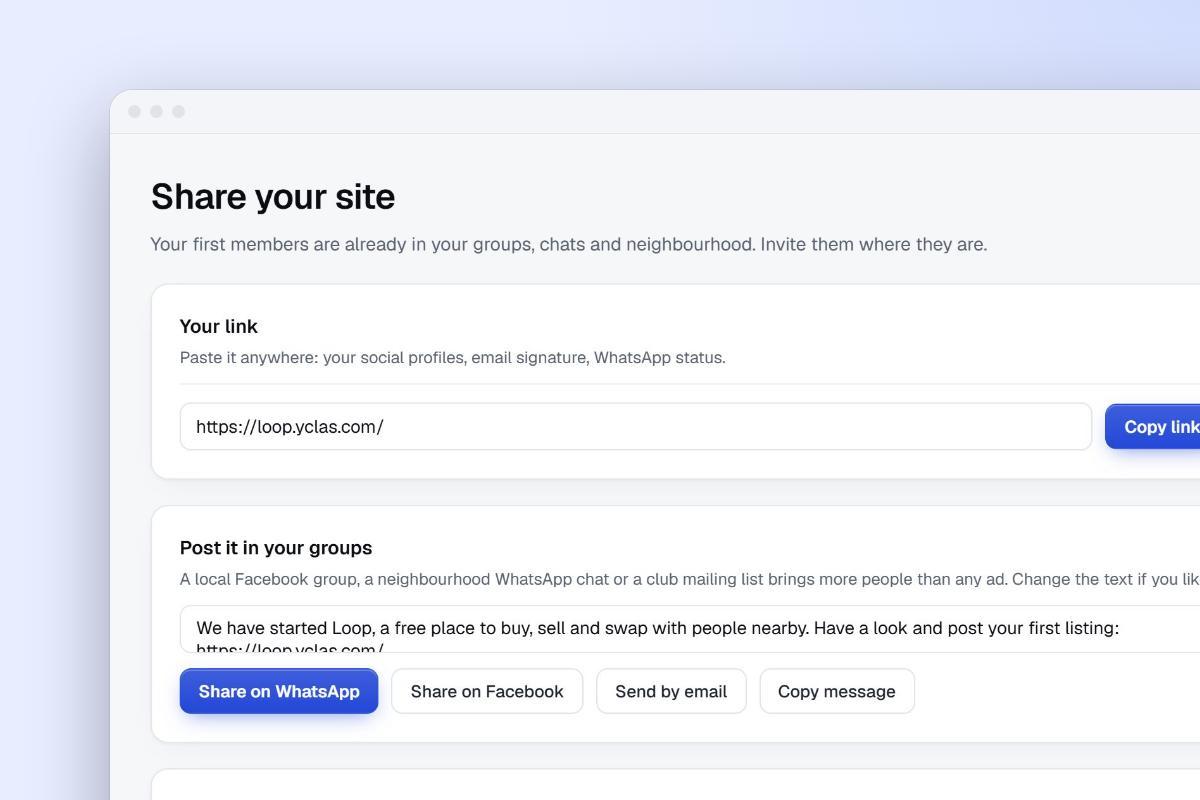
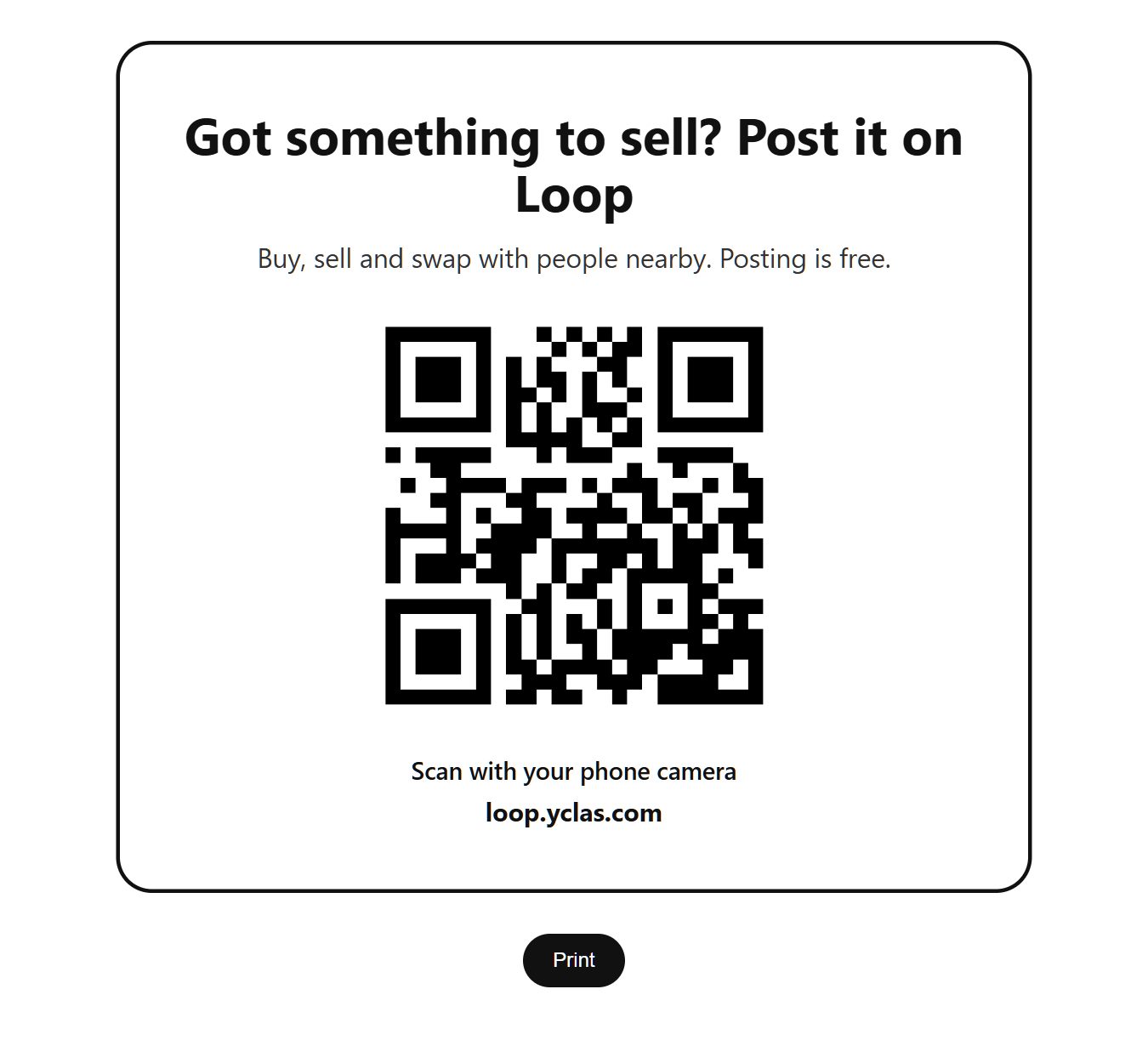
- Share your site (admin panel > Share your site): a ready message for WhatsApp and Facebook groups, plus a QR code and a printable A4 poster for the notice boards you visit.
- Add listings from text: paste posts from a Facebook or WhatsApp group (with the sellers' permission) and get draft listings to review. CSV import works when a dealer or club sends a spreadsheet.
- Posting from a photo with AI: the seller takes a photo and the listing fills itself in, as quick as pinning a note on a board.
- Custom fields and categories: keep the form short and named the way your sellers talk.
- Featured listings and paid plans: when you are ready to earn, start with paid extras rather than charging for every basic ad.
For more on how the big classified sites grew, see our earlier posts on what made Craigslist so successful and the success of OLX.
Sources
- Blocket startar: Nu börjar svenskarna handla via nätet — Internetmuseum (Internetstiftelsen) — https://internetmuseum.se/tidslinjen/blocket-tar-prylmarknaden-till-natet/
- Nu kan du shoppa – med din dator — Internetmuseum — https://internetmuseum.se/utstallningar/for-unga/nu-kan-du-shoppa-med-din-dator
- Fjälkingebolag säljs för 183 miljoner till Aftonbladet — Kristianstadsbladet (2003) — https://www.kristianstadsbladet.se/kristianstad/fjalkingebolag-saljs-for-183-miljoner-till-aftonbladet/
- Blocket.se — Svenska Wikipedia (used as a lead; cites Dagens Industri 2003 and Internetmuseum) — https://sv.wikipedia.org/wiki/Blocket.se
- Schibsted ASA (SCH) - Finnmer acquires Blocket AB — Schibsted press release via GlobeNewswire (2003) — https://www.globenewswire.com/news-release/2003/12/05/1786647/0/en/Schibsted-ASA-SCH-Finnmer-acquires-Blocket-AB.html
- Blocket i rad mot annonssnyltare — Realtid (2005) — https://www.realtid.se/bors-finans/blocket-i-rad-mot-annonssnyltare/
- Det otippade internetundret — Affärsvärlden (c. 2010) — https://www.affarsvarlden.se/artikel/det-otippade-internetundret-6724637
- Historien om Blocket.se till frukost — notes from a Sveriges Annonsörer breakfast talk (2012) — https://beachvolleyboll.wordpress.com/2012/05/22/historien-om-blocket-se-till-frukost/
- Schibsted buys out Blocket minority — The Local / AFP (2006) — https://www.thelocal.se/20061219/5849
- Blocket fyller på Schibsteds kassa — Realtid (2009) — https://www.realtid.se/bors-finans/blocket-fyller-pa-schibsteds-kassa/
- Nu blir det gratis att kränga hemelektronik via Blocket — M3 (2022) — https://www.m3.se/article/1860339/nu-blir-det-gratis-att-kranga-hemelektronik-via-blocket.html
- Blocket om oseriösa säljare — SVT Nyheter — https://www.svt.se/nyheter/lokalt/vasternorrland/blocket-om-oseriosa-saljare
- Our history — Vend (formerly Schibsted Marketplaces) — https://vend.com/about-us/history
- Om Blocket — Blocket press room, Mynewsdesk / TT — https://www.mynewsdesk.com/se/blocket
- The secret of Schibsted Media's success — Worldcrunch (translated from French press) — https://worldcrunch.com/tech-science/the-secret-of-schibsted-medias-success/
- Connaissez-vous la vraie histoire du site Leboncoin ? — FrenchWeb (2023) — https://www.frenchweb.fr/connaissez-vous-la-vraie-histoire-du-site-leboncoin/442884
- Leboncoin a 10 ans — Clubic (2016) — https://www.clubic.com/leboncoin/actualite-804376-leboncoin-10-ans.html
- Looking to Europe for news industry innovation, part 2: Schibsted's classifieds — Nieman Lab (2012) — https://www.niemanlab.org/2012/02/looking-to-europe-for-news-industry-innovation-part-2-schibsteds-stunning-classifieds-and-services-business/
- Schibsted investor presentations and filings, 2010 and 2015 (Blocket concept sites and launch years) — FinancialReports — https://financialreports.eu/filings/schibsted/investor-presentation/2010/12073697/
- Schibsted ASA write-up — Value Investors Club — https://valueinvestorsclub.com/idea/Schibsted_ASA/4086726678
- Avito.ru — Wikipedia — https://en.wikipedia.org/wiki/Avito.ru
- Fjälkinge — Wikipedia — https://en.wikipedia.org/wiki/Fj%C3%A4lkinge
- Blocket – Hela Sveriges Prylmarknad, homepage of 23 June 2001 — Internet Archive (Wayback Machine) — https://web.archive.org/web/20010623163358/http://www.blocket.se/