In March 2000, two former bankers launched a classifieds site in London with no venture capital, about eight categories and the wrong domain name1. It was not even aimed at Londoners.
It was aimed at young Australians, New Zealanders and South Africans who had just landed in the city and needed three things fast: a room, a job and some friends. Five years later eBay bought it, profitable, with sites in 31 cities1.
Gumtree won the UK by first being the obvious place for one small, well-defined group of people. That is the part a one-person classifieds site can copy this month.
The short version
- Gumtree picked a community, not a category: expats in London who were both the buyers and the sellers.
- It launched with about eight categories and let users ask for the rest.
- Guides, news from home and a daily e-mail gave people a reason to visit before they needed anything.
- Marketing was flyers, pub toilets and one commuter paper, read at the moment people could act.
Michael Pennington and Simon Crookall knew the problem first hand. Banking postings had sent them to Hong Kong and Australia, and Pennington later called arriving in a new city without your network "a very lonely experience"1.
By 2007 Gumtree called itself the UK's largest local classifieds website, with around 3 million unique users a month and 20,000 ads posted every day3. Here is how it got from zero to there.
At a glance
- Founded
- March 2000, London1,2
- Founders
- Michael Pennington and Simon Crookall, ex-Hambros bank1
- Country
- United Kingdom (London first)
- Category
- General local classifieds, starting with flatshares, rentals, jobs and items for sale
- First-seller tactic
- Serve one expat community (about 1 million Australians, New Zealanders and South Africans in the UK) with free ads, newcomer guides and cheap street-level marketing1,5
- Where it is now
- Sold to eBay in 2005; eBay sold Gumtree UK to Adevinta, which sold it in 2021 to O3 Industries and Novum Capital, who sold it in 2024 to Ocean Link and its portfolio company 58.com. Gumtree UK, Australia and South Africa are now separate companies2
Part of the guide Marketplace case studies
The cold-start problem: a market that renewed itself every month
London in 2000 had a large, constantly changing population of young people from the Commonwealth on working-holiday visas. The founders put the group at roughly one million Australians, New Zealanders and South Africans living in the UK1.
They arrived, stayed a few years and left. Every month a new wave needed exactly what the last wave had needed.
These newcomers were not unserved. Since 1983 a free weekly magazine, TNT, had targeted this audience from Earls Court Road, covering travel, jobs, rooms and news from home. Its weekly print run reached 75,000 copies, picked up in pubs, hostels and travel agents4. Flatshare websites were appearing too: SpareRoom traces its roots to intoLondon.com, launched in 19997.
So the problem was not "nobody serves these people". It was:
- Print was slow. A weekly magazine cannot match a room that must be filled by Saturday, or a bar that needs staff tonight.
- The wider market was split up. Newspapers, shop windows and noticeboards each held a small piece of supply.
- A new site has nothing on day one. A buyer who finds an empty site does not come back, and a seller who gets no replies does not post again. This is the cold-start problem: you need listings to attract visitors, and visitors to attract listings.
Gumtree's answer was to make the market small enough that it could fill it.
How they got the first sellers
Move 1: Pick a community where buyers and sellers are the same people
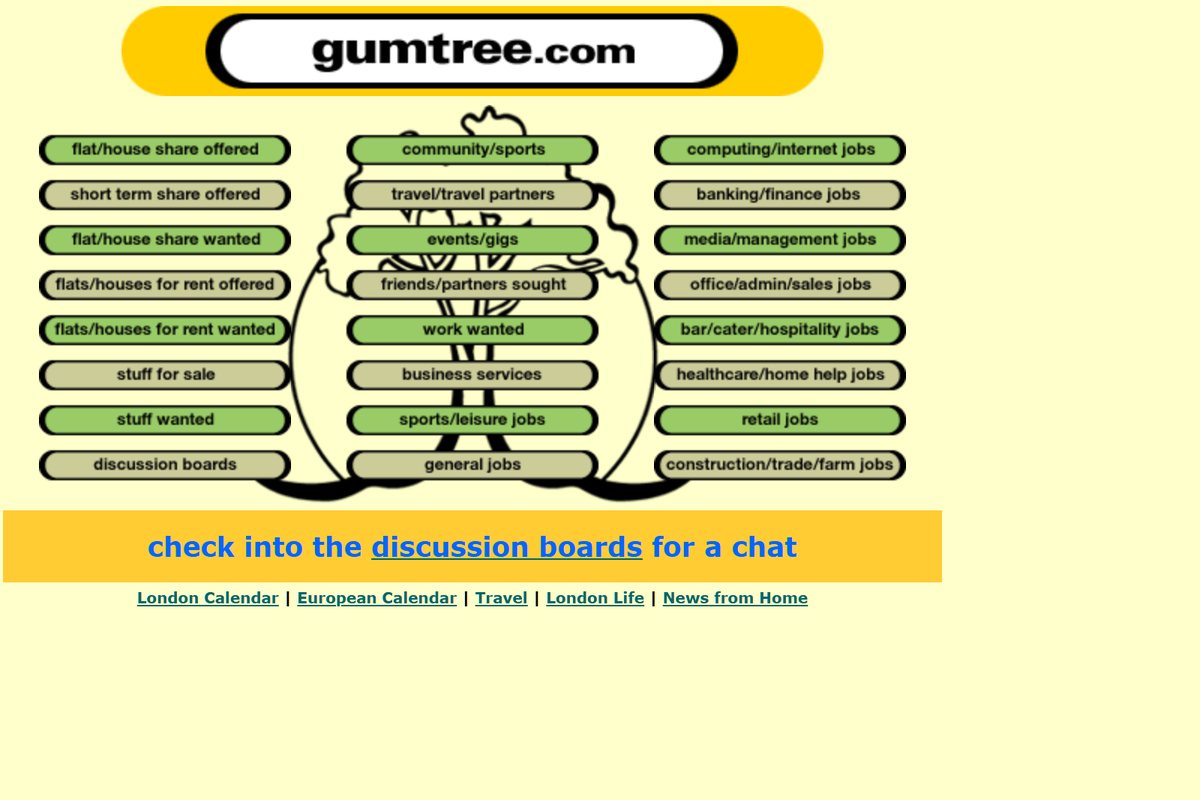
The site's title in 2000 said it plainly: London's online community for Aussies, Kiwis and South Africans5. Its search keywords listed what this group cared about: flatshares, bar work, agencies, part-time jobs, and even the three national rugby teams5.
Why this worked mechanically:
- One audience, both sides. The person leaving a room in a Clapham flatshare and the person looking for one were both young expats. Every new member added supply and demand at once, so Gumtree only had to recruit one group, not two.
- Churn made listings. People arriving needed rooms and furniture. People going home needed to get rid of rooms, furniture, phones and cars. A temporary population is a listings machine.
- Word of mouth was dense. Expats lived together, drank in the same pubs and worked through the same agencies. One happy user told people who were likely to need the site that same month.
The founders even chose the name for the group. They wanted a word that linked the three communities, liked the gum tree's idea of roots and branches, and let users vote in internet cafés. Gumtree won1.
If you need help finding that sentence, the worksheet below walks you through who your site is for and what they trade.
Template
Value proposition worksheet for both sides of a marketplace
Fill it in once for sellers and once for buyers before you write your home page, ads or outreach messages, then rewrite it whenever you change your niche.
If you cannot fill in 'What annoys them' from real conversations, run interviews before you write any marketing copy. More free tools →
Move 2: Launch with eight categories and let users ask for more
The first site had only about eight categories, mostly flatshare, rentals and items for sale1.
"...from your users what they want." Simon Crookall, London Loves Business (2012)
That was Crookall's rule: you learn what users want, then add categories from there1. The 2001 About page made it a public promise. New categories would be added as users suggested them, and anyone with something to add should get in touch5. It was signed by the whole team, five first names: Simon, Nikki, Debbie, Missy and Michael5.
The list grew fast. By February 2001, less than a year after launch, the home-page menu listed 23 categories, ten of them for jobs: bar and catering, healthcare and home help, office, banking, retail and more5.
By 2004 the home-page keywords covered a long tail that came straight from users: nanny, nursing and chef jobs, Glastonbury and V Festival tickets, musicians wanted, London events and speed dating5.
A few full categories look busier than thirty empty ones. Starting narrow put every early listing into the same few pages, so the site looked alive from week one.
Before you add categories, check how many listings it takes to make the ones you have look busy.
Calculator
How many listings do you need at launch?
Visitors leave a category that looks empty. Pick how many listings a category page needs to look alive, for the categories and places you launch with.
Too many weeks? Launch with fewer categories or one area first, and add more as listings come in. More free tools →
Move 3: Give newcomers a reason to visit before they need to buy
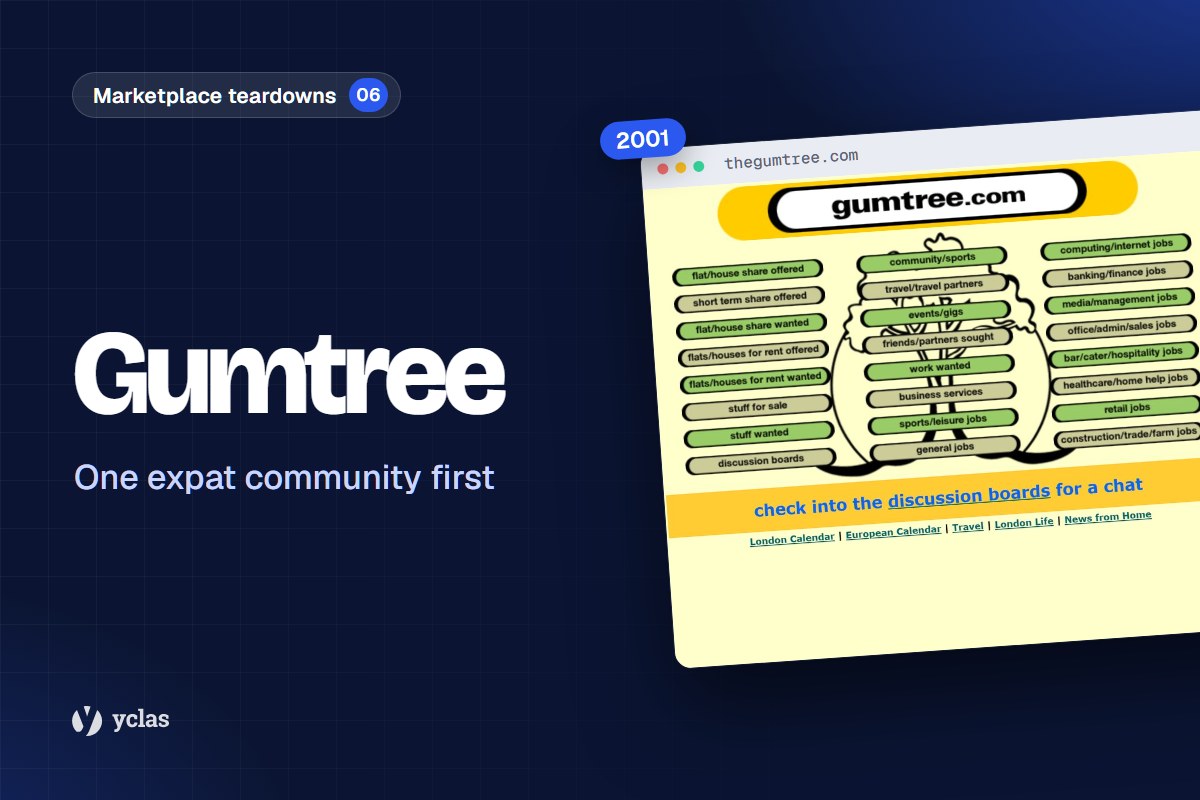
The early site was not only ads. Archived pages from 2001 show a menu of London Calendar, European Calendar, Travel, London Life and News from Home, plus a discussion board and practical guides5.
One guide explained how to open a first UK bank account: which banks were easiest, which documents you need, and how to get round the trap of needing an address for a bank account and a bank account for a flat5. Other pages covered airports, budget travel and agencies5.
This content did two jobs:
- It caught people before they arrived. Someone in Sydney planning a move searched for exactly these questions, and landed on a site full of London rooms and jobs.
- It built a habit. News from home, sport and events gave people a reason to return when they did not need a flat. Every return visit was a chance to see, and later post, an ad.
The About page promised the site was "free to use, and always will be", and offered a daily e-mail per category so users did not have to keep searching5. That daily e-mail was an early saved search: it pulled buyers back every day with new supply.
Move 4: Market by hand, where the community is, when it can act
The founders were self-funded and had little budget1. So they marketed by hand:
- Flyers all over London, and adverts in pub toilets1.
- Stunts. Pennington once stood outside Putney Bridge station wearing a billboard and a horned hat1.
- Parties. In June 2000, three months in, the home page invited users to a Gumtree midsummer party in Parson's Green, south-west London5. Members met each other, not only the site.
- One well-timed newspaper. Most people in the early 2000s used the internet at work, so they advertised in Metro, the free morning paper read on the commute. Traffic then spiked at lunchtime, when people browsed from office computers1.
They also tried the London Evening Standard. It worked less well, because few readers had internet access at home in the evening1.
Marketing worked when it reached the right people at the moment they could act. That one detail is the whole lesson.
Move 5: Keep posting free, and charge only the side with money
Ads were free for everyone, with one exception: employers paid to post jobs1. In 2007 a job ad in London or Edinburgh cost £19.95, while everything else stayed free to read and free to post3.
Why the split is smart:
- Individuals with a spare room or an old bike will not pay to list, and without them there is no site.
- Employers and agencies had a hiring budget, and the expat audience was exactly the flexible, short-term workforce they wanted: bar staff, nannies, nurses, temps.
- The free side built liquidity (enough listings and replies that people find what they want quickly). The paid side turned it into revenue. By 2005 the company was profitable1.
Move 6: Follow the same community into the next city
Expats move. Australians in London went to Edinburgh, travelled around Europe and went home. Gumtree followed them. By 2005 its 31 city sites included Edinburgh, Adelaide, Durban and Paris1. It launched in Warsaw in September 2004, Berlin in May 2005, and Rome and Milan in June 20052.
After the eBay sale it used the same wedge again. In August 2007 Gumtree launched in New York, Boston and Chicago aimed at about 2 million British, Australian and Polish expatriates in the US, saying the demand came from existing users who had moved there3.
Each new city started with people who already knew and trusted the brand. That is a much easier launch than starting from zero.
What didn't work, or was harder than it looks
The sources say less about failures than about wins, so this list is short:
- Evening newspaper ads reached people who could not act on them that night1.
- The domain. For its first four years the site ran on thegumtree.com. Archived copies show gumtree.com pointing to an unrelated personal home page in Australia until 2003; by mid-2004 Gumtree was on gumtree.com and the old address redirected there5. I found no source where the founders explain how they got the shorter name.
- Classifieds were not yet a proven business. Crookall said in 2012 that online classifieds were not a proven model at the time, which is partly why they first offered eBay only 25% before agreeing to sell the whole company1.
- Not every city worked. Years later, after many changes of owner, Gumtree Poland stopped taking new ads in March 2022 and closed in April 20222. Copying a wedge into a new place does not guarantee the wedge exists there.
How supply turned into demand: the community was both sides
Gumtree never had a separate "find buyers" phase. Because the community was both sides of the market, every flat posted brought in someone looking for a flat, and every person who found a flat later posted their old furniture.
You can see the speed in archived links from the site's message system. A link captured in June 2000, three months after launch, points to posting number 2,379. Links captured in September 2001 carry numbers above 100,000, and in October 2001 above 121,0005. These are database IDs, not an audited count, but they suggest roughly a hundred thousand postings in the first eighteen months.
The tipping point came when the site outgrew its wedge. By 2003, according to the founders, Londoners in general were posting ads in large numbers1. The expat community had made the site busy enough to be useful for everyone. The name that once meant "Australian" now just meant "free local ads".
- March 2000Launch with about 8 categories, self-funded1.
- June 2000Posting IDs reach 2,3795.
- October 2001Posting IDs pass 121,0005.
- 2003Londoners in general post in large numbers1.
- May 2005Profitable, 12 staff in London, 31 cities; bought by eBay1,2,6.
- 2007About 3 million unique users a month and 20,000 new ads a day3.
- 201014.8 million monthly unique visitors, audited2.
- 201213.7 million monthly users and over 100 million ads posted to date1.
The audience growth after the wedge filled up is clear when you put the later numbers side by side. They come from different measures (unique users, audited visitors, users), so read them as a trend, not an exact series.
After the expat wedge filled up, the audience grew to the whole UK. The measures differ (unique users, audited unique visitors, users), so read this as a trend. Sources 3, 2, 1.
Show the numbers
| Year | Monthly audience | Notes |
|---|---|---|
| 2007 | about 3M | unique users a month, The Guardian |
| 2010 | 14.8M | monthly unique visitors, ABC audit (Wikipedia) |
| 2012 | 13.7M | monthly users, London Loves Business |
eBay bought Gumtree through Kijiji, its international classifieds group, in May 2005. The press described it as an international classified ads site based in Southwark Street, London, with city sites in the UK, Australia, New Zealand and South Africa6. The price was not disclosed1. eBay is widely reported to have paid about $81.6 million in total for three classifieds sites, Gumtree, LoQUo and opusforum, with Gumtree the largest2.
The founders left soon after and started Slando, a classifieds site for Russia and Central and Eastern Europe, which they sold to Naspers in 20111.
The playbook
1. Start with a community that is both buyer and seller. Find a group whose members trade with each other: new arrivals in a city, parents at the same schools, students at one university, a breed club, a motorbike club. In 2026 that group usually has a WhatsApp or Facebook group where people post "room available" or "selling my pram". Give those posts a better home: searchable, with photos, not buried after one day.
2. Launch with fewer categories than you think you need. Eight categories with real listings beat forty empty ones. Start with the two or three things your community trades most. Add a category only when people ask for it or keep posting in "Other".
3. Write the guide your community is already searching for. Gumtree's bank-account guide is the model: a practical page that answers what a newcomer types into Google. For a farm-animal site that might be "how to transport sheep legally"; for an expat site, "how to rent a flat without a local payslip". These pages bring visitors before they need to buy, and search traffic for years.
4. Market where the community physically is, at the moment it can act. Gumtree used pub flyers and the morning commuter paper, not the evening one. For you that might be a QR poster in a student building's laundry, a stand at the livestock market, or a post in the club's group on meet day, when phones are out.
5. Keep the free side free and charge the business side. Individuals with one item will not pay to list, and without them you have no site. Businesses with a budget (employers, dealers, agencies, breeders, landlords) can. Wait for real traffic, then charge for job ads, featured listings or dealer plans, never for a private person's first ad.
6. Give people a reason to come back when they are not buying. Gumtree had a daily e-mail per category and news from home. The cheap version today: a weekly e-mail of new listings, a WhatsApp broadcast with the five best new ads, or a "this week on the site" post in your local Facebook group.
7. When the wedge is full, follow your users to the next place. Gumtree's next cities were the ones its users moved to. Before you open a second town or category, ask current users where else they buy and sell, and launch there with them as your first sellers.
Your first sellers are the people already posting in those groups. These ready posts, one per platform, help you show up there with a real listing instead of an advert.
Template
Social posts to promote your marketplace and its listings
Pick the version for each platform, swap in a real listing and link, and post a mix of single listings, roundups and posts about the site itself.
Ask the seller before you feature their listing, and only post in groups whose rules allow it. More free tools →
Try this this week
- Write your wedge sentence in 15 minutes, Gumtree style: "The site for [group] in [place] to find [2-3 things]." Put it in your site title and home page.
- Find 10 groups where your community already trades (Facebook, WhatsApp, Reddit, forums, noticeboards) in one hour. Join them and note the 3 things posted most.
- Message 30 people who posted in those groups in the last month (2 hours) and offer to put their item on your site for free, with photos. Aim for 20 live listings by Sunday.
- Hide every empty category in 30 minutes so you show at most 8. Make the busiest one the first thing visitors see.
- Write one 500-800 word guide in an evening, answering the most common question in those groups, and link it to the matching category.
- Print 20 QR posters and put up 10 by Friday where your community gathers: club boards, cafés, shops, the market.
- Contact 5 businesses that serve the community (agencies, dealers, landlords, breeders) and invite them to post free for now. They are your future paying side.
Doing it on Yclas
- Recruit sellers (admin panel > Recruit sellers): find local businesses that serve your community, send each a personal invite link (/join/...), draft the message with "Write it with AI", and keep a timeline of who you contacted. Its list of searches that returned nothing shows which category to add next, the way Gumtree let users shape its categories.
- Share your site (admin panel > Share your site): a ready group message for the WhatsApp and Facebook groups where your community trades, plus a QR code and printable A4 poster, the modern version of Gumtree's pub flyers.
- Add listings from text: paste posts from a Facebook or WhatsApp group and get draft listings, so you can seed your first 20 (with the owners' agreement) in one sitting. CSV import and import from another platform cover bigger moves.
- Custom fields and categories per niche: start with a few categories and add the fields your community cares about (move-in date and bills included for a room; breed and age for animals).
- Member email digest of new listings: Gumtree's daily category e-mail, without the manual work.
- Featured listings and paid plans for sellers: for later, when you have traffic. Charge the business side, like Gumtree's paid job ads, and keep private sellers free.
More on how other sites did it: what made Craigslist successful and 10 keys to Gumtree's success.
Sources
- "The Interview: The mysterious founders of Gumtree.com" — London Loves Business (2012) — https://londonlovesbusiness.com/the-interview-the-mysterious-founders-of-gumtree-com/
- "Gumtree" — Wikipedia (accessed 2026), used for the expansion timeline, the 2010 ABC traffic audit and later ownership; the $81.6 million figure is uncited there — https://en.wikipedia.org/wiki/Gumtree
- Jemima Kiss, "Gumtree comes to America" — The Guardian (2007) — https://www.theguardian.com/media/2007/aug/14/digitalmedia.advertising
- "TNT (magazine)" — Wikipedia (accessed 2026) — https://en.wikipedia.org/wiki/TNT_(magazine)
- thegumtree.com and gumtree.com archived pages, 2000-2004 (home page, About us, banking guide, posting links) — Internet Archive Wayback Machine — https://web.archive.org/web/2001*/thegumtree.com and https://web.archive.org/web/20010302042955/http://www.thegumtree.com/about_us.html
- "eBay snaps up Southwark-based Gumtree" — London SE1 (2005) — https://www.london-se1.co.uk/news/view/1584
- "About SpareRoom" — SpareRoom (accessed 2026) — https://student.spareroom.co.uk/content/about/about-spareroom-new