In April 2006, two people in the offices of a French free-ad newspaper company switched on a website. One was Olivier Aizac, the manager. The other was a developer.
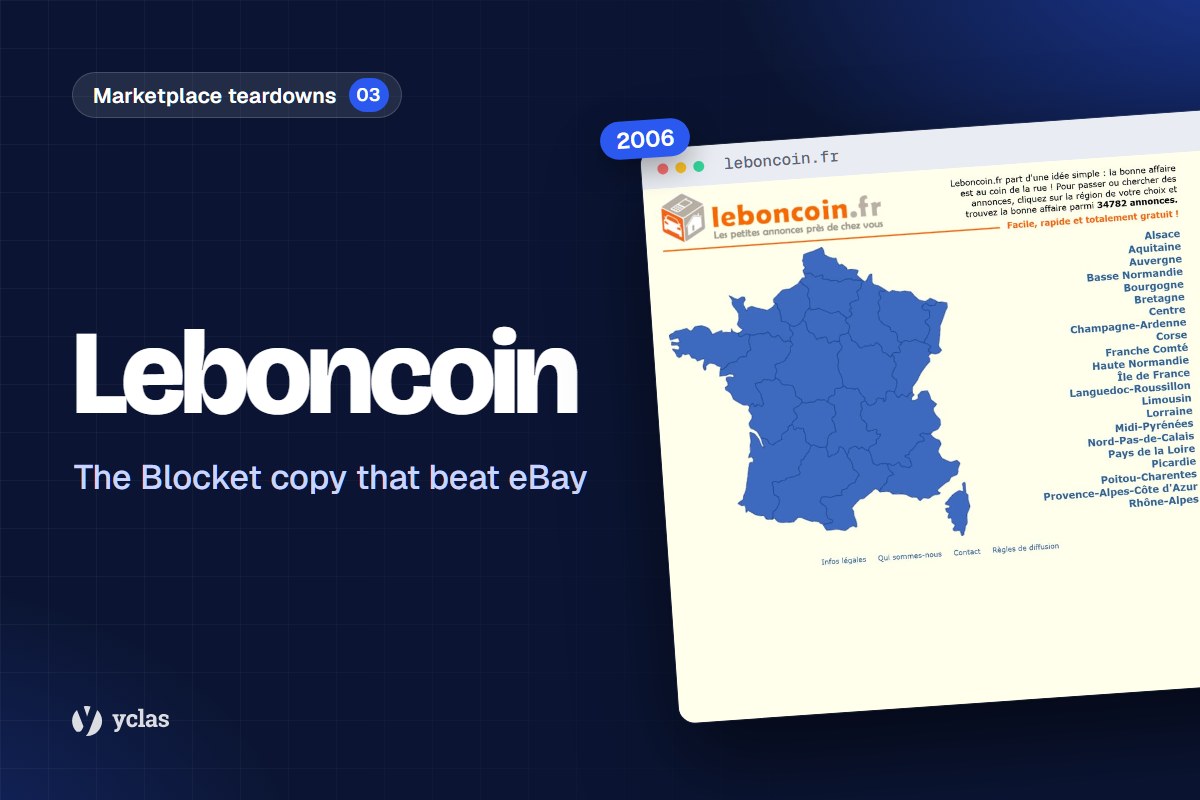
The site had no new idea in it. It was a near copy of a Swedish classifieds site from 1996, translated, renamed and given a mustard-yellow design that the French tech press would later mock6. eBay already ruled online buying and selling in France, and eBay's own classifieds brand, Kijiji, had a French site too7,9.
Four years later, in September 2010, that two-person copy was valued at 400 million euros, and eBay had already closed Kijiji.fr. By October 2011 Leboncoin had 13.7 million monthly unique visitors and had passed eBay in the French traffic rankings1,5,9. Today it is one of the most visited websites in France2.
This is how a copy beat the original players, and why the reasons it won cost almost nothing.
The short version
- Leboncoin copied a model that already worked (Sweden's Blocket) and spent its energy on sellers, not on features.
- It made posting free and faster than any rival. Better-funded sites lost because their forms were longer.
- It organised everything by place and grew first in the regions that already loved local ads.
- It checked every ad by hand, stayed free for years, and charged businesses only once they depended on it.
The first number is from the founding accounts2. The second is from the site's own home page on 18 May 2006, three weeks after launch, as saved by the Internet Archive25. The third is from the 2010 deal in which Schibsted bought out its French partner5,16.
At a glance
- Founded
- April 2006 (sources give 26 or 28 April)1,2,3
- Founders
- Joint venture of Schibsted (Norway) and Spir Communication (France, controlled by Ouest-France's Sofiouest); launched by Olivier Aizac with one developer2,4,5
- Country
- France
- Category
- General local classifieds: second-hand goods, cars, property, jobs6
- First-seller tactic
- Copy Blocket exactly: free ads for individuals, ads by département, every ad checked before publication, posting with almost no friction2,7,8
- Where it is now
- One of France's most visited sites; over 100 million monthly visits in spring 2026, about 1,500 staff, revenue above 550 million euros in 20232
Part of the guide Marketplace case studies
The cold-start problem: a crowded market with no winner
The market in 2006. France already had two ways to sell a used sofa or car. The first was paper: free weekly ad newspapers in letterboxes and racks, and the classified pages of regional dailies. Spir Communication, one of Leboncoin's two parents, was a big player in exactly that business, with free general ad papers (Topannonces) and the property paper Logic-Immo5.
The second was eBay, which Leboncoin's later CEO Antoine Jouteau described as dominant when Leboncoin arrived7.
The competitors online. Besides eBay there were free classifieds sites: Vivastreet, ParuVendu (the online arm of a rival free-ad paper), Topannonces, and eBay's Kijiji.fr9,10. None of them had won. A French media commentator noted in 2010 that free ads in France still faced little real competition11, which tells you how fragmented the field was.
The template. Schibsted had bought Blocket, the Swedish site, in 2003 for about 19 million euros4. Blocket started in 1996 as one man's digital version of a supermarket notice board in southern Sweden (see article 2 in this series) and had become a national habit12. Schibsted's plan was to roll the same product out country by country13. France was one of the first copies, and the most important.
The real problem. A local classifieds site is worthless until a buyer in Lille finds something in Lille. Leboncoin needed sellers in every one of France's 96 mainland départements, with two employees and no brand.
Paper readers were used to buying locally. eBay users were used to auctions and shipping. Leboncoin had to convince both that a free website was the new notice board.
How they got the first sellers: six free moves
The honest headline first: no source I could find describes one clever trick that filled Leboncoin with its first ads. There is no documented story of importing a newspaper's ads or paying people to post.
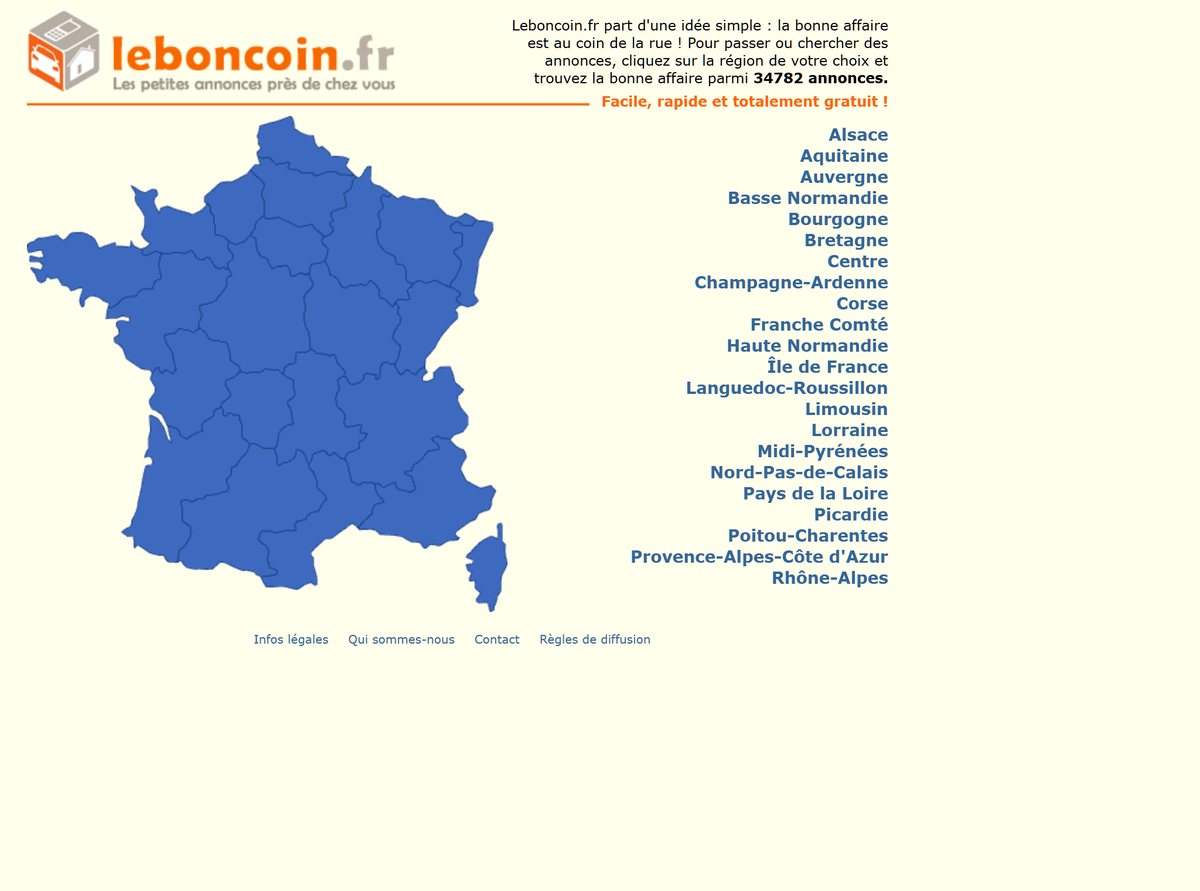
Yet something worked fast. Three weeks after launch, the home page said 18,206 ads; by mid-June it said 34,78225,26. The record does not say where those first ads came from. What it does show is a set of product and distribution choices, all copied from Blocket, that made posting easier and more trustworthy than anywhere else. Every one of them is free.
Move 1: Copy a model that already works, down to the details
Leboncoin did not invent a product. It adapted Blocket, a site Schibsted already knew was profitable and loved in Sweden4,12.
Even the name was tested, not guessed. Schibsted and Spir surveyed 400 French internet users and picked "Leboncoin" (roughly "the good corner", the spot where you find a good deal), which people found simple and reassuring1,2. Aizac summed up the concept as "an online yard sale"14.
Copying meant the team spent no time on design debates. The site looked plain, almost old-fashioned, on purpose: a map of France, a search box, a list of ads2,15. It kept that look for ten years; the first real redesign came in 20166.
Why it worked: a proven model removes risk from the parts you cannot test without traffic. Two people could spend their time getting ads and checking them, not building features.
Move 2: Make posting free, and faster than anyone else
Posting an ad on Leboncoin was free for private sellers2. Blocket in Sweden was by then charging for ads, but the French copy stayed free8. Jouteau later named free listings as the first of three founding choices7.
Free was not enough on its own, because Vivastreet and Kijiji were free too. The difference was friction. A French analysis in 2010 found that sites asking sellers extra questions were losing visitors. To confirm an ad on Leboncoin you only needed a password; Vivastreet made you tick boxes and type a code9. The same analysis blamed Kijiji's complicated posting process for its failure9.
Why it worked: a private seller with one pram to sell tries the easiest site, not the best-funded one. Every extra field is a seller who gives up.
Move 3: Organise by place, and win the regions first
On Leboncoin you started with a location, not a product. Ads were filed by département, and the home page was a clickable map of France2,15. That is how paper ad readers already thought: "what is for sale near me?"
Place also decided where Leboncoin won first. In 2010 Aizac said the site had grown best in the north of France, where the habit of regional classified ads was strong, while Parisians used classifieds less8. "Historiquement, le site s'est bien développé dans le nord de la France" ("historically, the site grew well in the north of France"), he told Journal de l'Automobile8.
That fits the parent company. Spir was a subsidiary of the Ouest-France group, publisher of France's biggest regional daily, and a specialist in free local ad papers1,5. Leboncoin was born inside a business whose whole job was regional classifieds.
Why it worked: liquidity (enough buyers and sellers that things actually sell) is local. A site busy in twenty regions beats one that is thin everywhere. Leboncoin grew where people already bought and sold through local ads, and let Paris come later.
How many listings is "enough" for your first area? It depends on how many categories you show. Work it out before you start recruiting, so you know your target.
Calculator
How many listings do you need at launch?
Visitors leave a category that looks empty. Pick how many listings a category page needs to look alive, for the categories and places you launch with.
Too many weeks? Launch with fewer categories or one area first, and add more as listings come in. More free tools →
Move 4: Check every ad before it goes live
Jouteau named content quality, with every ad checked before publication, as the second founding choice7. This came straight from Blocket. By 2010 Leboncoin had a team of 70 moderators.
Their job was not only to block fraud. Aizac said their mission was to educate sellers, guiding private individuals on how to write and present their ads8.
That matters most for the first sellers. A new seller who sees a page of clean, honest, local ads believes the site is real. A seller who sees spam, scams and duplicate dealer stock leaves.
Why it worked: on a young site, every bad ad is a big share of everything a visitor sees. Checking by hand is slow, but it is the cheapest way to make a small site look trustworthy.
Write your rules down before the first bad ad arrives, so you can point to them instead of arguing.
Template
Posting rules for your classifieds site
Publish this as your posting rules page and link it from the post-an-ad form; adjust the prohibited list to your country's laws and your niche.
Check your country's rules on items such as weapons, animals, alcohol and medicines before publishing. More free tools →
Move 5: Borrow distribution from partners who already had readers
Leboncoin did not have to build an audience alone. Spir distributed free ad papers and printed advertising to French letterboxes. It also owned a quarter of 20 Minutes France, the free daily newspaper that Schibsted co-owned5. By 2010 Leboncoin had a running partnership with 20 Minutes, and a property partnership with Spir's Logic-Immo.com5,16.
I could not find a source describing exactly what these partnerships did in 2006 and 2007, so treat this as context rather than a proven tactic. What is clear: the site launched inside a group whose daily business was putting local ads in front of French households.
Why it worked: a marketplace's first buyers are cheapest to reach through someone who already has their attention. Leboncoin had that built into its ownership.
Move 6: Stay free and tiny until the network was there
Leboncoin did not try to make money early. In 2009, its third full year, revenue was 18 million euros with a 47% EBITDA margin (earnings before interest, tax and depreciation: a rough measure of operating profit)17. It was profitable from 2009, with income from display advertising and small paid options for sellers2,8. In 2010 those options cost 1.50 to 10 euros, for example an "Urgent" label8.
The team stayed small: around 30 employees in 20111. Professionals paid first in property; car dealers and other pros kept free ads for years18. Only at the end of 2014 did Leboncoin end free listings for professionals1.
Why it worked: charging too early would have given sellers a reason to stay on paper or try a rival. Leboncoin let the habit form first, then charged the businesses that got the most value.
What didn't work, or went wrong
- Kijiji and Vivastreet show what failed. Kijiji.fr had eBay behind it and still never grew in France; eBay closed it in July 2010 and moved its users to eBay.fr9. Vivastreet lost traffic to Leboncoin over the same period. The French analysis of the time blamed complicated posting forms for both9. Money and a famous parent did not beat a shorter form.
- The "every ad is checked" promise outgrew the team. In December 2015 a French court found Leboncoin guilty of misleading commercial practice: it had claimed every ad was reviewed before publication, but some illegal ads got through6. A promise that works at 5,000 ads a day is hard to keep at 700,00019.
- Charging professionals hurt supply for a while. When Leboncoin ended free listings for pros at the end of 2014, more than 500,000 offers left the site within a month1. Some businesses came back on paid options2, but it shows how much supply had come from pros using a free tool.
- The design aged. The plain yellow site that helped in 2006 was being compared to Soviet design by 2016, and Leboncoin redesigned for its tenth birthday6. Simplicity is a strength; never updating is not.
How supply turned into demand: half a million ads in 14 months
The early record shows how fast the loop closed once ads were there:
- April 2006Launch, two people2.
- May 2006The home page counts 18,206 ads, three weeks in25.
- December 2006156,333 ads on the counter27.
- June 2007550,000 live ads, 10 million monthly visits, 300 million page views6. The home page counter says 587,73129.
- 20084 million monthly unique visitors7.
- 2009Revenue 18 million euros, 47% EBITDA margin, profitable17,1.
- March 2010About 700,000 car ads, 79% from private sellers; cars about 25% of page views8.
- July 2010eBay closes Kijiji.fr. Leboncoin is at 127 million visits a month, up nearly 50% in a year9,23.
- September 2010Valued at 400 million euros; Schibsted buys Spir's half. Revenue was expected to roughly double that year5,16,17.
- October 201113.7 million monthly unique visitors, top 15 in France, ahead of eBay1.
- 2018Fifth most visited website in France, the first French-owned one24.
The home page counter, saved by the Internet Archive every few months, shows the curve of the first 17 months: 18,206 ads in May 2006, 60,977 in August, 156,333 in December, 319,217 in March 2007, 587,731 in June and 710,688 in September 200725,31,27,28,29,30. Between May and December 2006 the count grew more than eightfold.
The ad count Leboncoin showed on its own home page, from Internet Archive captures, three weeks to 17 months after launch. Sources 25, 31, 27, 28, 29, 30.
Show the numbers
| Capture | Ads on the counter | Notes |
|---|---|---|
| May 2006 | 18,206 | 18 May 2006, about three weeks after launch |
| Aug 2006 | 60,977 | 13 August 2006 |
| Dec 2006 | 156,333 | 1 December 2006 |
| Mar 2007 | 319,217 | 2 March 2007 |
| Jun 2007 | 587,731 | 2 June 2007; Clubic gives 550,000 live ads that month |
| Sep 2007 | 710,688 | 12 September 2007 |
About 14 months after launch, the site had more than half a million live ads. That is the point where a local classifieds site feeds itself: most visitors find something near them, and most sellers get a reply. From there, each new buyer was also a likely future seller, and the site grew by word of mouth.
Cars were the turning point. A Harvard case summary notes that the model grew in France once Leboncoin expanded beyond household goods into used cars15. In France about 60% of used-car sales are between private individuals, and Leboncoin's free, local model fitted that exactly8. Cars brought serious buyers with real money, and later paying professionals: 14,000 pro clients by 2011, up from 9,000 a year earlier18.
Asked in 2011 whether Leboncoin would build Facebook groups, Jouteau said no18. By then the site itself was the place people gathered:
"Le Bon Coin est déjà une communauté en soi." ("Leboncoin is already a community in itself.") Antoine Jouteau, Journal de l'Automobile (2011)
The playbook: seven lessons for a small marketplace
Copy what already works in your niche, then change one thing. Leboncoin changed the name and the price (free), not the product. Look at the most used local group or noticeboard in your niche (a Facebook group for tractors, a WhatsApp group for rentals) and copy its categories, its language and its rhythm. Your one difference should be something the group cannot do, like search, filters or photos that do not scroll away.
Make posting the fastest in your market. Leboncoin beat better-funded rivals with a shorter form. Time yourself posting an ad on your phone; if it takes more than two minutes, cut fields. Ask only for what a buyer needs to decide (photo, price, place, contact) and make the rest optional.
Win one place before the whole map. Leboncoin grew first where people already used local ads. Pick one town, county or region where you can get 50 to 100 live listings, and say so on your home page. A busy local site convinces more than an empty national one.
Check every listing yourself while you are small. Leboncoin had 70 moderators in 2010; at your size, you are the moderation team. Read each new ad, fix titles and categories, and send sellers one tip to improve it. That personal note is also your best tool for keeping first sellers.
Borrow other people's audiences. Leboncoin had a free-ad newspaper and a free daily in its family. You have partners too: the local paper's website, a farm supply shop, a garage, a club newsletter, a community group admin. Offer them something useful: a free featured slot, a poster, or a weekly "new listings" post to share.
Stay free for individuals; charge businesses later. Leboncoin made money first from small options and display ads, and charged professionals only once they depended on it. Keep basic listings free, and plan your first income from optional extras (a featured spot, an "urgent" badge) or from dealers who post a lot.
Do not count on advertising to fill an empty site. Leboncoin's first sellers came from a product that was free, simple and local. Spend your first money on time (calling sellers, checking ads), not on ads that send buyers to empty categories.
Try this this week
Most of these need a message to sellers. Start from this one and make it personal to each seller.
Template
Outreach message to recruit your first sellers
Use this to contact people already selling on other sites, in groups or in shops; personalise the first line every time and offer what you can really deliver.
Send no more than one follow-up to people who did not reply, and keep a list of who asked not to be contacted. More free tools →
- Time your posting form (20 minutes). Post one ad on your phone with a stopwatch. Make optional every field that is not photo, title, price, place or contact. Target: under 2 minutes.
- Choose your first area (15 minutes). Pick one town or county and put it in your home page headline ("Used farm machinery in Normandy"). Target: 50 live listings there before you push anywhere else.
- Post 20 real listings with permission (2 hours). Find 20 items for sale in your niche on local Facebook groups, noticeboards or shop windows. Ask each seller if you can list it on your site for free, then post them yourself.
- Write to 30 local sellers (1 hour). Garages, dealers, farm shops, estate agents: a short personal message with a direct link to post. Target: 5 replies, 2 new sellers by Friday.
- Check every new ad within 24 hours (10 minutes a day). Fix titles and categories, and send each new seller one sentence of thanks plus one tip.
- Ask 1 partner for distribution (30 minutes). One newsletter, one shop wall or one group admin. Offer a free featured spot or a printed poster in return.
- Price your first paid option, but do not launch it (15 minutes). Decide what a "featured" or "urgent" listing would cost. Launch it when listings are steady, not before.
Doing it on Yclas
- Recruit sellers (admin panel > Recruit sellers): find local businesses in your first area, send each a personal invite link (/join/...), use "Write it with AI" for the first message, and keep a timeline of who you contacted. The list of searches on your site that returned nothing shows what local buyers want that you do not have yet.
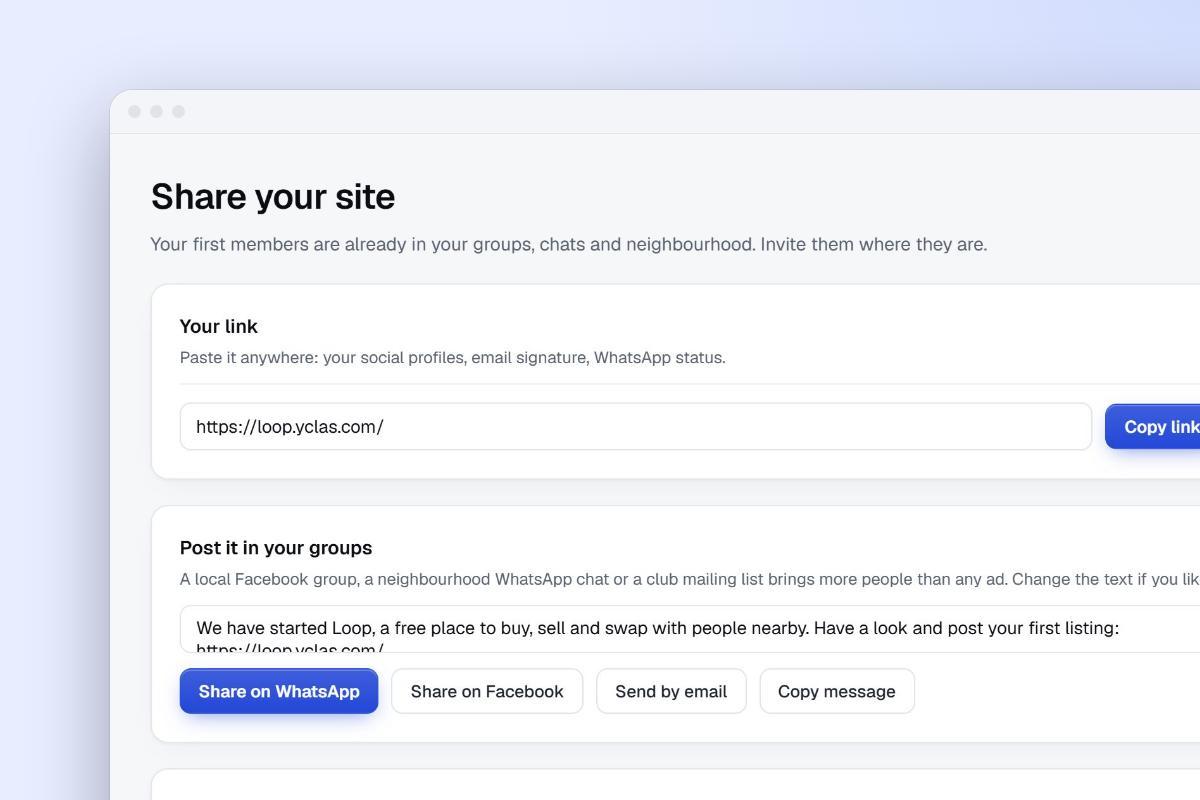
- Share your site (admin panel > Share your site): a ready message for WhatsApp and Facebook groups, plus a QR code and printable A4 poster for the shop walls and partners you visit.
- Add listings from text and other importers: paste a list of posts from a Facebook or WhatsApp group (with the sellers' permission) to get draft listings to check; use CSV import when a dealer sends you a spreadsheet.
- Posting from a photo with AI: the seller takes a photo and the listing fills itself in, which keeps posting as quick as Leboncoin's short form.
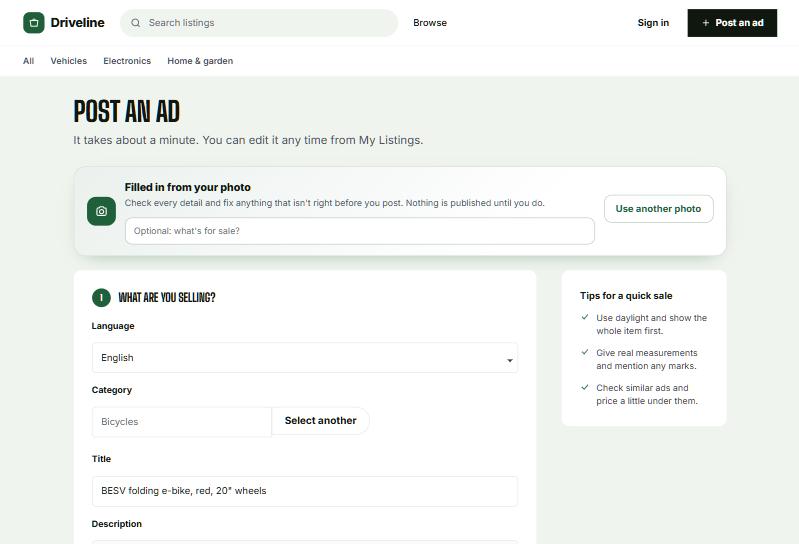
- Custom fields and categories: organise by place and by the categories your sellers use, and keep the form short.
- Featured listings and paid plans for sellers: when listings are steady, add paid extras for individuals and plans for businesses, the order Leboncoin followed.
For more on how the big classified sites grew, see our earlier posts on what made Craigslist so successful, the success of OLX and Avito as a leading classified marketplace.
Sources
- Connaissez-vous la vraie histoire du site Leboncoin ? — FrenchWeb — https://www.frenchweb.fr/connaissez-vous-la-vraie-histoire-du-site-leboncoin/442884
- Leboncoin, l'envers d'une réussite française — L'Essentiel de l'Éco — https://lessentieldeleco.fr/7776-leboncoin-lenvers-dune-reussite-francaise/
- Leboncoin — Wikipedia (2026) — https://en.wikipedia.org/wiki/Leboncoin
- Leboncoin — Wikipédia (French, citing Gless 2013) — https://fr.wikipedia.org/wiki/Leboncoin
- Communiqué de presse Schibsted / Spir Communication, 22 septembre 2010 — AMF (2010) — https://echanges.dila.gouv.fr/OPENDATA/AMF/ECO/2010/09/FCECO017757_20100922.pdf
- Leboncoin a 10 ans: du jaune pisseux au n°1 de la petite annonce en ligne — Clubic (2016) — https://www.clubic.com/leboncoin/actualite-804376-leboncoin-10-ans.html
- Comment leboncoin est devenu une des marques média les plus influentes de France ? (Antoine Jouteau) — CB News (2017) — https://www.cbnews.fr/node/25222
- Le Bon Coin a trouvé l'ouverture (interview with Olivier Aizac) — Journal de l'Automobile (2010) — https://journalauto.com/services/le-bon-coin-a-trouve-louverture/
- La chute d'audience de Kijiji.fr l'envoie au terminus — FrenchWeb (2010) — https://www.frenchweb.fr/la-chute-daudience-de-kijiji-fr-lenvoit-au-terminus/3996
- Petites annonces en France: comment vivre face à Leboncoin — Journal du Net (2019) — https://www.journaldunet.com/retail/1459190-petites-annonces-en-france-comment-vivre-face-a-leboncoin/
- The value of classified — Antoine de Tarlé, Tarlé Media blog (2010) — https://tarlemedia.blogspot.com/2010/09/
- Blocket: an idea that started a movement — Vend / Schibsted — https://vend.com/news/an-idea-that-started-a-movement
- Looking to Europe for news-industry innovation, Part 2: Schibsted's classifieds business — Nieman Lab (2012) — https://www.niemanlab.org/2012/02/looking-to-europe-for-news-industry-innovation-part-2-schibsteds-stunning-classifieds-and-services-business/
- The secret of Schibsted Media's success — Worldcrunch — https://worldcrunch.com/tech-science/the-secret-of-schibsted-medias-success/
- Le Bon Coin: the secrets of a local business model — Harvard Digital Innovation and Transformation — https://d3.harvard.edu/platform-digit/submission/le-bon-coin-the-secrets-of-a-local-business-model/
- Spir Communication cède sa participation dans LeBonCoin.fr, valorisé à 400M d'euros — FrenchWeb (2010) — https://www.frenchweb.fr/spir-communication-cede-sa-participation-dans-leboncoin-fr-valorise-a-400m-deuros/5266
- Schibsted interim report Q2 2010 (presentation) and Schibsted release on the Leboncoin.fr acquisition — Schibsted (2010) — https://cdn.financialreports.eu/financialreports/media/filings/3738/2010/RNS/3738_rns_2010-08-13_3c9a0545-d817-46b4-b000-64c9e5ca8a95.pdf
- « Notre objectif premier est de faire vendre » (interview with Antoine Jouteau) — Journal de l'Automobile (2011) — https://journalauto.com/services/notre-objectif-premier-est-de-faire-vendre/
- FW500 e-commerce: Le Bon Coin, un modèle hybride entre e-commerce et régie publicitaire — FrenchWeb (2016) — https://www.frenchweb.fr/fw500-e-commerce-le-bon-coin-un-modele-hybride-entre-e-commerce-et-regie-publicitaire/241937
- Havas Paris for leboncoin: property campaign — La Réclame — https://lareclame.fr/havasparis/realisations/immo-la-tartine-le-dressing-le-clou
- Havas Paris for leboncoin: "Trouvez votre place" jobs campaign (June 2016) — La Réclame (2016) — https://lareclame.fr/havasparis/realisations/trouvez-votre-place-juin-2016-campagne-tv-print
- Leboncoin, cet « ovni » qui a détrôné eBay — LSA (as summarised in search results; the page itself was not accessible) — https://www.lsa-conso.fr/le-bon-coin-cet-ovni-qui-a-detrone-ebay,233814
- Classement OJD: la fréquentation des sites Internet en juillet 2010 — FrenchWeb (2010) — https://www.frenchweb.fr/classement-ojd-la-frequentation-des-sites-internet-sur-juillet-2010/4028
- Schibsted: forensic look at the assets — The Analyst (2018) — https://d1o32tunh0h64a.cloudfront.net/6503/Schibsted---Forensic-Look-at-the-Assets_23-August-2018.pdf
- leboncoin.fr home page, 18 May 2006 ("parmi 18206 annonces") — Internet Archive (2006) — https://web.archive.org/web/20060518092858/http://leboncoin.fr/
- leboncoin.fr home page, 11 June 2006 ("parmi 34782 annonces") — Internet Archive (2006) — https://web.archive.org/web/20060611224945/http://www.leboncoin.fr/
- leboncoin.fr home page, 1 December 2006 ("parmi 156333 annonces") — Internet Archive (2006) — https://web.archive.org/web/20061201152702/http://www.leboncoin.fr/
- leboncoin.fr home page, 2 March 2007 ("parmi 319217 annonces") — Internet Archive (2007) — https://web.archive.org/web/20070302202427/http://www.leboncoin.fr/
- leboncoin.fr home page, 2 June 2007 ("parmi 587731 annonces") — Internet Archive (2007) — https://web.archive.org/web/20070602181557/http://leboncoin.fr/
- leboncoin.fr home page, 12 September 2007 ("parmi 710688 annonces") — Internet Archive (2007) — https://web.archive.org/web/20070912105145/http://www.leboncoin.fr/
- leboncoin.fr home page, 13 August 2006 ("parmi 60977 annonces") — Internet Archive (2006) — https://web.archive.org/web/20060813115749/http://leboncoin.fr/