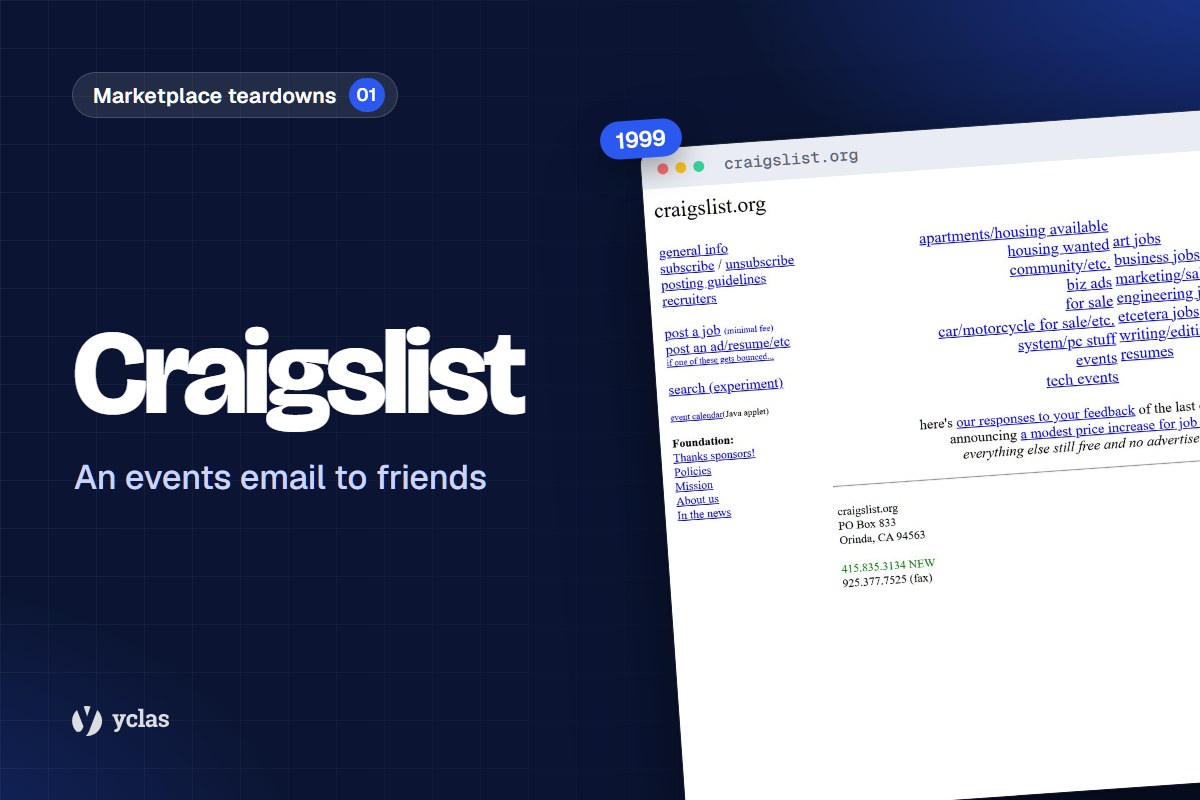
Craigslist did not start by chasing listings. In early 1995 it was an email about local arts and tech events, sent by a programmer at Charles Schwab to about a dozen friends in San Francisco. Then the readers started asking: can I add a job? A sofa for sale? An apartment?
There was no website, no listings form and no business plan. Craig Newmark had moved to the city in 1993 and simply wanted to share what was going on. The readers built the marketplace for him, one request at a time, and he said yes.
By the middle of 1995 the list had about 240 addresses and his email program could no longer cope. Five years later Craigslist was still a one-city site run from Newmark's apartment. Its second city, Boston, only opened in June 2000.
That slow, local, almost accidental start is the most useful part of the story if you run a small classifieds site. Craigslist did not buy or fake its first listings. It built a group of people who trusted one person, and the listings came out of that trust.
The short version
- Craigslist's first product was useful content (local events), not listings. Readers came first, and they posted the first jobs, items and apartments1,4.
- Categories were added only when readers asked, so each one opened with people ready to post1,2.
- The founder answered every message and chased spammers himself. On a site of strangers, that trust was the product6,8.
- Posting stayed free for individuals. Only businesses paid, and only where they already paid more elsewhere5,9.
At a glance
- Founded
- Early 1995 as an email list; website by end of 1995 / 1996; company in 19991,2,3
- Founder
- Craig Newmark; Jim Buckmaster joined in January 2000 and became CEO in November 20003
- Country
- United States (San Francisco Bay Area first)
- Category
- General local classifieds: jobs, housing, for sale, services, community
- First-seller tactic
- An events email to friends; readers asked to add jobs, items and apartments1,4
- Where it is now
- 700+ cities in 70 countries by 2012; still free for most posts, with fees in a short list of categories3,14
Part of the guide Marketplace case studies
The cold-start problem: newspapers owned local ads
Cold start is the moment when a marketplace has no buyers because it has no listings, and no listings because it has no buyers. Every new classifieds site hits it.
In 1995 local classifieds lived in the newspaper. Papers charged per line or per word, and classified ads were a huge part of their income: up to 40% of a typical daily paper's revenue, according to figures quoted by the Oakland Tribune in 20026.
Online job boards existed, but they were expensive for employers. In 2002 Monster charged about $300 for a job posting and CareerBuilder about $200. Craigslist charged $75 in the Bay Area and nothing elsewhere6,7.
Price of a single job posting on the big job boards against Craigslist. Sources 6, 7.
Show the numbers
| Site | Price per job ad | Notes |
|---|---|---|
| Monster | $300 | about, Oakland Tribune / AP, 2002 |
| CareerBuilder | $200 | about, same reports |
| Craigslist (Bay Area) | $75 | the only paid category |
| Craigslist (other cities) | free | no fee outside the Bay Area |
So buyers and sellers already had a channel. It was just slow, paid and impersonal. What Craigslist had that the papers did not was a small group of tech and arts people in one city who already read Newmark's email every week.
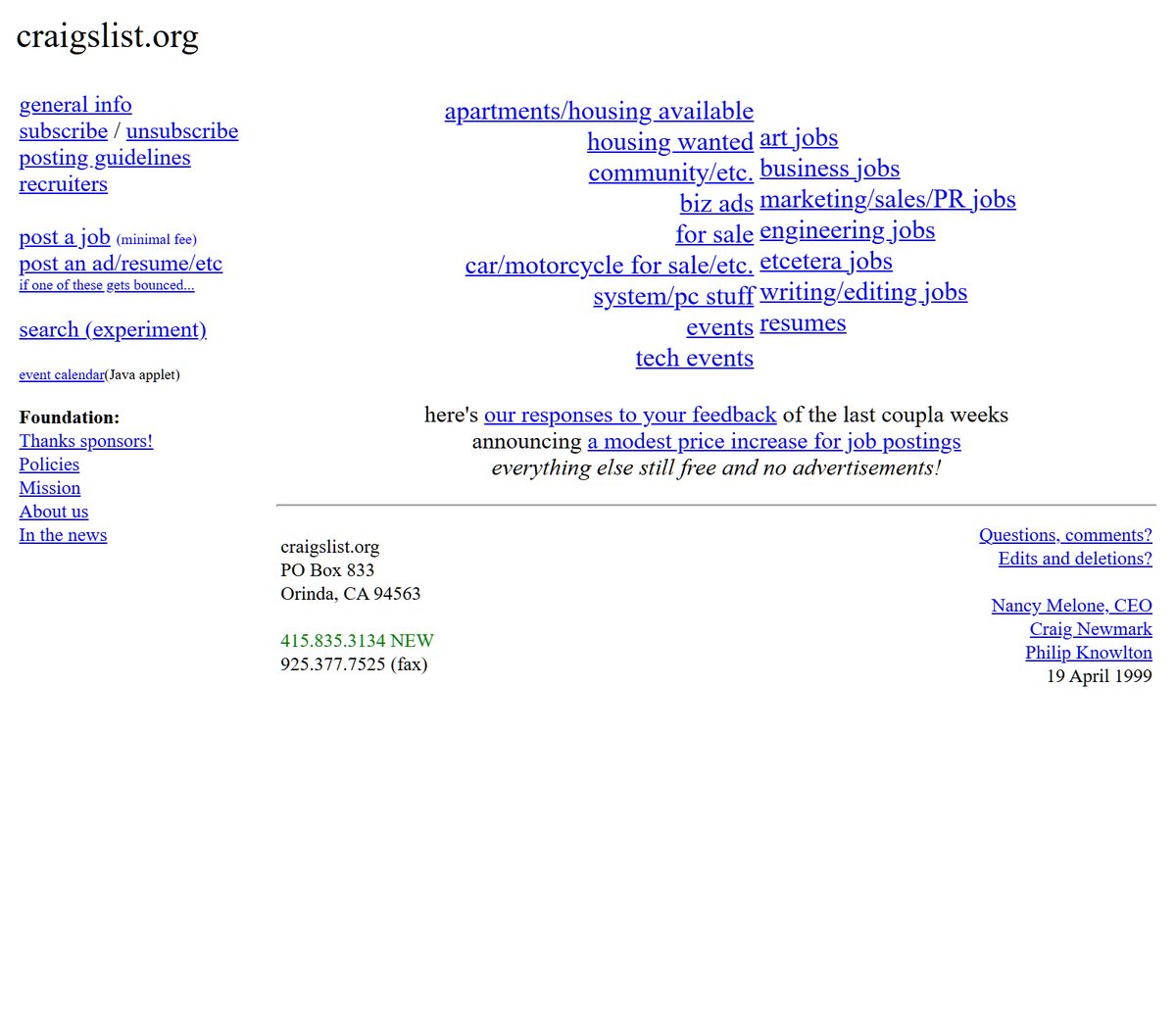
Two local conditions helped. San Francisco's tech scene was growing fast, and tech companies needed to hire. And the city had a housing shortage: Craigslist's own history says apartment listings were added because of it2. Jobs and apartments are urgent and local, and a weekly paper served both badly.
How they got the first sellers
Move 1: Send useful content before you have listings
The first thing Newmark sent out was not an ad. It was a list of events: art openings, tech meetups, things to do. He wrote and sent those early notices himself6. That gave people a reason to subscribe before there was anything to buy.
This matters mechanically. An audience you already have is the distribution channel for your first listings. When a reader wanted to fill a job or rent out a room, the cheapest place to announce it was the email they already got every week, read by people they half knew.
Word of mouth did the rest. In Newmark's words, people kept asking to be added4. He started with 10 to 12 recipients and reached about 240 within months4,1.
Move 2: Let readers choose the categories
Newmark did not decide up front that Craigslist would have jobs, housing and for sale. Readers asked if they could post a job, then an item to sell, and he added apartments1,2. In a 2006 PBS interview he described the loop that kept going for years: users make suggestions, the team acts on the ones that make sense, then asks for more feedback5.
It became company policy. In 2003 Newmark told Investor's Business Daily: "Everything we do is guided by people in the community"8. In 2006 CEO Jim Buckmaster told the Wall Street Journal that if users are not asking for something, the company does not consider it9.
Why it worked: a category requested by ten readers launches with ten possible posters. A category the founder guesses at launches empty.
Move 3: The founder answers every message
From the start, Craigslist was one person's list, and that person answered. Newmark ran the site alone for about three years1. Even after hiring a CEO, he moved himself into customer service, not management. By 2003 he spent at least 50 hours a week on it8. In 2007 he said he did customer service at least six hours a day, every day, and joked that his only exit from that job would be death10.
The work was concrete. In 2002 he personally tracked down spammers who harvested email addresses from the site and phoned them to ask them to stop6. ClickZ later reported that he filed about ten abuse reports a day with internet providers himself15. Staff screened postings for obscenity and chased flamers7.
Why it worked: on a site full of strangers, trust is the product. Forrester analyst Charlene Li said in 2003 that the site was easy to use and lacked a commercial feel, so people trusted it8. Newmark himself credited trust and customer service, and said people with good intentions far outnumber the bad ones1. A founder who answers personally is the cheapest trust tool there is.

Move 4: Keep it free, plain and non-commercial
At the end of 1997 the site had about one million page views a month. Microsoft's Sidewalk city guide offered to run banner ads at market rates, enough for Newmark to live on. He said no1,11. He later explained that he had a day job, did not need the money, and thought many banner ads were pointless1,11.
For years the site had no photos, no graphics and no ads, which kept it fast8. It never sold user lists, and Newmark turned down at least one buyout offer6,7. In 2002 he described it to the AP as a place where people help each other with everyday things7.
Why it worked for supply: a free post with no friction removes the main reason a casual seller does not bother. By January 2002 Craigslist was getting more than 9,000 new listings a day, nearly all of them free6.
Move 5: Charge only businesses, and only where they already pay more
Craigslist did start charging, in a very narrow way. Job ads in the San Francisco Bay Area became paid around 1998: the first and, for years, the only fee8,12. The AP reported it started at $25 and later rose to $7512. Before adding the fee, Newmark checked the site's discussion boards, reasoning that users had to see it as fair8.
The logic, he told PBS, came from users: employers and real estate advertisers already paid more elsewhere for ads that worked less well5.
"We're much more comfortable charging companies than charging individuals." Jim Buckmaster, The Wall Street Journal (2006)9
The paid part was small. In early 2002 about 150 paid job ads came in each weekday at $75 each, while thousands of other posts a day stayed free6. That was enough: the company says it has been profitable since 199912,13.
The next fees followed the same rule. In August 2004 job ads in New York and Los Angeles started costing $2512. Later, New York apartment brokers were charged $10 per listing. Newmark said the brokers asked for that fee themselves, because it cut the duplicate and spam listings that buried everyone's ads5. Craigslist expected it to cut broker listings by 90%9. A fee can be a quality filter, not just revenue.
Move 6: Open new areas only when people ask
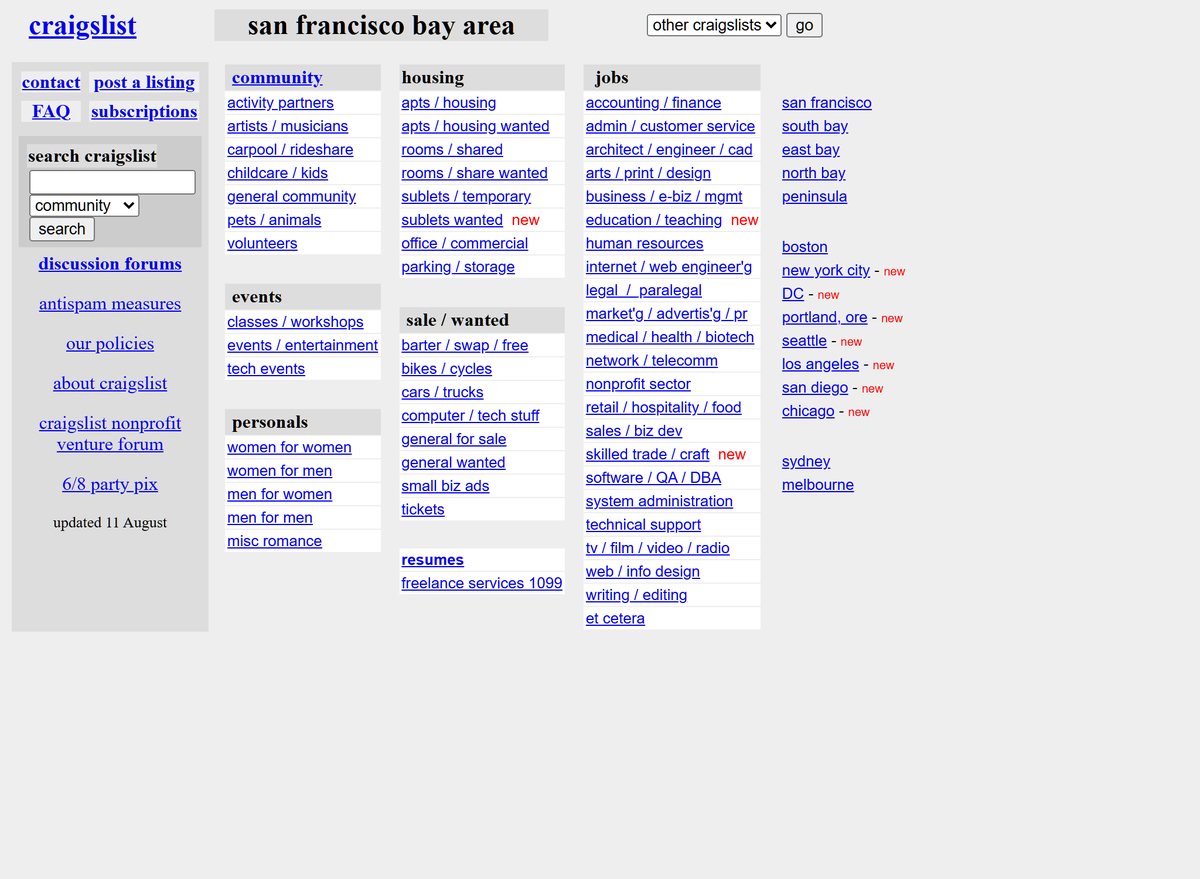
After Boston in June 2000, Craigslist added seven cities in August 2000 (Chicago, Los Angeles, New York, Portland, San Diego, Seattle, Washington DC) and Sacramento in October 200014. Then it slowed down: four cities in 2001, four in 2002 and 14 in 200314.
After five years in San Francisco alone, Craigslist opened new cities in bursts, where users had asked. Source 14.
Show the numbers
| Year | New cities | Notes |
|---|---|---|
| 2000 | 9 | Boston (June), 7 cities (August), Sacramento (October) |
| 2001 | 4 | Atlanta, Austin, Denver, Vancouver |
| 2002 | 4 | Miami, Minneapolis, Philadelphia, Phoenix |
| 2003 | 14 | including London and Toronto |
How did it choose? Not with a model. In 2004 Newmark said expansion was not scientific: requests came in through a feedback forum, and the team also looked at things like broadband use11. When Spokane was added in November 2004, Buckmaster said the main factor was user demand: enough requests and posts from people who wanted it16.
Opening where people had asked meant new sites rarely started empty. About a month after Spokane went live it had more than 300 for-sale ads and 35 jobs-wanted posts16. The pattern repeated in college towns: Bloomington, Indiana was added in 2006 after many requests, a lot of them from Indiana University students17.
What didn't work: volunteers, the founder as boss, standing still
The volunteer year. Some users suggested running Craigslist as a volunteer project. Newmark tried that in 1998. It failed: in his telling, things did not get done and the site started to decline1,11. In fall 1998 the project was renamed "List Foundation" with business partners. Newmark later cut ties with one partner who tried to commercialise the site, and the name was dropped in 19996,3.
His lesson: a community can suggest and police, but someone has to own the work. In 1999 he made Craigslist a real company and worked on it full time2,1.
The founder as manager. Newmark is candid that he was a poor manager. In November 2000 he handed the CEO job to Jim Buckmaster, who had joined as a programmer3. In 2003 he said the person who started the company was not the right person to lead it into the future8. Buckmaster built the multi-city setup, search, forums and the community flagging system that let Craigslist expand3.
The website lagged the email. Newmark turned the emails into web pages in late 1995, but said the email list stayed more popular than the website for a long time, probably until the early 2000s1. If you want to move your community to a new channel, remember: people stay where they already read.
Standing still. The minimalism that built trust was later criticised. Wired's 2009 cover story by Gary Wolf, as summarised by other outlets, argued the site had refused to evolve, partly because Newmark preferred answering support email to running product18.
Other sites copied Craigslist data to build better interfaces, such as PadMapper's apartment maps. Craigslist sued PadMapper in 2012, then added maps itself19. Facebook Marketplace now competes for free local listings, and when Craigslist began charging $5 for cars sold by owners in April 2019, reports pointed out that Facebook stayed free20.
How supply turned into demand: one city, then jobs
On Craigslist the same people were often buyers and sellers. The person posting a room this month was looking for a sofa next month. So supply and demand grew together, inside one city, for five years before the second city opened.
- Early 1995The events email goes to 10 to 12 friends4,1.
- Mid-1995About 240 email subscribers1,4.
- End of 1997About 1 million page views a month1.
- February 2000A Forrester report backs recruiters' view that Craigslist is the most effective job site in the Bay Area2.
- April 20009 employees, working from Newmark's apartment3.
- January 2002768,000 US visitors a month, 9,000+ new listings a day, 13 cities, 17 staff6.
- March 20031.6 million unique visitors, up from 699,000 in April 20028.
- 2005About $25 million revenue with about 21 staff9,13.
- 2006300 US cities and about 10 million monthly visitors9.
Jobs were the wedge. When the recruiting industry itself, and then Forrester, said Craigslist was the best place to hire in the Bay Area, employers had a reason to post and to pay2. Housing followed: by early 2002, San Francisco apartment listings had reached as many as 5,000 a week, up from 1,000 a year earlier7.
Liquidity is the marketplace word for "when you post, you get a response quickly." Craigslist reached it city by city, not nationally. Within San Francisco, the free, fast, trusted listing became the default habit.
You can check whether your own site has reached it yet. This calculator uses reply rate, sell-through and new listings per 1,000 people, so you know whether to push on in your first area or open the next one.
Calculator
Is your marketplace working yet?
Liquidity means a listing finds a buyer. Count last month on your site: the listings that were live, how many got at least one reply, and how many sold.
Work these out every month and compare areas and categories: put your effort where they rise, not where traffic is biggest. More free tools →
That habit is what eventually cost newspapers so much. A study by Robert Seamans (NYU) and Feng Zhu (Harvard) estimated that Craigslist saved classified advertisers about $5 billion between 2000 and 200721.
Today Craigslist is private and does not publish its figures. In 2025 Entrepreneur reported annual revenue of about $694 million, a figure a LinkedIn post by Newmark seemed to endorse, while other estimates are much lower4,3. Its fee list is still short: jobs ($10 to $75 depending on the area), gigs, apartments in Boston, Chicago and New York, commercial real estate, services, everything sold by dealers, and cars, RVs and motorcycles sold by owners. Everything else is free22.
The playbook: 8 lessons for a small site
Build an audience before you build a catalogue. Newmark's first product was a useful local email, and listings came from its readers. Start a WhatsApp channel, Facebook group or weekly email for your niche (events, auction dates, price news, new rules) and put the same items on your site, so readers have a reason to come back before the listings fill up.
Open categories only when someone asks. Craigslist added jobs, items and apartments because readers asked for them. Launch with 3 to 5 categories, keep a list of every "do you have…?" message and every search that found nothing, and add a category when at least five real people ask for it.
Answer every message yourself. The founder doing customer service made the site feel personal and kept bad actors out. Reply to every new seller within a day, by name, and thank them for their first listing. When a listing is a scam, remove it and say so in your group.
Keep posting free for individuals; charge businesses later. Craigslist charged only employers and brokers, who already paid newspapers and job boards much more. Keep private sellers free while you build volume. When you are ready, charge dealers, agents or employers clearly less than they pay elsewhere, and test the idea with your community first, as Newmark did on his discussion boards.
Use a fee to clean up a category. New York brokers asked to be charged because it cut duplicate listings. If one category fills with repeat posts from the same businesses, a small fee or a paid "featured" slot can do more for quality than more rules.
Win one place before you open the next. Craigslist stayed in one city for five years, then grew only where people asked. Pick one town, region or niche and get real activity there (new listings every day, replies within hours) before adding a second. When people from another area keep asking, that is your next area.
Make the community your moderators. Craigslist relied on users flagging bad posts, with staff acting on the flags. Write five plain posting rules, pin them, and ask your most active members to report problems to you directly.
Meet people offline. Craigslist held face-to-face parties for its users, with craigslist pocket protectors6. A stand at a local market, show or trade fair, with a printed poster and a QR code, builds the same "this is our site" feeling at almost no cost.
For lesson 7, this template gives you a starting set of posting rules to edit:
Template
Posting rules for your classifieds site
Publish this as your posting rules page and link it from the post-an-ad form; adjust the prohibited list to your country's laws and your niche.
Check your country's rules on items such as weapons, animals, alcohol and medicines before publishing. More free tools →
What does not transfer: Craigslist grew in the 1990s, when there was almost no free online alternative. Your sellers already have Facebook Marketplace. That makes the personal, niche and trusted part of the Craigslist story more important for you, not less.
Try this this week
Your first sellers will come from a personal message, not an announcement. Use this template for the 30 invites below, and change the first line for each person:
Template
Outreach message to recruit your first sellers
Use this to contact people already selling on other sites, in groups or in shops; personalise the first line every time and offer what you can really deliver.
Send no more than one follow-up to people who did not reply, and keep a list of who asked not to be contacted. More free tools →
- Write a "what's on" message (1 hour): 5 to 10 items for your niche (events, prices, news, new listings). Send it to 30 people in your market by WhatsApp or email. Put it in your calendar to repeat every week.
- Ask 20 of those readers one question (by Wednesday): "If you could post one thing here today, what would it be?" Write down every answer. These are your first categories and your first listings.
- Post 20 real listings (2 evenings), yourself or for sellers you know, with their permission, so the first visitor sees activity. Craigslist's first notices were Newmark's own.
- Personally contact 30 likely sellers (30 minutes a day for 5 days): local shops, dealers, people already selling in Facebook groups. Target: 5 who post.
- Reply to every message within 24 hours all week, and log each question. Questions that come back twice become your FAQ.
- Write five posting rules and a one-line "how to report a bad listing" note (30 minutes), and pin both.
- Put up 1 poster with your site's QR code by Saturday, where your buyers already are: a feed store, a garage, a university notice board, a club house.
Doing it on Yclas
- Recruit sellers (admin panel > Recruit sellers): find local businesses to invite, send each a personal invite link (/join/...), and keep a timeline of who you contacted. Its list of searches that found nothing is your version of Craigslist's feedback forum: it shows which categories and listings buyers want next.
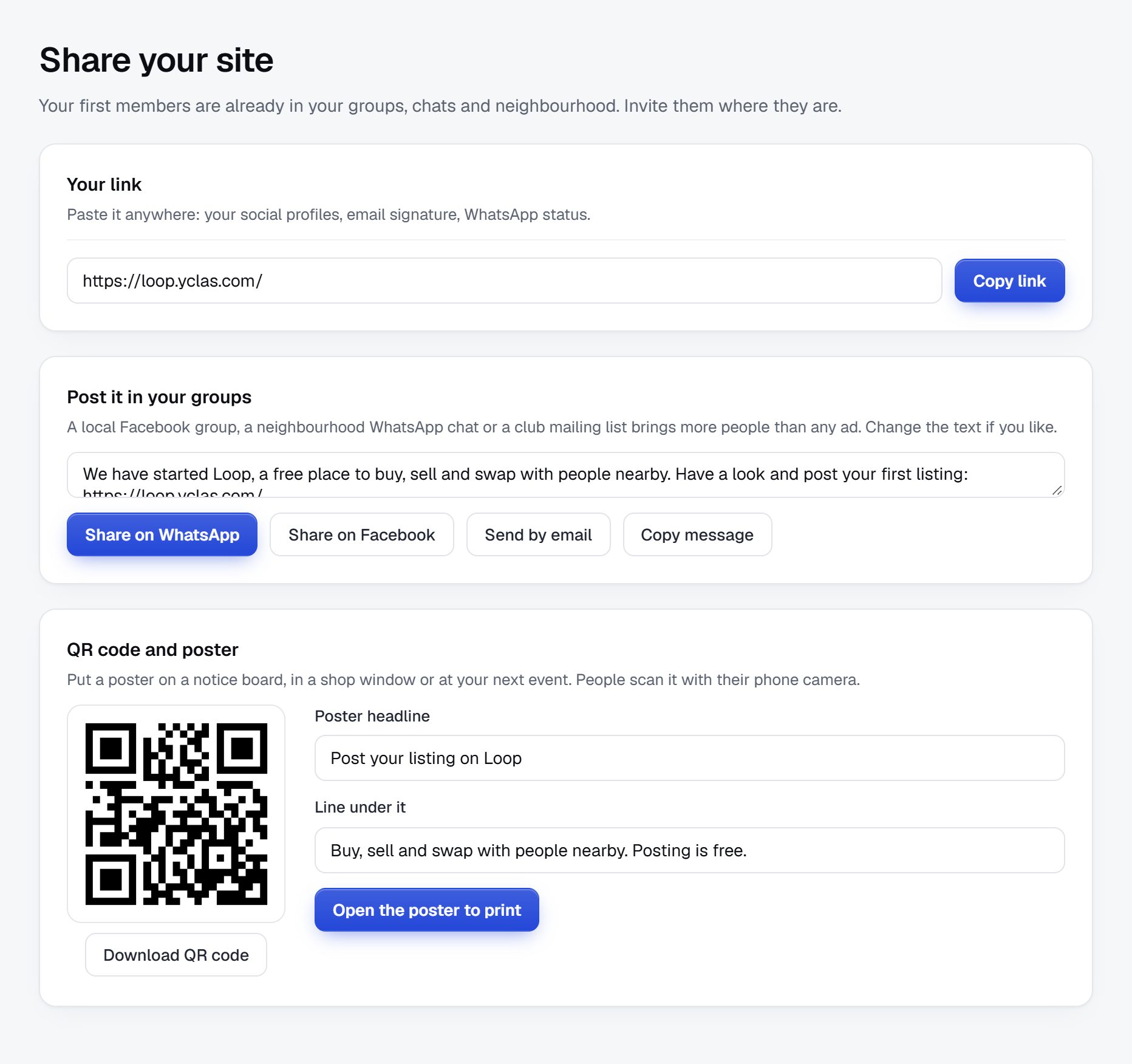
- Share your site (admin panel > Share your site): a ready group message for WhatsApp, Facebook or email for your weekly "what's on" message, plus a QR code and a printable A4 poster.
- Add listings from text: paste a list of posts from a Facebook or WhatsApp group (with the sellers' permission) and get draft listings, so the first 20 take minutes, not evenings.
- Posting from a photo with AI: a seller takes a photo and the listing is filled in, which keeps posting as easy as Craigslist's plain form.
- Custom fields and categories: start with the few categories your readers asked for and add more as requests come in.
- Paid plans and featured listings for sellers, when you are ready for Craigslist's rule: free for individuals, a fair fee for businesses. The member email digest of new listings is the modern version of the original Craigslist email.
For more on what kept Craigslist on top later, see our earlier post What has made Craigslist so successful as an online classified platform and the top classified websites in the USA.
Sources
- He calls his online creation a 'happy accident' (interview with Craig Newmark) — Computerworld (2007) — https://www.computerworld.com/?p=1570874
- craigslist is about: mission and history — craigslist.org (n.d.) — https://www.craigslist.org/about/mission_and_history
- Craigslist — Wikipedia (accessed 2026) — https://en.wikipedia.org/wiki/Craigslist
- Craigslist founder reveals origin story from side-hustle days — Entrepreneur (2025) — https://www.entrepreneur.com/business-news/craigslist-founder-reveals-origin-story-side-hustle-days/489035
- Interview: Craig Newmark (News War) — PBS Frontline (interview 2006, published 2007) — https://www.pbs.org/wgbh/pages/frontline/newswar/interviews/newmark.html
- Article on craigslist by Alan Zibel — Oakland Tribune (2002), via craigslist.org — https://www.craigslist.org/about/press/committed
- Article on craigslist by Paul Glader — Associated Press (2002), via craigslist.org — https://www.craigslist.org/about/press/commons
- His little Net idea that could (Pete Barlas) — Investor's Business Daily (2003), via craigslist.org — https://www.craigslist.org/about/press/netidea
- Zen and the art of classified advertising — The Wall Street Journal (2006), via newswatch.in — https://newswatch.in/news/2006/06/17/zen-and-the-art-of-classified-advertising
- Craig Newmark on running craigslist and being the Internet's most famous customer service rep — Mediabistro (2007) — https://www.mediabistro.com/archive/craig-newmark-on-running-craigslist-and-being-the-internets-most-famous-customer-service-rep/
- Craig Newmark interview (Nate Kaiser) — nPost (2004), via craigslist.org — https://www.craigslist.org/about/press/npostinterview
- Craigslist to charge for ads in New York and Los Angeles — Associated Press via NBC News (2004) — https://www.nbcnews.com/id/wbna5581320
- Article on craigslist by Verne Kopytoff — San Francisco Chronicle (2006), via craigslist.org — https://www.craigslist.org/about/press/chronicle.verne
- New craigslist sites added since 1995 — craigslist.org (n.d.) — https://www.craigslist.org/about/expansion
- Craigslist enlists police, ISPs and community to fight "spamvertising" — ClickZ (n.d.) — https://www.clickz.com/craigslist-enlists-police-isps-and-community-to-fight-spamvertising/60275/
- Craigslist makes debut in Spokane — The Spokesman-Review (2004) — https://spokesman.com/stories/2004/dec/21/craigslist-makes-debut-in-spokane
- Craigslist spreads to Bloomington — Indiana Daily Student (2006) — https://www.idsnews.com/article/2006/06/craigslist-spreads-to-bloomington
- Wired takes on Craigslist founder — VentureBeat (2009) — https://venturebeat.com/business/wired-takes-on-craigslist-founder-who-promptly-walks-into-a-door; and The tragedy of the tragedy of Craigslist — The Laboratorium (2009) — https://laboratorium.net/archive/2009/08/23/the_tragedy_of_the_tragedy_of_craigslist
- Craigslist: Unstoppable resource or Internet fossil? — Fortune (2014) — https://fortune.com/2014/03/21/craigslist-unstoppable-resource-or-internet-fossil/
- Craigslist now charges $5 to list a car for sale, Facebook remains free — Motor Authority (2019) — https://www.motorauthority.com/news/1122618_craigslist-now-charges-5-to-list-car-for-sale-facebook-remains-free
- Craigslist costs US newspapers billions: study (Seamans and Zhu) — Phys.org / NYU Stern (2013) — https://phys.org/news/2013-08-craigslist-newspapers-billions.amp
- Posting fees — craigslist.org help (accessed 2026) — https://www.craigslist.org/about/help/posting_fees