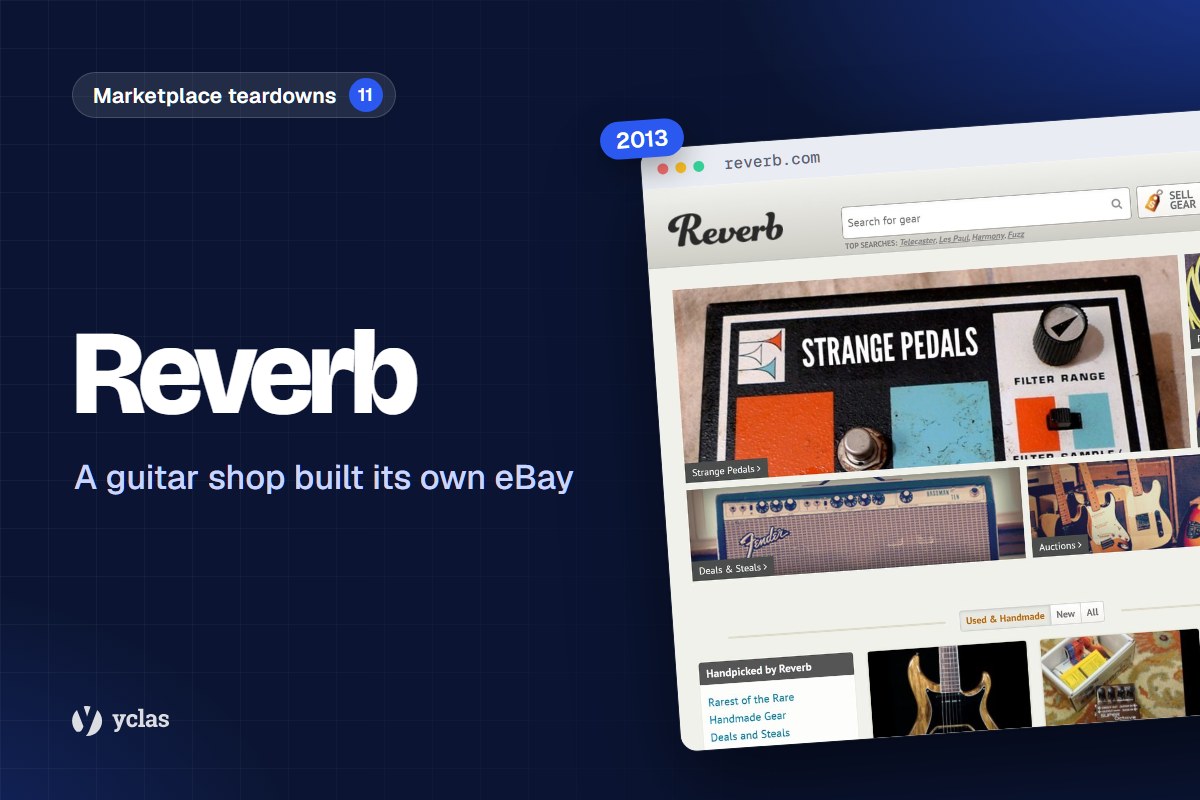
Reverb's first seller was its founder. In 2012 his Chicago guitar shop sold about $500,000 of gear on eBay and paid 10% or more on every sale24. So he built a marketplace for shops like his, and the shops came.
Reverb.com went live in January 20135. Ten months later more than 4,000 dealers had joined24. In 2019 Etsy bought it for $275 million in cash13,14.
If you run a vehicle, equipment or other specialist marketplace, this is the teardown closest to your situation. Reverb was not outsiders persuading a trade to trust them: it was a dealer, building for dealers, in a niche he knew from behind the counter.
The short version
- The founder's own shop was the first seller, with real stock and a real eBay problem.
- He signed up other shop owners himself, face to face, and 4,000+ dealers joined in ten months.
- A fee a dealer could repeat at the counter (free to list, 3.5% when it sells) made trying it cost nothing.
- A price guide and gear videos brought musicians, and individuals then sold next to the dealers.
At a glance
- Founded
- Started late 2012, site live January 20135 (one 2013 article dates the "official" launch to June6)
- Founder
- David Kalt, co-founder of optionsXpress, owner of Chicago Music Exchange since 20101,2
- Country
- United States (Chicago)1
- Category
- New, used and vintage musical instruments and gear1
- First-seller tactic
- The founder's own shop, then other dealers met face to face, then individuals selling next to dealers, pulled in by a 3.5% fee and a price guide12,23,24
- Where it is now
- Bought by Etsy for $275m (2019)13; Etsy sold it in 2025 to Creator Partners and Servco, both investors in Fender22
Part of the guide Marketplace case studies
The cold-start problem: a $7 billion market split into shops
In 2010 David Kalt, who had co-founded the online options broker optionsXpress in 2000 and taken it public in 2005, bought a guitar shop in Chicago21. The deal for Chicago Music Exchange was reportedly worth about $7.5 million, most of it inventory2.
Kalt soon had the problem every dealer of used goods knows. He held millions of dollars of vintage stock that he needed to turn into cash to make room for new stock4. The place to sell it online was eBay, which was built for everything, not for guitars.
The used instrument market was big and messy. Kalt put used gear spending at about $7 billion a year worldwide, next to about $15 billion of new instruments21. But it was split up by place. A vintage guitar in Ohio could only find buyers who walked into that shop, or who found it on eBay or Craigslist.
Each way to sell had a cost:
- Selling to a dealer was fast but cheap. Kalt later said that as a dealer, his offers to people selling guitars came to about 50 cents on the dollar21.
- eBay reached everyone, but cost his shop 10% or more per sale24 and was not designed for gear: no filter by year of make, no specialist buyers, no idea of the fair price.
- Craigslist was free but local, anonymous and full of time-wasters.
Kalt told TechCrunch: "I saw this massive spread between what dealers were looking to make" and what musicians got7. That spread was the opportunity. A marketplace that narrowed it would help both sides.
The cold-start problem was the usual one: buyers want selection, sellers want buyers. After the Etsy sale Kalt said that "convincing sellers to use a site that doesn't yet have an audience is tricky"12. He had one big advantage most founders lack, and he used it.
How they got the first sellers
Move 1: Be your own first seller
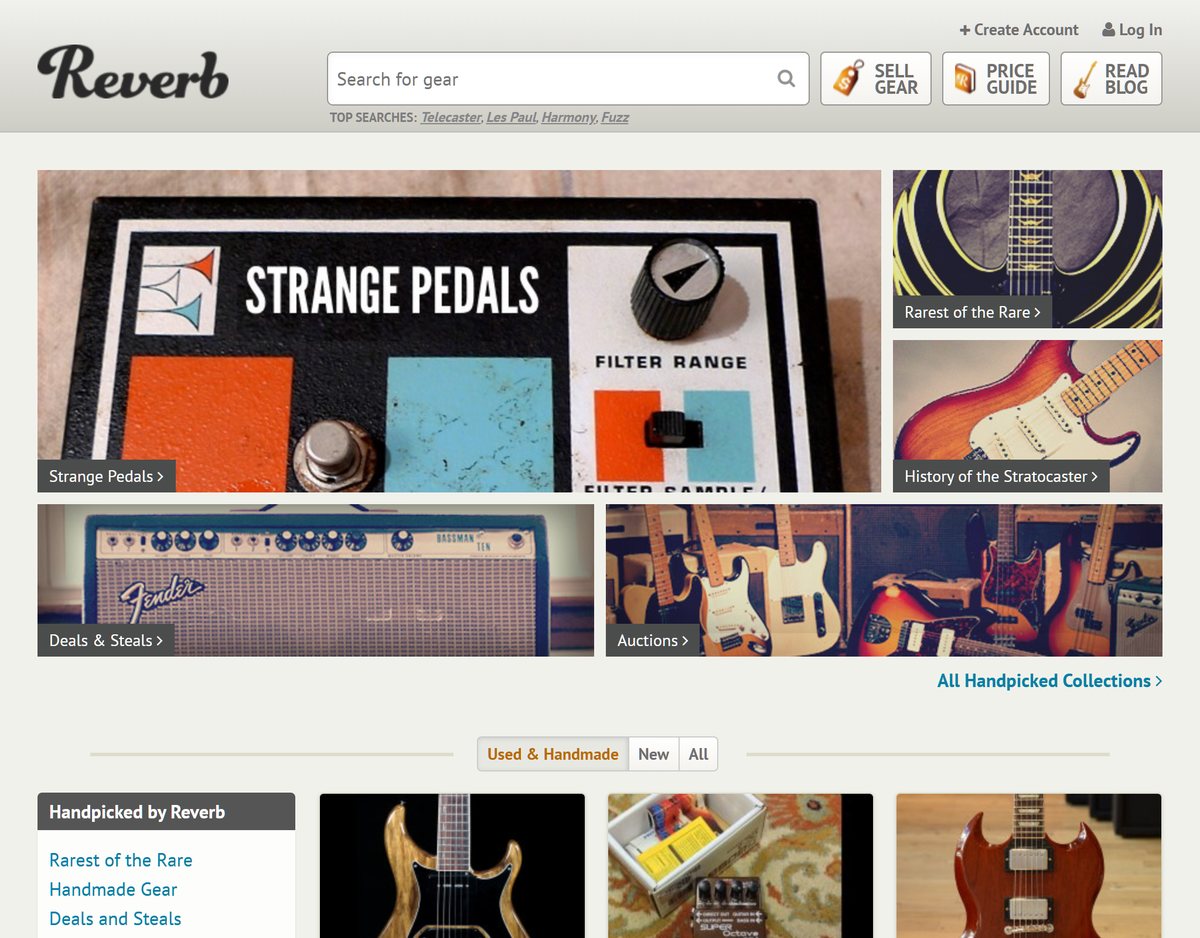
Kalt did not start Reverb as a pure tech idea. He told a NAMM audience in 2014 that he created it partly because he held millions of dollars in vintage inventory and needed to turn it over4. His own shop had the exact pain the marketplace would solve.
That mattered in three ways:
- Stock and sales on day one. The shop was already moving about $500,000 of gear a year through eBay in 201224. That is the trade Reverb was built to take over. No source we found gives a listing count at launch, so treat the exact scale as unknown.
- Real feedback. The founder knew what a dealer needs from a listing page, what buyers ask, and where eBay failed, because he lived it every week.
- Credibility with other dealers. When Kalt walked into another guitar shop, he was not a startup kid. He was a fellow shop owner with the same problem.
SoundCtrl's launch write-up described Reverb as a partner to small shops and craftsmen, not a competitor to local vintage dealers6. Kalt sold the marketplace as a tool for the trade, not a threat to it.
Move 2: Visit the shops yourself
Kalt has been clear about how the first dealers came. In his exit interview with Music Inc. in 2019, he said he spent much of Reverb's first few years meeting shop owners and retailers face to face12.
It worked fast. Reverb's funding announcement of 19 November 2013, ten months after going live, said more than 4,000 dealers had joined, and named Dave's Guitars as one of them24. SoundCtrl gave the same number that month, but as dealers who had shown interest, and named Main Drag Music in Brooklyn6.
Who else did the visiting is not on record. In August 2013 Kalt was still looking to hire developers and marketing staff25, so the first-year team was small. No source names an early sales rep or a trade-show booth used to sign dealers. The founder meeting shop owners himself is the only method on the record.
Dealers mattered more than their number suggests. One dealer brings tens or hundreds of listings, good photos, real descriptions and a shipping routine. By late 2019 Reverb had about 162,000 active individual sellers, but Fortune reported that music stores and manufacturers drove much of its volume and growth19.
The site was built for them. Sellers had shop pages, ratings and reviews, and each listing linked to the dealer's full stock6,25. The 2013 announcement stressed fast, free listing tools and a mobile app24.
Getting a shop's whole stock online without retyping it came later. In September 2015 Reverb announced Shopify, BigCommerce and Magento plugins that copied a dealer's web shop stock to Reverb and kept prices and stock in sync26. Kalt's pitch: most small shops had no staff or budget for online marketing, so Reverb's Google, Facebook and email ads would do it for them26. In 2018 the music-shop till system AIMsi added two-way stock and order sync27, and Reverb built a team that helps retailers set up their shops18.
The 2013 coverage mentions no import tools, so the first dealers probably listed item by item, but no source says so directly.
Before your first visit, write down what you will say to the owner in two minutes. This pitch template gives you the structure.
Template
Pitch to a local partner to promote your marketplace
Send it by email or message to an association, club, shop or community group whose members are your buyers or sellers; change the offer to something you can really give them.
Partners say yes more often when you hand them finished content to share than when you ask them to write about you. More free tools →
Move 3: Make the fee small enough to say at the counter
Reverb's offer to sellers in 2013 was simple: free listings and a 3.5% fee only when something sells24. The November 2013 announcement called it fees one-third of eBay's, measured against the 10% or more Chicago Music Exchange had paid there24. A dealer could do the maths in their head.
Buyers could make an offer on more than 90% of listings, much like haggling at a shop counter24. By 2017 the fee was also capped at $350 per sale10, which mattered a lot on a $20,000 vintage guitar.
Kalt framed the low fee as a mission, not a promotion. At NAMM 2014 he said he wanted to keep fees low so more of the money from used gear went back into the music industry4. The 3.5% stayed until August 202015.
What Chicago Music Exchange paid on eBay against Reverb's fee at launch and after the 2020 rise. Sources 24, 15.
Show the numbers
| Where | Fee per sale | Notes |
|---|---|---|
| eBay (2012) | 10% or more | what the founder's shop paid, Reverb 2013 release |
| Reverb (2020) | 5% | first fee rise, August 2020 |
| Reverb (2013) | 3.5% | free to list, fee only on sale |
Low fees did three jobs at once:
- They gave dealers a reason to try a site with little traffic. Free to list means trying it costs nothing.
- They gave the trade press a simple story to repeat.
- They made Reverb the obvious second channel for anyone already selling on eBay.
When you do start charging, check which model earns more for a site your size before you announce anything.
Calculator
Which way of charging earns more for your marketplace?
The same sellers and listings, charged four different ways. Change the numbers to your market: the share who pay is the honest guess that decides it.
Revenue a month for each model on its own. Many marketplaces mix them: free listings with paid promotions is the most common start, because it keeps listings coming in. More free tools →
Move 4: Publish prices so individuals dare to sell
By September 2013 Reverb had a price guide: for a given instrument it showed an estimated price range and examples of past sales on the site. SoundCtrl compared it to the Blue Book that car buyers use6.
This was Kalt's trading background showing. Markets with no visible prices favour the middleman. In a 2026 Guitar Center podcast he put the plan in one line23:
"Put a price guide out there and get individuals to sell alongside dealers." David Kalt, Guitar Center podcast
Once people could see what a Taylor 814 really sold for, he said, the price range for that guitar shrank from about $400 wide to $50-75 wide23.
The price guide quietly recruited sellers:
- It gave individuals the confidence to sell. A musician who knows a fair price will list a guitar instead of taking half its value from a shop.
- It brought people in before they were ready to buy or sell. Checking what your gear is worth is a reason to visit with nothing to sell yet.
- It got better with every sale. Each sale added data that no newcomer could copy.
Move 5: Film the stock, the way the shop already did
Chicago Music Exchange was a content business before Reverb existed. Kalt told NAMM in 2014 that the shop had invested heavily in video, training its own staff to sell and inspire on camera4.
In June 2012 the shop posted "100 Riffs (A Brief History of Rock N' Roll)", one continuous 12-minute take of a salesman, Alex Chadwick, playing 100 famous riffs. It reached the front page of Reddit and passed three million views within a few months2,3. The University of Michigan alumni magazine reported that it lifted the shop's web traffic, sales and mailing-list sign-ups3.
Reverb kept the habit. In August 2013 Techli reported sellers already using video on listings to show how an instrument sounded25. In its first year Reverb also ran a blog and an email list for deals and giveaways6. By 2015 TechCrunch listed demo videos, product histories, artist interviews and historical prices next to the listings7.
In 2018 Reverb's marketing director Dan Abel, a former YouTube manager, told a NAMM session that the channel started with very plain product demos and only later became more creative. The approach: make videos on what musicians were already searching for11.
Content mattered for supply because sellers follow buyers. A dealer lists where the audience is. Videos and buying guides brought musicians from Google and YouTube for free, and that traffic is what Kalt could show the next shop owner.
Move 6: Let people from the niche run it
Around 85% of Reverb's staff were musicians1, and Kalt kept repeating that Reverb was built for the instrument trade by musicians. Early filters let buyers search by instrument type, brand, price, year of make and staff picks, and sort by city, with handpicked collections chosen by staff6.
It is a seller tactic too: a dealer trusts a site whose support people know the difference between two years of the same amplifier. Kalt pointed to a whole team whose only job was supporting sellers12. eBay could not offer that for one category among thousands.
What didn't work, or what they got wrong
The record on early mistakes is thin, so here is only what is sourced:
- Side businesses away from the core. Reverb launched a lessons site around 2015 to connect music teachers and students; one later profile says it did not really work21. In 2017 it launched Reverb Sites, a free website builder for sellers synced to their Reverb shop17. It closed in April 2021, with Reverb saying it did not have the expertise to beat dedicated website services16. The core marketplace kept growing; the add-ons did not stick.
- The fee rise. In July 2020, a year after the Etsy deal, Reverb raised its selling fee for the first time, from 3.5% to 5%. It promised over 30% more spending on marketing and bigger support and product teams. Sellers on gear forums complained, and many linked the change to Etsy15. The low fee had been central to the original pitch to dealers.
- Mixed numbers in public. Reverb's 2015 sales were reported as about $90 million (TechCrunch)7 and more than $120 million of transactions (the lead investor's press release)8 in the same week. Different definitions, but a reminder to read marketplace numbers carefully.
- The later story. Etsy sold Reverb in 2025, saying it wanted to focus on its core marketplace; the price was not disclosed22. A niche marketplace can be a good business without fitting inside a general one.
How supply turned into demand
The early numbers show how fast a niche marketplace can move once the first dealers are in:
- January 2013Reverb.com goes live5.
- August 2013Hundreds of thousands of dollars of deals a month, growing 40-50% a month25; $180,000 of gear sold that month5.
- September 2013On track for $330,000 in the month5.
- November 20134,000+ dealers joined (company figure; SoundCtrl says interested)6,24. A $2.3m round from musicians and startup investors: Rick Nielsen of Cheap Trick, David Lowery, Eric Ries, Lightbank1,24.
- September 2015Shopify, BigCommerce and Magento plugins sync dealer stock26.
- 2015About $90m-120m of sales, and a $25m Series B7,8.
- 2016$240m of gear sold, $16m revenue1,9.
- Early 2017115,000+ sellers, about 500,000 live listings, 8m+ monthly visits9.
- 2017On track for $429m of sales10.
- Late 2019162,000 active individual sellers19.
- August 2019Bought by Etsy for $275m13,14.
Sales through the marketplace, in time order. 2015 was reported as $90m (TechCrunch) and $120m+ (Summit Partners); 2017 is a forecast. Sources 7, 8, 1, 9, 10.
Show the numbers
| Year | Gear sold | Notes |
|---|---|---|
| 2015 | $90m-120m | two reports the same week |
| 2016 | $240m | Music Connection, Wikipedia |
| 2017 | $429m (on track) | Built In Chicago forecast |
What drove the shift from supply to demand:
- Dealer stock made the site worth visiting. Thousands of shops listing real inventory meant a musician searching for a specific pedal or a 1970s amp found it on Reverb.
- Individuals followed. With a price guide and low fees, musicians started selling their own gear next to the dealers. Many users became both buyers and sellers, which Etsy pointed out when it bought the company13.
- Musicians became the marketing. Investors such as Rick Nielsen and Brad Paisley, and artists such as Jeff Tweedy, sold gear on the site, which made press stories easy1.
- Search and video traffic compounded. Price guide pages and demo videos answered questions musicians were already typing into Google and YouTube7,11.
Inc. ranked Reverb 18th on its 2017 list of fastest-growing private companies in the US, with 12,327% growth from 2013 to 20161.
The playbook: Reverb's moves without a $7.5 million shop
Start from a trade you know, or partner with someone who does. Reverb worked because its founder had the sellers' problem himself. If you run a farm machinery or used car site, your best first seller is someone already in that trade: a dealer friend, your own side business, or a partner who brings stock. Ask one trusted dealer to be your "anchor" and give them a free, featured place in return.
Recruit dealers in person before you recruit the public. One dealer brings dozens of listings with photos and prices; one member of the public brings one. List the 30 dealers, workshops or rental yards within driving distance, visit the closest ten, and show your site on your phone. In a trade that runs on trust, a visit beats a hundred cold emails.
Make your fee simple enough to explain at the counter. "Free to list, pay only when you sell" or "free for your first 20 listings" is something a dealer can repeat to a colleague. Compare it in one line to what they pay today on eBay, Facebook ads or a classifieds paper.
Give people a reason to visit before they buy or sell. Reverb's price guide brought people in to check prices. Yours can be smaller: a monthly "what tractors sold for" post, average prices by model, or a buyer's checklist for a used excavator. Share it in the Facebook groups and forums your niche already uses.
Film the stock. Chicago Music Exchange won attention with one video shot on the shop floor. A 60-second phone walk-around of a dealer's best machine, posted with a link to the listing, helps the dealer and shows other dealers you bring buyers. Offer it free to your first dealers.
Tell the trade their peers are there. Reverb's first funding announcement led with a number, 4,000 dealers, and named well-known shops. For you that is the local paper, the trade magazine, the club newsletter or the biggest Facebook group in your niche. "40 local dealers now list on X" is a story; "new website launches" is not.
Stay in your niche, and be careful with side projects. Reverb's add-ons faded while the core kept growing. Do one thing well: listings in your category, in your region, with filters that match how buyers search (make, year, hours used, location).
Keep the low-fee promise as long as you can. Reverb's first fee rise in seven years upset sellers who had joined for the low fee. When you start charging, start with optional paid extras (featured listings, dealer plans) rather than raising the price everyone pays.
Try this this week
Before you start, work out how many listings your site needs to look alive in its categories and area, so you know what "enough dealers" means for you.
Calculator
How many listings do you need at launch?
Visitors leave a category that looks empty. Pick how many listings a category page needs to look alive, for the categories and places you launch with.
Too many weeks? Launch with fewer categories or one area first, and add more as listings come in. More free tools →
- Name your anchor seller (30 minutes). One dealer, workshop or business with 20+ items who will list them all. If that is you, list your own stock first.
- List 30 dealers within 50 km (2 hours). Use Google Maps, trade directories and Facebook Marketplace sellers with many listings. Note name, phone and what they sell.
- Visit or call 10 of them by Friday. Show the site on your phone, offer free listings and to enter their first 10 items yourself. Target: 3 yes answers.
- Post 20 real listings from those dealers (3 hours), with good photos, before you promote the site to buyers.
- Publish 1 price page (1 hour): "What used [your item] was listed for this year", with 10 examples. Share it in 3 groups or forums where your buyers talk.
- Film 3 phone videos of 60 seconds of your best listings and post each with a link back to the listing.
- Send 1 short story to a local or trade outlet once you pass 10 dealers: who is listing, how many items, what the fee is.
Doing it on Yclas
- Recruit sellers (admin panel > Recruit sellers) helps with moves 1 and 2: find local businesses in your category, send each one a personal invite link (/join/...), and keep a timeline of who you visited or called. "Write it with AI" drafts the invite message, and the list of searches that returned nothing shows what buyers want that no dealer has listed yet.
- Importers cover "post 20 listings": upload a dealer's stock list with CSV import, bring listings over from another platform, or paste a Facebook or WhatsApp list of items into "Add listings from text" to get draft listings.
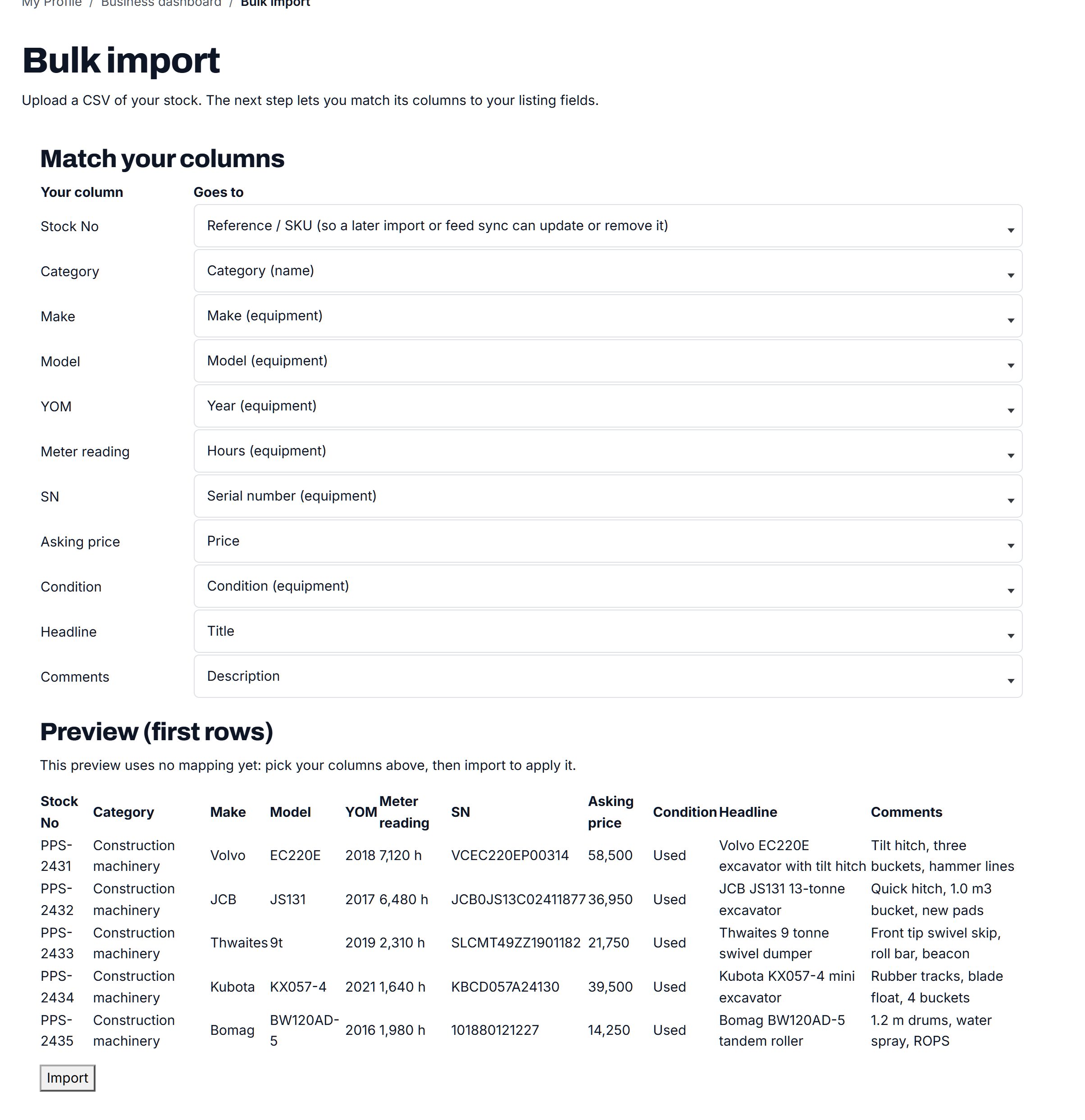
- Custom fields and categories give you the filters a niche buyer expects, like Reverb's year and brand filters: make, model, year, hours, condition, location.
- Posting from a photo with AI helps individual sellers list next to your dealers: they take a photo, and the AI fills in the listing.
- Share your site (admin panel > Share your site) gives you a ready group message for WhatsApp, Facebook and email, plus a QR code and a printable A4 poster to leave on the counter at dealers you visit.
- Featured listings and paid plans for sellers are there for later, when you want to earn from dealers without raising the basic fee. The member email digest of new listings keeps buyers coming back as stock grows.
For how a general marketplace took a different path, see our earlier piece on what made Craigslist so successful, and the top classified websites in the USA.
Sources
- Reverb.com — Wikipedia (accessed 2026) — https://en.wikipedia.org/wiki/Reverb.com
- Chicago Music Exchange — Wikipedia (accessed 2026) — https://en.wikipedia.org/wiki/Chicago_Music_Exchange
- Guitar Hero (David Kalt alumni profile) — University of Michigan LSA (2012) — https://prod.lsa.umich.edu/lsa/news-events/all-news/search-news/guitar-hero.html
- Online Breakthroughs: David Kalt, Chicago Music Exchange (NAMM Show 2014) — NAMM (2014) — https://ww1.namm.org/node/22856
- Reverb Builds Thriving Music Instrument Marketplace — Hypebot (2013) — https://www.hypebot.com/reverb-builds-thriving-music-instrument-marketplace
- Reverb.com: A New Marketplace for Buying and Selling Gear — SoundCtrl (2013) — https://soundctrl.com/reverb-com-launches-for-selling-and-buying-used-instruments
- Reverb.com's Marketplace For Musicians Tunes Up With $25 Million — TechCrunch (2015) — https://techcrunch.com/2015/12/04/reverb-coms-marketplace-for-musicians-tunes-up-with-25-million/
- Summit Partners Invests $25 Million in Reverb.com — Summit Partners (2015) — https://www.summitpartners.com/news/summit-partners-invests-25-million-in-reverb-com-backing-optionsxpress-co-founder-david-kalt-for-second-time
- Reverb.com profile (115,000 sellers, $240m in 2016) — Music Connection (2017) — https://www.musicconnection.com/?p=61041
- Chicago's music gear darling nabs another $15M — Built In Chicago (2017) — https://www.builtinchicago.org/articles/reverb-raises-15m
- 5 YouTube Power Users, and What You Can Learn From Them (Dan Abel, Reverb) — NAMM (2018) — https://ww1.namm.org/node/44149
- Reverb Acquired By Etsy: An Exit Interview With Reverb's Founder And CEO David Kalt — Music Inc. (2019) — https://www.musicincmag.com/features/detail/reverb-acquired-by-etsy-an-exit-interview-with-reverbs-founder-and-ceo-david-kalt
- Etsy to acquire Reverb (press release, exhibit 99.1) — Etsy / SEC (2019) — https://www.sec.gov/Archives/edgar/data/1370637/000119312519198611/d754497dex991.htm
- Etsy completes acquisition of Reverb (Form 8-K) — Etsy / SEC (2019) — https://www.sec.gov/Archives/edgar/data/1370637/000137063719000157/form8k8-15x19.htm
- Why is Reverb's selling fee moving from 3.5% to 5%? — MusicTech (2020) — https://musictech.com/news/why-is-reverbs-selling-fee-moving-from-3-5-to-5/
- Reverb.com's Sites feature to shut down on 30 April 2021 — MusicTech (2021) — https://musictech.com/news/industry/reverb-shut-down-sites-feature/
- Reverb.com Introduces Reverb Sites — Built In Chicago (2017) — https://www.builtinchicago.org/articles/reverbcom-introduces-reverb-sites
- Reverb, the company making a success of instrument retailing in challenging times — Music Instrument News (2020) — https://www.musicinstrumentnews.co.uk/2020/11/20/reverb-the-company-making-a-success-of-instrument-retailing-in-challenging-times/
- Reverb.com and the Etsy acquisition — Fortune (2021) — https://fortune.com/2021/01/25/reverb-com-music-retail-instruments-etsy-acquisition/
- Reverb Sees Huge Q4 Growth for Its Music Gear Marketplace — Built In Chicago (2021) — https://www.builtinchicago.org/articles/reverb-q4-growth-music-gear-marketplace-hiring
- A Techy to Enter Retail: Reverb's Founder Tells How He Had Lost to Found — EnvZone (2021) — https://envzone.com/a-techy-to-enter-retail-reverbs-founder-tells-how-he-had-lost-to-found
- Etsy to sell Reverb to Creator Partners and Servco — Digital Music News (2025) — https://www.digitalmusicnews.com/2025/04/22/reverb-sale-april-2025/
- Inside the Noise Episode 7: David Kalt — Guitar Center Riffs (2026) — https://www.guitarcenter.com/riffs/interviews/guitars/guitar-center-podcast-ep7-david-kalt
- REVERB.COM Announces $2.3 Million Series A Round with High-Profile Musicians and Startup Veterans — PRWeb / Reverb.com (2013) — https://www.prweb.com/releases/2013/11/prweb11346496.htm
- Innovation: How David Kalt Connected the Dots — Techli (2013) — https://techli.com/?p=6728
- Reverb partnership: Shopify, BigCommerce and Magento integrations — Music Inc. (2015) — https://www.musicincmag.com/legacy/News/2015/150831/150831_reverb.html
- Tri-Technical Systems, Reverb partnership (AIMsi v12) — Music Inc. (2018) — https://musicincmag.com/legacy/News/2018/081418/081418_TriTech.html